Cryptocurrency investing offers extraordinary return potential but comes with real, documented risks. Bitcoin fell 36% from its October 2025 all-time high of $126,200 within weeks. On October 10, 2025 alone, a single flash crash wiped $19 billion in leveraged positions. Without a structured risk management plan, these events can permanently damage a portfolio. This guide covers the techniques that protect capital while preserving the upside.
Key Takeaways
- Diversification reduces risk by spreading investments across multiple cryptocurrencies and sectors. In 2025, the RWA sector surged 245% while Bitcoin corrected 36% from its peak, rewarding diversified investors who had sector exposure across both.
- Position sizing is the single most important mechanical risk control. Risking no more than 1 to 2% of total portfolio capital per trade means 20 consecutive losses still leaves approximately 82% of capital intact.
- Stop-loss orders protect against catastrophic losses by automating exit decisions. The October 10, 2025 flash crash wiped $19 billion in leveraged longs in a single day; stop-losses provided automatic protection at pre-set thresholds.
- Security risk is real and growing. The Bybit exchange hack in February 2025 resulted in $1.46 billion stolen, the largest digital heist in history. Self-custody with a hardware wallet is the most effective protection for significant holdings.
- Psychological risk management is as important as technical strategy. Emotional decisions during volatile periods — panic selling at lows, FOMO buying at peaks — are the most common cause of preventable investor losses.
- Regular portfolio rebalancing prevents accidental over-concentration. A position that starts at 10% of portfolio and triples in value becomes 30% without rebalancing, creating risk that was never intended.
Cryptocurrency investors are drawn to the potential for high returns, but these opportunities come with significant risks. The market’s extreme volatility can lead to sudden price drops that wipe out gains overnight. Regulatory changes across different countries create ongoing uncertainty. Security breaches are a constant threat as hackers target exchanges and wallets. Without proper strategies in place, these risks can undermine even the most promising investments. This guide examines the key cryptocurrency risk management techniques that reduce exposure, safeguard assets, and build a more resilient investment strategy for long-term success.

What Are the Main Types of Cryptocurrency Risk?
To effectively manage crypto investment risk, you first need to understand the different categories that can affect performance and security. Each type requires a different mitigation approach:
Market Risk: Price volatility causing sudden losses. Bitcoin’s annualized volatility was approximately 54% in early 2025 (BlackRock), compared to approximately 15% for the S&P 500. Even in a bull market, intraday moves of 5 to 10% are routine.
Regulatory Risk: Government actions changing the legal status, tax treatment, or availability of crypto assets. The US GENIUS Act (2025) and EU MiCA regulation clarified rules significantly, but regulatory risk remains in many jurisdictions globally.
Security Risk: Hacks, phishing, and malware targeting exchanges, wallets, and individual users. The Bybit hack ($1.46 billion, February 2025) and total 2025 crypto theft of approximately $2 billion confirm this risk is growing, not shrinking.
Operational Risk: Exchange outages, failed transactions, network congestion, and service provider failures. During the October 2025 flash crash, several major exchanges experienced performance degradation at precisely the moment users needed to execute risk-management trades.
Liquidity Risk: Inability to buy or sell at desired prices due to thin order books. Most pronounced in small-cap altcoins: a single large sell order can gap the price 10 to 20% downward when market depth is insufficient to absorb it.
Counterparty Risk: The risk that an exchange, lending platform, or DeFi protocol fails to fulfil obligations. BlockFi, Celsius, and Genesis all collapsed in 2022 to 2023, trapping billions in customer funds with limited recovery. The FTX collapse froze approximately $8 billion in customer deposits.
Reputational Risk: Negative news or association with fraud, scams, or unethical practices causing rapid loss of investor confidence and sharp price declines. Projects linked to fraudulent activity, rug pulls, or prominent failures can lose 80 to 100% of their value within days of negative revelations regardless of technical fundamentals.
How Does Diversification Reduce Crypto Portfolio Risk?
Diversification is a strategy that involves spreading investments across different assets to reduce risk. In cryptocurrency, this means investing in multiple coins and sectors rather than concentrating all capital in one asset. When one cryptocurrency declines in value, others may perform well or remain stable, partially offsetting the loss.
In 2025, sector diversification proved particularly valuable. While Bitcoin corrected 36% from its October peak, the real-world asset (RWA) tokenization sector surged 245% during the same broad period, surpassing $22.5 billion on-chain. Investors concentrated entirely in Bitcoin missed this rotation entirely. Diversifying across Bitcoin, Ethereum, DeFi protocols, RWA tokens, and stablecoins captured different return drivers simultaneously.
“A well-diversified crypto portfolio in 2025 allocates 60 to 70% to core assets (Bitcoin and Ethereum), 20 to 30% to fundamentals-driven altcoins across different sectors, and 5 to 10% to stablecoins for liquidity. This structure captures the broad ecosystem while limiting concentration risk in any single asset.”
An important caveat: most cryptocurrencies are moderately to highly correlated with Bitcoin during market-wide sell-offs. Simply owning 30 different altcoins does not provide genuine diversification if they all fall together during a broad crypto downturn. True diversification requires assets from genuinely different sectors with different underlying value drivers. See our full guide on cryptocurrency portfolio diversification strategies for a detailed sector breakdown and allocation frameworks.
What Is Position Sizing and How Do You Apply It?
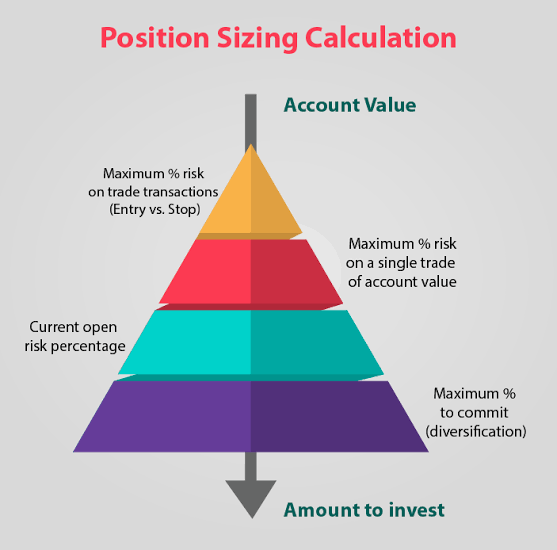
Position sizing refers to determining how much capital to allocate to a particular trade or holding. It is arguably the single most important mechanical risk control available to any investor, yet it is frequently overlooked by beginners who focus on entry and exit signals rather than capital allocation.
The 1% Rule in Practice
The standard professional rule is to risk no more than 1 to 2% of total portfolio capital on any single trade. With a $10,000 portfolio at 1% risk per trade, the maximum loss per trade is $100. Even if you experience 20 consecutive losing trades, the portfolio declines by approximately 18%, preserving roughly $8,200 to continue trading and recover. Without position sizing, a trader who risks 20% per trade loses their entire portfolio in just five consecutive losses.
How to Calculate Position Size
Position size is calculated based on three inputs: total portfolio value, maximum risk percentage per trade, and the distance from entry price to stop-loss. The formula is straightforward: Position Size = (Portfolio Value × Risk Per Trade %) / (Entry Price – Stop-Loss Price). For example, with a $10,000 portfolio risking 1% per trade on an ETH trade where entry is $2,000 and stop-loss is $1,900 (a $100 risk per ETH), the position size would be $100 / $100 = 1 ETH.
Adjusting for Volatility
Highly volatile assets like small-cap altcoins require smaller position sizes than established large-cap assets like Bitcoin or Ethereum. If an asset’s typical daily range is 20%, a stop-loss placed at the standard technical distance will be triggered by normal price noise unless position size is reduced accordingly. This is why portfolio concentration limits are as important as per-trade risk limits: no single position should represent more than 10 to 15% of total portfolio value regardless of conviction level.
Read Also: Understanding Crypto Market Cycles
How Do Stop-Loss and Take-Profit Orders Work?
Stop-loss and take-profit orders are automated instructions placed with an exchange that execute trades when price reaches a predetermined level, removing the need for constant monitoring and eliminating emotional decision-making during volatile conditions.
How Does a Stop-Loss Order Work?
A stop-loss order automatically sells a cryptocurrency when its price falls to a specified level. For example, if you buy Bitcoin at $95,000 and set a stop-loss at $90,000, the exchange will automatically sell your Bitcoin if the price reaches $90,000, limiting your loss to approximately 5.3% of the position value. This prevents a loss from becoming catastrophic if you are unable to monitor the market in real time. During the October 10, 2025 Bitcoin flash crash, which dropped $19 billion in leveraged longs in a single day, traders with stop-losses were automatically protected at their pre-set thresholds while unprotected traders experienced much larger drawdowns.
How Does a Take-Profit Order Work?
A take-profit order automatically sells a cryptocurrency when its price reaches a specified profit target, locking in gains without requiring the trader to actively monitor the position. This prevents a common mistake among crypto investors: watching a profitable position reverse and give back gains while waiting for even higher prices. Setting take-profit targets at technical resistance levels or channel boundaries, rather than arbitrary round numbers, produces better outcomes based on the asset’s actual price structure.
Where Should You Place Stop-Losses?
Stop-losses should be placed at technically meaningful levels rather than arbitrary percentage distances from entry. Common approaches include placing stops just below a key support level, just outside the lower boundary of a standard deviation channel, or below a significant moving average. Stops placed too close to entry price are frequently triggered by normal price noise before the actual trend change. Stops placed too far away provide insufficient protection. The correct placement depends on the asset’s volatility, the timeframe traded, and the risk-to-reward ratio of the specific setup.
Slippage warning: During extreme volatility events like flash crashes, a stop-loss order becomes a market sell order when triggered. In a fast-moving market with thin liquidity, execution may occur significantly below the stop price (slippage). Stop-limit orders set both a trigger price and a minimum execution price, providing price protection but risking non-execution if the price gaps through the limit. Understanding the difference between stop-market and stop-limit orders is important for each market condition.
Read Also: Best Crypto Staking Platforms
What Hedging Strategies Are Available for Crypto?
Hedging is a technique used to offset potential losses in one investment by taking a corresponding position in a related asset or instrument. In cryptocurrency, multiple hedging mechanisms are available:
- Futures contracts: Selling Bitcoin or Ethereum futures contracts against a long spot position creates a hedge: if the spot price falls, the short futures position gains value, partially offsetting the spot loss. This is the most common institutional hedging tool. Perpetual futures on platforms like UEEx are accessible to individual traders and allow flexible hedge sizing.
- Options: Buying put options on Bitcoin provides the right to sell at a specified price (the strike price) regardless of where the market trades, acting as insurance against a price decline. The option premium is the cost of this protection. This approach preserves full upside if the market rises while capping downside to the premium paid.
- Stablecoins as passive hedges: Holding a portion of the portfolio in stablecoins like USDC or USDT provides stability during downturns without requiring derivatives knowledge. Stablecoin allocations of 5 to 10% of the portfolio act as both a hedge and a reserve for deploying into corrections.
- Inverse ETFs: Where available, inverse Bitcoin ETFs gain value as Bitcoin price falls. These instruments are available in some jurisdictions and through certain regulated brokers for investors who want market hedging without derivatives complexity.
Hedging reduces both upside and downside, so it is most valuable during periods of elevated uncertainty, ahead of major regulatory announcements, or when position sizes have grown large relative to portfolio value. It is not typically cost-effective as a permanent portfolio state. Understanding the costs and mechanics of each hedging instrument before deploying them is critical, as poorly constructed hedges can amplify losses rather than reduce them. See our guide on Bitcoin ETFs vs Stock ETFs for more on regulated hedging vehicles.
How Do Staking and Yield Farming Affect Risk?
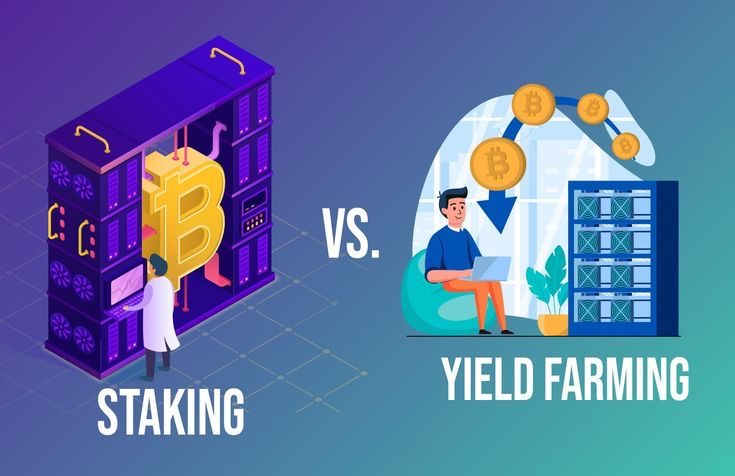
Staking and yield farming are two ways investors can earn passive income from their cryptocurrency holdings, but both introduce specific risks that must be understood before participating.
What Is Crypto Staking?
Staking involves locking up cryptocurrency in a proof-of-stake network to support its operations, such as validating transactions. In return, participants earn rewards in the form of additional coins. Ethereum staking through liquid staking protocols like Lido, which held $22.6 billion in TVL in 2025, allows holders to earn staking yields without locking up assets permanently. Visit our guide on crypto staking platforms for a full comparison. The primary risks are smart contract vulnerabilities in the staking protocol, slashing penalties for validator misbehaviour, and lock-up periods that prevent you from selling during sharp market declines.
What Is Yield Farming?
Yield farming involves providing liquidity to DeFi protocols in exchange for interest or rewards. Platforms like AAVE ($24.4 billion TVL in 2025) allow users to earn yield on deposited crypto assets. The potential returns can exceed traditional savings rates significantly. However, yield farming introduces several distinct risks:
- Smart contract risk: Exploits and bugs in DeFi protocol code remain a leading cause of losses. DeFi protocols lost billions to exploits in 2024 and 2025.
- Impermanent loss: When providing liquidity to automated market makers, price divergence between the assets in a pair can result in a lower value than simply holding the assets.
- Protocol insolvency: If a protocol’s economic model fails or large withdrawals trigger a cascade, users can lose deposited principal, not just yield.
The DeFi market’s TVL of $90 to 100 billion in 2025 demonstrates genuine scale, but participation requires thorough due diligence on each protocol’s audit history, team, economic model, and track record before depositing meaningful capital.
What Security Best Practices Protect Crypto Holdings?
Security risk is one of the most controllable risks in crypto because it depends primarily on your own behaviour and practices rather than market forces. The most effective protections are straightforward and available to every investor:
- Use a hardware wallet for significant holdingsA hardware wallet (Ledger, Trezor) stores your private key on a device that never exposes it to the internet when signing transactions. This makes remote hacking practically impossible. For any meaningful long-term holdings, hardware wallets are the security standard. The $1.46 billion Bybit hack in 2025 was an exchange-level failure, confirming the importance of not relying on exchange custody for significant amounts.
- Enable authenticator-app two-factor authenticationUse an authenticator app (Google Authenticator, Authy) rather than SMS-based 2FA. SMS-based 2FA is vulnerable to SIM-swapping attacks where fraudsters convince your mobile carrier to transfer your number. Apply authenticator 2FA to every exchange account and every email account associated with your crypto activity.
- Store seed phrases offline and in multiple locationsYour seed phrase (12 to 24 words) is the master key to your wallet. Write it down on paper and store copies in multiple secure physical locations: a home safe and a bank safe deposit box, for example. Never photograph your seed phrase, store it digitally, share it with anyone, or enter it on any website. No legitimate exchange or wallet provider will ever ask for your seed phrase.
- Keep only trading funds on exchangesNever store more cryptocurrency on an exchange than you actively need for trading. Exchanges are not banks and are not FDIC-insured. If an exchange is hacked or becomes insolvent, customer funds may be partially or fully lost with limited recourse. Transfer long-term holdings to self-custody as soon as the exchange transaction is complete.
- Be vigilant about phishingPhishing attacks targeting crypto users have grown significantly, with AI-generated phishing content becoming harder to detect in 2025. Always navigate to exchanges by typing the URL directly rather than clicking links from emails, Telegram, Discord, or social media. Verify that the URL and SSL certificate match the genuine exchange before entering any credentials.
Read Also: Crypto Volatility Analysis: A Complete Guide
Why Does Regulatory Compliance Matter for Risk?
Regulatory compliance involves adhering to the laws and regulations governing cryptocurrency transactions in your jurisdiction. As governments developed clearer frameworks in 2024 and 2025, the cost of non-compliance became more concrete and enforceable.
In the United States, the GENIUS Act of 2025 established federal stablecoin rules with KYC and AML requirements. The SEC’s streamlined framework and withdrawal of major enforcement actions clarified the treatment of many crypto assets. In Europe, MiCA brought all crypto service providers under a unified licensing regime across 27 member states. In both regions, users of regulated exchanges are subject to reporting requirements for capital gains and in some cases for holdings above threshold amounts.
Practical compliance means: reporting crypto gains and losses accurately on tax returns (the IRS treats crypto as property, making every taxable disposal event a reportable capital gain or loss); completing KYC verification on regulated exchanges; following AML requirements for large transactions; and choosing reputable exchanges that maintain regulatory compliance in your jurisdiction. The tax implications of active rebalancing, staking rewards, and DeFi yield should be understood before engaging in these activities, as each can generate taxable events. Using tax reporting tools like Koinly or CoinTracking helps maintain accurate records across multiple wallets and exchanges.
What Are the Advanced Risk Management Strategies?
Scenario Analysis and Stress Testing
Scenario analysis involves creating hypothetical situations that could impact the market and assessing how your portfolio would perform under each. Useful scenarios for 2025/2026 include: a Bitcoin correction to $50,000 from current levels (roughly a 40% decline from $80,000); a DeFi protocol exploit affecting a position held; a regulatory crackdown on stablecoins in a major jurisdiction; and a broad risk-off macro event driving Bitcoin-NASDAQ correlation above 0.80. Stress testing extends this by examining extreme scenarios: what happens to your portfolio if Bitcoin drops 80%, as it did in 2018 and 2022? If you cannot financially and emotionally withstand the worst-case stress scenario, your position sizes are too large.
Risk-Adjusted Return Metrics
Two metrics are particularly useful for evaluating crypto portfolio performance relative to risk taken:
- Sharpe Ratio: Measures excess return (above the risk-free rate) per unit of total volatility. Bitcoin’s Sharpe ratio over the 2020 to 2024 period has generally been above 1.0, indicating positive risk-adjusted returns. Compare this to altcoins in your portfolio to identify which positions are generating returns that justify their volatility.
- Sortino Ratio: Similar to Sharpe but measures only downside volatility rather than total volatility. This is more appropriate for assets like crypto that have strong positive skew (large upside moves as well as large downside moves). Bitcoin’s Sortino ratio of 1.86 versus its Sharpe ratio of 0.96 (Fidelity Digital Assets, 2024) confirms that most of its volatility has historically been to the upside.
Psychological Risk Management
Psychological risk management addresses the emotional dimension of investing that no technical tool can fully replace. The cryptocurrency market’s extreme volatility creates intense emotional pressure: fear during corrections, greed during rallies, and FOMO during parabolic runs. All of these emotional states impair rational decision-making and are the most common cause of preventable losses.
Effective psychological risk management techniques include: defining your investment thesis and risk parameters in writing before markets move; setting clear rules for entry, exit, and position sizing that you commit to following regardless of emotional state; maintaining a trading journal that documents the reasoning behind each decision; limiting portfolio-checking frequency during volatile periods; and separating analysis time from execution time to avoid impulsive real-time decisions.
Regular Portfolio Rebalancing
Regular rebalancing is the process of periodically adjusting portfolio allocations back to target weights. Without rebalancing, a position that starts at 10% of portfolio value and triples becomes 30% of the portfolio, creating concentration you never intended. Most individual investors rebalance quarterly or after any position moves more than 5 percentage points from its target allocation. Automated tools like Shrimpy maintain target allocations continuously across connected exchanges. Tax-loss harvesting during rebalancing can offset capital gains by selling underperforming positions to book losses that reduce taxable income, then reinvesting in similar assets.
Using Automated Trading Systems
Automated trading systems or bots execute trades based on predefined rules, removing emotion from execution and enabling 24/7 market monitoring that humans cannot sustain. Grid bots place buy and sell orders at regular price intervals within a range, accumulating gains from back-and-forth price oscillation. DCA bots execute regular fixed-amount purchases automatically. Trend-following bots execute entries and exits based on moving average crossovers or other technical signals. While these systems improve consistency and remove emotional bias, they require monitoring and parameter adjustment as market conditions change. A bot set up for trending conditions will produce losses in sideways markets without adjustment.
Read Also: How to Diversify Your Cryptocurrency Portfolio
What Tools Help Manage Crypto Portfolio Risk?
| Tool | Category | Risk Management Application |
|---|---|---|
| UEEx | Exchange | Stop-loss and take-profit orders; 200-plus trading pairs; margin controls; real-time price alerts; professional charting |
| TradingView | Charting and Analysis | Multi-indicator technical analysis; volatility indicators; alerts for price levels and indicator conditions; portfolio tracking across exchanges |
| Shrimpy | Auto-Rebalancing | Automated portfolio rebalancing to target allocations; drift-triggered rebalancing; multi-exchange support; prevents accidental over-concentration |
| Koinly / CoinTracking | Tax Reporting | Tracks all taxable events across wallets and exchanges; calculates capital gains for tax filing; essential for managing regulatory compliance risk |
| Glassnode / CryptoQuant | On-Chain Analytics | MVRV ratio, NUPL, exchange net flow, whale activity tracking; early warning signals for market tops and bottoms; fundamental risk assessment |
| Ledger / Trezor | Hardware Wallet | Self-custody of long-term holdings; eliminates exchange custody risk; protects against remote hacking; essential for any significant portfolio |
| Technique | Risk Reduced | Complexity | Best Application |
|---|---|---|---|
| Diversification | Market, concentration | Low | All investors; most important first step for any portfolio |
| Position Sizing | Market, operational | Low | All traders; prevents any single loss from being catastrophic |
| Stop-Loss Orders | Market, psychological | Low to medium | Active traders; anyone holding leveraged positions |
| Hardware Wallet | Security, counterparty | Low | All investors holding significant long-term positions |
| Hedging | Market, regulatory | Medium to high | Experienced traders; institutional investors; large positions |
| Rebalancing | Concentration, market | Low to medium | All long-term investors; quarterly minimum schedule |
Building your risk management plan: Risk is unavoidable in cryptocurrency investing. The goal is not to eliminate risk, which would also eliminate return potential, but to make risk deliberate. A written risk management plan that specifies your position sizing rules, stop-loss placement approach, rebalancing schedule, security setup, and psychological guidelines converts abstract intentions into actionable decisions that protect your portfolio when market conditions become extreme.
Read Also: Bitcoin ETFs vs Stock ETFs
Frequently Asked Questions
What are the most common risks associated with cryptocurrency investments?
The most common risks are: market risk (extreme price volatility causing sudden losses), regulatory risk (government actions changing legal and tax status), security risk (exchange hacks and wallet compromises; $1.46 billion stolen from Bybit in February 2025), operational risk (exchange outages and transaction failures), liquidity risk (inability to sell small-cap assets at desired prices), counterparty risk (exchange or DeFi protocol failure, as seen with BlockFi, Celsius, and FTX), and reputational risk (negative publicity driving rapid price declines).
Is diversification a recommended strategy for cryptocurrency investments?
Yes. Diversification is one of the most effective risk management strategies. Spreading investments across multiple assets and sectors reduces the impact of any single asset’s poor performance. In 2025, the RWA sector surged 245% while Bitcoin corrected 36% from its October peak, rewarding investors with cross-sector diversification. True diversification requires assets with genuinely different value drivers, not just owning many coins from the same category or altcoins that all correlate highly with Bitcoin during sell-offs.
Can stop-loss orders help minimize losses in cryptocurrency trading?
Yes. Stop-loss orders automatically sell a cryptocurrency when it reaches a specified price, limiting potential losses without requiring constant monitoring. During the October 10, 2025 Bitcoin flash crash, $19 billion in leveraged long positions were wiped in a single day. Traders with stop-losses in place were automatically protected at their pre-set thresholds. Place stop-losses at technically meaningful support levels rather than arbitrary percentage distances to avoid being triggered by normal price noise before a genuine trend change.
What is the purpose of position sizing in risk management?
Position sizing determines how much capital to allocate to a single trade, ensuring no individual loss can materially damage the overall portfolio. The standard rule is to risk no more than 1 to 2% of total portfolio capital per trade. With a $10,000 portfolio at 1% risk per trade, the maximum loss per trade is $100. Even 20 consecutive losses still leave approximately $8,200 intact. Without position sizing, a trader who risks 20% per trade can lose their entire portfolio in just five consecutive losses.
How can investors protect themselves from security risks in cryptocurrency?
The most effective security protections are: using a hardware wallet (Ledger, Trezor) for significant long-term holdings that keeps private keys offline; enabling authenticator-app-based 2FA (not SMS-based) on all exchanges; storing seed phrases offline in multiple physical locations and never digitally; keeping only trading funds on exchanges rather than long-term holdings; and being vigilant about phishing attacks impersonating exchanges and wallet providers. The $1.46 billion Bybit hack in 2025 was an exchange-level failure confirming the importance of self-custody.
How does hedging work in cryptocurrency risk management?
Hedging uses financial instruments to offset potential losses in primary holdings. Common crypto hedging approaches include: selling futures contracts against long spot positions to neutralise price exposure; buying put options that gain value if price falls; holding stablecoins as a non-volatile portfolio counterbalance; and using inverse ETFs where available. Hedging reduces both upside and downside, so it is most valuable during periods of elevated uncertainty rather than as a permanent portfolio state. Understanding the cost and mechanics of each instrument before deploying them is essential.