In blockchain, there are different ways to agree on which transactions are valid. These are called consensus mechanisms.
The most popular ones are Proof of Stake, Proof of Work, and Proof of Authority. However, we will only be discussing Proof of Authority (PoA).
Now, this is a type of system where only a few trusted people are chosen to approve transactions and add them to the blockchain. These people are known, and their identities are verified. Because of this, PoA can work much faster and use less energy than other methods.
This article provides a straightforward explanation of what Proof of Authority is, how it works, and its significance.
Proof of Authority (PoA) is a blockchain consensus method where a few trusted, verified individuals validate transactions.
PoA was introduced in 2017 by Gavin Wood, co-founder of Ethereum, as a faster and more efficient alternative to PoW and PoS.
Validators in PoA are selected based on identity and reputation, not computing power or token ownership.
PoA is energy-efficient since it doesn’t require mining or complex calculations.
Only approved validators can add new blocks, making the system faster but more centralized
What is Proof of Authority?
In 2017, Gavin Wood, co-founder of Ethereum, introduced Proof of Authority (PoA) as a consensus algorithm for blockchain networks. PoA works by giving a small, trusted group of validators, called authorities, the right to create new blocks and verify transactions.
Unlike Proof of Work (PoW) or Proof of Stake (PoS), PoA does not require high computing power or staking coins. Instead, it relies on the verified identity and reputation of validators. This makes PoA energy-efficient, fast, and scalable, which is ideal for private or permissioned blockchains.
Join UEEx
Experience the World’s Leading Digital Wealth Management Platform
However, its main drawback is centralization, since only a few selected nodes control the network. Platforms like VeChain (VET) use PoA to achieve low fees, high performance, and secure validation.
How Does Proof of Authority Work?
Once the validators are chosen, they use software to help organize and confirm transactions on a blockchain. These validators are trusted individuals whose real identities are known to the network. They don’t need to compete or solve puzzles like in Proof of Work (PoW). Instead, the Proof of Authority (PoA) system depends on their identity and reputation.
Becoming a Validator
To become a validator in a PoA network, a person must meet a few important requirements:
They must be trustworthy and have a clean criminal record.
Their real identity must be confirmed and easy to verify.
They must be willing to risk their reputation and sometimes money.
This setup helps make sure only responsible people can be validators. It also encourages them to behave well because any dishonesty could hurt their public reputation or get them removed.
How Transactions Are Handled
When someone sends a transaction, it gets sent to all validators. Each validator checks it to make sure it follows the rules. If a majority of validators agree it’s valid, the transaction is added to a block.
Creating Blocks
Validators take turns creating blocks. This is usually done using a round-robin method or a fixed schedule, so everyone knows whose turn it is. Only one validator signs each block, so there’s no overlap or confusion.
Join UEEx
Experience the World’s Leading Digital Wealth Management Platform
Unlike PoW or Proof of Stake (PoS), PoA doesn’t need a lot of votes or computational power. Because the validators are known and trusted, they can quickly agree on each block. This makes the system fast and reliable.
Keeping Things Running
Validators must keep their computers (also called nodes or admin sites) online and secure. If a validator goes offline or its system is compromised, it can slow down the network or cause problems.
Incentives and Trust
PoA uses reputation as the main motivation for good behavior. Validators don’t want to lose their position or trust, so they are careful to follow the rules. In this way, PoA replaces the energy costs of PoW and the money staking in PoS with trust and accountability.
The Proof of Activity (PoA) protocol that we propose is also likely to have other features, such as promoting an enhanced network topology and less overall energy consumption. In exchange for the desirable properties that we argue the PoA protocol achieves, nodes in the PoA network are required to do more work and communication relative to nodes in the Bitcoin network.
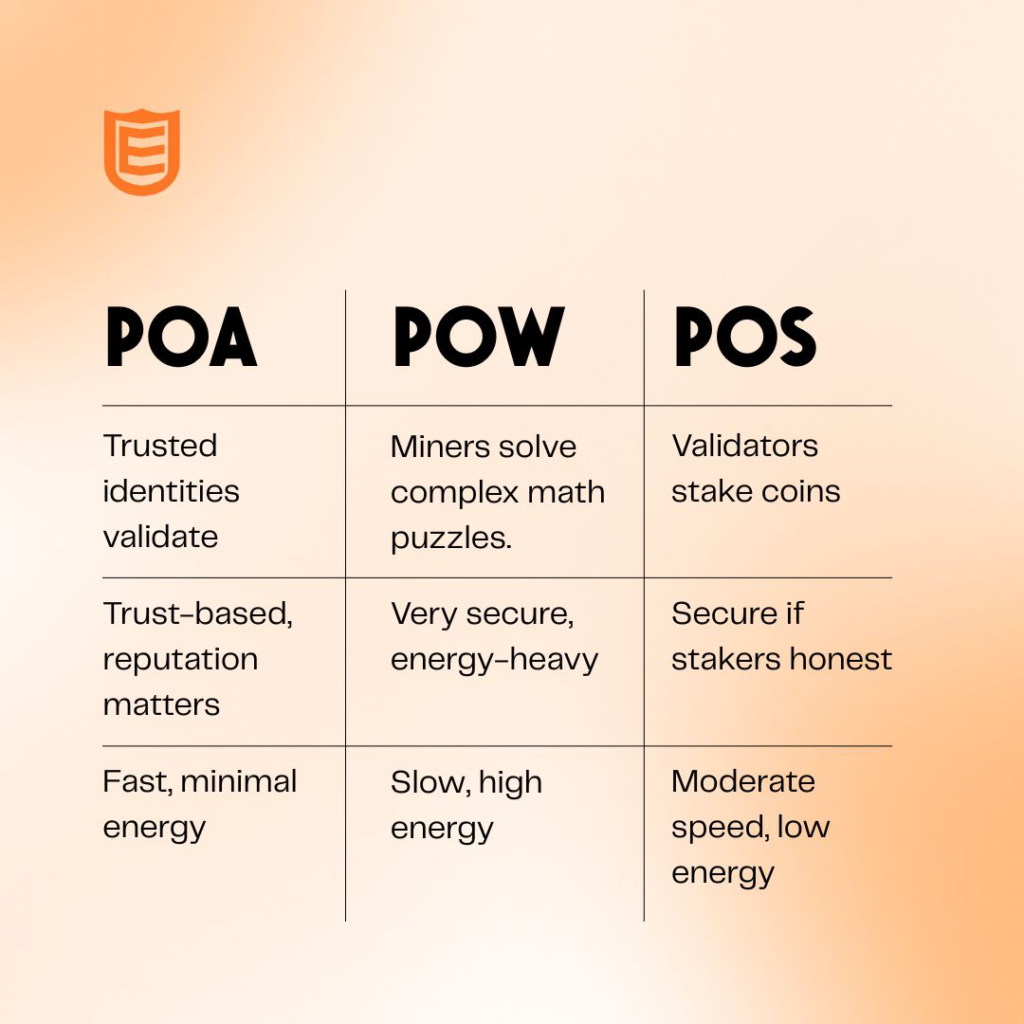
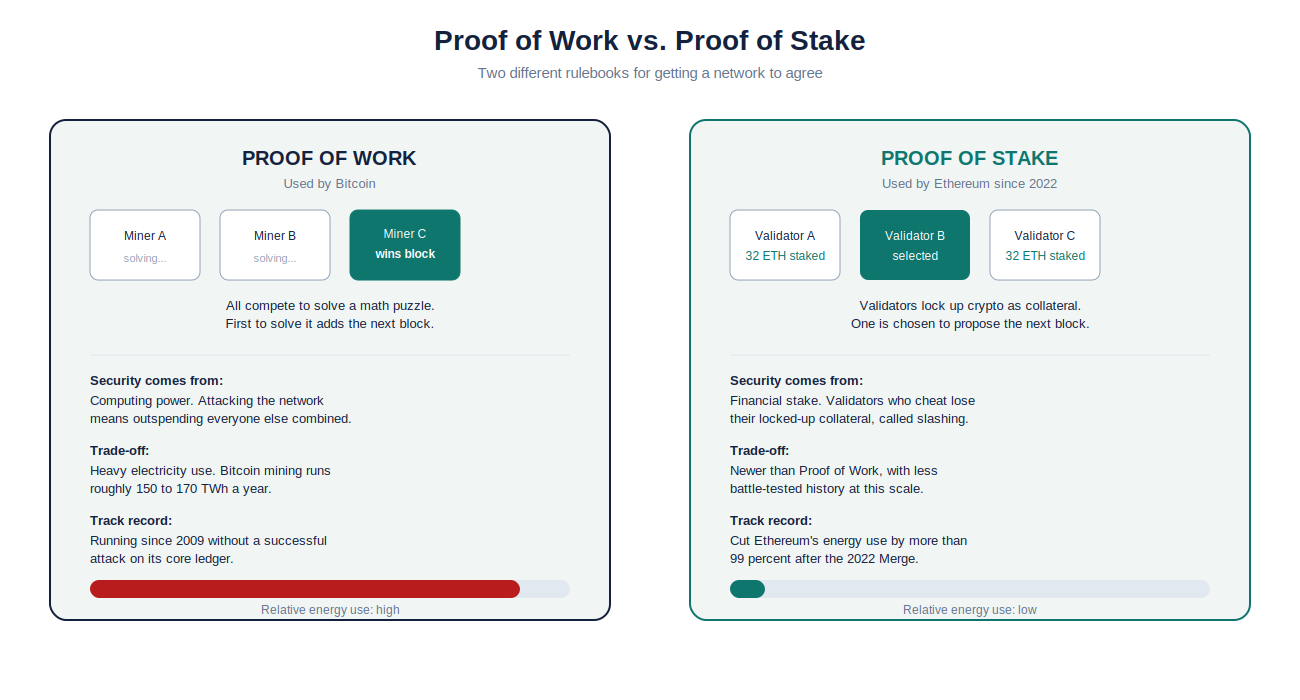
Although in the same consensus family, Proof of Work (PoW), Proof of Stake (PoS), and Proof of Authority (PoA) use different methods to validate transactions and secure blockchain networks.
Features
Proof-of-Work (PoW)
Proof-of-Stake (PoS)
Proof-of-Authority (PoA)
How it works
Miners solve math puzzles
Validators are chosen based on staked coins
Pre-approved validators use their identity
Used by
Bitcoin (Ethereum before 2022)
Ethereum (post-2022), Cardano
Haven1, private/consortium networks
Security
Very secure due to high computing effort
Secure, depends on stake size and validator honesty
High—based on validator reputation
Decentralization
High (many miners globally)
Moderate to high (many stakers)
Lower (few trusted validators)
Scalability
Low (slow and energy-hungry)
Moderate
High (fast and efficient)
Energy consumption
Very high
Much lower than PoW
Very low
Hardware required
Yes, powerful machines
Not much (just tokens)
Minimal
Best suited for
Public, decentralized systems
Public networks need efficiency
Private/consortium chains needing speed & trust
Carbon footprint
High
Low
Very low; can be carbon-negative
Proof of Authority Use Cases
PoA can be an efficient and secure consensus mechanism for specific blockchain applications where trust is placed in a limited number of approved validators. This approach is especially useful in private or consortium blockchains where participants are known and trusted. In the following sections, we’ll explore key use cases where PoA stands out as a practical and effective solution.
Quorum Blockchain Service for Enterprises
Quorum is an enterprise-grade blockchain built on Ethereum that uses a PoA-based consensus mechanism called QuorumChain. It’s designed for privacy and scalability, making it ideal for businesses that need to share sensitive data securely.
VeChain for Supply Chain Management
VeChain uses a public PoA model with 101 Authority Masternodes, trusted entities that validate transactions. It’s especially suited for enterprise applications like supply chain tracking.
Join UEEx
Experience the World’s Leading Digital Wealth Management Platform
Major companies such as Walmart China and BMW use VeChain to ensure transparency and traceability.
Its PoA model enables high speed and low costs while maintaining trust through verified validator identities.
Gnosis Chain (formerly xDai) for Fast, Low-Cost Transactions
Originally launched as xDai, Gnosis Chain used PoA for quick and stable microtransactions. Validators were trusted members of the community, which kept block times short and fees minimal.
Although it now incorporates staking, its PoA origins showed how trusted validators could make blockchain transactions more practical for everyday use.
POA Network’s Legal Validator Approach
The POA Network was one of the earliest true PoA projects. It required validators to be licensed notaries in the U.S., making their identities public and legally verifiable.
Though the network has faded in relevance, it broke new ground by proving that legally verified individuals could effectively and efficiently run a blockchain.
Binance Smart Chain (BSC) and Proof-of-Staked Authority
BSC introduced a hybrid called Proof-of-Staked Authority (PoSA). Validators must be approved and stake Binance’s token, BNB.
This approach allows BSC to maintain fast block times—around 3 seconds, while keeping costs low.
Despite critiques of centralization, the model has made BSC a top platform for DeFi by blending speed with selective validator access.
The purpose of the PoA protocol is to have a decentralized cryptocurrency network whose security is based on a combination of Proof of Work and Proof of Stake.
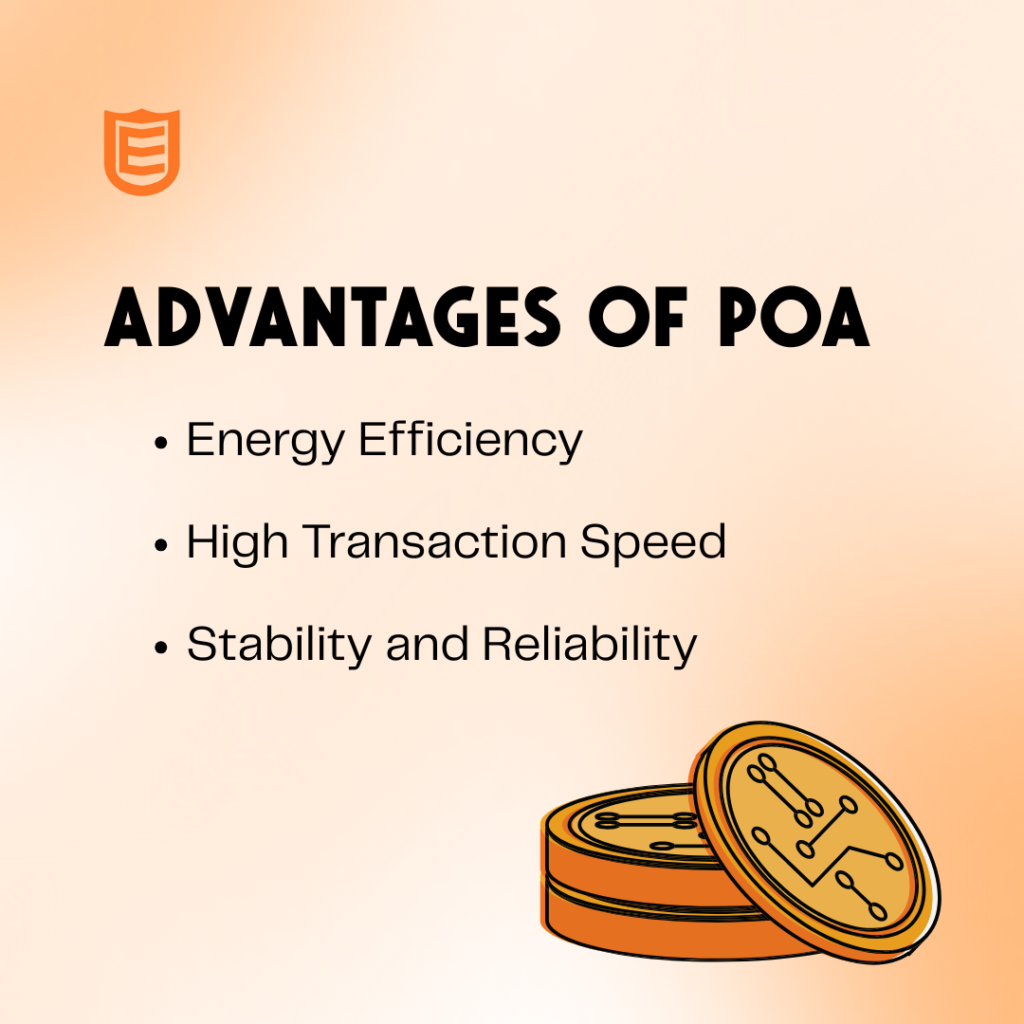
Proof of Authority (PoA) has several key benefits, especially when compared to other consensus mechanisms like Proof of Work (PoW) and Proof of Stake (PoS).
Energy Efficiency
Since PoA doesn’t require mining or complex computations, it consumes very little power, which makes it environmentally friendly and cost-effective. This also means networks using PoA can run on modest hardware without sacrificing performance.
High Transaction Speed
Because only a small group of pre-approved validators is involved, block creation is fast and transactions are confirmed quickly.
This results in higher throughput, making PoA suitable for applications that demand speed and scalability, such as enterprise use or private blockchains. Transaction costs are also very low due to the absence of mining rewards and the streamlined validation process.
Stability and Reliability
Validators are chosen through a thorough vetting process and are known by their real identities, which increases accountability. If something goes wrong, it’s easier to trace the source and take action.
Disadvantages of Proof of Authority
Despite these advantages, PoA has significant drawbacks.
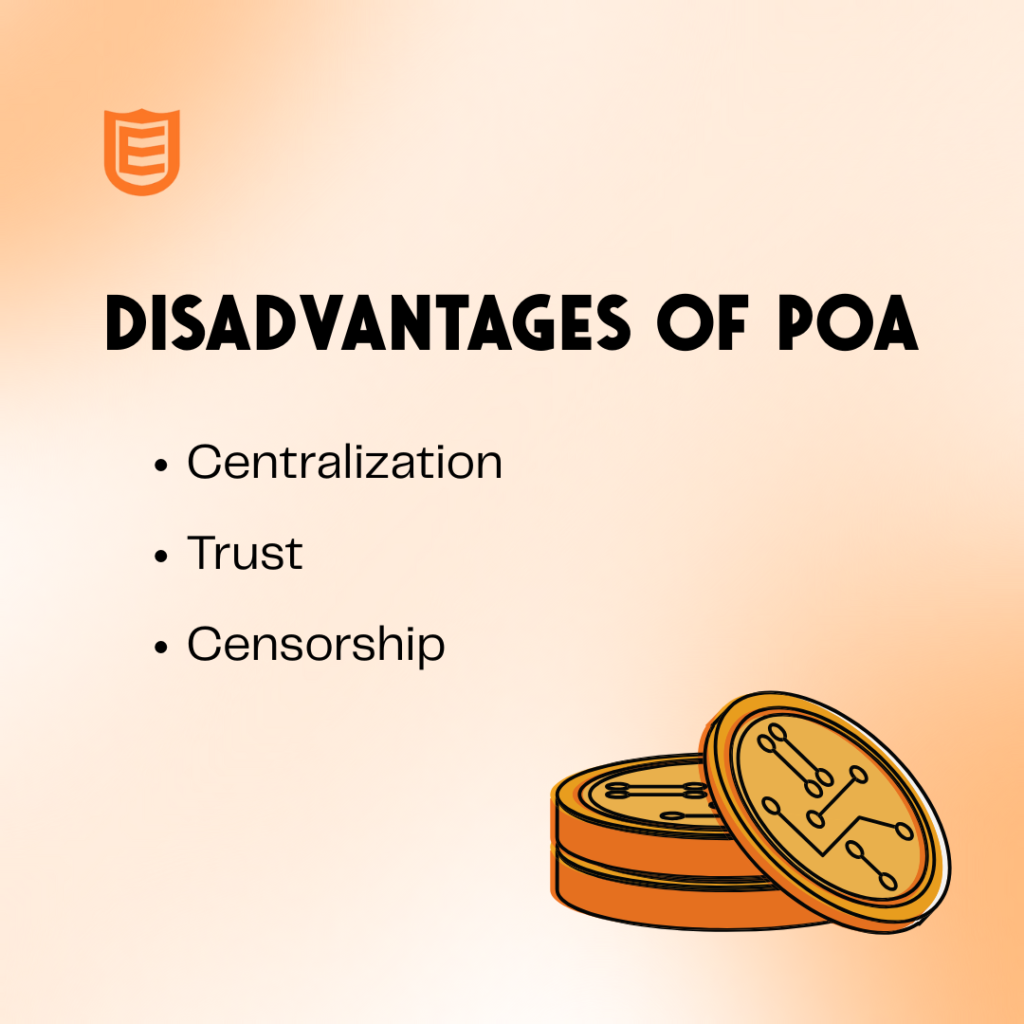
Centralization
The fact that only a few known validators control the network means power is concentrated in the hands of a small group. This makes PoA less resistant to censorship, collusion, and external manipulation compared to more decentralized systems like PoW and PoS.
Trust
Since validators are known entities, users must believe these individuals or organizations will act in the network’s best interest. If any validator becomes malicious or is compromised, the security and fairness of the entire system can be affected.
Censorship
Because there are so few validators, it’s easier to block or reverse transactions, undermining the immutability of the blockchain.
Moreover, the public nature of validators’ identities can put them at risk. They may be targets for bribery, coercion, or other attacks, which can weaken the network’s integrity.
Conclusion
Proof of Authority is a blockchain consensus system that works by having trusted, known validators approve transactions instead of using energy-heavy mining or token staking.
While PoA offers clear benefits like fast transaction speeds, low energy use, and reliable performance, it comes with trade-offs in terms of centralization and trust requirements. This makes Proof of Authority perfect for private blockchains, enterprise networks, and situations where speed and efficiency matter more than complete decentralization.
Join UEEx
Experience the World’s Leading Digital Wealth Management Platform
Companies like VeChain and Binance Smart Chain have shown that PoA can work well in real-world applications, proving that sometimes having fewer, trusted validators is better than having many unknown ones.
As blockchain technology continues to grow, Proof of Authority will likely remain an important option for organizations that need fast, secure, and cost-effective blockchain solutions.
Frequently Asked Questions
What Does Proof of Authority Mean?
Proof of Authority (PoA) is a blockchain consensus method where a few trusted nodes validate transactions based on their identity and reputation, not computational power.
What Are the Advantages of Proof of Authority?
PoA is fast, energy-efficient, and reliable for private networks, offering high transaction speed and low costs due to fewer validators.
Who Uses Proof of Authority?
Enterprises, private blockchain networks, and government-related projects use PoA where trust in known validators is acceptable.
Orebiyi Eniola is a writer whose soul work is content marketing with a focus on the cryptocurrency industry. Equipped as a marketing storyteller and driven by a passion for crafting impactful stories, she helps businesses connect with their audiences via strategic and thought-provoking writing. Orebiyi assists businesses in projecting their stories and actualizing their ambitions through the force of words. She likes to settle in with her favorite fiction novels when not pounding on her keyboard.
Disclaimer: This article is intended solely for informational purposes and should not be considered trading or investment advice. Nothing herein should be construed as financial, legal, or tax advice. Trading or investing in cryptocurrencies carries a considerable risk of financial loss. Always conduct due diligence before making any trading or investment decisions.
Trade with proof of Reserves
UEEx publish monthly audits and third party verification on every listed market.