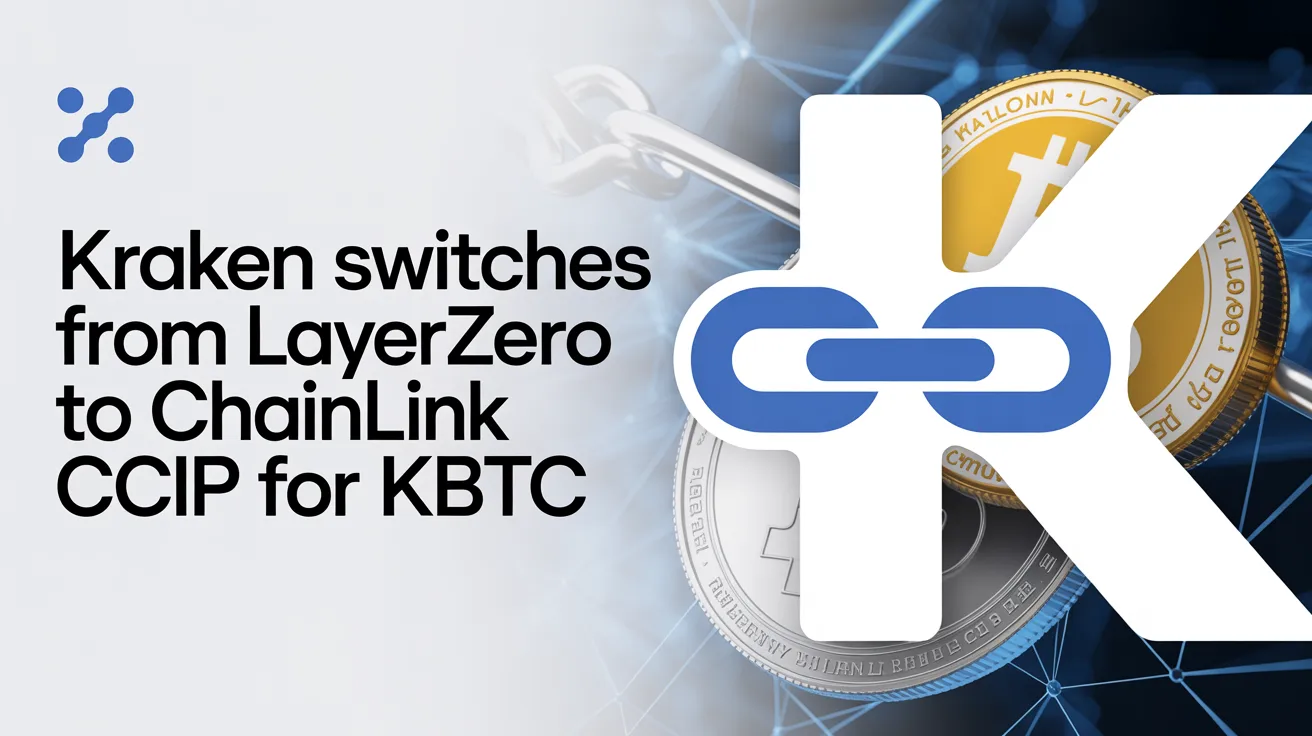
Kraken is moving its wrapped Bitcoin infrastructure away from LayerZero and adopting Chainlink’s Cross-Chain Interoperability Protocol (CCIP) as the exclusive interoperability layer for kBTC and future wrapped assets, a decision that highlights how cross-chain security is becoming one of the most important battlegrounds in crypto infrastructure.
The migration will initially support transfers across Ethereum, Optimism, Ink, and Unichain, with additional blockchain integrations expected later. Kraken said holders of kBTC will not need to take any action during the transition.
The move comes as decentralized finance protocols and institutional crypto firms reassess the risks tied to bridge infrastructure following multiple high profile exploits that collectively wiped out billions of dollars across the industry over the last several years.
In a statement announcing the migration, Kraken said it was deprecating its existing crosschain provider in favor of Chainlink CCIP to secure kBTC and all future Kraken Wrapped Assets.
Key Takeaway
- Kraken is migrating kBTC and future wrapped assets from LayerZero to Chainlink CCIP for stronger cross-chain security.
- The move follows rising concerns over bridge exploits, including the $292 million Kelp DAO incident.
- Chainlink CCIP offers enterprise grade security features and institutional compliance standards.
- Major DeFi protocols are increasingly shifting toward CCIP as bridge security becomes a top priority.
- The migration strengthens Bitcoin liquidity infrastructure across multi-chain DeFi ecosystems.
Bridge Security Moves Back Into Focus
Cross-chain bridges have become critical infrastructure in digital asset markets because they allow tokens to move between otherwise isolated blockchain ecosystems. Wrapped Bitcoin products such as kBTC depend heavily on those systems to function across decentralized finance applications, lending markets, and liquidity protocols.
However, bridges have also emerged as one of crypto’s most vulnerable attack surfaces. The issue intensified after the recent Kelp DAO exploit, where attackers drained roughly $292 million in losses tied to bridge infrastructure reportedly connected to LayerZero-powered configurations. Investigators later linked the exploit to North Korea’s Lazarus Group, adding further pressure on protocols to tighten operational security around interoperability systems.
Kraken’s migration follows a broader trend already underway across decentralized finance.
Protocols including Kelp DAO, Solv Protocol, Re, and Huma Finance have all announced transitions toward Chainlink CCIP infrastructure in recent weeks. Collectively, those projects represent billions of dollars in total value locked shifting away from older bridge systems.
The latest migration suggests interoperability infrastructure is no longer being treated as experimental tooling inside crypto markets. Increasingly, firms are evaluating bridge architecture using standards closer to institutional custody and financial market infrastructure.
Why Kraken Chose Chainlink CCIP
Kraken framed the migration primarily around operational resilience and enterprise grade security. According to the exchange, Chainlink CCIP provides defense-in-depth architecture, configurable rate limits, independent node verification, and formal security certifications including ISO 27001 and SOC 2 Type II compliance.
Kraken also highlighted that CCIP secures transfers through multiple independent node operators rather than relying on narrower validation structures that have come under scrutiny after recent bridge exploits.
“Kraken is deprecating its existing cross-chain provider and migrating to Chainlink CCIP as its exclusive cross-chain infra,” the company stated.
Johann Eid, Chief Business Officer at Chainlink Labs, said the migration reflects growing institutional demand for stronger interoperability systems.
“By deprecating its legacy infrastructure and adopting CCIP, Kraken is ensuring its assets can move seamlessly across networks while maintaining the institutional grade security that enterprises require to bring significant capital,” Eid said.
The migration also expands Chainlink’s role well beyond its original position as an oracle network supplying market data to smart contracts.
Over the last several years, Chainlink has steadily expanded into tokenization infrastructure, institutional blockchain connectivity, and cross-chain communication systems. CCIP now sits at the center of that strategy.
Chainlink says its infrastructure already supports integrations involving major financial organizations and institutions including Swift, Euroclear, UBS, Fidelity International, ANZ, Mastercard, and J.P. Morgan Kinexys.
Why Wrapped Bitcoin Infrastructure Matters
The transition carries broader implications because kBTC is designed to bring Bitcoin liquidity into decentralized finance markets. Wrapped Bitcoin products allow BTC holders to use their assets across smart contract ecosystems for lending, trading, collateralization, and liquidity provision without selling underlying Bitcoin holdings.
Kraken launched kBTC as a 1:1 Bitcoin-backed token supported by BTC held under custody through Kraken Financial, the company’s Wyoming chartered special purpose depository institution. As tokenized Bitcoin products expand across multiple blockchain ecosystems, interoperability systems become increasingly important to the stability of decentralized finance itself.
Failures at the bridge layer can undermine confidence across entire liquidity ecosystems because wrapped assets rely on secure communication between chains to maintain redemption guarantees and collateral integrity.
A Larger Shift Across Crypto Infrastructure
The migration also reflects a broader institutionalization trend reshaping crypto markets. Earlier generations of bridge infrastructure often prioritized rapid expansion and multi chain growth during bullish market cycles. Security architecture and operational standards sometimes developed later.
That approach is changing quickly.
Institutional firms entering tokenized asset markets increasingly demand auditability, formal certifications, resilient infrastructure, and tighter risk controls before deploying large amounts of capital. Cross-chain interoperability now sits directly in the middle of that transition because decentralized finance, tokenized assets, and multi chain applications all depend on reliable asset movement between blockchain networks.
For Kraken, the switch strengthens the security positioning of its wrapped asset ecosystem while aligning the exchange with infrastructure standards increasingly favored by institutional market participants.
For Chainlink, the migration further establishes CCIP as one of the dominant interoperability layers connecting decentralized finance, crypto-native exchanges, and institutional blockchain systems.
The broader message from the industry is becoming increasingly clear: bridge infrastructure is no longer viewed as a secondary technical layer. It is rapidly becoming foundational financial market infrastructure for the next phase of digital asset adoption.