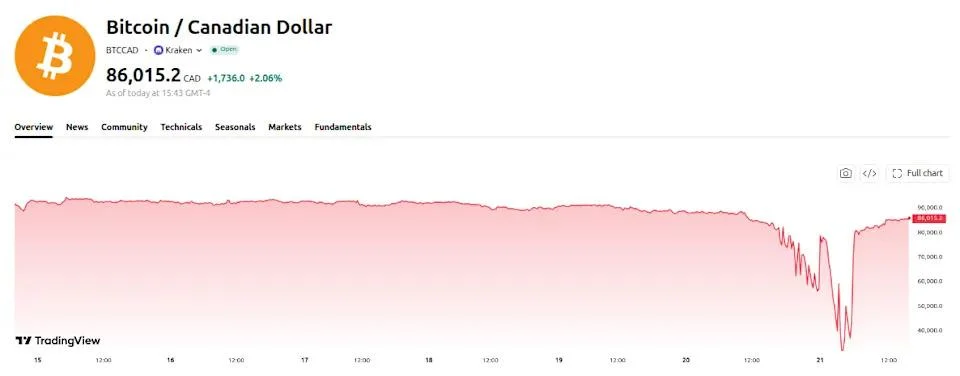
Kraken will honour trades executed during a sell-off in its Canadian-dollar markets that took Bitcoin to C$24,250 early on 21 November. At the Bank of Canada’s reference exchange rate, that was about US$16,900. Bitcoin was trading near US$57,650 on Kraken’s US-dollar book around the same time, according to Cointelegraph.
The gap illustrates how two trading pairs on one exchange can produce very different fills. Kraken attributed the price move to heavy selling in CAD pairs and said it had found no evidence of a breach or compromised accounts. The exchange has yet to confirm what started the dislocation.
Key Takeaways
- BTC/CAD touched C$24,250 at about 08:00 UTC on Saturday, roughly 71% below the comparable BTC/USD price after conversion.
- Other Kraken CAD pairs also diverged, including ether, XRP and USDT.
- Kraken said orders were processed correctly and that it would honour the executed trades.
The sell-off was concentrated in CAD pairs
In a statement reported by Cointelegraph, Kraken put the start of heavy selling at around 20:00 UTC on Friday, 20 November. The BTC/CAD low appeared in a 15-minute interval starting 12 hours later. CoinDesk’s analysis of exchange data found about 245 BTC changed hands during a series of low-price intervals in the early hours of Saturday, when average prices stayed below C$50,000.
USDT also fell sharply in Canadian-dollar terms. A stablecoin can trade at a substantial discount in a particular order book even when its prices elsewhere look very different. The simultaneous moves in multiple CAD pairs are a reason to look closely at the shared quote currency and the venue where the trades occurred. CoinDesk reported a low of C$0.56 for USDT on Kraken’s CAD market, against about C$1.43 at the prevailing foreign exchange rate. That comparison helps identify the scale of the disruption across more than one crypto asset.
Why a local fill can diverge
An order book shows the prices and sizes at which other traders are offering to buy or sell. Where visible market depth is thin, a sell order can fill across several lower price levels as it consumes the available bids. The price on a separate currency pair is a reference point. It does not provide liquidity to the book executing the order.
Blockstream CEO Adam Back suggested that a liquidity problem in the USD/CAD market could have spread through arbitrage to other CAD pairs. Kraken had not corroborated that explanation in its public account. The sequence of trades shows where and when prices diverged. An explanation of what started the divergence would require more information.
An episode like this also puts market and limit orders in different positions. A market order seeks immediate execution at the best prices available at the time, which can be far from the quote a trader saw earlier. A limit order constrains its execution price, though no fill is guaranteed. A stop order that becomes a market order can be sensitive to a local price move, depending on the platform’s trigger rules.
Kraken’s decision leaves the fills in place
Kraken’s decision means the trades stand even though prices on the CAD books diverged sharply from other markets. The Canadian Bitcoin market did recover from its lows, but the recovery did not change the prices at which sellers had already traded. That is why the exchange’s handling of fills is a separate story from the shape of the chart. It has not published a detailed explanation of why buying interest failed to absorb the sell-off. A fuller account would help traders assess market depth and order triggers across quote currencies, especially during periods when fewer counterparties may be active.