You’re watching Bitcoin climb from $68,000 to $69,500 in minutes. You hit “Buy” with a market order at $69,500 but your order fills at $69,847. You just paid $347 more per BTC than you planned. That’s slippage, and it just cost you roughly 0.5% in a single click.
Had you placed a limit order at $69,600 instead, you’d have either gotten your price or waited for a better one. That one decision, limit order versus market order, is one of the most overlooked reasons traders lose money in fast-moving crypto markets.
Slippage alone can eat 0.5% to 2% out of a single trade, before fees. Miss the moment with a limit order priced wrong, and you lose the trade entirely.
This guide breaks down every major order type, with real numbers from exchanges, such as UEEX, Coinbase, Binance, so you know exactly which order to use and when.
Key Takeaways
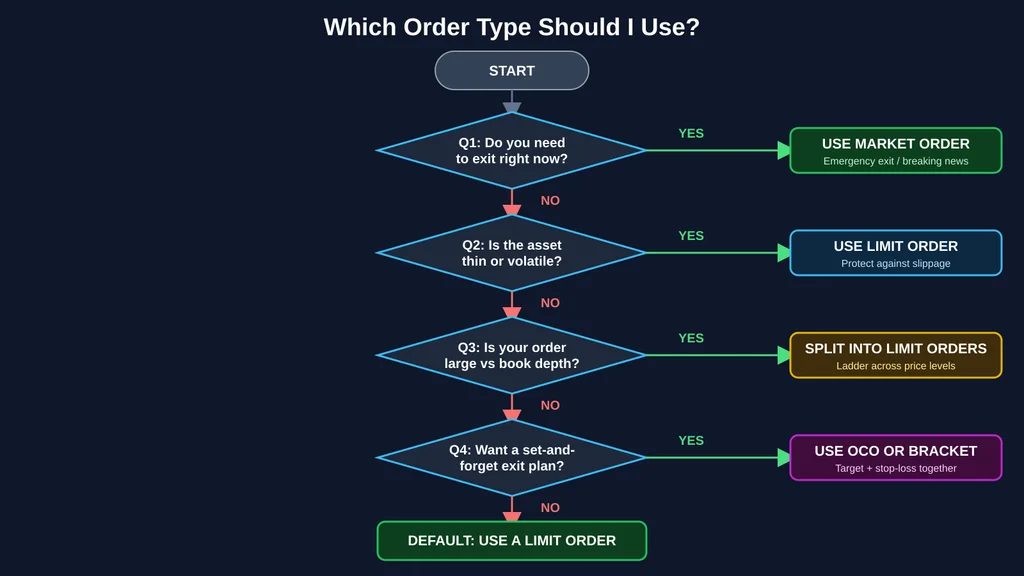
Default to limit orders. They protect you from slippage and usually cost less in fees. Save market orders for moments when speed truly matters.
Add up your real cost. Slippage (0.5% to 2%, sometimes more) plus taker fees (0.05% to 0.6%) compound fast. Look at total cost, not just the fee line.
Check the order book before placing big orders. A large market order can make promises and fill at progressively worse prices if there isn’t enough depth.
Match the order type to your strategy. Day trading, dollar-cost averaging, and swing trading each call for a different approach.
Learn one advanced order type at a time. Once you’re comfortable with limit and market orders, add stop-limit or trailing stop orders to manage risk without watching charts all day.
Join UEEx
Experience the World’s Leading Digital Wealth Management Platform
An order is just an instruction you give an exchange: buy this, sell that, at this price, under these conditions. Every order falls into one of two camps.
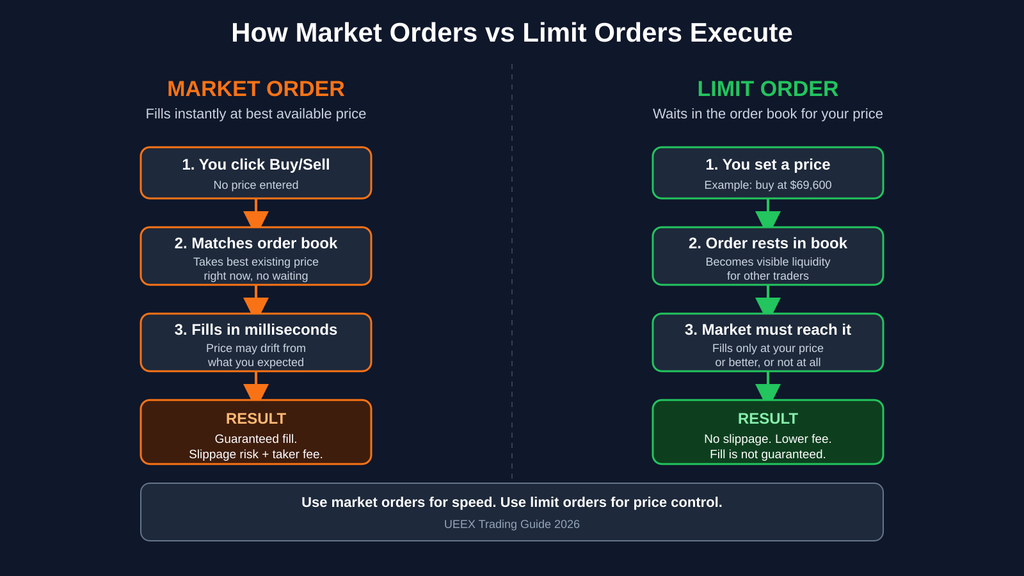
Market orders care about speed; you want in or out right now, and you’re willing to accept whatever price the market gives you. Limit orders care about price; you name your number, and the order only fills at that price or better. You might wait a while and you might not get filled at all.
That single choice affects how much you pay in fees, how much you might lose to slippage, and whether your order goes through at all.
How The Order Book Actually Works
Every exchange runs on an order book. Think of it as a running list of everyone who wants to buy and everyone who wants to sell, sorted by price.
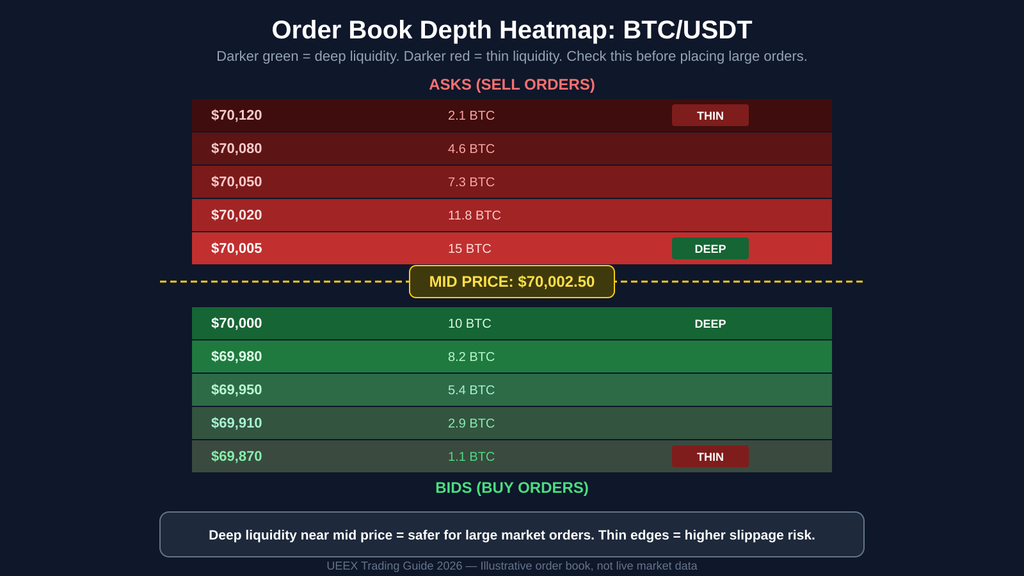
The buy side is called the bid. The sell side is called the ask. The gap between the highest bid and the lowest ask is the spread. A tight spread (a few cents on Bitcoin) means a liquid, healthy market. A wide spread usually means thin trading and more risk.
Picture a real Bitcoin order book: $70,000 has 10 BTC worth of buy orders stacked up. $70,005 has 15 BTC worth of sell orders. That stack, at every price level, is what traders call market depth. The deeper it is, the more you can buy or sell without moving the price against yourself.
Centralized Exchanges Vs Decentralized Exchanges
Centralized exchanges (CEXs) like Binance, Coinbase, and Kraken match buyers and sellers directly through an order book. Decentralized exchanges (DEXs) like Uniswap work differently: instead of an order book, they use automated market makers (AMMs), where price shifts based on the ratio of tokens sitting in a liquidity pool.
That difference matters for order types. CEXs give you real limit and market orders with maker-taker fees. DEXs mostly rely on slippage tolerance, a setting where you tell the platform the maximum price movement you’ll accept before it cancels your trade.
A market order is an instruction to buy or sell immediately at the best price currently available. You’re not naming a price. You’re saying “get me in or out now.”
How Market Orders Work
When you place a market order, it matches against whatever limit orders are already sitting in the order book. If you’re buying, you get filled at the lowest asking price available. If you’re selling, you get the highest bid.
In a liquid market, this happens in milliseconds. The catch is that “best available price” can move between the moment you click and the moment your order actually fills, especially in a fast market.
Breaking news forces you to enter or exit right now
You’re trading a highly liquid pair, like BTC or ETH on a major exchange
Your trade size is small compared to the order book depth
You’re chasing a short-lived opportunity, like arbitrage
You need to exit a position immediately to avoid a bigger loss
Real example: During a sharp Bitcoin pullback, a trader holding 5 BTC watches the price drop from $71,000 to $69,000 in about a minute. Waiting for a limit order to fill at a specific price isn’t realistic here. A market order executes instantly around $68,850. It’s not a great price, but it beats holding on and watching the position fall further.
Advantages Of Market Orders
You get filled, almost always, in liquid markets
Dead simple to use, no price guessing required
Best tool for genuine emergencies
Works well when spreads are already tight
Disadvantages Of Market Orders
Slippage is the big one: It’s the gap between the price you expected and the price you actually got. In fast or thin markets, a market order can fill noticeably away from the last quoted price.
Taker fees usually cost more: Market orders remove liquidity, and exchanges charge more for that. This taker fee is almost always higher than the maker fee you would pay with a limit order.
No protection during wild swings: Nothing stops your order from filling at a price you would never have agreed to in a calmer moment.
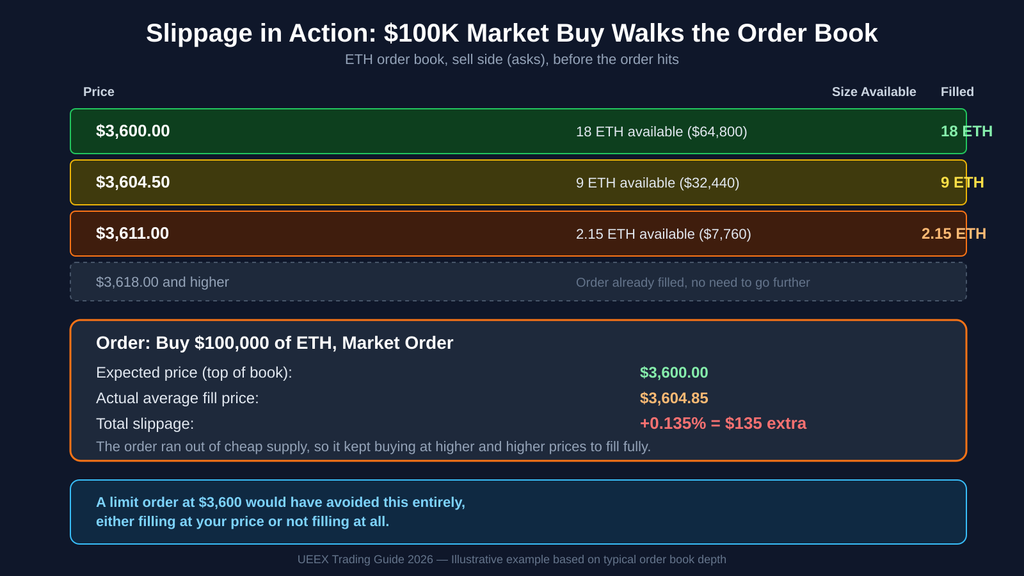
Large orders eat through the book: If your order is bigger than what’s sitting at the best price, it fills at the next price level, then the next. Your final average price can end up much worse than the first quote you saw.
Say you expected to buy Bitcoin at $65,000 and it filled at $65,200. That’s a slippage of 0.31%. Doesn’t sound like much until you’re trading larger positions or trading often.
For major coins like BTC or ETH under normal conditions, slippage of 0.5% to 1% is common and usually tolerable. Smaller tokens or genuinely volatile stretches can push that to 2% or more.
A 2026 liquidity report from TokenInsight found that BTC slippage on major exchanges stayed under 0.1% even for six-figure orders during calm periods, but jumped noticeably on lower-liquidity pairs and during sharp sell-offs.
Limit Orders: Price Control Over Speed
A limit order only executes at your specified price or better. Buy limit orders fill at your price or lower or sell limit orders fill at your price or higher. If the market never reaches your number, your order just sits there, unfilled, for as long as you let it.
How Limit Orders Work
Because a limit order doesn’t execute the moment you place it (unless the market’s already at your price), it sits in the order book and adds to the available liquidity. That’s why limit orders are usually classified as “maker” orders. You’re literally making the market for someone else’s trade.
You’re building a position gradually and don’t need to rush
You’re trading a thin or genuinely volatile asset where slippage risk is high
Your order is large enough that a market order would move the price against you
You have a specific entry or exit point based on your strategy
You want to pay lower maker fees instead of taker fees
Real example: Ethereum is trading at $3,600. A trader believes it’s a bit overvalued short term and places a buy limit at $3,500. Overnight, the price dips to $3,480. The limit order fills at $3,500, saving $100 per ETH compared to buying at the current price. On top of that, the trader pays a maker fee instead of the higher taker rate, since the order sat on the book waiting to be matched.
Advantages Of Limit Orders
You get your price or better, guaranteed, if the order fills
Lower fees in most cases, since you’re adding liquidity
Zero slippage risk, since you set the ceiling or floor yourself
You can set it and walk away instead of watching charts
Useful for splitting large orders across multiple price points
Disadvantages Of Limit Orders
No guarantee it fills at all: If the market never touches your price, you simply don’t get the trade.
You can miss the move entirely: Set your limit too far from the current price and you might watch an asset run 20% higher while waiting for a 2% discount that never comes.
Requires more market awareness: You need some sense of support, resistance, or fair value to set a sensible limit price.
Frustrating in fast markets: A limit order can feel like it’s always one step behind when prices move quickly.
Time-In-Force Options You Should Know
Good ‘Til Canceled (GTC): Stays active until you manually cancel it
Good ‘Til Time / Good ‘Til Date (GTT/GTD): Expires automatically at a set time or date
Immediate Or Cancel (IOC): Fills whatever it can right away, cancels the rest
Fill Or Kill (FOK): Must fill completely and immediately, or it cancels entirely
Post Only: Guarantees your order only acts as a maker; if it would execute immediately instead, it gets cancelled rather than filled as a taker
Market Orders Vs Limit Orders Comparison
Factor
Market Orders
Limit Orders
Execution speed
Immediate
Delayed, or may never fill
Price certainty
None, subject to slippage
Guaranteed at your price or better
Fill certainty
Very high in liquid markets
Depends on market movement
Typical fees
0.05%–0.6% taker
0.00%–0.4% maker
Slippage risk
Real, 0.5%–2%+ in volatile conditions
None if unfilled
Best for
Urgent trades, liquid markets, small size
Patient entries, large orders, volatile assets
Order book effect
Removes liquidity
Adds liquidity
Tax timing
Cost basis set immediately
Cost basis set only if order fills
Strategy flexibility
Limited
Supports laddering, averaging, planned exits
How Major Platforms Handle This Differently
Coinbase Advanced includes a market price protection feature that stops market orders from filling at extreme, far-off prices during a sudden spike
Kraken lets you toggle “post only” so your limit order only ever counts as a maker, or it cancels instead of filling as a taker
Binance supports OCO (one-cancels-the-other) orders that pair a limit order with a stop-limit order
Uniswap and other DEXs replace traditional limit orders with a slippage tolerance setting instead
Maker Vs Taker Fees: Where Your Money Actually Goes
Explore how the fees work
What Makes You A Maker Or A Taker
A maker adds liquidity; your order sits on the book instead of matching instantly, which usually means you used a limit order priced away from the current market. On the other hand, a taker removes liquidity. Your order matches immediately against something already on the book, which is what happens with market orders (and limit orders priced to fill instantly).
Your role is set by how the order behaves, not by whether you’re buying or selling.
Maker example: You place a limit buy for ETH at $3,500 while the market sits at $3,550. Your order waits. Later, the price drops and someone’s market sell order matches your resting limit order. You’re the maker, and you get the lower fee.
Taker example: The market is at $3,550 and you place a market buy. It matches instantly against existing sell orders. You’re the taker, and you pay the higher fee.
2026 Exchange Fee Comparison
Fee schedules change often, so these are the base (entry-level) rates as of September 2026. Always check the exchange’s live fee page before trading, since tiers shift with your 30-day volume.
Exchange
Maker Fee
Taker Fee
Notes
UEEX
0.05%
0.08%
Competitive entry-level spot rate
MEXC
0.00%
0.05%
Drops further with MX token holdings
Binance
0.10%
0.10%
25% discount when paying fees in BNB
OKX
0.08%
0.10%
Rates confirmed on OKX’s official fee schedule
Kraken Pro
0.40%
0.80%
Drops fast with volume: 0.22%/0.38% once you clear $10,000 in 30-day volume
Coinbase Advanced
0.40%
0.60%
Simple app interface uses a separate spread-based model instead
Once you’re comfortable with the basics, these order types give you more control without needing to watch the market all day.
Stop-Limit Orders
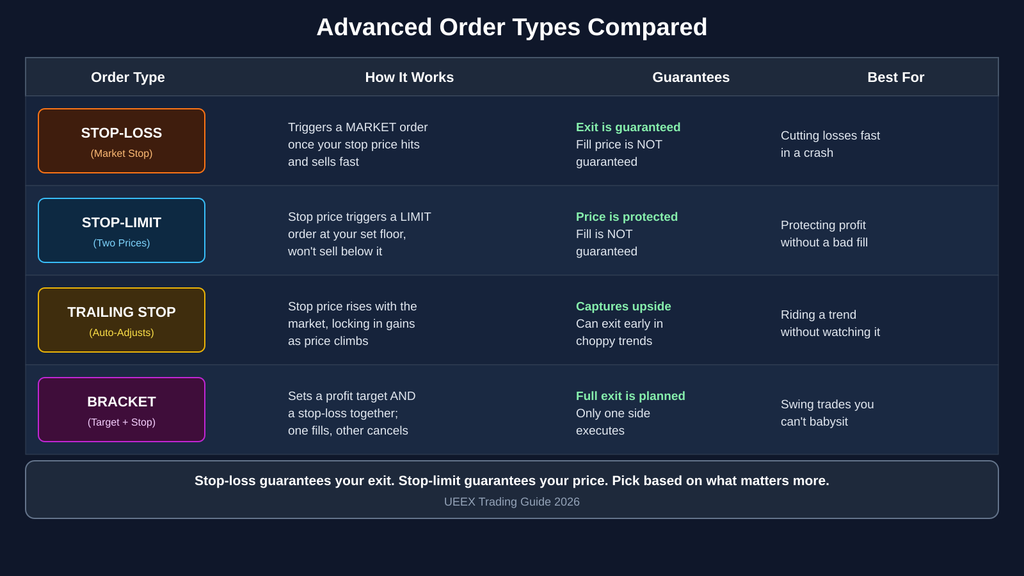
A stop-limit order combines two prices. The stop price triggers the order. The limit price sets the worst price you’ll accept once it triggers.
Example: You hold ETH bought at $3,200; it’s now trading at $3,800. You want to protect your gains without selling on a small dip. You set a stop at $3,700 and a limit at $3,650. If the price drops to $3,700, a limit sell order gets placed at $3,650. It will fill anywhere between $3,650 and $3,700, but never below $3,650.
The risk: if the price gaps straight through your limit (say, a crash from $3,700 straight to $3,600), your order might not fill at all, since it refuses to sell below $3,650.
Stop-Loss Orders (Market Stop)
This is the simpler cousin. Instead of triggering a limit order, it triggers a market order once your stop price hits. That means it guarantees you get out, but not at what price. It’s the right tool when you’d rather take a worse price than risk staying in a falling position.
Trailing Stop Orders
A trailing stop automatically adjusts your stop price as the asset moves in your favor, locking in gains without needing to change anything manually.
Example: BTC is at $70,000, and you set a 5% trailing stop. If BTC rises to $75,000, your stop rises with it, to $71,250. If BTC then drops to $71,250, the sell triggers. You captured the upside and protected most of the gain, without watching the screen.
The trade-off: in a choppy but still trending market, a tight trailing stop can knock you out of a position that would’ve kept climbing.
Bracket Orders
A bracket order sets both a profit target and a stop-loss at the same time. Whichever one hits first executes, and the other one automatically cancels.
Example: You buy BTC at $70,000. You set a bracket: sell limit at $75,000 (your target) and a stop-limit at $68,000 (your floor). If BTC hits $75,000 first, it sells there and the $68,000 order cancels. If it drops to $68,000 first, that one triggers instead.
This is especially useful for swing trading, since it removes the need to babysit a chart.
OCO (One-Cancels-The-Other) Orders
Similar idea to a bracket order: you place two orders at once, and whichever fills first cancels the other. Binance, OKX, and Bybit all support this natively.
Iceberg Orders
An iceberg order splits a large order into small, visible pieces so the rest of the market doesn’t see your full size. Want to buy 100 BTC without spooking the market? An iceberg order might show just 5 BTC at a time, refilling automatically as each chunk fills.
This is mostly an institutional or API-trader tool. It’s rarely available in a standard retail interface, but worth knowing exists if you ever trade at serious size.
Which Order Type Fits Your Trading Style
Explore the order type that fits your trading style below
1. Day trading in high volatility: Limit orders for entries at support or resistance levels. Market orders for exits when momentum shifts fast. Keep a stop-loss running as a safety net either way.
2. Dollar-cost averaging (DCA): Stick to limit orders almost exclusively. Set a weekly buy limit slightly below the current price, maybe 1% to 2% lower, and adjust it up if it doesn’t fill. You’ll pay maker fees the whole way, and your average entry improves over time.
3. Emergency exits (flash crashes): Market orders, full stop. Every second matters more than getting a slightly better price. You’re avoiding a much bigger loss, not chasing a perfect exit.
4. Large position entries: Split the order into smaller limit orders spread across several price levels, executed over hours or days. This avoids moving the market against yourself, similar to the TWAP/VWAP strategies institutional desks use.
5. Arbitrage trading: Simultaneous market orders on both sides. If BTC is $70,000 on one exchange and $70,200 on another, the gap might last seconds. Limit orders are too slow.
6. Swing trading: Limit orders for entries at support, then an OCO or bracket order for the exit, pairing a profit target with a stop-loss. Example: ETH support at $3,400, resistance at $3,800. Buy limit at $3,400, then OCO a sell limit at $3,800 with a stop-limit near $3,300.
7. News-based trading: Pre-position with limit orders before a major announcement. Once the news hits, switch to market orders to capture the move or cut losses fast.
The Psychology Behind Order Type Mistakes
Knowing the mechanics isn’t the hard part. Managing your own reactions is.
1. FOMO buying with market orders: An asset pumps 40% in a day, and fear of missing out pushes you to buy right near the local top. The fix: pre-set limit orders at levels you actually believe in, before the emotional moment hits.
2. Waiting too long with limit orders: You set your limit 2% below the market for a “better deal,” and the asset runs 20% higher without coming back. The lesson isn’t to abandon limit orders but to be realistic about where you place them.
3. Overcomplicating with advanced orders: OCO, bracket, and iceberg orders are powerful, but stacking too many conditions can leave you stuck in analysis instead of placing a trade. Start simple and add complexity once you’re comfortable.
4. Setting stops too tight: A stop-loss placed just below your entry gets triggered by normal price noise, not a real reversal. Look at the asset’s typical volatility before deciding how far away your stop should sit.
5. Revenge trading after slippage: A bad fill leads to frustration, which leads to an impulsive trade to “make it back.” Treat slippage as a known cost of trading, not a personal insult.
Read our guide on Trading Psychology for indepth analysis on managing your emotions during trading.
Tax Implications Of Order Types
Tax could apply to your trading order types and here’s how to know
Cost Basis Timing
A market order sets your cost basis the moment it fills. A limit order only sets a cost basis if and when it actually executes, which gives you some flexibility, including the ability to place a limit order in December that might not fill until January, shifting the tax event into the next year.
FIFO vs LIFO Considerations
Because market orders fill instantly, there’s little room to choose which specific “lot” of your holdings you’re selling. Limit orders, by contrast, give you more room to plan around which accounting method (FIFO or LIFO) works better for your tax situation.
Say you bought BTC at $30,000 in 2023 and again at $60,000 in 2024. Selling at $70,000 today triggers a $40,000 gain under FIFO, but only a $10,000 gain under LIFO. A limit order gives you the breathing room to plan which lot you actually want to sell.
Wash Sale Awareness
Selling at a loss with a market order and immediately rebuying can raise wash sale concerns in other asset classes. Crypto has historically been treated differently under U.S. tax rules, though this is an area regulators have been revisiting, and rules could tighten. This is a fast-moving area, so don’t assume today’s treatment holds indefinitely.
This section provides general awareness, not tax advice. Consult a qualified tax professional about your specific situation, since trading frequency, order types, and holding periods all affect how your trades are taxed.
Common Mistakes And How To Avoid Them
Here are common mistakes in order types and how you can avoid them
1. Always using market orders: Even a modest 0.5% average slippage plus a slightly higher taker fee adds up fast across dozens of trades. Default to limit orders and save market orders for when urgency is real.
2. Setting unrealistic limit prices: A buy limit set 5% below the market in a strong uptrend may simply never fill. Base your limit prices on actual support or resistance, not just a number that feels good.
3. Ignoring order book depth: A $100,000 market order against a book with only $30,000 at the best price guarantees painful slippage. Check depth first, and split the order if needed.
4. Confusing stop-loss and stop-limit: A stop-limit order can fail to execute during a fast crash if price gaps past your limit. If your priority is a guaranteed exit, use a stop-loss (market stop) instead.
5. Forgetting about time-in-force: A GTC limit order can sit forgotten for months and execute at a stale price. Use GTD or GTT when that matters.
6. Overriding your own plan emotionally: Cancelling a stop-loss because “it’ll recover” is one of the most common ways traders turn a manageable loss into a much bigger one. Trust the rule you set while calm more than your judgment in the moment.
Join UEEx
Experience the World’s Leading Digital Wealth Management Platform
There’s no single “best” order type. There’s only the right order type for what you’re actually trying to do in that moment. A limit order that saves you 0.3% on a calm Tuesday is the wrong tool during a flash crash, and a market order that saves your position during a crash is the wrong tool for a routine DCA buy.
The traders who consistently do well aren’t the ones who found some secret order type. They’re the ones who match the tool to the moment, check the fee schedule before they trade, and don’t let a bad fill turn into a bad week.
Frequently Asked Questions
What’s the main difference between limit orders and market orders?
A market order fills immediately at the best available price, but you don’t control what that price ends up being. A limit order only fills at the price you set or better, but there’s no guarantee it fills at all.
Should I use market or limit orders for Bitcoin?
For a liquid asset like Bitcoin, limit orders are the safer default since they protect you from slippage and usually cost less in fees. Reach for a market order only when speed genuinely matters more than price, like closing a position fast during a sharp move.
How much slippage is normal in crypto trading?
For major coins like BTC and ETH under normal conditions, 0.5% to 1% slippage is common and generally acceptable. Smaller tokens, thin order books, or genuinely volatile stretches can push slippage to 2% or higher, so always check order book depth before placing a large order.
Are maker fees always cheaper than taker fees?
On nearly every centralized exchange, yes. Maker fees (from limit orders that add liquidity) are almost always lower than taker fees (from market orders that remove it), since exchanges want to reward traders for providing liquidity. Always check the exchange’s current fee schedule, since exact rates and tiers vary by platform and change over time.
Disclaimer: This article is intended solely for informational purposes and should not be considered trading or investment advice. Nothing herein should be construed as financial, legal, or tax advice. Trading or investing in cryptocurrencies carries a considerable risk of financial loss. Always conduct due diligence before making any trading or investment decisions.
Trade with proof of Reserves
UEEx publish monthly audits and third party verification on every listed market.