The stablecoin market just crossed $300 billion. In less than a decade, a corner of crypto built to solve one boring problem, price swings, has grown into one of the largest pools of dollar-denominated assets outside a bank.
Here is the problem stablecoins solve. Bitcoin can drop 10% before lunch, and Ethereum can do the same by dinner. That is fine if you are trying to get rich fast. It is a nightmare if you just want to pay a supplier in Vietnam or park cash between trades. Stablecoins fix this by staying at (or very near) one dollar, while still moving at internet speed on a blockchain.
This guide walks through the 12 stablecoins worth knowing in 2026, how they actually work, and how to pick the right one for what you are doing.
Note: There is no single “best” stablecoin. USDT wins on pure liquidity. USDC wins on transparency and regulatory comfort. DAI wins if you want something no single company controls. Pick based on what you are actually trying to do, not the biggest name.
4 Key Takeaways
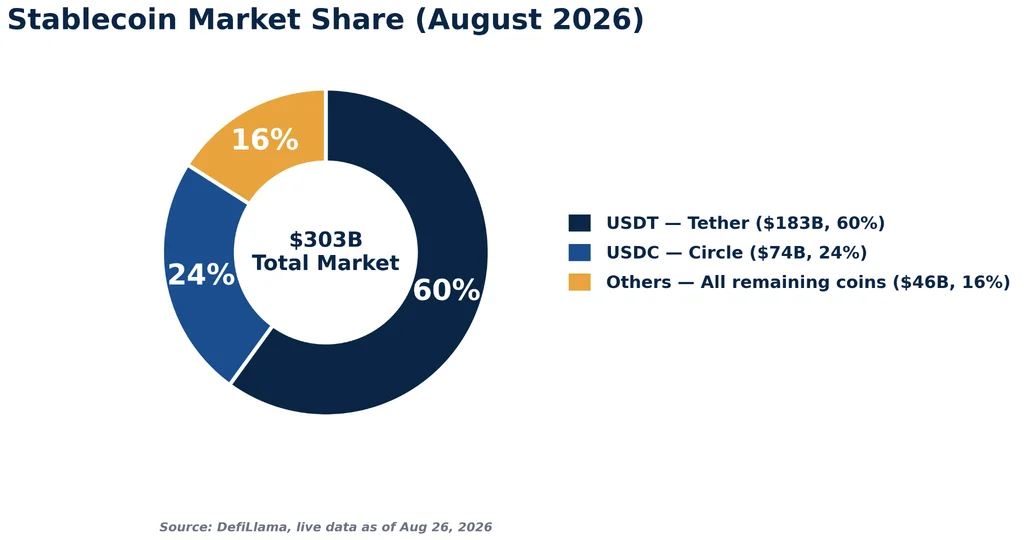
- The stablecoin market sits at roughly $300 billion, and just two coins, USDT and USDC, control about 82% of it.
- The GENIUS Act, signed into law in July 2025, is the first federal U.S. law written specifically for stablecoins, and its rules fully kick in by January 18, 2027.
- Not every stablecoin is backed the same way. Some hold real dollars in a bank. Others are backed by crypto collateral, and a few use no reserves at all, which is riskier than it sounds.
- Market caps move fast. FDUSD lost roughly three-quarters of its value in 2026 alone, a reminder that “stable” refers to the price, not the business behind it.
What Are Stablecoins
A stablecoin is a cryptocurrency built to hold a fixed value, almost always one U.S. dollar, by backing each coin with reserves like cash, government bonds, or other crypto assets that can be redeemed on demand.
Think of it as a digital dollar bill. It moves like cryptocurrency, settling in seconds across borders, but it is designed to spend like cash because its price does not swing.
Tether launched the first real one, USDT, back in 2014. For years it was a niche tool traders used to sit out volatile markets without leaving crypto exchanges. That has completely changed. Stablecoins now make up close to 13% of the entire crypto market and are used for far more than trading.
Here is why people actually use them:
- Sending money across borders in minutes instead of days
- Powering lending and borrowing inside DeFi platforms
- Parking value between crypto trades without cashing out to a bank
- Paying for goods and payroll where card fees or wire delays are a real cost
How Stablecoins Work
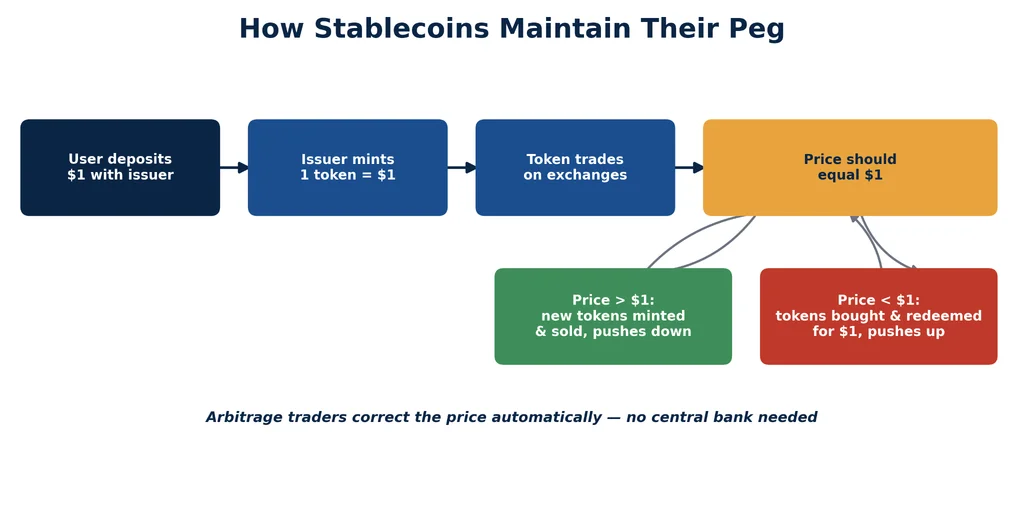
Every stablecoin needs a way to stay glued to one dollar. Most fiat-backed coins do it through 1:1 reserves and redemption. The issuer holds one dollar (or equivalent) in the bank for every token in circulation and lets big holders redeem tokens for real dollars whenever they want.
That redemption right is what keeps the price honest. If USDC ever traded at $0.98, a trader could buy it cheap, redeem it for a full dollar with Circle, and pocket the difference. That arbitrage pulls the price back to $1 automatically, no central bank required.
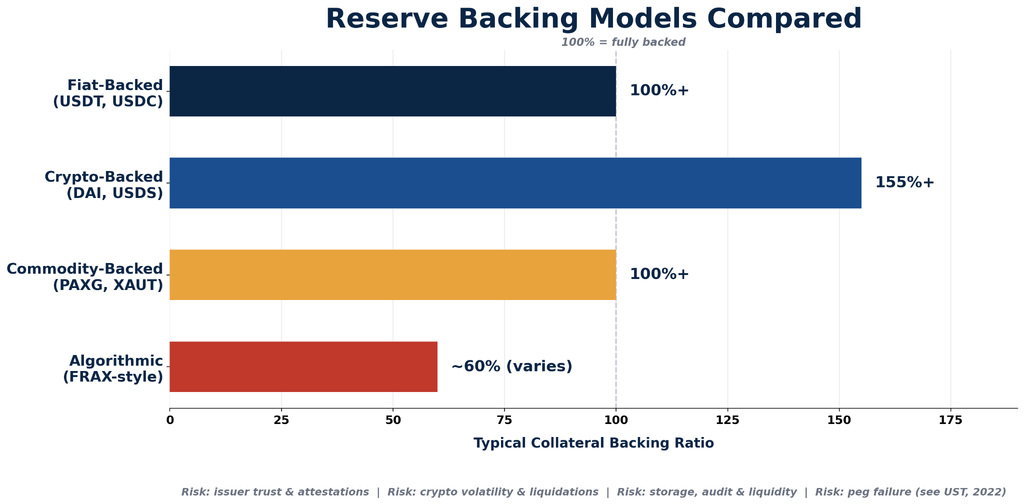
Crypto-backed coins like DAI work differently. Instead of dollars in a bank, users lock crypto (like ETH) into a smart contract and borrow stablecoins against it, usually at 150% collateral or more, so the system stays solvent even if crypto prices drop.
Price feeds called oracles report real-world prices onto the blockchain so these systems know, in real time, whether collateral is still worth enough to back the debt. If it is not, the collateral gets liquidated automatically, no human in the loop.
Types of Stablecoins
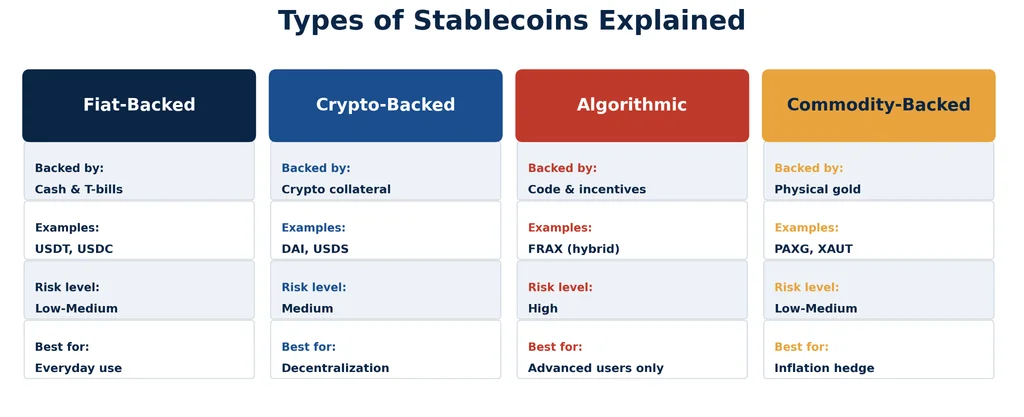
Below are the different types of stablecoins
Fiat-Backed Stablecoins
This is the simplest model and the one most people mean when they say “stablecoin.” A company holds real dollars or short-term Treasury bills in a bank or trust and issues one token for every dollar held. USDT, USDC, USD1, PYUSD, and RLUSD all work this way.
Pros:
- Easiest to understand
- Direct 1:1 redemption
- Deepest liquidity
Cons: You are trusting a company to actually hold what it says; reserves can include non-cash assets, and issuers can freeze funds or face regulatory action.
Crypto-Backed Stablecoins
Here, the reserve is another cryptocurrency instead of dollars, locked into a smart contract with more collateral than the debt it backs. DAI is the classic example, and it has run this way since 2017 without a single insolvency event.
Pros:
- No company controls it
- Fully visible on-chain
- Resistant to any one government freezing it
Cons: Capital inefficient (locking $150 to borrow $100) and still exposed to crypto’s own volatility during a crash.
Algorithmic Stablecoins
These try to hold the peg through code and incentives instead of hard reserves, adjusting supply up or down to defend the price. It sounds elegant. It has also produced crypto’s most spectacular failure.
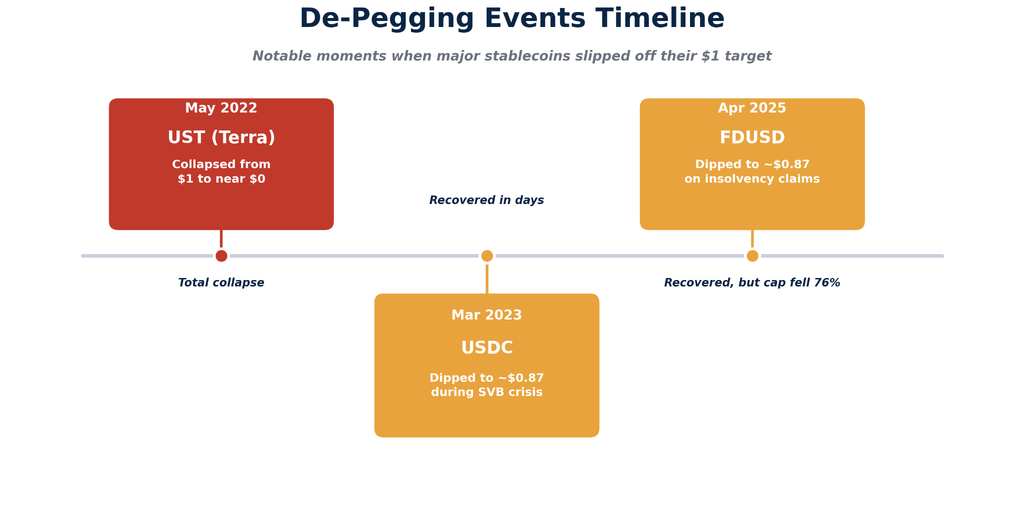
Warning worth remembering: In May 2022, Terra’s UST stablecoin, once worth $18.7 billion, collapsed to near zero in a matter of days when its algorithmic mechanism spiraled instead of stabilizing. It remains the clearest lesson in the sector: code promises are not the same as dollars in a vault.
Because of that collapse, pure algorithmic models now hold a tiny slice of the market. Most surviving projects, like FRAX, blend algorithmic elements with real collateral.
Commodity-Backed Stablecoins
Instead of dollars, these are backed by a physical commodity, almost always gold, sitting in a vault. PAXG and XAUT both work this way, with one token equal to one troy ounce of physical gold.
Pros: a hedge against inflation and currency weakness, with the convenience of instant blockchain settlement.
Cons: storage and audit costs, and a much smaller pool of buyers and use cases than dollar stablecoins.
Top 12 Stablecoins by Market Cap
We ranked these by market cap, trading activity, and how transparent the issuer is about reserves, using live data from DefiLlama and CoinGecko. Figures move daily; treat them as a snapshot from August 2026, not a permanent ranking.
| The following analysis is based on publicly available information and our independent research. We have no financial relationships with the issuers mentioned. Always conduct your own research (DYOR) before interacting with any stablecoin |
Tier 1: The Giants
1. Tether (USDT)
- Market cap: $183 billion (about 60% of the entire stablecoin market)
- Type: Fiat-backed | Launched: 2014 | Issuer: Tether Limited (El Salvador / BVI)
USDT is the coin that made stablecoins mainstream, and it is still the one every exchange lists first. It runs on 15+ blockchains, with TRON and Ethereum holding the largest shares of supply, and its daily trading volume regularly beats every other stablecoin combined.
Reserves lean heavily on U.S. Treasury bills, alongside cash, gold, and a smaller Bitcoin position, per Tether’s quarterly transparency reports attested by BDO Italia. Tether posted a net profit of over $10 billion in 2025, an extraordinary number for a private company, and it has since launched USAT, a separate U.S.-focused stablecoin, to work within the new federal rules.
The catch is transparency. Attestations are a point-in-time snapshot, not a full audit, and Tether settled with the CFTC and New York’s attorney general years ago over past reserve claims. That history, plus its offshore structure, keeps regulators watching closely even as its liquidity keeps it essential.
Best for: Active traders and anyone who needs to move size without slippage.
Where to buy: UEEx, Binance, Coinbase, Kraken, and essentially every major exchange.
2. USD Coin (USDC)
- Market cap: $74 billion | Type: Fiat-backed | Launched: 2018 | Issuer: Circle
USDC built its reputation on transparency, and that reputation has turned into a real business advantage. Reserves sit in cash and short-dated Treasuries, managed largely through a BlackRock-run money market fund, with monthly attestations now handled by Deloitte & Touche.
Circle went public on the NYSE in June 2025 under ticker CRCL, which means USDC’s issuer now files quarterly earnings like any other public company, a level of scrutiny no competitor matches. USDC also plugs into Visa’s settlement network and holds licenses across most U.S. states plus an EU e-money license under MiCA.
The trade-off is liquidity. USDC still trails USDT in raw trading volume and total supply, though the gap has been narrowing as institutions lean toward the more transparent option.
Best for: Businesses, institutions, and anyone prioritizing compliance over raw liquidity. Where to buy: UEEx, Coinbase, Kraken, Binance, most regulated exchanges.
3. Ethena USDe
- Market cap: $4 billion (fluctuates significantly month to month) | Type: Synthetic dollar | Launched: 2024 | Issuer: Ethena Labs
USDe does not hold dollars at all. It backs its peg with crypto collateral (mostly ETH and staked ETH) paired with short positions on perpetual futures, a strategy called delta-neutral hedging that is designed to cancel out crypto’s price swings.
What makes USDe interesting is yield. Staking it as sUSDe has paid out real returns, funded by funding rate income from the hedge positions, at times far higher than a savings account. Ethena has also built partnerships with institutional players like Anchorage Digital and integrated into platforms including Robinhood Chain.
The complexity is the risk. This is not a simple dollar-in-a-bank model; it depends on derivatives markets behaving normally, and it does not qualify as a payment stablecoin under the GENIUS Act, which limits how U.S.-regulated platforms can treat it.
Best for: Experienced DeFi users comfortable with yield-bearing, non-fiat structures. Concerns: Regulatory uncertainty and a mechanism that has never been tested through a true black swan event at this size.
Tier 2: The Established Challengers
4. Dai (DAI) and Sky Dollar (USDS)
- Market cap: DAI $4.8 billion, USDS $6.6 billion | Type: Crypto-collateralized | Launched: 2017 (DAI)
DAI is the original decentralized stablecoin, run by MakerDAO, now rebranded as Sky Protocol. In 2024, Sky introduced a companion token, USDS, that upgrades from DAI at a fixed 1:1 rate, so the two now circulate side by side backed by the same collateral pool.
That pool has shifted a lot over the years. It started as pure crypto (mostly ETH) and now includes a large and growing share of tokenized real-world assets like Treasury bills, a change that has split the DeFi community between those who want maximum decentralization and those who want stable yield.
Best for: Users who want a dollar stablecoin no single company can freeze.
Concerns: Governance is concentrated among large token holders, and the RWA shift adds a layer of traditional-finance counterparty risk to a coin built to avoid exactly that.
5. World Liberty Financial USD (USD1)
- Market cap: $4 billion | Type: Fiat-backed | Launched: April 2025 | Issuer: World Liberty Financial (Trump family-linked)
USD1 has grown faster than almost anything else on this list. Reserves are held by BitGo Trust under a South Dakota charter, backed by cash and Treasuries, with monthly attestations. It charges zero fees to mint or redeem, a rarity in the space.
Best for: institutions wanting a newer, fee-free option with a compliance-first pitch. Concerns: It has a short track record, and its political ties draw scrutiny that other issuers do not face.
6. PayPal USD (PYUSD)
- Market cap: $2.8 billion | Type: Fiat-backed | Launched: August 2023 | Issuer: Paxos Trust
PYUSD lives inside an app 430 million people already use. It is backed by cash and Treasuries, issued by Paxos, and now moves across seven blockchains, including Ethereum and Solana. It has grown fast on the back of PayPal and Venmo integration, merchant payouts, and reward programs.
Best for: Everyday PayPal or Venmo users and small merchants.
Concerns: Thinner liquidity outside the PayPal ecosystem compared to USDT or USDC.
7. Ripple USD (RLUSD)
- Market cap: $2.1 billion | Type: Fiat-backed | Launched: December 2024 | Issuer: Ripple Labs
RLUSD is one of the fastest-growing coins on this list, up sharply in the past month alone. It holds New York Department of Financial Services approval, one of the harder licenses to get, and uses BNY Mellon as its reserve custodian. It runs on both the XRP Ledger and Ethereum.
Best for: Cross-border payment users and anyone already inside Ripple’s payment network.
Concerns: Still small next to the top two, and growth is closely tied to Ripple’s own business fortunes.
8. Tether Gold (XAUT)
- Market cap: $2.5 billion | Type: Commodity-backed | Issuer: Tether (TG Commodities)
Each XAUT token equals one troy ounce of physical gold, stored in Swiss vaults and traceable to a specific serial-numbered bar. It has grown alongside gold’s own rally and trades on both Ethereum and TRON.
Best for: Traders wanting gold exposure without a brokerage account.
Concerns: Tracks gold’s price, not the dollar, so it is not “stable” in the same sense as the coins above it.
Tier 3: Smaller and Cautionary Names
9. Pax Gold (PAXG)
Market cap is around $1.7 billion, and it’s backed by allocated, LBMA-certified gold stored in London vaults, issued by Paxos under NYDFS oversight. It has no storage fees, and its regulated structure appeals to institutions over XAUT’s higher-volume, less-regulated profile.
10. TrueUSD (TUSD)
Market cap around $480 million. One of the earliest fiat-backed coins with live, third-party attestations, but usage has declined steadily as the field around it has grown. Treat it as a legacy option rather than a growth story.
11. First Digital USD (FDUSD)
Market cap has fallen from a peak above $2 billion to roughly $350 million in 2026. The drop followed a 2025 insolvency accusation against its issuer, a brief depeg to $0.87, and Binance gradually delisting FDUSD trading pairs while promoting its own stablecoin. This is the clearest current example of liquidity risk on this list.
12. Gemini Dollar (GUSD)
Market cap has shrunk to roughly $40 million, down sharply from earlier years. It remains fully regulated by the NYDFS with State Street custody, but adoption has not kept pace with larger, better-marketed rivals. Include here as an example of a well-run, well-regulated stablecoin that simply never found broad demand.
Quick Comparison
| Stablecoin | Type | Market Cap | Regulatory Status | Best For |
| USDT | Fiat-backed | $183B | Quarterly attestation, offshore | Liquidity, trading |
| USDC | Fiat-backed | $74B | Deloitte-attested, NYSE-listed issuer | Compliance, institutions |
| USDe | Synthetic | $4B | Not GENIUS-compliant | DeFi yield seekers |
| DAI / USDS | Crypto-backed | $5B / $7B | Decentralized governance | Censorship resistance |
| USD1 | Fiat-backed | $4B | Pursuing OCC bank charter | Institutional, fee-free |
| PYUSD | Fiat-backed | $2.8B | NYDFS / OCC (Paxos) | PayPal/Venmo users |
| RLUSD | Fiat-backed | $2.1B | NYDFS-approved | Cross-border payments |
| XAUT | Gold-backed | $2.5B | Unregulated commodity token | Gold exposure |
| PAXG | Gold-backed | $1.7B | NYDFS-regulated | Regulated gold exposure |
| TUSD | Fiat-backed | $480M | Attested, legacy | Long-time holders |
| FDUSD | Fiat-backed | $350M | Declining, exchange-dependent | Not recommended for new users |
| GUSD | Fiat-backed | $40M | NYDFS-regulated | Small, cautious NY users |
How to Choose the Right Stablecoin
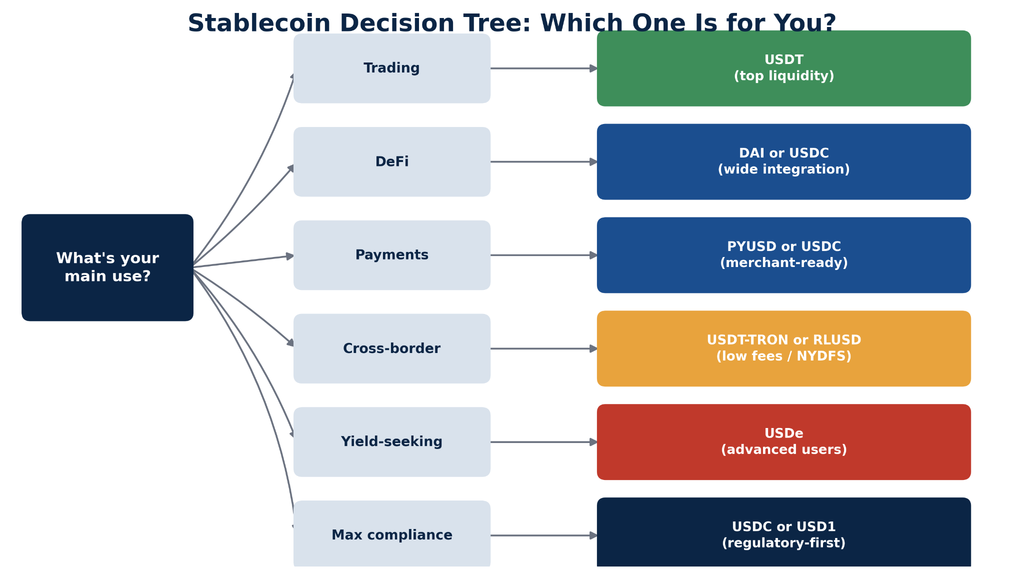
There is no single best stablecoin for everyone. The right choice depends on what you need it for, how much risk you can accept, where you operate, and which blockchain you use.
1. Match the Stablecoin to Your Use Case
| Use case | Better options | Why |
| Trading | USDT | Deep liquidity and broad exchange support |
| DeFi | USDC, DAI | Strong ecosystem integration and liquidity |
| Payments | USDC, PYUSD | Merchant and payment infrastructure |
| Cross-border transfers | USDT, USDC, PYUSD | Fast settlement across supported networks |
| Institutional use | USDC | Strong reserve disclosure and regulatory positioning |
| Yield strategies | USDe, USDC/DAI in DeFi | USDe is designed to generate native yield, while lending returns vary by protocol and market conditions |
2. Consider Regulation
Regulation now plays a much bigger role in stablecoin selection.
In the US, the GENIUS Act became law in July 2025 and created a federal framework for payment stablecoins. It requires permitted issuers to maintain at least 1:1 reserves in approved liquid assets and disclose reserve composition monthly.
For users who prioritize regulatory clarity, USDC stands out. Circle’s USDC is compliant with the EU’s MiCA framework, and Circle France received approval in 2026 to provide regulated crypto-asset services across the European Economic Area.
For European users, also check whether the stablecoin and the service provider you use comply with MiCA rather than assuming every dollar stablecoin is available under the same conditions.
3. Check Reserves and Transparency
Do not judge a stablecoin only by its market cap. Check what backs it and how often the issuer reports its reserves.
- USDC: 1:1 backing, weekly reserve disclosures, and monthly third-party assurance.
- USDT: Large liquidity and substantial Treasury exposure, with quarterly attestations from BDO. Tether reported $8.23 billion in excess reserves in Q1 2026.
- DAI: Uses on-chain collateral and decentralized governance, but its risk depends on the assets and mechanisms supporting the system.
- PYUSD: Fully backed by US dollar reserves and cash equivalents.
Transparency does not eliminate risk, but it makes that risk easier to evaluate.
4. Look at Liquidity and Availability
Liquidity matters most when you trade large amounts or need to move in and out of positions quickly.
USDT remains the dominant liquidity choice, while USDC has broad exchange, DeFi, and institutional adoption. DAI remains important across DeFi, while newer stablecoins such as USDe and USD1 have been expanding their market presence.
Also check the exact blockchain. A stablecoin may be available on several networks but have very different liquidity, fees, and applications on each one.
5. Choose the Right Network
The stablecoin is only half the decision. The network matters too.
- Ethereum: Strong DeFi ecosystem, but transaction costs can be higher.
- Solana: Fast transactions and generally low network costs.
- TRON: Widely used for USDT transfers and often inexpensive, although fees can vary.
- Base, Arbitrum, and other Layer 2s: Useful for lower-cost Ethereum-compatible transactions.
Never send a stablecoin without checking that the sender and recipient support the same token and network.
6. Match It to Your Risk Tolerance
A simple framework is
Lower relative risk: USDC and other fully reserved, regulated payment stablecoins.
Moderate risk: USDT, PYUSD, and similar fiat-backed stablecoins, where issuer, regulatory, and reserve considerations still matter.
Higher risk: USDe and other synthetic or yield-generating models because their mechanisms differ from traditional fiat-backed stablecoins.
DeFi-specific risk: DAI and other decentralized stablecoins add collateral, governance, and smart-contract risks.
No stablecoin is risk-free. Even a regulated, fully reserved stablecoin can face issuer, custody, regulatory, liquidity, or operational risks.
7. Compare Fees Before You Transfer
Network fees can make a major difference for frequent transfers. Ethereum can become expensive during periods of congestion, while networks such as Solana and TRON can generally offer cheaper transfers.
Do not rely on a fixed claim such as “USDT on TRON always costs less than $0.01.” Fees change with network conditions, wallet requirements, and exchange policies.
Quick Decision Guide
| If you are | Consider |
| A frequent trader | USDT |
| An institutional or compliance-focused user | USDC |
| A DeFi user | USDC or DAI |
| A PayPal merchant or user | PYUSD |
| Sending money internationally | USDT or USDC on a suitable low-cost network |
| Looking for stablecoin-based yield | USDe or DeFi lending, after assessing the risks |
| Focused on EU regulation | MiCA-compliant options such as USDC |
| Seeking decentralisation | DAI, while accepting additional DeFi risks |
If you already trade actively, our Stablecoin Trading Strategies guide covers how to invest using these stablecoins.
Stablecoin Risks You Should Understand
Before choosing a stablecoin, consider six major risks:
| Risk | What it means | How to reduce it |
| De-pegging | The token falls below or above $1 | Use established, liquid stablecoins and monitor market conditions |
| Issuer risk | The issuer cannot meet redemptions | Check reserves, attestations and redemption terms |
| Smart-contract risk | A contract vulnerability causes losses | Use established protocols and limit exposure |
| Regulatory risk | Rules affect access or usage | Choose compliant assets for your jurisdiction |
| Liquidity risk | You cannot easily sell or redeem | Prefer deep-liquidity stablecoins |
| Reserve risk | Backing assets may not perform as expected | Review reserve composition and independent reports |
Diversifying across more than one stablecoin can also reduce concentration risk, especially for larger holdings.
Common Stablecoin Use Cases
Here are the common stablecoins use cases
1. Cross-Border Payments
A sender can buy USDT or USDC, transfer it to the recipient, and let the recipient convert it to local currency through an exchange or other supported service.
Settlement can take minutes rather than the days associated with some traditional international transfers. However, the final cost depends on the blockchain, exchange, wallet, and local off-ramp.
2. DeFi Lending
Users can deposit USDC or another supported stablecoin into lending protocols such as Aave and earn variable interest.
The key advantage is liquidity and on-chain access. The trade-off is smart contract protocol and market risk. Rates are variable, so a quoted APY should never be treated as guaranteed income.
3. Trading Hedge
Traders often convert volatile assets into stablecoins when they want to reduce exposure to price swings without leaving the crypto ecosystem.
However, converting one cryptoasset into a stablecoin can have tax consequences depending on the jurisdiction. Users should check their local tax rules rather than assuming stablecoin swaps are automatically tax-free.
4. E-commerce and Business Payments
Businesses can accept stablecoins through payment processors and settle in crypto or fiat, depending on the provider.
Stablecoins can offer faster settlement and potentially lower payment costs than traditional card networks, but the actual savings depend on the processor, blockchain, and conversion method.
Stablecoin Regulation in 2026
The regulatory environment has moved from uncertainty toward clearer frameworks.
United States
The GENIUS Act, signed into law on July 18, 2025, established the US federal framework for payment stablecoins. It requires permitted issuers to maintain 1:1 reserves in approved assets and publicly disclose reserve composition monthly.
Regulators missed their original July 18, 2026, deadline for final implementing rules, but the law still takes full effect by January 18, 2027, or 120 days after final rules land, whichever comes first.
That deadline pressure is already reshaping the market: well-capitalized issuers like Circle and Tether have the infrastructure to absorb the new compliance costs, while some smaller issuers are expected to be acquired, exit the U.S. market, or shut down.
The law also makes clear that payment stablecoins cannot be marketed as government-backed, federally insured, or legal tender. You can read the full breakdown from Congress.gov.
European Union
Outside the U.S., the picture varies. Markets in Crypto-Assets (MiCA) provides a regulatory framework for stablecoins classified as electronic money tokens or asset-referenced tokens. USDC is currently positioned as a MiCA-compliant dollar stablecoin, while EURC provides a euro-denominated alternative.
Note that the EU’s MiCA framework already forced several exchanges to delist USDT for European users in 2025, since Tether has not pursued an EU license.
Meanwhile, Hong Kong passed its own Stablecoin Ordinance in 2025, which is why issuers like First Digital have leaned on it for regional compliance.
What This Means for Users
Regulation does not automatically make a stablecoin safe. It does, however, make it easier to assess issuer requirements, reserves, disclosures, and consumer protections.
For 2026, the best approach is simple: choose the stablecoin based on your use case, verify its reserves and regulatory status, check the network and fees, and never treat a $1 peg as a guarantee that your funds are risk-free.
For a broader look at how these rules interact globally, see our crypto regulations explainer.
How to Buy and Store Stablecoins
Explore how you can buy and store your stablecoins
Step-by-Step Guide to Buying Stablecoins
1. Centralized Exchanges
For most beginners, centralized exchanges are the simplest option. Popular choices include UEEx, Coinbase, Binance, and Kraken. Availability varies by country, so check which stablecoins and payment methods your exchange supports.
Steps:
- Create an account and complete identity verification if required.
- Add funds using a supported bank transfer, card, or other payment method.
- Search for USDT, USDC, or another supported stablecoin.
- Choose a market or limit order and review the quoted price and fees.
- Withdraw the stablecoins to your personal wallet if you want self-custody.
Fees and payment options vary by exchange and location. Coinbase, for example, displays applicable trading and payment fees before you confirm a transaction.
Important: Always select the same blockchain network supported by your receiving wallet. Sending stablecoins through the wrong network can permanently lose your funds.
2. P2P Platforms
P2P marketplaces let you buy stablecoins directly from other users using local payment methods. They can be useful where traditional exchange funding options are limited.
Use platforms with escrow, verified merchants, and strong reputation systems. Never release payment outside the platform’s protection system.
2026 update: LocalBitcoins and Paxful are no longer active trading platforms, so older guides recommending them are outdated.
3. On-Ramp Services
Services such as MoonPay, Transak, and Ramp let users purchase crypto directly through supported wallets and apps. They are convenient but can cost more than exchange trades, especially when card payments and currency conversion are involved.
4. DeFi and DEX Swaps
If you already hold cryptocurrency, you can swap it for stablecoins through decentralized exchanges such as Uniswap or Curve.
You connect your wallet, select the asset you want to sell and the stablecoin you want to receive, then approve the transaction. You do not create a traditional exchange account, but you still need to pay network fees and manage your own wallet.
5. Direct Institutional Purchase
Large businesses and institutions can obtain USDC directly through Circle Mint. Circle says Circle Mint is currently available to institutions, not individuals, and supports direct USDC redemption.
Where to Store Stablecoins
Hot Wallets
Hot wallets remain connected to the internet and are best for everyday transactions and DeFi.
Examples include MetaMask, Trust Wallet, Coinbase Wallet, and Rabby.
Pros: Convenient, fast, and compatible with Web3 apps.
Cons: More exposed to phishing, malware, and device compromise.
Best for: Spending, trading, and smaller balances.
Hardware Wallets
Hardware wallets such as Ledger and Trezor keep private keys offline and reduce exposure to online attacks.
Pros: Strong protection for long-term holdings.
Cons: Costs money and requires careful backup of the recovery phrase.
Best for: Larger balances and long-term storage.
Custodial Wallets
Exchange wallets keep your stablecoins under the platform’s control. They are convenient because the platform manages the private keys and account recovery. The trade-off is that you depend on the exchange to safeguard your assets and process withdrawals.
Best for: Beginners, active traders, and temporary holdings.
Multisignature Wallets
Multisig wallets such as Safe require multiple authorized keys to approve transactions.
They are particularly useful for companies, DAOs, treasury management, and shared crypto accounts because one compromised key does not automatically give an attacker control of the funds.
Stablecoin Storage Best Practices
- Keep only what you need in hot wallets. Store larger balances offline.
- Back up your recovery phrase. Keep physical backups in secure locations and never store the phrase in screenshots, email, or cloud storage.
- Enable 2FA on exchanges and other custodial accounts.
- Verify the wallet address and blockchain network before every transfer.
- Send a small test transaction before moving a large amount.
- Use official apps and websites and beware of fake wallet extensions and phishing links.
- Check the exact token. Some networks have bridged or unofficial versions of a stablecoin. For example, Circle warns that bridged USDC on Ethereum is not issued by Circle and may not be recoverable if sent to Circle Mint.
The Future of Stablecoins
Stablecoins are moving beyond crypto trading into payments, remittances, business settlements, and financial infrastructure. Recent forecasts vary widely, with Citigroup estimates ranging from about $500 billion to $3.7 trillion by 2030, and some forecasts placing the market around $2 trillion by 2028.
Regulation is also becoming clearer. In the United States, the GENIUS Act established a federal framework for dollar-denominated payment stablecoins, including requirements around reserves and permitted issuers.
At the same time, stablecoin use is expanding into real-world payments. A 2026 industry forecast cited by Reuters projects stablecoin card spending could reach $50 billion annually by 2028.
The result is a market increasingly focused on payments, interoperability, regulatory compliance, and integration with traditional finance, rather than simply using stablecoins as a way to trade crypto.
Conclusion
Picking from the best 12 stablecoins in 2026 comes down to one question: what are you actually trying to do? USDT still wins on pure liquidity. USDC wins on transparency and regulatory comfort. DAI wins if you want a dollar no single company can freeze. There is no universal winner, only the right tool for your specific job.
What has changed this year is the ground underneath all of them. The GENIUS Act has turned stablecoins from a crypto side project into a regulated part of U.S. finance, and that shift is already separating strong issuers from weak ones. FDUSD’s collapse this year is proof that market cap alone means nothing without solid reserves behind it.
Before you move real money into any stablecoin, check its reserve reports yourself, understand how it holds its peg, and never assume “stable” means “risk-free.”
FAQs
Can stablecoins lose their peg?
Yes, even well-run stablecoins can trade slightly off a dollar during extreme stress, as USDC did briefly in March 2023. Algorithmic coins are far more exposed to a full collapse, as Terra’s UST showed in 2022.
Are stablecoins better than holding USD?
They serve different purposes. A stablecoin moves faster across borders and works inside crypto and DeFi apps, but it depends on an issuer honoring redemption, while cash in an FDIC-insured bank account carries government-backed protection a stablecoin does not.
What’s the difference between USDT and USDC?
USDT has far more liquidity and wider exchange support, while USDC is more transparent, with monthly third-party attestations and a publicly traded issuer. Many traders use USDT for speed and USDC for holding.
Are stablecoins legal?
In the U.S., yes, and the GENIUS Act now sets clear federal rules for how they must be issued and backed. Legality and rules still vary by country, so check local regulations before using any specific coin.