If you have ever bought crypto, you have probably used a stablecoin without giving much thought to what backs it. While “stablecoin” sounds like a simple digital dollar designed to hold its value, not all stablecoins work the same way.
In 2026, the market includes six major stablecoin types, each with different mechanisms, risks, and use cases. The differences matter: some rely on cash and other reserves, while others use crypto collateral, algorithms, or real-world assets to maintain their peg.
Meanwhile, regulation is reshaping the market, with the U.S. implementing the GENIUS Act and the EU enforcing MiCA for stablecoin issuers. This guide explains all six types, their real-world examples, key risks, and which stablecoin may best suit your needs.
Key Takeaways
- The stablecoin market sits at roughly $290-320 billion in September 2026, and it is not one product. It is six different products wearing the same “$1” label.
- Fiat-backed coins like USDT and USDC still run the show, holding around 85–90% of the market because they are the simplest to trust and the easiest to trade.
- Yield-bearing stablecoins are the fastest-growing group. Coins like USDe, USDY, and sUSDS now pay holders real interest, something older stablecoins never did.
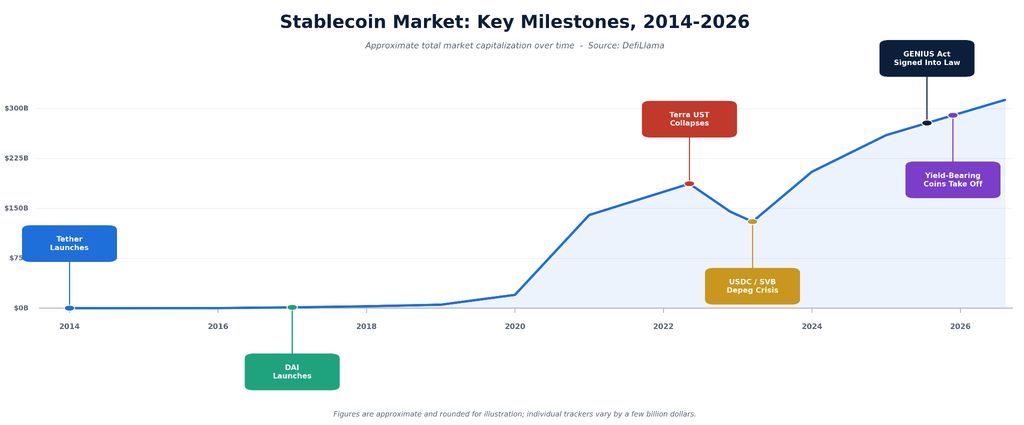
- Algorithmic stablecoins are the cautionary tale. Terra’s UST wiped out roughly $40 billion in three days in May 2022, and regulators have not forgotten it.
- No type is risk-free. USDC itself briefly fell to $0.87 in March 2023 during the Silicon Valley Bank collapse. Spreading your holdings across two or three types is safer than betting on one.
What Is a Stablecoin, Really?
A stablecoin is a cryptocurrency built to hold a steady price, usually one US dollar, instead of swinging up and down like Bitcoin or Ethereum.
Think of it like a poker chip. The chip itself isn’t worth anything on its own, but the casino promises to hand you a dollar for it whenever you want. A stablecoin works the same way. It’s a digital token that some issuer promises you can trade for a dollar’s worth of value, one way or another.
Stablecoins are not the same thing as a central bank digital currency (CBDC), like a digital euro or China’s e-CNY. A private company issues stablecoins, while a country’s central bank issues a CBDC. That one difference explains a lot of the news you’ll see about stablecoin regulation in 2026.
People use stablecoins for a few main reasons:
- Trading: most crypto trades settle in a stablecoin, not real dollars, because moving in and out of a bank account is slow.
- Payments: sending stablecoins across borders is often faster and cheaper than a wire transfer.
- Saving and earning: newer stablecoins pay yield, something a regular bank savings account also does, just on-chain.
- DeFi: stablecoins are the collateral that powers most lending and borrowing apps in crypto.
A stablecoin’s peg is only as strong as three things: what backs it, how easily you can redeem it for the real thing, and whether the market trusts the people running it.
Why Stablecoins Depeg (and Why It Matters Here)
Every stablecoin promises $1. However, not every stablecoin keeps that promise under pressure.
For instance, USDC slipped to $0.87 for about 48 hours in March 2023 when Silicon Valley Bank, which held some of its cash reserves, collapsed. Although, it recovered once Circle confirmed the funds were safe.
Meanwhile, USDT has wobbled several times since 2018 but always bounced back within a few days, and DAI has dipped as low as $0.89 during market stress but never broke down completely.
Then there’s Terra’s UST, which is the one everyone in crypto still talks about. It didn’t just wobble; it totally collapsed.
In our companion piece, Why Stablecoins Depeg, we cover the mechanics of why stablecoins lose their peg and how to spot the warning signs early. Learn more about the risks of depegging before you decide which type to hold.
So, basically, how a stablecoin is built determines how it breaks. That’s exactly why the six types below matter so much.
The 6 Types of Stablecoins Explained
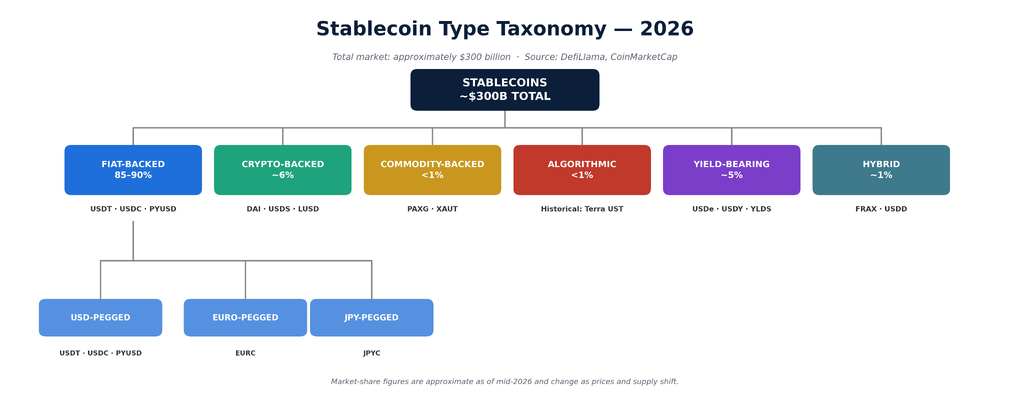
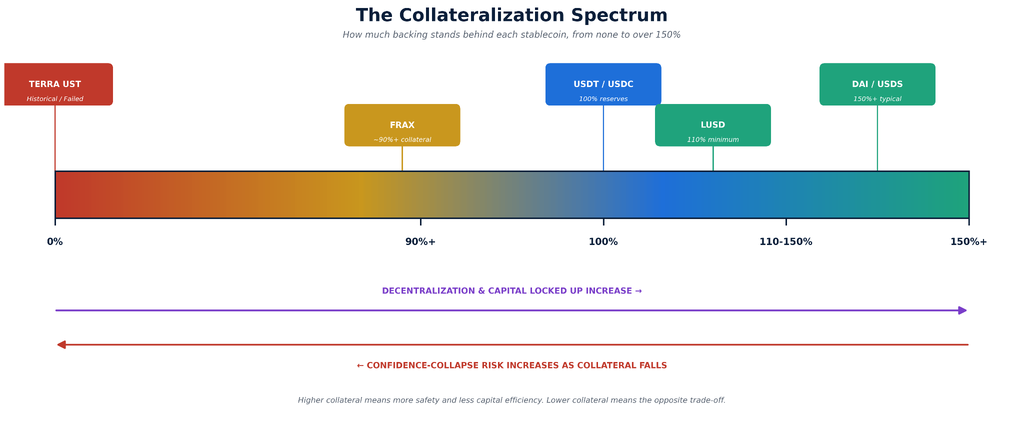
Here’s the fastest way to think about it. Every stablecoin sits somewhere on a spectrum between two extremes: fully backed by real dollars in a bank account or backed by nothing but code and market incentives. Everything else is a variation in between.
1. Fiat-Backed Stablecoins
A fiat-backed stablecoin is a token backed one-to-one by real money, usually cash and short-term US government debt, sitting in a bank or investment account somewhere.
This is the model behind roughly 85–90% of the entire stablecoin market. When you hold USDT or USDC, the company behind it (Tether or Circle) is supposed to be holding a dollar in reserve for every token you own. You give them a stablecoin, they give you back a dollar.
How it works: you hand over dollars, and the issuer mints new tokens and gives them to you. You send tokens back, the issuer burns them, and they wire you dollars. Simple in theory. The complicated part is trusting that the reserves are really there.
The big two:
- Tether (USDT): The largest stablecoin by far, with roughly $183 billion in circulation and around 59–64% of the total stablecoin market as of September 2026, according to CoinMarketCap data reported by The Motley Fool. Its reserves are mostly short-term US Treasury bills, and it publishes attestations, but it has never completed a full audit by a major accounting firm, which critics still bring up regularly.
- USD Coin (USDC): The second largest, at roughly $75 billion. Circle, the company behind it, went public on the NYSE in 2025 and is generally seen as the more transparent option, with monthly attestations from Grant Thornton.
Other notable ones: PayPal USD (PYUSD), issued through PayPal’s massive user base, and First Digital USD (FDUSD), which briefly lost its peg to $0.76 in March 2025 before recovering within two days.
Why people choose it: it’s the most liquid, the most widely accepted on exchanges, and the easiest to understand.
The catch: it’s centralized. Tether and Circle can freeze wallets. You’re trusting a company, not math, and traditional fiat-backed coins pay you nothing while the issuer earns interest on your money in the background.
Also Read: Technical Analysis vs Fundamental Analysis: Complete Comparison
2. Crypto-Backed Stablecoins
A crypto-backed stablecoin is backed by other cryptocurrencies, like Ethereum, instead of dollars, and it deliberately holds more collateral than the stablecoins it issues to absorb price swings.
Imagine a pawn shop that only lends you $100 if you hand over $150 worth of jewelry. That buffer protects the shop if the jewelry’s value drops before you pay the loan back. Crypto-backed stablecoins work the same way.
The main example is DAI, created by MakerDAO in 2017 and one of the oldest and most tested stablecoins in crypto. MakerDAO rebranded to Sky Protocol in 2024, and DAI now has a sibling called USDS, which has actually overtaken DAI in size, sitting around $7–8 billion versus DAI’s roughly $4–5 billion, according to Sky’s own data via DeFiLlama.
Both still work, and both are backed by the same mechanism: users lock up crypto collateral like ETH to mint new stablecoins. To mint DAI or USDS, you deposit collateral worth more than what you’re borrowing, often 150% or more.
If your collateral’s value drops too far, a smart contract automatically sells it off to keep the system solvent. This happened at scale on “Black Thursday” in March 2020, when ETH dropped 50% in a single day and MakerDAO briefly ended up with bad debt.
A smaller, purer option is LUSD from Liquity, which only accepts ETH as collateral and has no governance token pulling strings.
Why people choose it: no company can freeze your funds, and everything is verifiable on the blockchain in real time.
The catch: it takes more capital to use (locking up $150 to borrow $100 isn’t efficient), and it’s still exposed to crypto market crashes.
3. Commodity-Backed Stablecoins
A commodity-backed stablecoin represents ownership of a real physical asset, almost always gold, stored in a vault somewhere. These aren’t trying to track the dollar. They track gold prices instead, which makes them less of a “stablecoin” in the traditional sense and more of a digital way to own gold.
PAX Gold (PAXG), issued by Paxos, gives you one token for one troy ounce of gold sitting in a Brink’s vault in London.
Tether Gold (XAUT) works the same way, with gold held in Swiss vaults. Both let you trade gold exposure 24/7, which regular gold markets don’t offer, and both cost less than a typical gold ETF.
Why people choose it: It’s a way to hedge against a weak dollar or general market uncertainty without dealing with the hassle of buying and storing physical gold.
The catch: the market cap here is tiny, around $500–600 million each for PAXG and XAUT, and physical redemption comes with fees and minimum amounts. It’s also not “stable” against the dollar at all; if gold drops, so does your token’s dollar value.
4. Algorithmic Stablecoins
An algorithmic stablecoin tries to hold its peg through code and market incentives, with little or no real collateral backing it up. This is the riskiest type, and the industry learned that the hard way.
When the price rises above $1, the algorithm mints more tokens to push it back down. When the price falls below $1, it tries to shrink the supply to push it back up. In theory, this creates a self-correcting system that never needs real dollars sitting in a vault. In practice, it depends entirely on people continuing to believe the system works.
Terra’s UST peaked at an $18.7 billion market cap in early 2022. By May 12, 2022, it was trading at roughly ten cents, and its sister token LUNA had lost effectively all its value. Roughly $40 billion in market value disappeared in about 72 hours.
Here’s what happened: UST kept its peg through a two-token system with LUNA. When large withdrawals hit a liquidity pool in early May 2022, UST slipped just below $1. That small crack triggered panic selling.
As people dumped UST, the system minted more and more LUNA to absorb it, flooding the market and crashing LUNA’s price, which destroyed the very mechanism meant to defend UST’s peg. This is what people mean by a “death spiral,” and it’s a one-way door. Once it starts, there’s no algorithm that can reverse it.
Founder Do Kwon was later indicted and arrested, and regulators worldwide took note. Algorithmic stablecoins now sit at under $1 billion combined in market cap, a fraction of what they once were.
FRAX is the surviving example worth knowing, and even it isn’t purely algorithmic anymore. After Terra collapsed, FRAX moved to being over 90% backed by real collateral, essentially becoming a hybrid model (more on that below).
Why people choose it (in theory): Unlimited scalability without locking up capital.
The reality: Don’t. Pure algorithmic stablecoins with no meaningful collateral have already failed once at massive scale, and most global regulators, including the EU, now treat them as too risky to operate.
5. Yield-Bearing Stablecoins
A yield-bearing stablecoin pays you interest just for holding it, usually funded by US Treasury bills, staking rewards, or trading strategies happening behind the scenes.
This is the newest and fastest-growing category, and it exists because of a simple, slightly unfair fact: traditional stablecoin issuers like Tether and Circle earn billions of dollars a year in interest on the reserves backing your tokens, and none of it used to reach you. Yield-bearing stablecoins flip that around and share the return.
There are a few different ways issuers generate that yield:
Backed by Treasury bills
Ondo Finance’s USDY is backed by short-term US Treasuries and bank deposits and recently crossed $2.1 billion in market cap after three years, per Ondo’s own August 2026 update. It’s available mainly to non-US investors.
Backed by derivatives strategies
Ethena’s USDe is the boldest of the bunch. It holds staked Ethereum and shorts an equivalent amount in the futures market, a “delta-neutral” trade that earns funding-rate income.
USDe briefly became the third-largest stablecoin in the world with a market cap north of $14 billion in 2025, though it now sits closer to $4.5–6 billion. Its yield has swung wildly, from over 20% APY in strong bull markets down to around 4-5% as of September 2026.
Built into DeFi savings modules
sUSDS, Sky Protocol’s yield-bearing wrapper around USDS, pays a variable rate that tracked between 3.75% and 4.5% APY in early 2026.
Registered as a security
YLDS, issued by Figure Markets, took the boldest legal path of all: it registered directly with the SEC as a public security. It pays SOFR minus 0.50% and only launched in February 2025, so it’s still tiny by comparison, but it set a precedent that other issuers are watching closely.
Why people choose it: It’s the closest thing crypto has to a savings account. Corporate treasuries in particular are using yield-bearing stablecoins to earn a return on idle cash instead of letting it sit flat.
The catch, and it’s a big one: In the United States, the GENIUS Act specifically bans regulated “payment stablecoin” issuers from paying interest directly to holders. That’s exactly why USDT and USDC pay 0%, and it’s why yield-bearing coins like USDe and USDY exists as entirely separate products, built outside that framework, often based offshore, and carrying more regulatory uncertainty as a result.
6. Hybrid Stablecoins
A hybrid stablecoin blends two or more of the mechanisms above, usually pairing real collateral with some algorithmic flexibility, to try to get the best of both worlds.
FRAX is the clearest example. It started in 2020 as a mostly algorithmic stablecoin, then gradually shifted to over 90% collateral-backed after watching what happened to Terra. Its collateral ratio adjusts based on market conditions: more collateral when the market is nervous, a bit less when the peg is holding strong.
USDD, issued through the Tron network, claims roughly 200% over-collateralization using a mix of TRX, Bitcoin, and USDT, though its centralized management has drawn some criticism.
Why people choose it: It’s an attempt to be more capital-efficient than a fully over-collateralized model like DAI, while avoiding the total collapse risk of a purely algorithmic model like Terra.
The catch: More moving parts means more to go wrong, and it’s genuinely harder to explain to a new user what’s actually backing their tokens at any given moment.
Our complete stablecoin trading guide and long-term crypto investing guide walk through how to actually put this into practice.
Which Stablecoin Type Fits Your Needs?
.
Stablecoin Comparison Table
| Criteria | Fiat-Backed | Crypto-Backed | Commodity-Backed | Algorithmic | Yield-Bearing | Hybrid / Synthetic |
| Market Position (2026) | Dominant; $250B+ | Multi-billion-dollar segment | $1B+ niche | <$1B; largely diminished | Multi-billion-dollar and growing | Multi-billion-dollar niche |
| Collateralization | Typically 1:1 reserves | Usually overcollateralized | Typically 1:1 commodity exposure | Partial, reflexive or none | Varies by design | Variable; multiple mechanisms |
| Decentralization | Low | High | Low–Medium | High | Varies | Medium–High |
| Peg Stability | Excellent | Good–Excellent | Tracks underlying commodity | Weakest; model-dependent | Generally good, but varies | Good, but mechanism-dependent |
| Yield Potential | Usually none to holder | Usually low/none natively | Generally none | Usually none | Potentially positive | Varies |
| Liquidity | Excellent | Good | Moderate–Low | Low | Medium–High | Medium–High |
| Regulatory Clarity | Highest under emerging rules | Medium | Medium | Low | Uncertain/structure-dependent | Medium–Low |
| KYC / Access | Often required for direct minting/redemption | Usually no direct KYC on-chain | Often required for issuer redemption | Usually no | Varies by platform | Varies |
| Smart-Contract Risk | Low–Medium | High | Low–Medium | Very High | High | High |
| Censorship Resistance | Low | High | Low–Medium | High | Varies | Medium–High |
| Reserve Transparency | Attestations and disclosures | Fully visible on-chain | Varies by issuer/custodian | On-chain mechanisms | Varies | Varies |
| Best Use Case | Payments, trading, settlement | DeFi collateral and lending | Commodity exposure | Experimental DeFi | Yield strategies, treasury management | Advanced DeFi and synthetic exposure |
| Major Examples | USDT, USDC, PYUSD | DAI, LUSD | PAXG, XAUT | AMPL, legacy UST | sUSDe, sDAI, USDY | FRAX, USDe |
| Primary Risk | Issuer, reserve and regulatory risk | Liquidation and smart-contract risk | Commodity price and custody risk | Depeg/death spiral | Smart-contract, market and yield-source risk | Complexity, liquidity and mechanism risk |
Stablecoin Use-Case Decision Guide
The best stablecoin depends on your goal, risk tolerance, and need for liquidity. No model eliminates risk, so match the asset to the use case rather than chasing the highest yield.
Best Stablecoin by User Type
- Beginners & safety-first: USDC or USDT. Both offer deep liquidity and a straightforward fiat-backed model. USDC is the stronger choice if reserve transparency is your priority, with weekly disclosures and monthly third-party assurance. USDT remains the liquidity leader across global crypto markets.
- Active traders: Go for USDT. Its broad exchange support and deep markets make it the practical choice for frequent trading. Choose USDC if transparency and regulatory alignment matter more.
- DeFi users: Consider DAI; its crypto-collateralized structure offers strong DeFi composability without relying entirely on a centralized issuer. The trade-off is greater collateral and liquidation complexity.
- Yield seekers: Consider USDY or sDAI, but treat yield as compensation for additional smart-contract, market, and counterparty risks, not as a free return. Avoid comparing advertised yields without checking their current rates and underlying mechanisms.
- Inflation or non-dollar exposure: PAXG provides tokenized gold exposure, while EURC offers euro-denominated exposure. Neither should be treated as a dollar stablecoin.
- Advanced DeFi users: USDe can provide higher potential rewards through its delta-neutral strategy, but its risks are materially different from those of fiat-backed stablecoins.
- Avoid: Uncollateralized algorithmic stablecoins. The TerraUSD collapse remains a major warning about relying primarily on incentives and algorithms to maintain a peg.
Stablecoin Risk Matrix
| Risk | Higher exposure | Lower exposure |
| Counterparty | Fiat- and commodity-backed | Crypto-collateralized |
| Smart-contract | Algorithmic/yield strategies | Fiat-backed |
| Liquidation | Crypto-backed | Fiat-backed |
| Regulatory | Algorithmic/yield products | Compliant fiat-backed tokens |
| Depeg | Algorithmic/complex models | Well-reserved fiat-backed |
| Censorship | Centralized issuers | More decentralized models |
Regulation also matters. Under MiCA, euro- and dollar-referenced stablecoins can fall under the e-money-token framework, with specific issuer and reserve requirements.
Example Portfolio Allocations
- Conservative: 80% USDC/USDT, 15% USDY/sDAI, 5% DAI.
- Balanced: 50% USDC/USDT, 25% USDY/sDAI, 15% DAI, 10% USDe.
- Aggressive: 30% USDC/USDT, 30% USDe, 20% DAI, 10% FRAX, 10% PAXG.
- DeFi-focused: 40% DAI, 30% sDAI, 20% FRAX, 10% USDC.
Key takeaway: Diversifying across stablecoin models can reduce single-model risk. The 2022 Terra collapse and 2023 USDC depeg demonstrate that even major stablecoins can face stress. No stablecoin is completely risk-free.
Our Top DeFi Protocols cover how to use these stablecoins safely inside different platforms.
How Regulation Is Reshaping Stablecoins in 2026
Two laws changed the game more than anything else in the past year, and they don’t treat all six types the same.
GENIUS Act Implications
The GENIUS Act, signed into US law on July 18, 2025, created the country’s first real federal rulebook for stablecoins. It only applies to what the law calls “payment stablecoins,” which covers the fiat-backed category almost exclusively.
Under the act, issuers must hold reserves 1:1 in cash or short-term Treasuries, publish monthly reports, and get regular audits once they’re large enough, according to the White House fact sheet on the signing.
Section 4 of the GENIUS Act bars any permitted issuer from paying holders interest or yield “in connection with the holding, use, or retention” of a payment stablecoin in any form.
That single line is why USDT and USDC pay you nothing and why yield-bearing stablecoins had to build themselves as separate products outside the “payment stablecoin” definition entirely, as confirmed in Congressional Research Service analysis.
Crypto-backed, commodity-backed, algorithmic, and hybrid stablecoins are barely mentioned in the GENIUS Act at all. That’s not necessarily good news. It mostly means they’re operating in a legal gray zone while fiat-backed coins get a clear, favorable rulebook.
MiCA (EU) Impact
In Europe, MiCA has been fully in effect since January 2025, and it drew a hard line in the sand. Stablecoins backed by a single fiat currency, called “E-Money Tokens,” need a licensed issuer and full reserve backing.
Everything else, including most crypto-backed and commodity-backed coins, falls into a stricter “Asset-Referenced Token” bucket. Many non-compliant stablecoins were delisted from EU exchanges by the December 2024 deadline, which is part of why Ethena’s USDe exited the EU market entirely after regulator BaFin restricted it under MiCA.
Other Jurisdictions: 2026 Stablecoin Regulation Update
Hong Kong
Hong Kong’s Stablecoins Ordinance took effect on August 1, 2025, creating a licensing regime for fiat-referenced stablecoin issuers.
The HKMA requires licensed issuers to maintain adequate reserves and meet strict financial, governance, and risk-management standards. The regulator began accepting applications in August 2025 and issued the first two stablecoin licenses in April 2026.
- HKMA licensing is required for regulated fiat-referenced stablecoin activities.
- Issuers must maintain sufficient liquid assets and strong reserve arrangements.
- The framework strongly favors prudently backed, fiat-referenced stablecoins.
Japan
Japan regulates fiat-linked stablecoins as Electronic Payment Instruments, with issuers and intermediaries subject to registration requirements. JPYC became Japan’s first yen-pegged stablecoin and began issuing in 2025, backed by domestic deposits and Japanese government bonds.
- Fiat-backed stablecoins face registration and reserve requirements.
- Japan continues strengthening oversight of stablecoin transfers through travel-rule requirements.
- The FSA is also supporting bank-led stablecoin initiatives and payment innovation.
Singapore
Singapore regulates stablecoin-related activities through its payments framework, with licensed entities subject to MAS oversight. The regulatory environment favors well-backed, compliant stablecoin models and imposes licensing requirements on relevant payment and digital-token activities.
Bahrain
Bahrain introduced its Stablecoin Issuance and offering module in July 2025. It permits licensed issuers to offer fully backed, single-currency stablecoins pegged to the BHD, USD, or another CBB-approved fiat currency.
- Stablecoins must maintain 1:1 backing with the referenced fiat currency.
- Reserve assets must meet quality and liquidity standards.
- The framework focuses on regulated, fiat-backed issuance rather than algorithmic models.
The overall pattern is clear; regulators everywhere are rewarding fiat-backed, fully reserved, boring stablecoins and treating anything more experimental with suspicion. That doesn’t mean the other types are going away. It means they’re building outside the traditional banking rulebook, often with more risk and less protection if something goes wrong.
Conclusion
Stablecoins look identical from the outside. They all promise a dollar. However, once you understand the different types of stablecoins in 2026, that promise means six different things depending on what’s backing it.
Fiat-backed coins like USDT and USDC will likely keep leading the market, simply because trust is easier to sell than complexity. Yield-bearing stablecoins are the category worth watching closest, since they finally answer a question crypto users have asked for years: why should a digital dollar sit there earning nothing?
And Terra’s collapse still stands as the clearest lesson in the space: a stablecoin without real backing is only as strong as everyone’s willingness to keep believing in it.
Picking a stablecoin type isn’t a small detail. It shapes how safe your money is, how much it earns, and how it holds up the next time the market gets tested.
FAQs
What is the main difference between stablecoin types?
The difference comes down to what backs the token. Fiat-backed coins hold real dollars in reserve, crypto-backed coins hold extra crypto as collateral, commodity-backed coins hold physical assets like gold, algorithmic coins hold little to no collateral and rely on code, yield-bearing coins add interest payments on top of a backing asset, and hybrid coins mix two or more of these approaches together.
Which type of stablecoin is safest?
Fully-reserved fiat-backed stablecoins like USDC are generally considered the safest since they’re backed 1:1 by cash and Treasury bills and now fall under the GENIUS Act’s reserve rules in the US. That said, “safest” isn’t the same as “risk-free.” Even USDC briefly dropped to $0.87 in March 2023 during the Silicon Valley Bank crisis.
Can I earn yield on stablecoins without DeFi farming?
Yes, yield-bearing stablecoins like USDY, sUSDS, and YLDS pay you interest automatically just for holding them, without needing to stake, farm, or manage anything yourself. The yield comes from Treasury bills or savings modules built directly into the token.
Are algorithmic stablecoins safe after the Terra collapse?
Purely algorithmic stablecoins with no real collateral are widely considered too risky, and most regulators now treat them with heavy suspicion or outright restrictions. The few survivors, like FRAX, only made it through by shifting to over 90% real collateral backing, essentially becoming hybrid models rather than staying purely algorithmic.