WordPress database error: [You have an error in your SQL syntax; check the manual that corresponds to your MariaDB server version for the right syntax to use near '' at line 1]SELECT * FROM wp_mica_ecta WHERE cta_id =
WordPress database error: [You have an error in your SQL syntax; check the manual that corresponds to your MariaDB server version for the right syntax to use near '' at line 1]SELECT * FROM wp_mica_ecta WHERE cta_id =
WordPress database error: [You have an error in your SQL syntax; check the manual that corresponds to your MariaDB server version for the right syntax to use near '' at line 1]SELECT * FROM wp_mica_ecta WHERE cta_id =
WordPress database error: [You have an error in your SQL syntax; check the manual that corresponds to your MariaDB server version for the right syntax to use near '' at line 1]SELECT * FROM wp_mica_ecta WHERE cta_id =
In February 2025, North Korea’s Lazarus Group stole about $1.5 billion from Bybit, the largest crypto theft on record, according to the FBI. More than a year later, DeFi remains a major part of crypto markets, while decentralized exchanges are gaining ground. In July 2026, DEXs captured a record 19.5% of global spot trading volume.
That growth highlights the core DeFi vs. CeFi trade-off. Centralized exchanges such as Binance and Coinbase offer deep liquidity, simple interfaces, and customer support, but they custody your assets.
DeFi platforms such as Uniswap and Aave let you control your funds and verify transactions on-chain, but you take responsibility for security and smart contract risks.
This guide compares both models, including how MiCA and newer stablecoin rules have changed the market and which approach fits different traders.
There's no Call To Action with the ID #0.Key Takeaways
- Control vs. convenience: DeFi gives you the keys and the responsibility. CeFi gives you a login, customer support, and someone else holding the keys.
- Security risk looks different, not smaller: CeFi failures are rarer but massive (Bybit lost $1.5 billion in one attack). DeFi failures are smaller but frequent (hundreds of millions lost across dozens of incidents every six months).
- CeFi still has far more liquidity, though the gap is closing. DEX trading now makes up roughly 18% to 20% of total spot volume, up from single digits just a few years ago, per DeFiLlama.
- Regulation is catching up. The U.S. GENIUS Act (July 2025) and the EU’s MiCA framework (fully in force since December 2024) gave both ecosystems clearer rules, though DeFi itself is still only loosely regulated.
- The two models are merging. Binance runs its own blockchain, Coinbase runs a Layer-2 network, and institutions are borrowing DeFi’s transparency while keeping CeFi’s compliance. Expect hybrid “CeDeFi” platforms to keep growing.
What Is CeFi Trading?
CeFi, or centralized finance, means trading cryptocurrency through a company that holds your funds and matches your orders, similar to how a stock brokerage works. Ueex, Binance, Coinbase, and Kraken are all CeFi platforms. You create an account, verify your identity, and deposit money, and the exchange handles execution behind the scenes.
Here’s what that looks like in practice:
- You don’t hold the keys: The exchange controls the wallets. Your account balance is really just an entry in their internal database until you withdraw.
- You need to pass identity checks: Know Your Customer (KYC) verification is now required almost everywhere CeFi operates, partly because of rules like the GENIUS Act and MiCA.
- Orders are matched centrally: A traditional order book pairs buyers and sellers, the same model stock exchanges have used for decades.
- You get more advanced tools: Margin trading, futures, options, and stop-loss orders are standard on most CeFi platforms.
Example: Someone opens a Ueex account, verifies their ID, wires $10,000 from their bank, and buys Bitcoin and Ethereum with a few clicks. If they forget their password, support can help them recover the account.
What Is DeFi Trading?
DeFi, or decentralized finance, means trading directly from your own crypto wallet using smart contracts on a public blockchain, with no company standing in the middle. Uniswap (for swaps), Aave (for lending), and Curve (for stablecoin trades) are the best-known examples.
Here’s how it works:
- You hold the keys: Your funds sit in a wallet like MetaMask or a hardware device. No company can freeze or seize them.
- No account needed: You connect a wallet and start trading. No sign-up form, no ID check.
- Trades run through liquidity pools, not order books: Most DEXs use an automated market maker (AMM) model; you swap against a pool of two tokens instead of waiting for a matching buyer.
- Everything is visible: Every trade, every pool balance, and every line of contract code is public and checkable on a block explorer like Etherscan.
Example: A trader connects MetaMask to Uniswap, swaps ETH for USDC, then deposits that USDC into Aave to earn interest, all in a few minutes, with no account and no customer support line.
DeFi in one line: it’s software that replaces the bank teller with code you can read yourself, in exchange for taking on the job of protecting your own money.
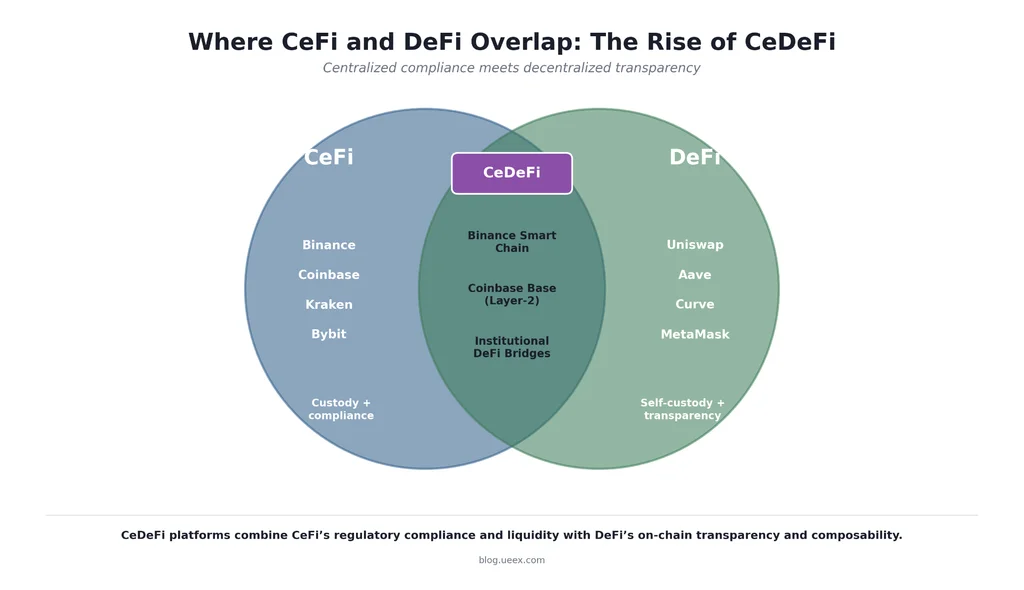
The line between these two worlds is already blurring. Binance runs its own blockchain with DeFi apps built on top of it, while Coinbase built a Layer-2 network called Base to connect its users to DeFi. BlackRock has explored DeFi yield access through regulated partners. This guide covers the “pure” versions of each model first, then looks at where they’re converging.
The Core Differences: DeFi vs CeFi Deep Dive
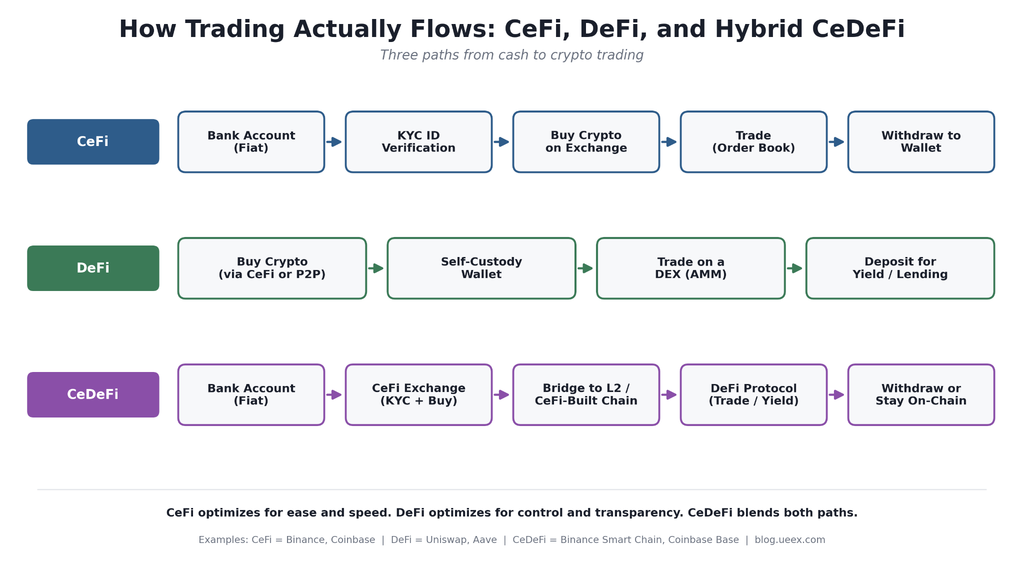
DeFi and CeFi both let users buy, sell, lend, borrow, and earn from crypto, but they operate on very different foundations. DeFi relies on self-custody and smart contracts, while CeFi relies on companies, accounts, and centralized infrastructure.
Difference 1: Control and Custody
DeFi: You control the assets
DeFi uses self-custody. Your crypto stays in a wallet such as MetaMask or a hardware wallet, and you control the private keys. There is no central company that can reset your password, freeze your wallet, or return funds sent to the wrong address.
Advantages
- Full control over your assets
- 24/7 access without asking for permission
- Greater resistance to censorship and account freezes
- No direct exposure to an exchange bankruptcy
Risks
- Losing your private key or seed phrase can mean permanent loss
- Wrong-address transactions are usually irreversible
- Users must manage wallet security, approvals, and network fees
The collapse of FTX in 2022 showed the danger of custodial platforms. Customers depended on the exchange to hold and return their assets. Self-custody removes that specific counterparty risk, although it introduces greater personal responsibility.
There's no Call To Action with the ID #0.CeFi: The platform controls custody
With CeFi, exchanges such as Coinbase, Binance, and Kraken generally hold users’ private keys. You control an account, but the platform controls the underlying wallets.
Advantages
- Password recovery and customer support
- Easier onboarding for beginners
- Built-in security and account controls
- Simpler fiat deposits and withdrawals
Risks
- Exchanges can freeze withdrawals or accounts
- Bankruptcy creates counterparty risk
- Governments can require platforms to restrict accounts
- A successful attack can affect many customers at once
The February 2025 Bybit attack demonstrated that even sophisticated custodial systems can fail. The FBI attributed the theft of roughly $1.5 billion in assets to North Korean actors.
Bottom line: DeFi gives you more control, while CeFi gives you more support and convenience.
Difference 2: Transparency and Auditability
DeFi: Transactions are visible on-chain
One of DeFi’s biggest advantages is transparency. Transactions, balances, liquidity pools, and smart-contract activity can be inspected through public block explorers such as Etherscan.
Protocols such as Uniswap and Aave expose much of their activity directly on-chain. Users can check liquidity, borrowing levels, collateral, and transaction history without relying entirely on an internal company report.
Advantages
- Real-time visibility into blockchain activity
- Public transaction history
- Open-source code can be reviewed and audited
- On-chain collateral can be independently verified
Limitations
- Wallets are pseudonymous, not automatically private
- MEV bots can monitor pending transactions
- Raw blockchain data can be difficult for beginners to interpret
- Open-source code does not guarantee that the code is safe
CeFi: Faster, but less transparent
Centralized exchanges maintain private databases and matching engines. Users can see their balances, but they generally cannot inspect the exchange’s complete internal accounting in real time.
Proof-of-reserves has improved transparency, but it is not the same as continuous, independent verification of every liability.
Bottom line: DeFi makes more activity publicly verifiable. CeFi asks users to place greater trust in the platform and its reporting.
Difference 3: Accessibility and Permissioning
DeFi: Open access by design
Anyone with a compatible wallet and internet connection can generally interact with a DeFi protocol without opening an account with a central intermediary.
There is no universal KYC process at the smart-contract level. However, access through specific websites, wallets, bridges, or on-ramps may still involve restrictions.
This makes DeFi useful for people who have limited access to traditional financial services. It also means users usually have little customer support or legal recourse when something goes wrong.
CeFi: Regulated access
Centralized exchanges typically require identity verification and comply with local KYC and AML rules. They may also restrict users based on nationality, residence, sanctions, or local licensing requirements.
The trade-off is clear:
DeFi: easier permissionless access, greater personal responsibility.
CeFi: more restrictions, but stronger compliance and consumer support structures.
In addition, MiCA is now fully shaping the European crypto market. ESMA states that the EU’s transitional period for existing crypto-asset service providers ended on July 1, 2026, meaning unauthorized providers must stop serving EU clients.
Difference 4: Trading Mechanics and Execution
CeFi: Order books
Most major centralized exchanges use order-book systems. Buyers and sellers place orders, and the exchange’s matching engine pairs them.
This supports:
- Market and limit orders
- Stop-loss and take-profit orders
- Trailing stops
- Futures and perpetuals
- Margin trading
- OTC and institutional execution
Because matching happens off-chain, trades can settle almost instantly inside the exchange.
DeFi: Liquidity pools and smart contracts
Many DEXs use automated market makers (AMMs). Instead of matching buyers with individual sellers, users trade against liquidity pools.
For example, a trader can swap ETH for USDC against a Uniswap pool. The smart contract calculates the exchange rate and settles the transaction on-chain.
In addition, DEX trading has become significantly more competitive. In August 2026, DEXs accounted for about 24% of spot crypto trading volume relative to centralized exchanges, up from 17% a year earlier.
DeFi strengths
- Permissionless trading
- On-chain settlement
- Composable liquidity
- Access to new tokens and markets
Weaknesses
- Slippage can increase in shallow pools
- MEV can affect execution
- Network fees add to trading costs
- Execution depends on blockchain confirmation
Bottom line: CeFi still offers the smoother trading experience, but DEX infrastructure is rapidly closing the gap.
Difference 5: Liquidity and Market Impact
CeFi remains larger overall, especially for professional and derivatives trading. July 2026 data from CCData shows centralized exchanges processed $3.76 trillion in combined spot and derivatives volume, while spot DEX volume stood at about $176 billion.
Centralized exchanges benefit from:
- Large institutional market makers
- Deep order books
- High-frequency trading
- Fiat trading pairs
- Leverage and derivatives
DeFi liquidity is more fragmented across chains, protocols, pools, and trading pairs. Aggregators help solve this problem by routing transactions across multiple venues.
However, the gap is narrowing. Better aggregators, faster chains, and deeper on-chain liquidity have made large DEX trades increasingly competitive.
Bottom line: CeFi still leads in overall liquidity, but DeFi is taking a growing share of spot trading.
Difference 6: Security Models
Neither model is automatically safer. They simply concentrate risk in different places.
CeFi: Custody and infrastructure risk
CeFi concentrates assets and decision-making within companies. A successful attack, insider compromise, operational failure, or bankruptcy can therefore affect thousands of users.
The 2025 Bybit attack is a major example. The FBI attributed approximately $1.5 billion in stolen assets to North Korean attackers.
CeFi can still provide advantages such as:
- Dedicated security teams
- Cold-storage systems
- Multi-signature controls
- Insurance or emergency funds
- Customer support
“This makes it the largest crypto theft of all time, by some margin… It may even be the largest single theft of all time,” Elliptic co-founder Tom Robinson told TechCrunch in the hours after the hack.
DeFi: Smart-contract and protocol risk
DeFi replaces institutional custody with code. That removes some counterparty risk but creates new technical risks.
Common attack vectors include:
- Smart-contract vulnerabilities
- Oracle manipulation
- Governance attacks
- Compromised private keys
- Economic exploits
- Bridge vulnerabilities
Security remains a major concern in 2026. TRM Labs recorded 207 crypto hacks in H1 2026, with approximately $972 million stolen. Smart-contract exploits accounted for most incidents, while infrastructure and operational compromises caused most of the financial losses.
Bottom line: CeFi concentrates trust in institutions. DeFi shifts more of that trust to code, governance, and users.
Our crypto security best practices guide walks through the specific steps for both environments.
Difference 7: Regulation and Compliance
CeFi: Clearer regulatory obligations
Centralized exchanges operate within established financial and crypto regulations. In the U.S., the GENIUS Act became law in July 2025, creating a federal framework for payment stablecoins. Permitted issuers must maintain one-to-one reserves, disclose reserve composition monthly, and meet AML requirements.
In Europe, the Markets in Crypto-Assets (MiCA) provides a common regulatory framework for crypto-asset issuers and service providers, covering areas such as authorization, disclosure, supervision, and market integrity.
For users, this can mean:
- KYC and AML checks
- Greater disclosure
- Formal complaint processes
- Licensed service providers
- Stronger regulatory oversight
The downside is reduced privacy and more restrictions.
DeFi: Regulation remains more complicated
Fully decentralized protocols can fall outside parts of existing frameworks. ESMA notes that crypto-asset services provided in a fully decentralized manner without an intermediary are outside MiCA’s scope, although regulators assess whether a platform is genuinely decentralized on a case-by-case basis.
That creates difficult questions around:
- DAOs
- Developers
- Front-end operators
- Governance
- Cross-border enforcement
- Liability for autonomous smart contracts
Bottom line: CeFi has clearer regulatory obligations. DeFi offers greater flexibility but operates in a more complex legal environment.
Difference 8: Trading Costs and Fees
CeFi
Centralized exchanges usually charge maker/taker fees. Rates vary by platform, trading volume, and account tier.
Other potential costs include:
- Fiat deposit fees
- Crypto withdrawal fees
- Funding rates
- Borrowing interest
- Liquidation fees
The advantage is predictability. Once a trade executes, there is normally no separate blockchain gas fee for the internal transaction.
DeFi
DEX users typically pay three main costs:
- Protocol fee paid to the liquidity pool or protocol
- Network fee for processing the transaction
- Slippage caused by the available liquidity
Costs vary sharply by network. Ethereum mainnet can become expensive during congestion, while Layer 2 networks and Solana generally offer much cheaper transactions. Uniswap, for example, offers multiple fee tiers depending on the liquidity pool.
Cost-saving strategies
- Use Layer 2 networks where appropriate
- Compare DEX prices before trading
- Use aggregators for larger swaps
- Avoid trading during periods of high network congestion
- Compare total execution cost rather than headline trading fees
Bottom line: CeFi usually offers more predictable costs. DeFi can be cheaper, but network conditions and slippage matter.
Difference 9: Trading Features and Sophistication
CeFi still leads in advanced trading
Centralized exchanges remain the stronger choice for professional traders who need a complete trading toolkit.
Common features include:
- Perpetual futures
- Options
- Margin trading
- High leverage
- Advanced order types
- Trading APIs
- Sub-accounts
- OTC desks
- Institutional custody and prime services
This makes CeFi particularly attractive to active traders and institutions.
DeFi is catching up
DeFi now supports much more than simple token swaps. Perpetual DEXs, on-chain options, lending markets, structured products, and tokenized real-world assets have expanded what users can do without a centralized intermediary.
Institutional DeFi is also developing through permissioned markets and lending platforms designed around real-world assets and compliance requirements. However, DeFi still faces limitations in liquidity, leverage, execution, capital efficiency, and advanced order functionality.
Bottom line: CeFi remains ahead for sophisticated trading, but DeFi is rapidly expanding its capabilities.
DeFi vs CeFi: The Real Trade-Off
The debate is not simply about which model is better. It is about where you want the risk and responsibility to sit.
| Factor | DeFi | CeFi |
| Custody | User-controlled | Platform-controlled |
| Access | Generally permissionless | KYC and account-based |
| Transparency | High on-chain visibility | Limited internal visibility |
| Trading | DEXs, AMMs, on-chain markets | Order books and derivatives |
| Liquidity | Growing rapidly | Still larger overall |
| Security risk | Smart contracts, keys, oracles | Custody, infrastructure, insolvency |
| Regulation | Developing and complex | More established |
| Fees | Gas + protocol fees + slippage | Trading + withdrawal/funding fees |
| Advanced features | Expanding | More mature |
| User responsibility | High | Shared with platform |
For beginners, CeFi can offer a simpler entry point, account recovery, fiat access, and customer support. For users who prioritize self-custody, permissionless access, and on-chain transparency, DeFi offers a different level of control.
In practice, many crypto users do not have to choose one exclusively. They can use CeFi for fiat on-ramps, liquidity, and advanced trading while using DeFi for self-custody, lending, swaps, staking, and on-chain applications.
Real-World Use Cases: When to Use DeFi vs CeFi
Use Case 1: Beginner Crypto Buyer
Scenario: Sarah wants to spend $1,000 from her bank account to buy her first Bitcoin.
Best choice: CeFi
A centralized exchange such as UEEx is easier for beginners because it handles fiat deposits, identity verification, custody, and the buying process in one place.
Why CeFi works:
- Direct bank and card funding in supported regions
- Simple interface and customer support
- No need to manage private keys or blockchain fees
- Easy conversion from fiat to BTC
DeFi is less suitable for a first-time buyer because you normally need crypto to access a DEX, plus a self-custody wallet and enough knowledge to manage networks and gas fees.
Verdict: Start with CeFi. Move into DeFi once you understand wallets, networks, and self-custody.
Use Case 2: Active Day Trader
Scenario: Marcus trades BTC, ETH, and altcoins dozens of times a day and needs deep liquidity, fast execution, and advanced orders.
Best choice: CeFi
Large centralized exchanges remain better suited to high-frequency trading because they combine deep order books, fast matching engines, derivatives, APIs, and advanced risk-management tools. Coinbase Advanced, for example, offers hundreds of spot markets, advanced order types, and trading APIs.
DeFi alternative: dYdX platform provides onchain perpetual trading with market, limit, stop, and take-profit orders. However, DeFi traders still face liquidity differences, market-specific leverage limits, execution risks, and protocol-related risks.
Verdict: CeFi remains the stronger choice for professional, high-frequency traders. DeFi is increasingly competitive for traders who prioritize self-custody and onchain access.
Use Case 3: Privacy-Conscious Investor
Scenario: Alex wants to buy and hold Bitcoin while minimizing the amount of personal information attached to his holdings.
Best choice: Self-custody and, where legal, non-custodial trading
DeFi and peer-to-peer systems can reduce reliance on centralized databases. A service such as Bisq allows peer-to-peer Bitcoin trading without a traditional centralized exchange account.
But DeFi does not provide complete anonymity. Blockchain transactions are public, and analytics firms can sometimes connect wallet activity to real-world identities.
CeFi generally requires more identity information because regulated crypto businesses must comply with applicable KYC and AML rules. In the EU, for example, crypto-asset service providers operate under the MiCA framework and related AML requirements.
Verdict: DeFi and self-custody offer greater control and can reduce data exposure, but neither guarantees anonymity.
Use Case 4: Yield Seeker
Scenario: Lisa has $100,000 in stablecoins and wants to earn a return without actively trading.
Best choice: Depends on risk tolerance
CeFi platforms can provide a simpler route to yield, but rates and eligibility vary by country and product. For example, Coinbase currently advertises up to 3.50% USDC rewards for eligible Coinbase One customers, with availability depending on location.
DeFi lending protocols such as Aave offer variable interest rates through non-custodial lending markets. Aave has also expanded its institutional and real-world-asset infrastructure through Aave Horizon and launched V4 deployments in 2026.
CeFi advantages:
- Easier to use
- Customer support
- Simpler fiat access
- Less responsibility for wallet management
DeFi advantages:
- Non-custodial access
- Transparent onchain activity
- Potentially higher or more flexible yields
Risks: CeFi carries platform and counterparty risk. DeFi carries smart-contract, liquidity, and market risks. Neither offers a guaranteed return.
Verdict: Choose CeFi for simplicity and DeFi for greater control. Do not assume a higher APY means a better or safer investment.
Our stablecoin trading strategies piece covers how to balance that tradeoff.
Use Case 5: Institutional Investor
Scenario: A $50 million investment fund wants crypto exposure while meeting custody, compliance, and reporting requirements.
Best choice: CeFi, with DeFi increasingly becoming an institutional option
Institutional investors generally need regulated custody, reporting, security controls, and clear legal structures. Services such as Coinbase Prime and Fidelity Digital Assets are designed for institutional participation.
DeFi is also moving into institutional markets. Aave Horizon, for example, was built around real-world assets and institutional borrowers, while Aave V4 is designed to support more sophisticated onchain credit and permissioned assets.
Verdict: CeFi remains the practical choice for most institutions in 2026, but compliant DeFi infrastructure is closing the gap.
Use Case 6: Unbanked or Underbanked User
Scenario: Juan lives in a country where access to stable banking and foreign currency is limited.
Best choice: DeFi, where legally and practically accessible
DeFi can provide access to stablecoins, payments, lending, and exchanges without requiring a traditional bank account. A user can receive crypto, hold it in a self-custody wallet, and exchange assets through a DEX.
This can be particularly useful in countries facing currency instability or limited access to international financial services.
However, DeFi does not solve every problem. Users still need internet access, a way to obtain crypto, and enough technical knowledge to avoid scams and irreversible transaction errors. Local laws can also restrict how crypto services are used.
Verdict: DeFi can provide valuable financial access where traditional banking is limited, but it is not automatically the only option or a universal replacement for banking.
Use Case 7: Arbitrage Trader
Scenario: An automated trader wants to profit from temporary price differences between markets.
Best choice: Depends on the strategy
CeFi arbitrage involves buying an asset on one exchange and selling it on another. The main challenges are trading fees, withdrawal limits, transfer times, and price movements while funds are moving.
DeFi introduces a different tool: flash loans. A trader can borrow capital, execute several swaps, and repay the loan within the same transaction. If the transaction cannot repay the loan, the transaction normally reverts.
But flash-loan arbitrage is not risk-free. Gas costs, slippage, failed transactions, MEV competition, and smart-contract vulnerabilities can eliminate profits.
Verdict: CeFi remains useful for cross-exchange arbitrage, while DeFi enables sophisticated atomic strategies that are difficult to replicate in traditional markets. In both cases, competition is intense, and profitable opportunities are increasingly captured by automated systems.
Bottom Line: CeFi wins when you need simplicity, fiat access, deep liquidity, customer support, or institutional infrastructure. DeFi wins when you value self-custody, permissionless access, transparent markets, and on-chain financial tools.
The strongest approach in 2026 and the future hybrid, known as CeDeFi: use CeFi where regulation and convenience matter and DeFi where self-custody and on-chain access provide a clear advantage.
Security Best Practices: Staying Safe in Both Ecosystems
Whichever you choose, security starts with understanding who or what controls your funds.
CeFi Security Best Practices
Choose reputable, regulated platforms
Check the exchange’s licensing, security record, proof-of-reserves, and official domain before depositing funds. In Europe, MiCA is now fully enforced, so verify that your provider is authorized to serve EEA customers. Kraken, for example, published a March 2026 proof-of-reserves report showing reserves above 100% for several major assets.
Secure your account
Use an authenticator-based 2FA method rather than SMS where possible. Enable withdrawal address whitelisting, anti-phishing codes, login alerts, and other available account protections.
Keep only what you need on exchanges
Use exchanges for trading and purchases, but move long-term holdings to self-custody when appropriate. Spreading funds across reputable platforms can also reduce single-platform risk.
Verify every withdrawal
Check the address and network before confirming. For large transfers, send a small test amount first. Blockchain transactions are generally irreversible once confirmed.
There's no Call To Action with the ID #0.Watch for social engineering
Never share passwords, private keys, seed phrases, or 2FA codes with anyone claiming to be support. The 2025 Bybit attack, which the FBI attributed to North Korea and estimated at about $1.5 billion, shows that even major platforms can face serious security incidents.
DeFi Security Best Practices
Protect your wallet
Use hardware wallets for significant holdings and keep seed phrases offline. Never enter a seed phrase on a website.
Verify before signing
Check the official dApp URL, contract address, audit history, and transaction details. Ethereum’s 2026 security guidance specifically recommends reading transaction messages and avoiding unlimited token spending approvals.
Limit token approvals
Approve only what a transaction requires and regularly revoke unused permissions through tools such as Revoke.cash.
Avoid blind signing
Newer wallet security efforts in 2026 focus on clear transaction signing, helping users understand what they are approving before assets move.
Test before committing large amounts
Send a small transaction first, confirm the recipient and network, then transfer the remainder. Track transactions with the relevant blockchain explorer.
Red Flags to Watch
CeFi: unclear regulation, outdated proof-of-reserves, unexplained withdrawal restrictions, poor support, suspicious login activity, or unrealistic returns.
DeFi: unaudited contracts, anonymous teams, copied code, extreme APYs, opaque tokenomics, weak liquidity, or unrestricted admin powers.
The mindset is simple: CeFi requires you to secure your account and assess the platform. DeFi requires you to verify every transaction, contract, and permission yourself.
Regulatory Picture 2026: GENIUS Act vs MiCA
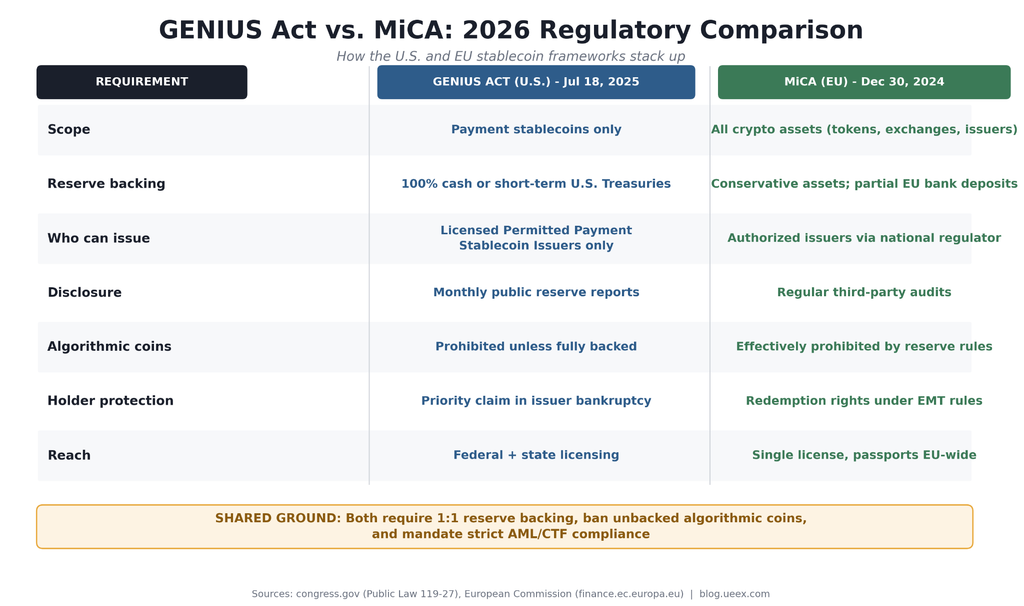
The U.S. and EU are taking different approaches to stablecoin regulation.
U.S. GENIUS Act
Signed into law on July 18, 2025, the GENIUS Act establishes federal rules for payment stablecoins. Issuers must maintain 1:1 reserves, generally in cash, bank deposits, or short-term U.S. government securities, and provide redemption at par. Issuers also face disclosure, AML/CFT, and regulatory requirements.
The law uses a federal-state licensing model, with federal regulators including the OCC overseeing qualifying issuers. Importantly, implementation is still underway in 2026. The OCC issued proposed GENIUS Act rules in February and additional AML/CFT proposals in June, so some operational details remain subject to final rules.
For DeFi, the biggest benefit is greater certainty around regulated stablecoins. For CeFi, the framework gives exchanges, banks, and fintech companies clearer rules for issuing and supporting payment stablecoins.
EU MiCA
The EU’s Markets in Crypto-Assets Regulation (MiCA) is much broader. It began applying on December 30, 2024, with stablecoin provisions applying from June 30, 2024.
MiCA divides stablecoins mainly into e-money tokens (EMTs) and asset-referenced tokens (ARTs). Issuers must meet authorization, reserve, disclosure, and governance requirements. ART holders also have a permanent redemption right, while issuers cannot pay interest on ARTs.
MiCA also regulates crypto-asset service providers through licensing, market-abuse rules, consumer protections, and operational requirements. Unlike GENIUS, it covers much more than stablecoins.
In 2026, the European Commission is reviewing how MiCA works in practice, with its consultation open until September 30, 2026.
GENIUS Act vs MiCA
| Area | GENIUS Act | MiCA |
| Main focus | Payment stablecoins | Broad crypto-asset market |
| Reserve rules | 1:1 backing | Risk-based reserve requirements |
| Redemption | Explicit at par | Strong redemption rights |
| Licensing | Federal/state model | EU authorization and passporting |
| Interest | Prohibited for payment stablecoins | Prohibited for ARTs |
| DeFi | Limited direct coverage | Decentralized activities remain an evolving area |
| Status in 2026 | Implementation underway | Fully applicable, under review |
Asia-Pacific Snapshot
Regulation is also tightening across Asia. Hong Kong’s Stablecoins Ordinance took effect on August 1, 2026, creating a licensing regime for fiat-referenced stablecoin issuers. The HKMA accepted applications from August 2025 and announced its first two licensed issuers in April 2026.
Japan continues strengthening crypto-asset investor protection and security rules, while reviewing its framework as crypto increasingly becomes an investment asset.
What It Means for Crypto
The global direction is clear: more regulated stablecoins, stronger reserves, greater transparency, and tighter oversight. The trade-off is compliance. As U.S., EU, and Asian rules diverge, issuers and exchanges may face higher costs and increasingly fragmented markets.
For DeFi, the key question is whether regulators eventually extend these frameworks beyond issuers and centralized platforms to the interfaces, governance systems, and infrastructure that users actually interact with.
There's no Call To Action with the ID #0.The Future is CeDeFi: Where DeFi Meets CeFi
The bigger trend is not DeFi replacing CeFi, but the two merging into CeDeFi. In 2026, this is already taking shape. BNB Chain combines Binance’s centralized ecosystem with on-chain DeFi, while Coinbase’s Base provides a direct route into on-chain trading and DeFi.
Institutional markets are also adopting permissioned, KYC-gated DeFi vaults that combine on-chain transparency with compliance controls. As regulators provide clearer crypto rules, including the SEC’s proposed 2026 framework, expect more products that blend DeFi’s efficiency and transparency with CeFi’s familiar safeguards.
Frequently Asked Questions
Is DeFi safer than CeFi?
Neither is safer across the board; they carry different kinds of risk. CeFi failures are rarer but can be enormous, like the $1.5 billion Bybit hack in 2025. DeFi failures happen more often but tend to be smaller and contained to individual protocols. Your safest approach is usually spreading funds across both rather than betting everything on one model.
Can I use DeFi and CeFi together?
Yes, and most experienced traders do. A common approach is buying crypto on a CeFi exchange for the easy fiat on-ramp, then moving part of it into DeFi protocols for yield or specific trading opportunities, while keeping active trading capital on CeFi where liquidity is deepest.
What do I need to get started on each?
For CeFi, you need a government-issued ID, a bank account or card, and roughly 24 hours for identity verification on most platforms. For DeFi, you need a crypto wallet like MetaMask, a small amount of crypto already in it to cover gas fees, and no ID at all.
Disclaimer: This article is for educational purposes only and isn’t financial, legal, or tax advice. Both DeFi and CeFi trading carry real risk of loss, including total loss of your funds. Regulations referenced here, including the GENIUS Act and MiCA, continue to evolve. Always do your own research, verify any smart contract independently before using it, and consult a licensed financial advisor before making investment decisions.