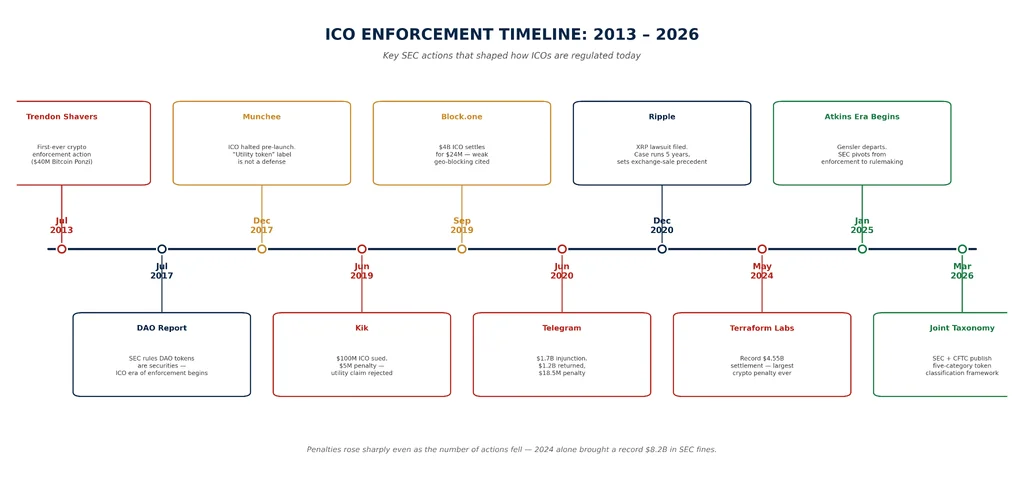
In June 2024, a jury took less than two hours to decide that Terraform Labs had defrauded its investors. The company and its founder, Do Kwon, ended up owing the SEC $4.5 billion.
It remains the largest crypto penalty ever handed out, and it came from a token sale that started small, grew fast, and collapsed in a week, wiping out more than $40 billion in investor money.
That case sits at one end of ICO regulation. At the other end sits March 17, 2026, when the U.S. Securities and Exchange Commission (SEC) and the Commodity Futures Trading Commission (CFTC) did something that had never happened before.
They sat down together and sorted crypto tokens into five clear categories so that most builders and investors could finally tell, in plain terms, which rules apply to them. Both stories matter if you are trying to run, invest in, or simply understand an Initial Coin Offering (ICO) in 2026.
This guide walks through where ICO regulation stands right now: the new US token rules, the European Union’s MiCA law, the state of pending US legislation, what it costs to comply, and what happens if you don’t.
Key Takeaways
- There is no single global ICO regulation framework. Rules depend on the token, offering structure and target market.
- The Howey Test still decides US law, but the SEC and CFTC now sort tokens into five categories, and three of them are not securities at all.
- MiCA is fully active in the EU. Every crypto firm serving EU customers needs a license by July 1, 2026, or they lose access to the market.
- Compliance is cheaper than getting caught. Most legal paths in the US cost $25,000 to $500,000. Enforcement penalties have run into the billions.
The State of ICO Regulation in 2026
Initial Coin Offerings (ICOs) raise money by selling a new token to buyers, usually before the product is even built. The idea is simple, but the rules around it are not.
For most of the last decade, US regulators leaned on a single 1946 court case, SEC v. Howey, to decide whether a token counted as a security. If it did, sellers needed to register the offering or find an exemption or face fines. That approach never gave founders much certainty, and it filled dockets with enforcement cases instead of clear rules.
2026 is the year that started to change. Here’s the short version of what’s different:
- The SEC, under Chairman Paul Atkins, has spent the past year moving away from “regulation by enforcement” and toward written rules founders can actually read in advance.
- On March 17, 2026, the SEC and CFTC jointly published a 68-page interpretation that sorts crypto assets into five buckets, only one of which is automatically a security.
- The Senate is still negotiating the CLARITY Act, a bigger bill meant to lock in market structure rules permanently, and it missed its August 2026 deadline.
- In the European Union, MiCA (Markets in Crypto-Assets Regulation) is no longer a future deadline. It’s the law, and the transition period for existing crypto firms closed on July 1, 2026.
- The ICO market itself has changed shape. Fewer projects use the classic public token sale; more use IEOs (offerings run through an exchange) or IDOs (offerings run through decentralized exchanges), which made up roughly two-thirds of token sales in 2025, according to ICO market data compiled by SQ Magazine.
“For over a decade, the crypto industry operated without a clear answer to the most basic regulatory question: Is this token a security or a commodity?” one legal analysis of the March 2026 interpretation put it before noting that the joint SEC-CFTC release was the first binding attempt to answer that question for the entire market at once.
Why This Actually Matters to You
The SEC’s 2026 interpretation clarifies that a crypto asset can be not a security itself but still become part of an investment contract when it is sold with promises about the issuer’s managerial efforts and the other elements of the Howey test are met. The guidance also covers airdrops, protocol mining, staking, and wrapping.
This distinction matters because the asset and the transaction involving it are separate legal questions. A token may not be a security, yet its sale could trigger securities laws if buyers expect profits from the issuer’s future work.
For projects, this can affect fundraising, legal costs, marketing, and investor access. Securities offerings generally must be registered or qualify for an exemption. Under Rule 506(c), issuers can advertise publicly but must sell only to verified accredited investors.
In the EU, MiCA’s transitional period ended on July 1, 2026, requiring unauthorized crypto service providers to wind down EU operations.
The Howey Test Explained
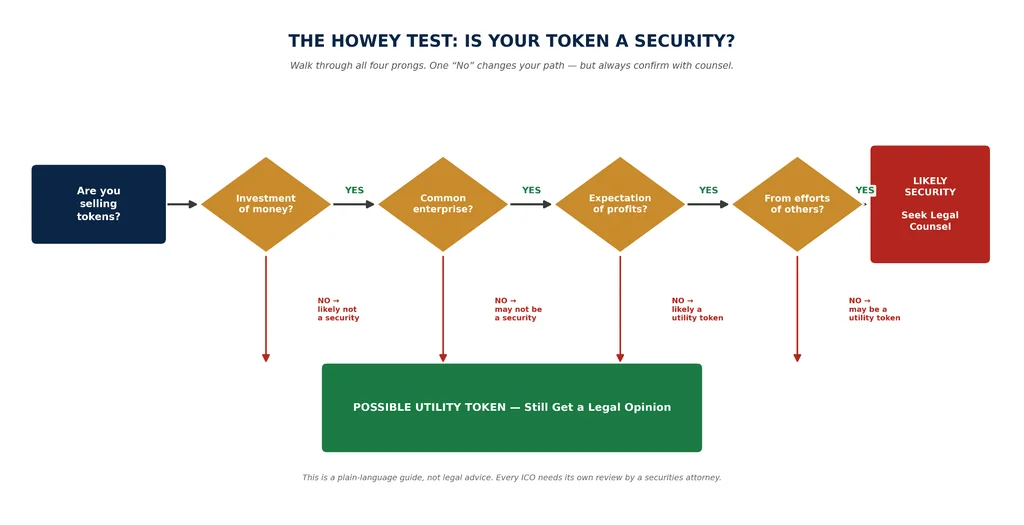
That 1946 test still applies to crypto in 2026, though it now sits alongside the SEC’s new taxonomy rather than standing alone. Four questions decide whether a token counts as a security:
- Did buyers put in money or something of value? Paying with ETH or BTC counts just as cash does. This box gets checked in almost every ICO.
- Was there a common enterprise? If the money raised gets pooled to build one product, this is usually satisfied.
- Did buyers expect profit? This is the question that decides most cases. If marketing pushes “get in early” language or hints at price gains, that expectation is baked in.
- Did that profit depend on someone else’s work? If a founding team controls development, upgrades, and the roadmap, buyers are relying on that team, not just their own effort.
If all four are true, US law treats the token as a security, and the SEC’s older 2019 framework tried to help issuers reason through it with 38 separate factors.
“The interpretation formally adopts the position that courts have consistently held: a crypto asset is not itself a security; rather, the transaction is the proper unit of analysis,” one law firm’s client alert on the March 2026 release explained, noting that the shift means the same token can be a security in one sale and not a security in the next, depending on how it’s sold.
Bitcoin and Ethereum Set the Precedent
Regulators have long treated Bitcoin and Ethereum as sufficiently decentralized that no single team’s effort drives their value anymore, so neither counts as a security. That “decentralization defense” became the seed for the SEC’s 2026 taxonomy, which now names specific tokens outright rather than leaving founders to guess.
The DAO Report and Munchee: Two Cases Every Founder Should Know
The SEC’s first real ICO ruling came in July 2017, when it examined “The DAO,” a project that raised $150 million and gave token holders voting rights and a share of profits. The SEC found it met every Howey prong and treated it as a security, setting the tone for years of enforcement that followed.
Munchee Inc. offers the opposite lesson. In December 2017, the company planned to sell a “utility token” tied to a restaurant review app. The SEC stepped in before the sale launched, not because the token lacked a real use case, but because Munchee’s marketing leaned heavily on the idea that the token’s price would rise.
The lesson held up for years afterward: calling something a utility token doesn’t matter if the pitch sounds like an investment.
ICO Basics: What You’re Actually Buying
An Initial Coin Offering (ICO) lets a blockchain project raise funds by selling tokens, usually for cryptocurrency or fiat. For example, imagine a company is building a blockchain-based storage network.
It could create a token that users will eventually need to pay for storage. The company might sell some of those tokens before the network is fully operational to help fund development.
That sounds simple, but the legal treatment depends on the details.
Regulators may ask:
- What rights does the token give the buyer?
- Is the product already working?
- Does the buyer expect the token to increase in value?
- Will the development team’s work determine the token’s success?
- Who is allowed to buy it?
- Where are the buyers located?
- How is the token being marketed?
This is why an ICO should be treated as a legal and financial product from the beginning, not simply a technology project.
Mastercoin is widely recognized as the first ICO, raising about $500,000 in 2013. Ethereum followed in 2014, raising roughly $17.3 million and helping shape the ICO model. The 2017–2018 boom then saw thousands of projects raise more than $20 billion.
The market has since matured. CoinLaw’s 2026 data puts the median ICO raise at $3.7 million in 2025, with ICOs still accounting for 49% of token fundraising events.
IEOs and STOs: The Compliant Cousins
An Initial Exchange Offering (IEO) runs the sale through an exchange, which vets the project and often provides instant liquidity once the sale ends. It doesn’t remove securities law obligations. It just adds a gatekeeper.
A Security Token Offering (STO) goes the other direction entirely: it registers as a security from day one. That means higher legal costs, usually $200,000 and up, and a much longer runway, but it buys real legal certainty and opens the door to institutional money that won’t touch an unregistered token.
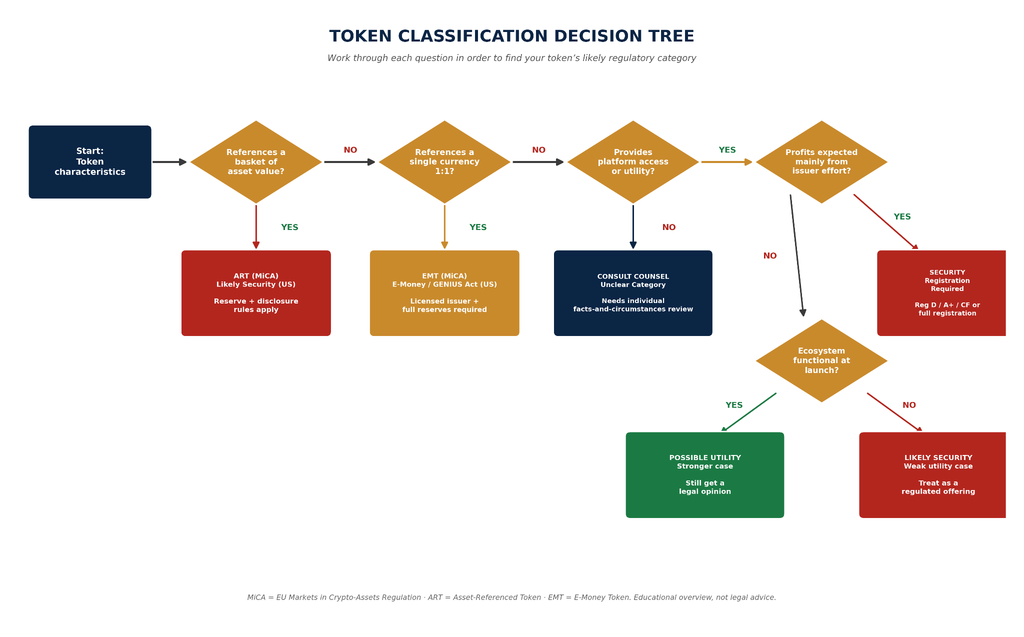
Three Ways to Think About a Token
Security Tokens
A security token works like an investment contract and represents an interest that can fall under securities laws. Buyers hand over money expecting the founding team to build something and expecting the token’s value to rise because of that work. Most ICO tokens from the 2017-2018 era fell into this bucket once regulators looked closely.
Examples may include tokens that represent:
- Ownership interests
- Debt
- Profit rights
- Rights to future income
- Other investment interests
If a token or its sale falls within securities laws, the issuer may need to register the offering or rely on an exemption
Utility Tokens
A utility token is designed to provide access to a product or service: storage space, an in-app feature, or a vote on how a protocol runs. In theory, a genuine utility token isn’t a security.
In practice, regulators look past the label and check how the token was marketed. If the pitch leaned on price appreciation, “utility” won’t save it.
MiCA takes a specific approach to utility tokens. Its rules provide an exemption from certain whitepaper requirements for a utility token that provides access to a good or service that already exists or is already operational.
The distinction is important: A promised future use is not the same as an existing working use.
Stablecoins
Stablecoins (USDT and USDC), also called asset-referenced or e-money tokens under EU law, aim to hold a steady price by backing themselves with reserves like cash or short-term government debt.
An ICO can use stablecoins as a payment method, but creating or issuing a stablecoin can create separate regulatory obligations. The U.S. has now created a federal framework for payment stablecoins through the GENIUS Act, which became law in July 2025.
For readers who want to understand what happens when a stablecoin loses its peg, UEEx also has a current guide on stablecoin depegging.
The SEC’s New Five-Category Token Taxonomy
This is the single biggest change in US crypto law since the Howey Test itself became the industry’s default reference point. On March 17, 2026, the SEC and CFTC jointly released a formal interpretation that sorts every crypto asset into one of five groups:
| Category | Treated as a Security? | Examples |
| Digital commodities | No | Named tokens including BTC, ETH, SOL, XRP, and others tied to sufficiently decentralized networks |
| Digital collectibles | No | NFTs and similar one-off digital items |
| Digital tools | No | Tokens that function purely as access keys or software components |
| Stablecoins | Governed separately, under the GENIUS Act | USDT, USDC, and other payment stablecoins |
| Digital securities | Yes | Tokenized versions of stocks, bonds, or other traditional securities |
The 2026 SEC interpretation clarified that a token can be sold under an investment contract at launch but later separate from that contract once the issuer fulfills its promises or abandons them.
It also states that certain airdrops, protocol mining, and staking activities generally do not involve securities transactions. However, this does not erase past liability. If a 2021 token sale violated securities laws, its later status as a non-security does not remove potential exposure.
Where the CLARITY Act Fits In
The taxonomy is powerful, but it’s an agency interpretation, not a law passed by Congress, which means a future SEC chair could unwind it. That’s exactly what the CLARITY Act (formally the Digital Asset Market Clarity Act) is meant to fix.
The House passed it in July 2025 by a wide bipartisan margin. The Senate Banking Committee advanced its version in May 2026, but as of mid-August 2026, the bill is still stuck behind procedural votes and an unresolved fight over ethics provisions covering officials with crypto ties.
A vote is now expected no earlier than September 2026, and even supporters admit the window for passing it this year is narrowing. Until Congress acts, issuers are building around the SEC-CFTC interpretation and Atkins’ promise that the agency “stands ready” to write formal rules on its own if the bill stalls out entirely.
Registration Paths for US ICO Issuers
If your token lands in the “digital security” bucket, or you’d rather not bet your project on a taxonomy interpretation, you still need one of the traditional securities exemptions.
Regulation D
Regulation D is the most popular route for crypto startups. The SEC rule lets companies raise capital through private placements without full registration. It uses exemptions under Rules 504, 506(b), and 506(c) to simplify fundraising for businesses.
Rule 504: Allows small businesses to raise up to $10 million in a 12-month period.
Rule 506(b): Allows unlimited capital-raising from an unlimited number of accredited investors and up to 35 non-accredited investors, with no general advertising.
Rule 506(c): Allows unlimited capital-raising and general public solicitation, provided that all investors are verified as accredited.
This route can suit projects that want to raise capital without offering tokens broadly to retail investors. It lets you market publicly, but only accredited investors (generally, people with a net worth over $1 million or income over $200,000) can actually buy in. Cost typically runs $50,000 to $150,000, and the process takes two to four months.
Regulation A+ (Tier 2)
This rule opens the door to everyday retail investors and allows up to $75 million raised per year, but it requires SEC review of an offering circular and audited financials. Expect $200,000 to $500,000 in costs and four to six months of runway. Blockstack’s 2019 raise was the first ICO to use this path.
Regulation CF (crowdfunding)
This rule caps out at $5 million a year but is the cheapest option, often $25,000 to $75,000, and lets smaller projects reach retail buyers through a licensed crowdfunding portal.
Full SEC registration (Form S-1)
This is the traditional IPO-style path. It’s rarely worth it for a token launch: $500,000 to $2 million upfront, six to twelve months, and ongoing quarterly and annual reporting. It only makes sense for large, established companies.
Regulation
This rule lets you sell to non-US buyers without US registration, often paired with Reg D to cover both domestic accredited investors and an international audience. The catch: regulators have gone after “offshore” sales that quietly targeted US buyers anyway, so geo-blocking has to be real, not just a line in the terms of service.
The European Union: MiCA Is No Longer Optional
While the US built its framework through court cases and now an agency interpretation, the EU wrote one unified law and rolled it out on a fixed schedule. MiCA (Markets in Crypto-Assets Regulation) has been law since 2023, and by 2026 nearly every part of it is fully active.
- June 30, 2024: Rules for stablecoins (called asset-referenced tokens and e-money tokens) took effect.
- December 30, 2024: Crypto-asset service providers needed MiCA authorization to operate anywhere in the EU, with one license valid across all 27 member states.
- July 1, 2026: The last transitional grace periods, which some countries had extended for existing firms, closed for good.
That means, as of September 2026, any exchange, wallet provider, or token issuer serving EU customers needs a real MiCA license, not a promise to get one eventually. As part of that shift, unlicensed dollar-pegged stablecoins were pulled from several EU trading platforms once the deadline passed.
Also, firms like Tether, incorporated outside the EU, have said publicly they don’t plan to seek MiCA authorization at all, according to recent tracking of global stablecoin rules.
What a Compliant Token Sale Looks Like Under MiCA
Outside of stablecoins, most tokens fall under MiCA’s “other crypto-assets” category. To sell one to EU buyers, you generally need to:
- Publish a standardized whitepaper covering the issuer, the project, token economics, and risks, using ESMA’s template.
- Notify your national regulator and wait out a 20-working-day review window.
- Avoid misleading marketing and include clear risk warnings.
- Stay under MiCA’s radar entirely if you’re raising less than €1 million over 12 months or selling only to fewer than 150 people.
The cost for a compliant whitepaper process runs roughly €30,000 to €100,000, and most projects get through it in two to three months.
If you’re issuing a stablecoin instead, the bar is much higher. E-money tokens need a licensed credit institution or e-money institution behind them, with 1:1 reserves and redemption rights.
As of early 2026, only 19 issuers had been authorized under this regime across 29 tokens and 11 countries, according to independent tracking of MiCA authorizations. That’s a small club, and it’s likely to stay small given the capital and governance requirements involved.
Other Countries Requirements
A quick look at the requirements other countries have put in place.
United Kingdom
The UK is developing a broader cryptoasset framework under the FCA, separate from the EU’s MiCA regime. The FCA published its final rules and guidance on June 30, 2026, with the new regime expected to take effect on October 25, 2027.
Firms can apply for authorization from September 30, 2026, to February 28, 2027. For projects targeting the UK, early preparation is essential, especially for those currently registered under existing rules.
Singapore
The Monetary Authority of Singapore has offered clear guidance since 2018 and requires a license for most token-related services, which has made it a popular base for compliant projects.
Switzerland
Switzerland has one of the clearest long-running approaches to token classification. FINMA divides tokens into three broad groups:
- Payment tokens
- Utility tokens
- Asset tokens
Hybrid tokens can have characteristics of more than one category. FINMA says utility tokens generally do not qualify as securities when their sole purpose is to provide digital access to an application or service and the token can already be used for that purpose when issued.
If the token also functions as an investment, it can be treated as a security. The official FINMA ICO guidance remains a useful starting point for projects considering Switzerland.
Japan
The Financial Services Agency runs one of the strictest licensing regimes anywhere, which has kept Japan’s ICO market small relative to the US, EU, and Singapore.
China
ICOs and crypto trading have been banned outright since September 2017, pushing Chinese-founded projects to Hong Kong, Singapore, or offshore jurisdictions instead.
UAE
In Dubai, VARA (Virtual Assets Regulatory Authority) regulates virtual-asset issuance outside DIFC (financial free zones), while SCA (Securities and Commodities Authority) and financial-free-zone regulators cover other securities and financial products.
VARA’s 2026 framework requires issuers to assess their token category, obtain approval or licensing where applicable, publish a compliant whitepaper, and meet AML/CFT, technology, disclosure and marketing requirements.
Stablecoins Now Have Their Own US Law
For years, U.S. stablecoin oversight relied on state money-transmitter rules and banking guidance. That changed on July 18, 2025, when President Trump signed the GENIUS Act into law, creating the country’s first federal stablecoin framework.
The law requires approved issuers to maintain 1:1 reserves and meet disclosure, compliance, and consumer-protection requirements. By 2026, regulators had begun turning the law into detailed rules, including Treasury proposals covering state-level regimes and anti-money-laundering requirements.
Meanwhile, in Europe, MiCA now requires authorization and disclosures for stablecoins classified as e-money tokens.
What Enforcement Actually Looks Like
Regulators didn’t get to 2026’s clearer rules by ignoring bad actors along the way. A few cases shaped how every project since has approached compliance.
Terraform Labs ($4.5 billion, 2024)
A jury found Terraform and Do Kwon liable for securities fraud tied to the algorithmic stablecoin UST and its sister token LUNA. The settlement broke down to roughly $3.6 billion in disgorgement, $467 million in interest, and a $420 million civil penalty, according to the SEC’s own announcement of the settlement. Do Kwon also faces separate criminal proceedings.
Ripple Labs (2020-2025)
The SEC sued Ripple over XRP sales in December 2020, and a 2023 court ruling drew a sharp line: institutional sales of XRP counted as unregistered securities, but sales on public exchanges did not.
Both sides eventually dropped their appeals in August 2025, and Ripple paid a $125 million penalty, closing one of the longest-running cases in crypto history and leaving that public-versus-institutional distinction as a lasting precedent.
Kik ($100 million, 2019)
Kik raised $100 million selling “Kin” tokens as a utility play. A court disagreed, and Kik settled for a $5 million penalty. Together with Munchee, this case is why lawyers still tell founders that a working product doesn’t automatically save you from securities law if your marketing told a different story.
A Practical Roadmap for Launching a Compliant ICO
If you’re actually planning a token sale, here’s the order most compliant projects follow:
1. Define what the token does: Before you write a single line of marketing copy. Governance, access, revenue share, and payment tokens all face different scrutiny. This is where tokenomics should also be mapped out; supply, distribution, vesting, and incentives can affect how regulators and investors understand the token.
2. Run a Howey analysis with a securities lawyer: Check your project against the SEC’s five-category taxonomy as well as the four-prong test. Write the reasoning down. You’ll want that record if anyone ever asks.
3. Pick your jurisdictions deliberately: Decide where you’ll sell, where you’ll block, and whether you’re following a U.S. exemption, a MiCA whitepaper, or both.
4. Choose your compliance path: Reg D, Reg A+, Reg CF, or full registration in the U.S.; or a MiCA whitepaper filing in the EU, based on how much you’re raising and who you want to sell to.
5. Get your smart contract audited: This can be done by a firm like CertiK, Trail of Bits, or OpenZeppelin. Budget $30,000 to $100,000 and start early; audits typically take four to eight weeks. UEEx’s smart contract guide explains why testing and independent code review matter.
6. Build real KYC and AML checks: Don’t just use a checkbox. Use a certified provider like Jumio, Onfido, or Sumsub, and screen against sanctions lists. Our KYC and identity verification resources guide provides a practical example of how identity checks work on a crypto platform.
7. Write honest marketing: Every enforcement case in this guide involved language that promised profit, even indirectly. If your whitepaper leans on price appreciation, expect regulators to notice.
ICO Compliance Costs
There is no universal cost for launching a compliant ICO.
The amount depends on:
- Token structure
- Target countries
- Offering size
- Investor type
- Legal structure
- Required licenses
- KYC and AML requirements
- Accounting work
- Smart contract development
- Security audits
- Ongoing reporting
Although the article states cost estimates depending on the regulatory route, those figures should be treated only as planning estimates, not fixed 2026 market prices.
A small token project and a large regulated securities offering can have completely different legal bills. The important thing is to budget for compliance before the token sale begins.
Common ICO Regulation Mistakes
Here are some regulation mistakes to watch out for
1. Calling a token a utility token without testing it: The label does not decide the legal outcome. The actual token, transaction, and marketing matter.
2. Assuming an offshore company solves everything: A Cayman, BVI, or other offshore company does not automatically remove regulations in the countries where investors live.
3. Ignoring marketing: A legally reviewed whitepaper cannot protect a project from misleading public statements.
4. Launching before classification: Once money starts coming in, changing the structure becomes harder. Legal classification should come before the sale.
5. Treating every country the same: MiCA may provide a common EU framework, but the U.S., UK, Singapore, Switzerland, Japan, and other jurisdictions have their own rules.
6. Assuming an exchange listing makes the ICO legal: An exchange may conduct its own due diligence, but that does not automatically make the original token offering compliant.
The Future of ICO Regulation
Three things are worth watching for the rest of 2026 and into 2027:
1. Whether the CLARITY Act passes: A Senate vote is now expected no earlier than September 2026. If it fails or stalls again, the SEC has said it will move ahead with its own formal “Regulation Crypto” rulemaking regardless, building directly on the March 2026 taxonomy.
2. How wide MiCA’s influence spreads: The UK, Brazil, and several Asia-Pacific regulators have already said they’re borrowing pieces of MiCA’s reserve and disclosure rules for their own frameworks.
3. Whether STOs keep growing: Security Token Offerings made up 18% of token sales in 2024, up from 8% the year before, as more projects choose certainty over speed.
None of this makes ICO regulation simple. But compared to the fog founders and investors were working in even two years ago, 2026 is the first year the rules actually resemble a map instead of a minefield.
Final Thoughts
The ICO market is moving toward more structured fundraising. Projects can now choose from private token sales, regulated security offerings, crowdfunding, exchange-led launches, and other models.
At the same time, regulators are becoming more specific about the difference between a crypto asset and the transaction involving it.
The U.S. is a good example. The SEC’s March 2026 interpretation provides a clearer taxonomy for crypto assets and explains when non-security crypto assets can become part of an investment contract.
The EU has taken a different route through MiCA, with specific requirements for crypto-asset offerings and service providers. The UK is building another model, with its new cryptoasset regime expected to begin in October 2027.
This means ICO issuers should expect more rules, not fewer. However, clearer rules can also make it easier for serious projects to build products that investors and exchanges can trust.
Frequently Asked Questions
Is an ICO legal in the United States?
Yes, an ICO can be legal in the United States, but it depends on the token, the offering, the issuer, and the investors. If the transaction involves securities, the issuer generally needs to register the offering or rely on an available exemption. The SEC’s March 2026 interpretation provides updated guidance on crypto assets and transactions involving them.
Is every ICO token a security?
No, some crypto assets are not themselves securities. The SEC’s 2026 interpretation identifies categories such as digital commodities, digital collectibles, and digital tools that are not themselves securities. However, a transaction involving a non-security crypto asset can still create an investment contract depending on the circumstances.
Can I avoid U.S. regulation by blocking U.S. investors?
Not automatically. An issuer can use geographic restrictions and investor controls, but simply stating that U.S. investors are prohibited does not answer every legal question. The actual structure and conduct of the offering matter.
Does MiCA apply to companies outside the EU?
It can. A company outside the EU should determine whether its offering or crypto services fall within MiCA’s scope before marketing to EU residents. The answer depends on the activity and structure.