How can people and organisations keep the same record of transactions without relying on one central authority? Distributed ledger technology (DLT) offers one answer by allowing multiple participants to share, verify and maintain a common record.
You may already know blockchain, especially through Bitcoin and other cryptocurrencies. But blockchain is only one part of the bigger DLT picture. There are different types of distributed ledgers, and they do not all store, verify or share information in the same way.
So, what makes a blockchain different from a DAG-based ledger? When would a business choose a permissioned network over a public one? And which type makes sense for a particular use case?
This guide breaks down the main types of distributed ledgers, their differences and real-world examples, so you can see where each one fits.
Join UEEx
Experience the World’s Leading Digital Wealth Management Platform
Distributed ledger technology is broader than blockchain, with different technologies using different ways to record and verify data.
The main types of distributed ledgers differ in structure, access, governance and how transactions are validated.
Public, private and consortium ledgers provide different levels of openness and control, depending on who can participate
Bitcoin, Ethereum, Hedera and Hyperledger Fabric show how DLT works in practice.
What is a Distributed Ledger?
A distributed ledger is a digital record-keeping system that stores and synchronises data across multiple computers, known as nodes. Unlike a traditional database, it does not rely on one central system to maintain the record.
Instead, multiple participants can hold and verify copies of the same ledger. When a new transaction is submitted, the network checks it against agreed rules before adding it to the record.
Blockchain is the best-known example of distributed ledger technology (DLT), but it is not the only one. Other technologies, such as Directed Acyclic Graph (DAG)-based systems and Hashgraph, use different structures to record and verify transactions.
Bitcoin shows how this works in practice. When someone sends Bitcoin, the transaction is broadcast to the network. Nodes check it, and miners compete to add valid transactions to a new block using Bitcoin’s proof-of-work system.
Once the block is accepted, the transaction becomes part of the shared blockchain record. Other distributed ledgers may use different methods and structures.
Some ledgers are permissionless, allowing anyone to participate. Others are permissioned, limiting access to approved users or organisations. This is one way the types of distributed ledgers can be classified.
“Distributed ledger technology (DLT) refers to the protocols and supporting infrastructure that allow computers in different locations to propose and validate transactions.”
How Do Distributed Ledgers Work?
Distributed ledgers work by allowing multiple computers, known as nodes, to maintain and verify a shared record.
Instead of sending every update to one central database, the network uses agreed rules to confirm transactions and update the ledger.
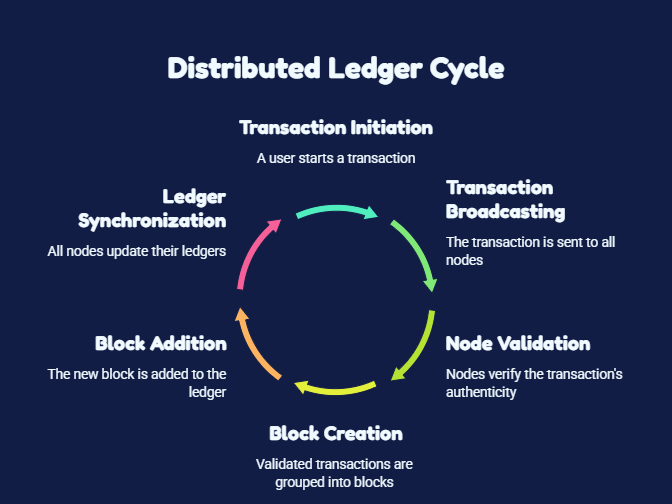
The exact process varies across the types of distributed ledgers, but the basic steps are similar:
A Transaction Is Initiated
Someone starts a transaction or submits new information to the network. This could be a cryptocurrency transfer, a payment or an update to a shared business record.
The Transaction Is Shared With the Network
The transaction is sent to the relevant nodes on the network. These nodes check whether the transaction meets the network’s rules.
The Network Validates the Transaction
The network uses a consensus mechanism to agree on whether the transaction is valid. Different distributed ledgers use different approaches, so there is no single method for reaching agreement.
For example, Bitcoin uses Proof of Work (PoW), while Ethereum uses Proof of Stake (PoS). Permissioned networks may use different consensus approaches because their participants are already known and authorised.
The Transaction Is Added to the Ledger
Once the network reaches the required agreement, the transaction is recorded. In a blockchain, transactions are grouped into blocks. Other distributed ledger technologies may use different structures.
The Ledger Is Updated
The relevant nodes update their records to reflect the new transaction. This creates a shared and synchronised record across the network.
This process helps participants work from the same version of the record without requiring one central database to coordinate every transaction. The specific way this happens depends on the technology, its consensus mechanism and whether the network is public or permissioned.
What Are the Main Types of Distributed Ledgers?
There is no single way to classify distributed ledger technology (DLT). The term covers several technologies that use different methods to record, share, and verify data across a network.
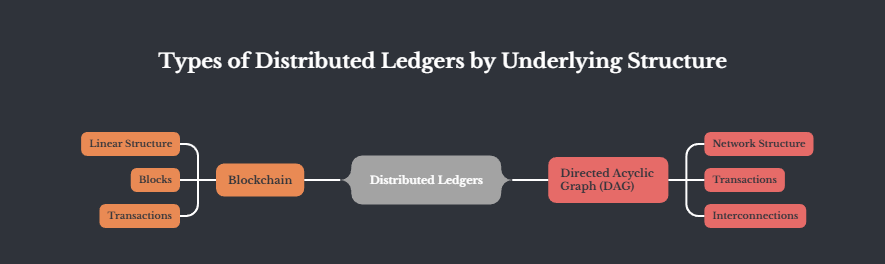
The most common way to distinguish the types of distributed ledgers is by looking at the underlying structure they use to store and validate transactions. These include:
Blockchain-Based Distributed Ledgers
Blockchain is the most widely recognised form of distributed ledger technology. It records transactions in groups called blocks, with each block cryptographically linked to the previous one to create a chain.
Before a transaction is added, participants use a consensus mechanism to agree on its validity. Different blockchain networks use different consensus mechanisms. For example, Bitcoin uses Proof of Work, while Ethereum uses Proof of Stake.
Blockchain can be used for cryptocurrencies, smart contracts, supply-chain tracking, digital identity, and other applications where multiple parties need to share a trusted record without relying entirely on one central database.
Directed Acyclic Graph (DAG) Distributed Ledgers
DAG-based distributed ledgers take a different approach from blockchain. Instead of organising transactions into sequential blocks, they represent transactions as a graph in which transactions are linked to earlier transactions.
Some DAG-based systems allow a new transaction to validate previous transactions. This can reduce reliance on the block-based structure used by traditional blockchains.
IOTA is a well-known example of a project that has used a DAG-based ledger structure. Its approach was designed with applications involving large numbers of transactions and Internet of Things (IoT) devices in mind.
However, DAG is a broad category rather than one single technology. Different DAG-based networks can use different validation and consensus mechanisms, so they should not all be assumed to work in exactly the same way.
Hashgraph
Hashgraph is a distributed ledger technology that uses a data structure known as a directed acyclic graph and a consensus approach based on gossip about gossip and virtual voting.
Rather than grouping transactions into blocks, Hashgraph records information about how network participants communicate with one another. This allows the network to establish the order and consensus of transactions.
Hedera is a prominent example of a network built using the Hashgraph consensus algorithm. It is designed for applications such as payments, tokenisation, and other decentralised services.
While Hashgraph and other DAG-based systems share some structural similarities, Hashgraph is a specific technology and consensus approach. It should therefore not be treated as interchangeable with every DAG-based distributed ledger.
Holochain
Holochain takes a different approach from traditional blockchain systems. There’s no single shared global ledger. Instead, each participant, called an “agent”, keeps their own chain of records.
They share only the data that’s relevant, based on rules built into the application. This is called an agent-centric model. Blockchain and most other DLTs are data-centric instead.
In a data-centric system, the whole network must agree on one shared history. In Holochain, each agent validates and maintains its own local chain. Consensus only happens where it’s actually needed, not across the entire network by default.
Sometimes agents do need to share or check data with others. When that happens, the data is published to a distributed hash table (DHT). A DHT spreads data across many peers, so it can be looked up and verified without a central server. BitTorrent uses this same idea for file sharing.
Because agents aren’t all storing and syncing one giant history, Holochain is designed to be lighter and more scalable than traditional blockchains. Users also get more direct control over their own data.
This makes it a good fit for peer-to-peer apps; think social networks, supply-chain tracking, or reputation and identity systems. These are cases where individual data control matters more than one universal financial ledger.
Holochain itself is the underlying technology. Holo is a separate hosting ecosystem built on top of it. It lets people host Holochain apps on their own devices and get paid for providing that hosting capacity.
“Not all distributed ledgers employ blockchains and, conversely, blockchain technology could be used in other contexts.”
How Are Distributed Ledgers Classified by Access and Permission?
Another useful way to understand the types of distributed ledgers is to classify them according to who can access the network and what participants are allowed to do.
The key question is simple: Who is allowed to participate, and who decides what participants can do?
Public or Permissionless Distributed Ledgers
A public or permissionless ledger is generally open for anyone to join the network, submit transactions, and, depending on the network, participate in transaction validation or consensus.
Bitcoin and Ethereum are examples of public, permissionless blockchain networks. You do not need approval from a central organisation to create a wallet and submit a transaction to either network.
However, participants typically still need to pay a network fee to have their transaction processed.
This openness can provide transparency and broad participation, but it can also create challenges around scalability, privacy, and governance.
“The core shared distributed ledger can be broadly classified as being either permissioned or permissionless blockchain networks.”
Private or Permissioned Distributed Ledgers
A private or permissioned ledger restricts participation to approved users or organisations. An administrator or governing entity typically determines who can join the network and what permissions different participants have.
This model can be useful where organisations need greater control over access, privacy, or transaction validation. For example, businesses using DLT for internal processes or between known counterparties may prefer a permissioned system rather than an open public network.
A good example is JPMorgan’s Kinexys Digital Payments, formerly known as JPM Coin. It operates as an institutional, permissioned blockchain-based system rather than an open public network like Bitcoin.
Consortium or Federated Distributed Ledgers
A consortium or federated ledger is a type of permissioned network governed by a group of organisations rather than a single organisation. The participating entities agree on the rules for operating the network and validating transactions.
This model can be useful where several organisations need to share records without relying entirely on one organisation to maintain the system. Financial institutions, supply-chain participants, and other business networks are examples of areas where this structure may be considered.
R3 Corda provides a useful example of technology designed for this type of business environment. It is built for organisations that need to exchange and manage records among known participants, particularly in sectors such as financial services.
The important point is that permissionless, permissioned, and consortium describe access and governance, rather than necessarily describing the underlying technical structure.
For example, a blockchain can be public or permissioned, so “blockchain” and “permissioned” are not competing categories.
Hybrid Distributed Ledgers
A hybrid distributed ledger combines features of public and private ledgers. It allows some information or activities to remain accessible to the public while keeping sensitive data or certain functions restricted to authorised participants.
This approach can be useful when an organisation wants transparency without making everything public. For example, a company could make proof that a transaction occurred publicly verifiable while keeping the details of the transaction visible only to approved parties.
XinFin’s XDC Network is a good example often associated with a hybrid blockchain approach. It combines public blockchain features with permissioned elements and is designed for business and trade-related applications.
The key point is that hybrid does not simply mean “partly public.” The specific design determines which information is public, which remains private, and who can perform particular actions.
Restricted to approved participants from participating organisations
Combines elements of open and restricted access, depending on how the network is configured
Control
No single organisation typically controls the network
Usually controlled by one organisation or a designated governing entity
Governance is shared among multiple participating organisations
Control can be split between a managing organisation and a public-facing layer, depending on the design
Participants
Participants may be unknown to one another
Participants are generally known and authorised
Participants are known organisations or entities within the consortium
May include both authorised participants and unrelated public users, depending on which layer or function they interact with
Transparency
Transaction data is generally visible to network participants and, depending on the ledger, the public
Access to transaction data can be restricted based on permissions
Information can be shared among authorised consortium members according to agreed rules
Certain data or transactions can be made public while other information remains restricted
Privacy
Generally offers less privacy at the network level, although some public ledgers use privacy-enhancing technologies
Greater control over who can access transactions and data
Allows participating organisations to control access to shared information
Allows organisations to keep sensitive data private while still using a public network for selected purposes, such as verification
Consensus
Often uses mechanisms such as Proof of Work or Proof of Stake, depending on the network
Can use consensus mechanisms designed for known and authorised participants
Consensus can be managed collectively by authorised members
Can combine different consensus approaches for different parts of the network, depending on the implementation
Identity
Users can generally participate without being approved by a central authority
Participants are typically identified and approved before accessing the network
Participating organisations are generally identified and authorised
Identity requirements can vary by function, with some interactions requiring authorisation and others open to the public
Typical use cases
Cryptocurrencies, public digital assets and decentralised applications
Enterprise record-keeping, supply chains and controlled business processes
Financial services, trade networks and other applications involving multiple organisations
Organisations wanting private internal control with the option to verify or anchor records on a public network
Example
Bitcoin and Ethereum
Hyperledger Fabric-based enterprise networks
Multi-organisation networks built using platforms such as R3 Corda
Networks such as Dragonchain, which combine private and public elements
How to Choose the Right Type of Distributed Ledger
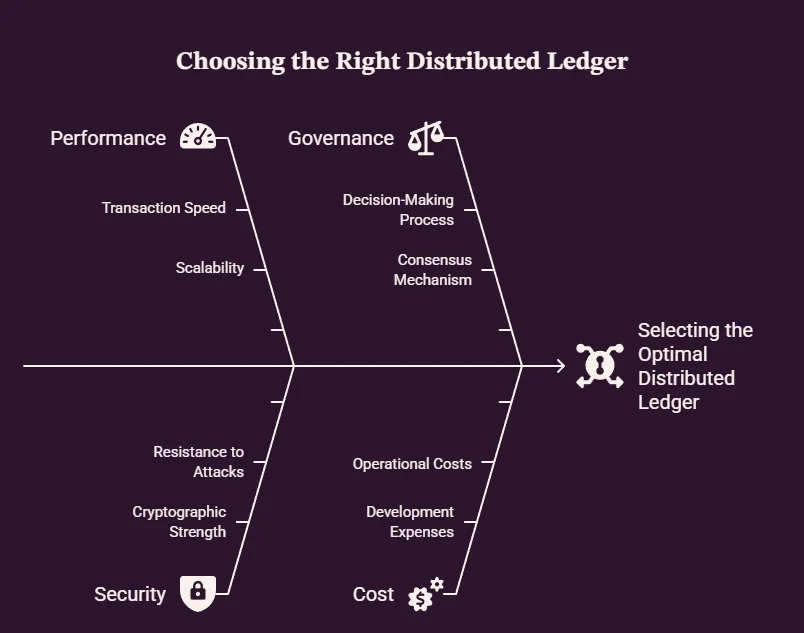
Choosing between the types of distributed ledgers should start with the problem you are trying to solve rather than the technology itself. Here are some factors to consider:
Consider Who Needs Access
If the network needs to be open to anyone, a public permissionless ledger may be appropriate. This is the model used by networks such as Bitcoin and Ethereum.
If participants need to be identified and approved before joining, a permissioned system may make more sense. This is common in enterprise environments where organisations need greater control over network membership.
Consider Privacy Requirements
Think about whether transaction information should be publicly visible or restricted to specific participants.
For example, a company sharing sensitive commercial information with selected business partners may prefer a permissioned or consortium network rather than a public ledger.
Consider Governance
Governance is another important consideration. Ask who should be able to make decisions about the network, update its rules, admit participants, or resolve disputes.
A public permissionless network distributes governance differently from a private network controlled by one organisation or a consortium governed collectively by several organisations.
Consider Scalability and Performance
The network should be able to handle the expected number and frequency of transactions.
If an organisation expects high transaction volumes, it should examine the specific system’s throughput, latency, and consensus mechanism.
It is also important to examine the scalability model rather than choosing a ledger type based on its label alone.
Consider Regulatory and Business Requirements
Finally, consider the legal and regulatory environment surrounding the proposed use. Requirements relating to data protection, financial regulation, record keeping, auditability, and cross-border data transfers may affect which architecture is appropriate.
For example, a financial institution handling regulated information may require stronger access controls and audit mechanisms than an application designed for openly transferring digital assets.
Conclusion
Distributed ledgers can solve very different problems. A public network such as Bitcoin prioritises open participation, while permissioned networks give organisations more control over who can access the system.
The right choice comes down to what you actually need the ledger to do. Privacy, access, governance, scalability and regulatory requirements can all influence that decision.
The goal is not to pick the most popular technology. It is to find the type of distributed ledger that fits the problem you are trying to solve.
Join UEEx
Experience the World’s Leading Digital Wealth Management Platform
No. Blockchain is one type of distributed ledger, but other architectures, such as DAG-based systems and Hashgraph, organise and validate data differently.
Can A Distributed Ledger Be Used Without Cryptocurrency?
Yes. Distributed ledgers can support business processes such as tracking goods, sharing records between organisations and settling financial transactions without involving cryptocurrency.
Do Distributed Ledgers Always Have To Be Public?
No. A distributed ledger can be public or restricted to approved participants, depending on how the network is designed.
What Is The Main Benefit Of Using A Distributed Ledger?
The main benefit is that multiple participants can maintain a shared record without depending entirely on one party to keep and reconcile the data.
Are Distributed Ledgers Secure?
Yes, distributed ledgers can provide strong security through cryptography, consensus mechanisms and controlled access. However, security also depends on the specific technology, network design, and implementation.
Can Businesses Use Distributed Ledger Technology?
Yes. Businesses can use DLT for areas such as payments, supply-chain tracking, identity management, trade documentation and sharing records between trusted parties.
Disclaimer: This article is intended solely for informational purposes and should not be considered trading or investment advice. Nothing herein should be construed as financial, legal, or tax advice. Trading or investing in cryptocurrencies carries a considerable risk of financial loss. Always conduct due diligence before making any trading or investment decisions.
Trade with proof of Reserves
UEEx publish monthly audits and third party verification on every listed market.