On October 10, 2025, Bitcoin traders saw how quickly leverage can turn a market shock into a disaster. After President Trump announced 100% tariffs on Chinese imports, more than $19 billion in crypto positions were liquidated.
Over 1.6 million traders were affected as Bitcoin fell sharply from its October record above $125,000.
By September 2026, Bitcoin trades around $78,000, roughly 38% below its peak. Institutional involvement remains significant, with BlackRock’s IBIT holding about $47.3 billion in net assets as of August 11. Strategy, meanwhile, holds more than 840,000 BTC.
This guide explores practical Bitcoin trading strategies for 2026, from long-term holding to leveraged derivatives, while showing how to manage risk and choose an approach that fits your experience.
Bitcoin’s volatility isn’t going away. What changed in 2026 is that the traders who survived stopped treating leverage like free money.
Key Takeaways
- Match the strategy to your skill level Beginners are usually better off with dollar-cost averaging or long-term holding. Active trading strategies take real time, tools, and emotional discipline
- Risk management is not optional The October 2025 crash proved that overleveraged accounts get wiped out fast. Use stop-losses, size positions carefully, and keep leverage low
- Watch institutional flows ETF inflows and outflows, along with corporate treasury buying, are now a real signal of where big money is positioning
- Adjust to the market you’re in Bitcoin spent much of 2026 range-bound and correcting, not trending upward. Strategies that worked in the 2024-2025 bull run don’t automatically work in a slower, choppier market
- Long-term holding still wins for most people Even with real trading opportunities available, a multi-year approach has historically produced the best results for the average investor, with far less stress
What Bitcoin Trading Looks Like in 2026
Bitcoin trading means buying and selling Bitcoin to profit from its price swings. That’s different from investing, where you buy and hold for years without reacting to daily moves.
Traders make active decisions about when to enter and exit, how much to risk, and which timeframe to focus on, whether that’s minutes, days, or months.
- In 2026, you can trade Bitcoin through several types of markets:
- Spot exchanges like Binance, Coinbase, Kraken, or UEEx, where you buy and hold actual Bitcoin
- Futures markets, where you agree to buy or sell Bitcoin at a set price in the future
- Options markets, which give you the right, not the obligation, to buy or sell at a set price
- ETFs, regulated funds that trade on stock exchanges and track Bitcoin’s price
- Over-the-counter (OTC) desks, used mostly by large institutions moving big blocks of Bitcoin
What Makes Bitcoin Different From Stocks or Forex
A few things set Bitcoin apart from traditional markets, and they matter for how you trade it:
It never closes: Bitcoin trades 24 hours a day, every day of the year. There’s no opening bell and no overnight gap protection.
It’s still volatile: Daily swings of 3% to 8% are common. The October 2025 crash saw an 18% drop in hours.
There are no circuit breakers: Stock exchanges pause trading during extreme moves. Crypto exchanges don’t, which is part of why the October crash spread so fast.
Liquidity is spread across the globe: Average daily trading volume runs in the tens of billions of dollars, split across more than 200 exchanges, so prices can vary slightly from one venue to another.
Leverage is everywhere: Many platforms still offer 10x to 125x leverage. This is also the single biggest reason traders lose their accounts.
It reacts to macro news: Federal Reserve decisions, inflation data, and the US dollar’s strength all move Bitcoin now more than they did in Bitcoin’s early years.
October 2025 Crash Impact on Bitcoin Trading
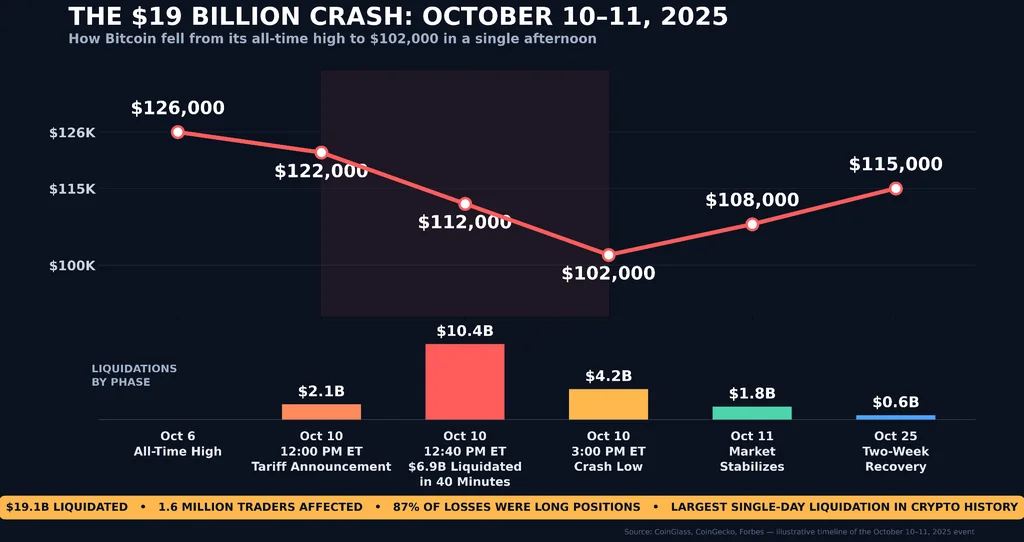
Understanding what happened on October 10, 2025, helps explain almost everything about how people trade Bitcoin today.
The trigger was political: Trump’s tariff announcement rattled every risk asset, and crypto reacted hardest because it never stops trading and had record levels of leverage built up.
According to on-chain data tracked by CoinGlass, roughly 85-90% of the liquidated positions were long bets, meaning most traders were leaning bullish and got caught off guard.
Exchanges like Hyperliquid and Binance saw billions in forced liquidations within a single hour, and CoinGecko’s breakdown of the event described it as exposing just how fragile the market’s derivatives structure had become.
Bitcoin fell as low as $102,000 before staging a partial recovery over the following weeks. But the damage to sentiment lingered.
Open interest in futures contracts dropped by more than 40% in the months after the crash, according to FTI Consulting’s analysis, as exchanges tightened leverage limits and traders became far more cautious about how much risk they carried.
Bitcoin never reclaimed its October highs. Instead, 2026 turned into a slower, choppier year, with Bitcoin drifting mostly between $60,000 and $80,000.
Macro pressure (rising bond yields, a stalled Federal Reserve, and cautious ETF flows) kept a lid on any strong rally.
Three lessons came out of that week that still guide trading decisions today:
1. Leverage kills accounts faster than bad analysis: Most of the traders wiped out on October 10 had the right long-term view on Bitcoin. They just sized their positions too aggressively to survive a sharp, fast move.
2. Stop losses are not optional: Traders who had stops in place lost a defined, manageable amount. Traders without them got liquidated at the worst possible price.
3. Institutions don’t panic the way retail does: While retail accounts were being forcibly closed, ETF issuers and corporate treasuries used the drop to keep accumulating, a pattern that has repeated through 2026’s slower grind lower.
Bitcoin Trading Strategies for Every Type of Trader
Here are the core Bitcoin trading strategies people use in 2026, organized from lowest to highest effort and risk.
1. HODL: Buy and Hold for the Long Term
“HODL” started as a misspelling of “hold” on a crypto forum, and it stuck as the name for the simplest strategy of all: buy Bitcoin and hold it for years, ignoring the day-to-day noise.
This isn’t really trading. It’s a bet on Bitcoin’s fixed supply, growing institutional adoption, and multi-year price history, which, despite huge drawdowns, has trended upward since Bitcoin launched.
HODLers who stayed in through the October 2025 crash avoided the panic entirely. They didn’t get liquidated because they never used leverage in the first place.
How to do it:
- Store Bitcoin in a hardware wallet (like Ledger or Trezor) for larger amounts, or a reputable exchange for smaller ones
- Buy in gradually or in a lump sum, then leave it alone
- Check your holdings once or twice a year, not daily
- Avoid making decisions based on short-term headlines
Best for: Beginners, long-term believers, retirement accounts, and anyone who doesn’t want to actively manage a position.
Risk: You’ll sit through 40% to 60% drawdowns without selling. That takes real conviction, and it means missing out on short-term trading gains.
For more on what’s driving Bitcoin’s price historically, see our Bitcoin Halving guide.
2. Dollar-Cost Averaging (DCA): The Beginner’s Best Friend
DCA means investing a fixed amount of money into Bitcoin on a regular schedule, no matter what the price is doing. Instead of trying to time the market, you spread your purchases out and let the average work in your favor.
Example: If you invest $500 every week for a month while Bitcoin bounces between $60,000 and $66,000, your average purchase price ends up somewhere in the middle, without you having to guess the bottom.
This approach shines during periods like 2026, when Bitcoin has been choppy and range-bound rather than trending clearly in one direction. Traders who kept buying through the dips in the months after the October crash ended up with a lower average cost than those who tried to wait for the perfect entry.
How to do it:
- Pick an amount you can comfortably invest, often 5% to 10% of monthly income
- Choose a frequency: weekly tends to smooth out volatility best
- Automate it through your exchange’s recurring buy feature
- Stick to the schedule even when prices are falling; that’s when DCA works hardest for you
- Track your average cost basis for tax purposes
Best for: Beginners, people with steady income, and anyone who finds market timing stressful.
Risk: In a strong, fast bull run, DCA can underperform a lump-sum investment. It also requires discipline to keep buying during a downturn.
3. Day Trading: High Effort, High Risk
Day trading means opening and closing positions within the same day, aiming to profit from short-term price moves.
It requires real screen time, usually four to eight hours a day, and a defined strategy you follow every single time.
The honest numbers here are rough. Most day traders lose money over the long run once fees are factored in.
The ones who do succeed tend to share a few habits: they risk only 1% to 2% of their account per trade, they specialize in a small number of setups, and they avoid revenge trading after a loss.
Common approaches:
- Breakout trading: Wait for Bitcoin to break above a key resistance level with strong volume, then enter
- Range trading: Buy near support and sell near resistance while Bitcoin trades sideways
- News trading: Position around scheduled events like Fed announcements or ETF flow reports
Tools you’ll need: A charting platform like TradingView, a low-fee exchange, and real-time price data from a source like CoinMarketCap or CoinGecko.
Risk management rules:
- Never risk more than 1-2% of your account on a single trade
- Set a stop-loss the moment you enter a position, and don’t widen it
- Stop trading for the day after two losses in a row
- Keep leverage low, 3x to 5x at most, if you use it at all
Best for: Experienced traders with the time, tools, and emotional discipline to treat it like a job.
4. Swing Trading: Riding Multi-Day Moves
Swing trading holds positions for a few days to a few weeks, aiming to capture a bigger move than day trading without needing to watch the screen constantly. It usually takes one to two hours a day to manage.
Swing traders look for confirmed trends using moving averages, watch for support and resistance zones, and often use chart patterns like double bottoms or ascending triangles to time entries.
The two-week bounce off the October 2025 crash lows was a textbook swing trade for anyone who caught it.
How to find setups:
- Confirm the trend using the 50-day and 200-day moving averages
- Watch round-number support and resistance zones ($60,000, $65,000, $70,000)
- Look for rising volume to confirm a move is real, not a fakeout
- Use Fibonacci retracement levels to identify likely pullback zones after a strong move
Take-profit and stop-loss guidelines:
- Conservative target: 5-8% gain
- Stop-loss: typically 4-6% from entry, placed below the recent swing low
- Aim for at least a 2:1 reward-to-risk ratio on every trade
Best for: Part-time traders with some technical analysis experience and the patience to wait for a real setup instead of forcing trades.
For a deeper look at managing downside risk across any of these strategies, see our Best Strategies for Long-Term Crypto Investing Guide.
5. Scalping: Not for Beginners
Scalping means making dozens or hundreds of trades a day, each targeting a tiny profit of 0.1% to 0.5%. It’s the most intense, most demanding style of trading, and it’s genuinely not suited to most people.
The math is brutal. Standard exchange fees of 0.1% to 0.2% per trade can eat an entire day’s profits unless you’ve qualified for VIP fee tiers.
Slippage during volatile moments, like the October crash, can run well above 1%. And the mental toll of watching every tick for eight-plus hours a day leads to burnout fast.
Best for: Full-time professional traders with low-latency execution, deep fee discounts, and years of experience.
If you’re new to trading, skip this one entirely and revisit it later, if at all.
6. Trend Following
Trend following means trading in the direction of the prevailing trend, using tools like moving averages, trendlines, and momentum indicators such as the RSI or MACD.
Buy when the trend is up; avoid or short when it’s down.
In 2026’s choppier market, trend followers have generally waited for a clear, confirmed uptrend before entering, rather than trying to catch the exact bottom after a drop.
7. Arbitrage Trading
Arbitrage means exploiting small price differences between exchanges or trading pairs. If Bitcoin trades at $63,000 on one exchange and $63,300 on another, an arbitrage trader buys low and sells high, pocketing the difference minus fees.
Common types:
- Exchange arbitrage: Buying on one platform, selling on another
- Triangular arbitrage: Cycling through multiple currency pairs to capture small pricing gaps
- Funding rate arbitrage: Exploiting the funding payments on perpetual futures contracts
Challenges: Transfer times between exchanges, trading fees, and the risk that an exchange freezes withdrawals can all eat into or wipe out the profit.
8. Range Trading
When Bitcoin trades sideways in a defined channel, range traders buy near the bottom of the range and sell near the top, repeating the process until the range breaks.
Much of 2026 has offered this kind of environment, with Bitcoin chopping between roughly $60,000 and $80,000 for extended stretches.
How to do it: Use limit orders at the range boundaries, and place stops just outside the range in case it breaks in either direction.
9. Futures and Derivatives Trading
Futures let you trade Bitcoin contracts with leverage, without owning the underlying asset. This is exactly where the October 2025 crash did the most damage.
Traders using 50x or even 100x leverage were liquidated within minutes as the price moved against them.
Types: Quarterly futures, perpetual swaps, and both coin-margined and USD-margined contracts.
Post-crash risk rules: Keep leverage to 3x-5x maximum and use isolated margin rather than cross margin.
This ensures one bad trade can’t wipe out your whole account; always set a stop loss before you enter.
10. Options Strategies
Options give you the right, not the obligation, to buy or sell Bitcoin at a set price by a certain date.
They’re more complex than spot or futures trading, but they open up strategies that limit risk in ways leverage alone can’t.
Popular approaches:
- Covered calls: Selling call options against Bitcoin you already own, for extra income
- Protective puts: Buying downside insurance on a position you want to keep long-term
- Spreads: Combining multiple options to create a defined risk and reward range
Institutional demand for Bitcoin options has grown as more funds use them to hedge existing positions rather than to speculate outright.
11. Event-Driven Trading
Some traders build their approach around known, scheduled events: Federal Reserve rate decisions, weekly ETF flow reports, and major corporate treasury announcements.
The idea is to position ahead of an event or react quickly once the news hits, rather than trading randomly throughout the week.
The October 2025 crash is the extreme example of event risk. A single political announcement moved Bitcoin 18% in hours.
Traders who understood the risk of holding leveraged positions into unpredictable news events came out far better than those who didn’t.
12. Algorithmic and Bot Trading
Bots let you automate a strategy so it runs 24/7 without you watching the screen. Common bot types include grid bots (which automate range trading), DCA bots (which automate scheduled buying), and market-making bots.
Platforms like 3Commas and Cryptohopper let retail traders set up bots without needing to code. More advanced traders build custom bots using exchange APIs.
Bots remove emotion from execution, but they only work as well as the strategy and risk rules programmed into them. A badly configured bot will lose money just as fast as a human trader.
Special Strategies for 2026 Market Dynamics
This section explores other special strategies for 2026 market dynamics
Trading Bitcoin ETFs vs. Owning Bitcoin Directly
Spot Bitcoin ETFs have become a major part of how both retail and institutional investors get exposure to Bitcoin.
As of September 2026, total US spot Bitcoin ETF assets sit around $105 billion, with IBIT alone holding roughly $45 billion of that.
Why some traders prefer ETFs:
- No wallet management or private key security to worry about
- Trades through a normal brokerage account, with standard tax reporting
- Can be held in retirement accounts like IRAs
Why some traders prefer direct ownership:
- Trading hours aren’t limited to stock market hours (9:30 AM to 4 PM ET)
- No annual management fee, which for ETFs typically runs 0.20% to 0.25%
- You can actually withdraw and self-custody your Bitcoin
A reasonable approach for many traders: use ETFs inside tax-advantaged retirement accounts and hold Bitcoin directly for active trading.
Learn more in our guide to Bitcoin vs Bitcoin ETFs.
Following Institutional Money
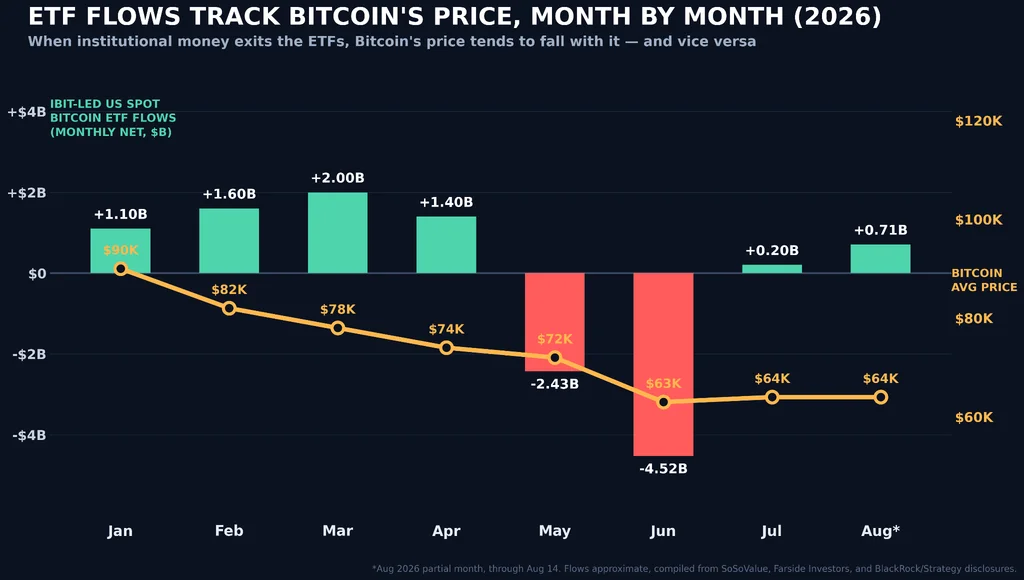
Institutional behavior has become one of the more reliable signals in Bitcoin trading, mostly because large holders don’t panic-sell the way leveraged retail accounts do.
BlackRock’s IBIT
The firm’s flows are published regularly and give a real-time read on institutional sentiment.
Sustained inflows tend to line up with price strength, while stretches of outflows have coincided with weaker price action.
Corporate Treasury
Corporate treasure buying is another signal worth tracking. Strategy (the company formerly known as MicroStrategy) held 843,775 BTC as of late July 2026, making it the largest corporate Bitcoin holder in the world.
The company kept buying through 2026’s price decline, funding purchases through stock and preferred share sales rather than selling Bitcoin.
This continued even as the value of its holdings fell along with the broader market.
Long-Term Holder
On-chain data shows long-term holders (wallets that haven’t moved coins in 155 days or more) controlling close to 79% of Bitcoin’s circulating supply as of September 2026, a record high.
That means a shrinking share of Bitcoin’s supply is actively available to trade, which can amplify price moves in both directions when new demand or selling pressure shows up.
When leveraged retail traders are getting liquidated, institutions and long-term holders are usually doing the opposite: accumulating quietly while everyone else panics.
Government Participation
The US established a Strategic Bitcoin Reserve by executive order in March 2025, built from Bitcoin already seized through law enforcement action.
As of early 2026, that reserve held roughly 328,000 BTC.
Congress has not yet passed legislation to make the reserve permanent, so its long-term future depends on political decisions.
Risk Management Rules Every Trader Needs
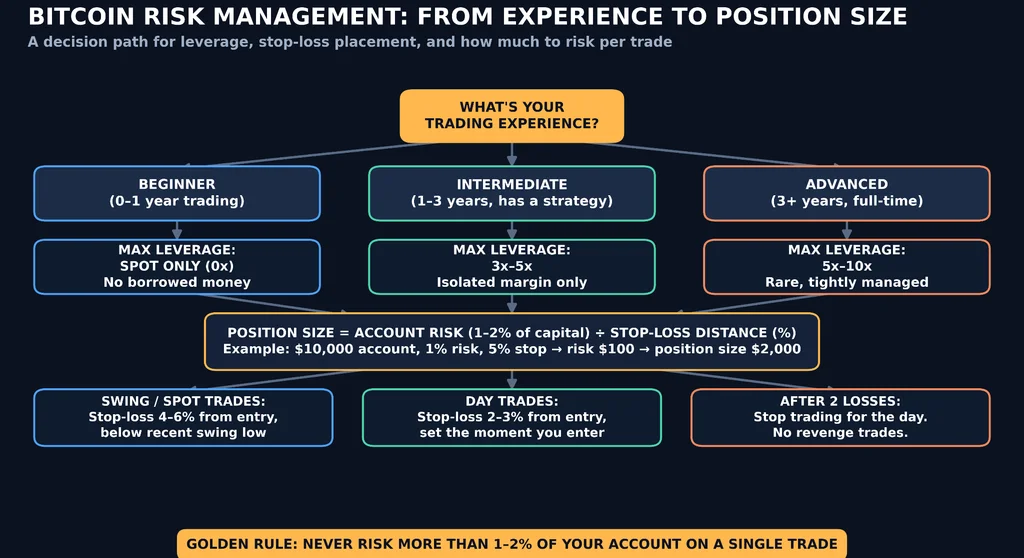
- The October 2025 crash is the clearest case study in why risk management matters more than picking the right strategy. Here’s the updated playbook most serious traders follow now:
- Cap your leverage: Where 20x to 50x leverage was once common, most disciplined traders now cap it at 3x to 5x, if they use leverage at all.
- Size positions small: Never risk more than 1-2% of your total capital on a single trade.
- Always use a stop-loss: Set it the moment you open a position, not after the trade starts moving against you.
- Limit your total crypto exposure: Many advisors suggest capping Bitcoin at 10-20% of an overall investment portfolio.
- Have an exit plan before you need one: Decide in advance what you’ll do if the market drops 20% in a day, so you’re not making that decision in a panic.
For a full breakdown of position sizing, stop-loss placement, and portfolio allocation, see our Cryptocurrency Risk Management Guide.
A Quick Note on Bitcoin Taxes
In the US, tax depends heavily on holding time. Short-term gains are taxed as regular income, which can run as high as 37%.
Long-term gains (held over a year) get preferential rates of 0%, 15%, or 20%, depending on your income.
Frequent traders generate many taxable events, so keeping accurate records of cost basis matters.
Tools like CoinTracker and Koinly help automate this. For more, see our Crypto Tax Guide for Crypto Traders.
Choosing the Right Platform
Your choice of platform affects your fees, your available tools, and how much risk you’re exposed to.
Spot trading: Compare fee structures and security track records across exchanges like Binance, Coinbase, Kraken, and UEEx, which offers competitive fees alongside charting and automated order tools.
Charting and analysis: TradingView remains the standard for technical analysis, with a free tier that covers most retail needs.
Portfolio and tax tracking: CoinTracker and Koinly both sync with most major exchanges.
Automated trading: 3Commas and Cryptohopper are the most widely used bot platforms for retail traders who want to automate a strategy without coding it from scratch.
Trading Psychology: The Part Most Guides Skip
- Every strategy on this list fails in the hands of a trader who can’t manage their own emotions.
A few habits separate traders who last from traders who blow up their accounts:
- Avoid FOMO entries: Chasing a price that’s already moved sharply is one of the most common ways traders lose money.
- Don’t revenge trade: After a loss, the urge to immediately “win it back” almost always leads to a bigger loss.
- Keep a trading journal: Reviewing your wins and losses weekly reveals patterns you won’t notice in the moment.
- Set realistic expectations: Consistent, modest returns from a disciplined strategy will outperform sporadic, oversized bets over time.
For a deep dive into how your mindset affects your trading, check out our Psychological Levels in Cryptocurrency Trading: Why Your Mindset Matters guide.
Frequently Asked Questions
What’s the best Bitcoin trading strategy for beginners?
Dollar-cost averaging is the most beginner-friendly Bitcoin trading strategy.
You invest a fixed amount on a regular schedule, which removes the pressure of trying to time the market.
How much money do I need to start trading Bitcoin?
You can start with $10 to $50 on major exchanges. Only invest what you can afford to lose and start small while you learn.
Is Bitcoin day trading profitable?
Day trading can be profitable, but most traders lose money once fees and mistakes are factored in. It requires real time and discipline.
Beginners should start with dollar-cost averaging or swing trading before attempting day trading.
Should I use leverage when trading Bitcoin?
Most experienced traders recommend little to no leverage. If you do use it, keep it low (3x to 5x) and always use a stop-loss.