Ethereum trading involves buying and selling Ether (ETH), the cryptocurrency powering the world’s largest smart contract network, to profit from price movements and market trends. As of January 2026, CoinMarketCap data shows that ETH trades around $3,110–$3,190 (recent 24h range $3,108–$3,232), with a market cap of approximately $376–$377 billion.
Additionally, the Ethereum network processes over 1.6 million transactions daily and supports active decentralized finance and NFT markets. Traders choose platforms, order types, and strategies based on goals, risk tolerance, and market conditions.
In this article you will learn what Ethereum trading is, how it works, and how to execute trades confidently across different platforms and strategies.
Source: Freepik
Key Takeaways
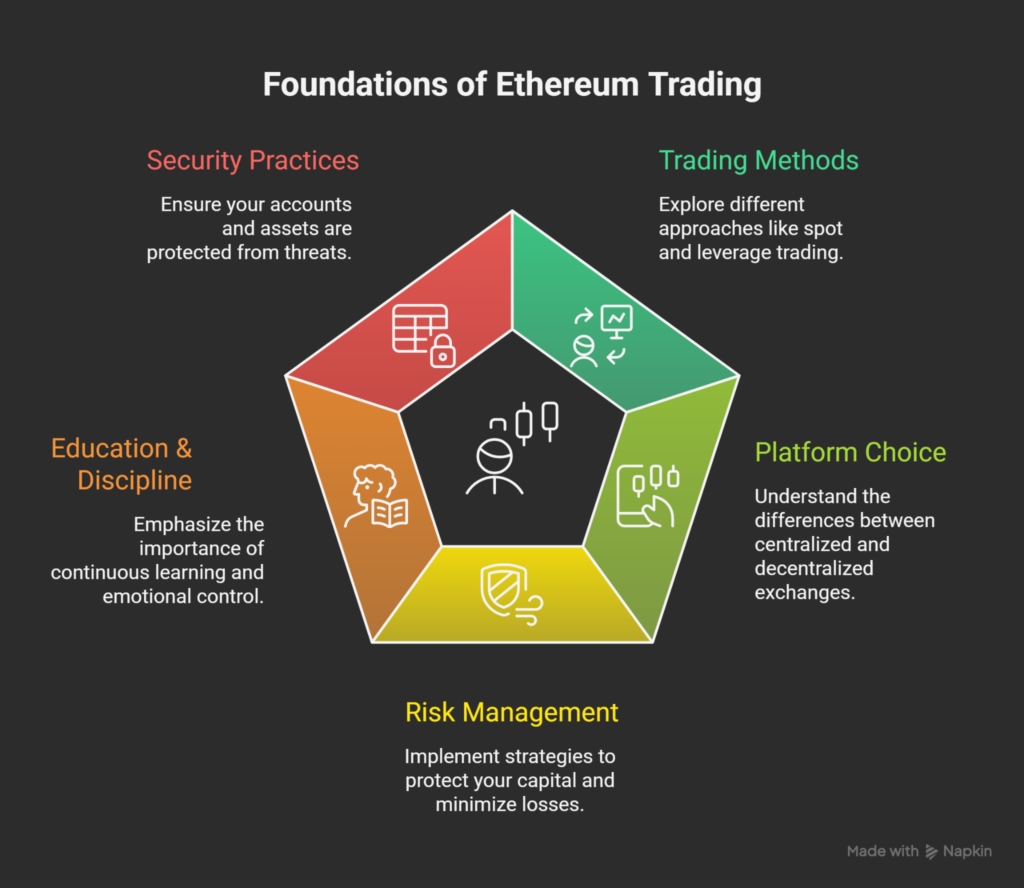
- Ethereum is more than a cryptocurrency. ETH powers a global smart contract network used for DeFi, NFTs, games, and decentralized apps.
- Different trading methods suit different goals. Beginners often start with spot trading, while experienced traders may use leverage or advanced strategies.
- Platform choice matters. Centralized exchanges offer ease and support, while decentralized exchanges give more control and transparency.
- Risk management is essential. Using stop-losses, limiting exposure, and securing private keys protects your capital.
- Education and discipline are key. Successful Ethereum trading requires understanding market mechanics, practicing strategies, and staying consistent.
What Ethereum Trading Really Is
Ethereum trading is the act of buying and selling Ether, the native asset of the Ethereum network, with the goal of making a profit from price movements. It is worth noting that Ethereum is more than a digital.
It is a global computing network that allows developers to build financial applications, digital marketplaces, games, and payment systems without relying on banks or centralized authorities. Because of this broad utility, ETH has become one of the most actively traded digital assets in the world.
When people trade Ethereum, they are not interacting directly with the blockchain every time. Instead, they trade through platforms that match buyers and sellers or facilitate trades through smart contracts.
It is important to add that the price of Ethereum moves based on supply and demand, market sentiment, network activity, global economic conditions, and broader crypto market trends.
Ethereum can be traded against fiat currencies like the US dollar or against stablecoins such as USDT. It can also be traded against other cryptocurrencies. Traders take positions based on whether they believe the price will rise or fall. Some traders focus on short time frames while others take longer positions that last weeks or months.
Types of Ethereum Trading
Ethereum can be traded in different ways depending on your goals, experience level, and risk tolerance. The two main approaches are spot trading and leverage trading.
Spot Trading
Spot trading is the most straightforward way to trade Ethereum. When you buy ETH in the spot market, you own it immediately. When you sell, you exchange it for another currency or asset.
Spot trading is popular among beginners because it is simple, transparent, and does not involve borrowing funds or complex contracts. You profit if the price moves in your favor and lose if it moves against you.
More experienced traders also use spot trading strategically. They study price charts, identify trends, and track support and resistance levels. For example, a trader might buy ETH during price pullbacks and sell when the price reaches a resistance zone.
Spot trading allows for this type of analysis without additional risk from borrowed funds.
Leverage Trading
Leverage trading allows traders to borrow funds from the platform to increase the size of their position. For example, using five times leverage lets you control a $5,000 position with only $1,000 of your own capital.
While leverage can amplify profits, it also magnifies losses. If the market moves against your position, losses can mount quickly, and positions may be automatically closed if losses reach certain limits. Because of the increased risk, leverage trading is generally not recommended for beginners. It requires careful planning, strict risk management, and constant attention to the market.
Choosing Between Spot and Leverage Trading
Your choice depends on experience, goals, and risk tolerance. Spot trading is safer and simpler, while leverage trading can increase potential gains but comes with much higher risk. Many traders start with spot trading to learn the market before experimenting with leverage.
How to Choose the Right Ethereum Trading Platform
Before you place your first trade, it is important to decide where you will trade Ethereum. The choice of platform affects fees, security, available tools, and overall trading experience.
Centralized Exchanges
Centralized exchanges are companies that provide a marketplace for trading. They hold customer funds, manage order books, and execute trades internally. These platforms usually require identity verification and offer customer support, advanced charting tools, and various order types.
Centralized exchanges are often easier for beginners because they provide a clear interface and customer support. For example, a trader using a platform like UEEx can deposit fiat currency, access ETH trading pairs, and use built-in charts and indicators to make trading decisions without worrying about managing private keys.
Decentralized Exchanges
Decentralized exchanges operate directly on the blockchain. They do not hold user funds; trades are executed through smart contracts, and users maintain control over their assets at all times. These platforms do not use traditional order books and instead rely on automated market makers (AMMs) to determine prices.
For example, on a platform like Uniswap, a trader can swap ETH for another token directly from their wallet. The platform automatically adjusts prices based on the liquidity pool, and the trader remains in full control of their private keys.
Comparing the Options
Both types of platforms have advantages and trade-offs. Centralized exchanges are generally faster and provide more tools, making them suitable for beginners or traders seeking efficiency. Decentralized exchanges offer greater control and transparency but require more knowledge of wallets, gas fees, and smart contract interactions.
By understanding these differences, you can select a platform that matches your trading style and comfort level. Beginners may start with centralized exchanges for simplicity, while more experienced users might explore decentralized platforms for full control over their assets.
How to Set Up for Ethereum Trading
Creating an Exchange Account
To trade Ethereum on a centralized exchange, you must first create an account. This involves registering with an email address or phone number and setting a secure password. Most exchanges will then require identity verification before allowing full access to trading features. This process usually includes submitting identification documents and confirming personal details.
Verification is important because it helps prevent fraud and ensures the platform complies with regulations. Once verified, you can deposit funds and begin trading.
Funding Your Account
After account verification, the next step is funding your account. Most centralized exchanges allow you to deposit fiat currency through bank transfer or card payment. You can also deposit cryptocurrency if you already own some.
When you deposit funds, they appear in your exchange wallet. From there, you can allocate them to trading. Always double check deposit addresses and payment details before sending funds to avoid errors.
Setting Up a Personal Wallet
Even if you trade primarily on an exchange, having a personal wallet is important. A wallet allows you to store Ethereum outside the exchange, giving you full control over your assets.
Software wallets are applications installed on your phone or computer. Hardware wallets are physical devices that store your private keys offline. For long term holding, hardware wallets are generally considered safer.
A good habit is to keep only the amount you need for active trading on the exchange and store the rest in your personal wallet.
A Step-by-Step Guide to Trading Ethereum
Alt text: Ethereum displayed on a desktop screen with a camera and headphones nearby
Source: Freepik
Once your account is funded or your wallet is ready, you can begin executing trades. Trading Ethereum involves understanding order types and how to use them effectively to manage risk and maximize opportunities. Below is a detailed breakdown of the process.
Understanding Order Types
When you trade Ethereum, the type of order you use depends on your goals. Each order type serves a specific purpose and helps you control when and how trades are executed.
Market Orders
A market order buys or sells ETH at the best current price available on the exchange. Market orders execute immediately, making them useful for entering or exiting positions quickly. However, they do not guarantee an exact price, especially in fast-moving markets.
Limit Orders
A limit order allows you to set the price at which you want to buy or sell Ethereum. The trade only executes if the market reaches your specified price. Limit orders give more control over entry and exit points but may not fill if the market does not reach your target.
Stop-Loss Orders
A stop-loss order automatically sells (or buys to cover) your position when the price reaches a predetermined level. Stop-losses are essential for limiting losses and protecting your capital from unexpected market swings.
Stop-Limit Orders
A stop-limit order combines a stop order with a limit order. Once the stop price is reached, the system places a limit order instead of a market order. This gives precise control over execution but requires careful planning to avoid missed trades.
It is important to mention that limit and stop orders are key tools for managing risk and planning trades. Knowing when and how to use each type helps you maintain discipline, avoid emotional decisions, and improve the consistency of your trading results.
Understanding Automated Market Makers in Ethereum Trading
Automated market makers, often referred to as AMMs, are one of the most important innovations in decentralized Ethereum trading. Unlike traditional exchanges that rely on order books, AMMs use mathematical formulas and liquidity pools to enable trading.
In a traditional exchange, buyers and sellers place orders at different prices. Trades happen when a buy order matches a sell order. In an AMM system, there is no order book. Instead, traders interact with a pool of funds supplied by other users.
A liquidity pool is made up of two assets, such as ETH and a stablecoin. Liquidity providers deposit equal values of both assets into the pool. In return, they earn a share of the trading fees generated by the pool.
When a trader wants to swap ETH for another asset, they trade directly with the pool. The price is determined by a mathematical formula that maintains balance between the two assets. As one asset is bought, its price increases relative to the other.
This system allows trading to happen at any time without needing a matching buyer or seller. It also means prices can change rapidly during large trades, a concept known as slippage.
AMMs are widely used on decentralized Ethereum platforms. They are efficient but require careful consideration of fees, slippage, and market conditions.
Risks and Costs of AMM Trading
While AMMs offer flexibility and decentralization, they also carry risks. One major risk is impermanent loss. This occurs when the price of assets in a liquidity pool changes significantly compared to when they were deposited. Liquidity providers may end up with less value than if they had simply held the assets.
Similarly, gas fees are another factor. Every transaction on Ethereum requires gas, and during periods of high network usage, these fees can become expensive. Traders must factor gas costs into their decisions, especially when making frequent trades.
Understanding how AMMs work is essential before using them. Many traders start with centralized platforms before exploring decentralized trading.
How to Trade Ethereum Using UEEx
Source: UEEx homepage
UEEx is a centralized cryptocurrency exchange that offers multiple trading options for Ethereum. It supports spot trading, margin trading, and derivatives, making it suitable for traders at different experience levels.
Creating and Verifying a UEEx Account
To trade Ethereum on UEEx, you first create an account and complete the verification process. This ensures you can access all trading features and withdraw funds without restrictions.
Once verified, you can deposit funds into your account. UEEx supports both fiat and cryptocurrency deposits.
Accessing Ethereum Markets
After funding your account, navigate to the markets section and locate Ethereum trading pairs such as ETH paired with stablecoins. These pairs allow you to trade Ethereum against assets that have relatively stable values.
The trading interface typically displays a price chart, order book, recent trades, and order entry panel. Familiarizing yourself with this layout helps you execute trades more efficiently.
Placing a Trade
To place a trade, select whether you want to buy or sell Ethereum. Choose your order type and enter the amount. Review the details carefully before confirming.
Once the order is executed, your Ethereum balance updates immediately. Open orders and trade history can be tracked through your account dashboard.
Using Advanced Features on UEEx
UEEx provides tools such as charting indicators, risk controls, and optional leveraged trading. These features allow traders to analyze price movements and manage positions more effectively. For experienced users, margin and futures trading options are available. These tools should be used cautiously and only with a clear strategy.
Practical Strategies for Trading Ethereum
Alt text: A man analyzing stock market charts financial data
Source: Freepik
Every successful Ethereum trader relies on a clear strategy. These core approaches help define how trades are planned, executed, and managed in different market conditions.
Define Clear Entry and Exit Rules
A strong Ethereum trading strategy starts with knowing exactly when to enter and when to exit a trade. This includes deciding what price confirms a valid entry and what conditions signal that it is time to take profit or accept a loss. Clear rules remove guesswork and reduce emotional decisions during fast market moves.
Use Dollar Cost Averaging for Consistency
Dollar cost averaging involves buying Ethereum in fixed amounts at regular intervals rather than trying to time the market. This approach helps smooth out price swings over time and is often used by traders who want steady exposure without reacting to short term volatility.
Apply Swing Trading for Medium Term Moves
Swing trading focuses on capturing price movements that unfold over several days or weeks. Traders using this method study trends, support levels, and resistance areas, then enter trades during pullbacks within an established trend. This strategy requires patience and careful timing rather than constant monitoring.
Practice Day Trading With Discipline
Day trading involves opening and closing Ethereum positions within the same day. The goal is to benefit from short term price changes. This approach demands focus, quick decision making, and strict discipline, as small mistakes can add up quickly in active markets.
Prioritise Risk Management at All Times
No strategy works without proper risk control. Traders should limit how much capital they risk on each trade, use stop loss orders to cap losses, and avoid making decisions based on fear or excitement. Protecting capital is more important than chasing profits.
Essential Security Practices for Ethereum Traders
Security is the foundation of successful Ethereum trading. Protecting your accounts and assets prevents losses from hacks, scams, and human error.
Use Strong Account Protection
Protect your trading accounts with strong, unique passwords and enable two factor authentication on all platforms. This adds an extra layer of security beyond just a login password.
Keep Control of Your Private Keys
Never share your private keys or recovery phrases with anyone. Store them offline and keep backups in secure locations that are not connected to the internet.
Verify Websites and Applications Carefully
Always confirm that you are using the correct exchange website or official application before logging in. Fake sites designed to steal login details are a common threat.
Watch Out for Phishing Attempts
Be cautious of unexpected emails, messages, or social media contacts related to your trading account. Most crypto losses happen through phishing scams rather than direct market activity.
Limit Funds Held on Exchanges
Only keep the amount of Ethereum you need for active trading on exchanges. Store long term holdings in personal wallets to reduce exposure if an exchange is compromised.
Final Thoughts
Trading Ethereum is a skill that develops over time. It requires understanding how markets work, choosing the right tools, and managing risk carefully. Whether you trade through centralized platforms like UEEx or explore decentralized AMM-based systems, the principles remain the same. Plan your trades, protect your capital, and stay disciplined.
More importantly, with patience, education, and consistent practice, Ethereum trading can become a structured and manageable activity rather than a gamble.
Frequently Asked Questions
What is Ethereum trading?
Ethereum trading is buying and selling ETH to profit from price changes, using either centralized or decentralized platforms.
Should I start with spot or leverage trading?
Beginners are advised to start with spot trading for simplicity and lower risk, while leverage trading is better suited for experienced traders.
What are the best platforms to trade Ethereum?
Centralized exchanges like UEEx are beginner-friendly, while decentralized exchanges like Uniswap offer full control over your assets.
How do I manage risks when trading Ethereum?
Use stop-loss orders, limit exposure per trade, secure your private keys, and avoid emotional decisions.
Do I need a personal wallet if I trade on an exchange?
Yes. Keeping most of your ETH in a personal wallet improves security while only keeping active trading funds on the exchange.