Picking a trading style is one of the first real decisions any new trader has to make, and it shapes almost everything else, how much time you need to set aside, how much capital you need to get started, and even the kind of personality that tends to do well at it.
Two of the most common paths people land on are day trading and swing trading, and while they’re both built around buying and selling within a relatively short window compared to long-term investing, they work very differently in practice.
Day trading means opening and closing every position within the same session, nothing carries overnight, and the pace is fast, with decisions often made in seconds. Swing trading takes a slower approach, holding positions for days to a few weeks to capture a larger move, with more room to think between decisions.
Neither style is inherently better than the other, the right fit depends on how much time you can realistically commit, how you handle risk and pressure, and how much capital you’re starting with.
It’s also worth noting that the rules around trading have shifted recently: FINRA’s long-standing $25,000 minimum for pattern day traders was eliminated in 2026, changing what’s actually required to get started with day trading.
This guide breaks down the real differences between the two, from time commitment and tools to risk, taxes, and how to figure out which one actually fits your life.
Join UEEx
Experience the World’s Leading Digital Wealth Management Platform
Day trading closes every position within the same session; swing trading holds positions for days to weeks to capture a larger price move.
Day trading generally requires being present during market hours, while swing trading can be managed with brief daily check-ins, making it more compatible with a full-time job.
FINRA eliminated the Pattern Day Trader rule in 2026, replacing the fixed minimum with a real-time, risk-based margin system, though exact requirements still vary by broker.
Day traders deal mainly with slippage and fast, in-session losses; swing traders deal with overnight and weekend gap risk since positions stay open when markets are closed.
Both demand discipline, proper risk management, and time to develop skill. The better fit comes down to your available time, risk tolerance, and personality, not which one sounds more exciting.
What Is Day Trading?
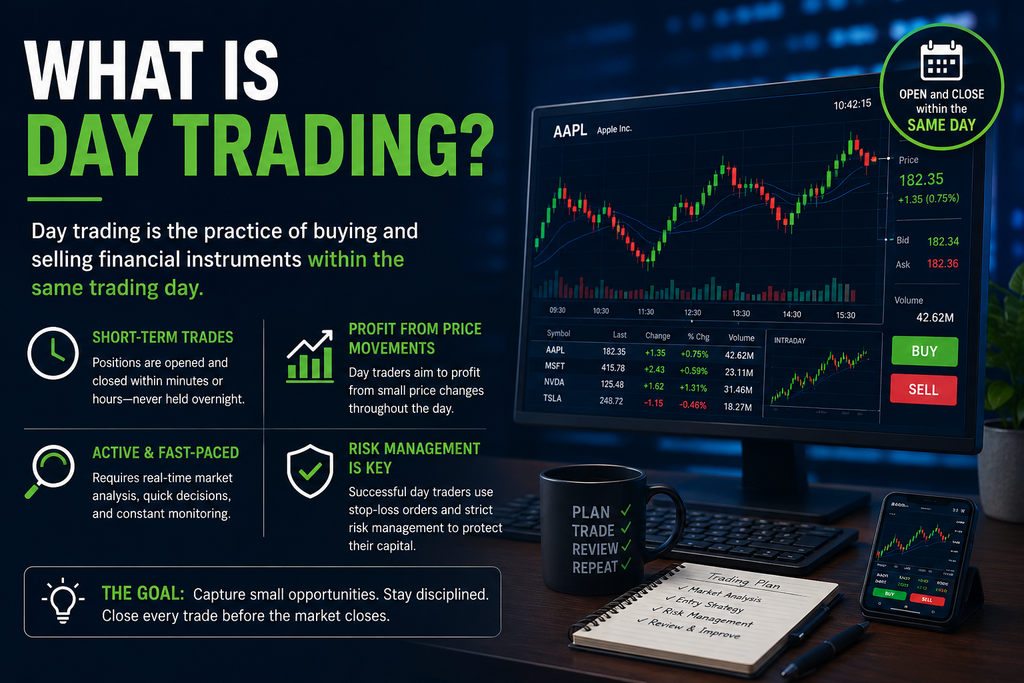
Day trading simply means buying and selling a stock, crypto asset, or other instrument within the same session, you’re in and out before the market closes. No holding overnight, no waiting for a story to play out over weeks.
For example, say you notice a stock jump 5% in the morning after a strong earnings report. As a day trader, you might buy in at 10 AM once the price shows signs of continuing upward, then sell by 1 PM after it gains another 2%, pocketing that difference.
Whether the stock keeps climbing or drops the next day doesn’t matter to you, because by the time the market closes, you’re no longer holding it.
Opening and closing positions within a single session.
A day trader might open a position at 9:45 AM and close it by 11 AM, or open and close five separate trades before lunch.
The number of trades depends on the substyle, but the defining trait is that every position started that day gets closed that day too.
Markets don’t stop moving just because trading hours end. Earnings surprises, geopolitical news, or a CEO tweet can gap a stock 10%+ before the next session opens and if you’re holding, there’s no way to react until the bell rings again.
Day traders sidestep that gap risk entirely by squaring up before the close.
Common Day Trading Styles
Not all day trading looks the same. The umbrella term covers a few distinct approaches:
Scalping: The fastest version, holding a position for seconds to a few minutes, aiming to capture tiny price movements repeatedly throughout the day.
Momentum/news trading: Trading stocks or tokens that are moving hard on a trigger such as earnings, a product announcement or a viral headline, and riding the initial move.
Range trading: Instead of chasing a big move, range traders identify a stock bouncing between a defined support and resistance level and trade the bounces, buying near support, selling near resistance. It works best in a market or stock that’s stuck sideways rather than trending.
Pros of Day Trading
No Overnight Position Risk: Every trade closes before the market shuts for the day, so there’s no chance of waking up to a gap-down from news that broke while you were asleep.
More Frequent Trading Opportunities: Because positions open and close within the same session, day traders can act on multiple setups in a single day rather than waiting days or weeks for one trade to play out.
Faster Feedback on Trading Decisions: A trade’s outcome is known within minutes or hours, not days. That quick feedback loop can help traders spot mistakes and refine their approach faster.
Positions Can Be Closed Quickly: Since day traders aren’t locked into multi-day setups, they can exit a trade the moment it stops working, without needing to wait out a longer thesis.
Cons of Day Trading
Requires Significant Time and Attention: Day trading generally demands being present and focused for most of the trading session, which makes it difficult to combine with a full-time job or other major commitments.
Higher Stress and Emotional Pressure: Fast-moving markets and quick decisions can create real emotional strain, especially during a string of losing trades.
Frequent Trading Costs Can Add Up: More trades mean more commissions, spreads, and fees costs that can quietly erode profits even when the trading itself is going well.
What is Swing Trading?
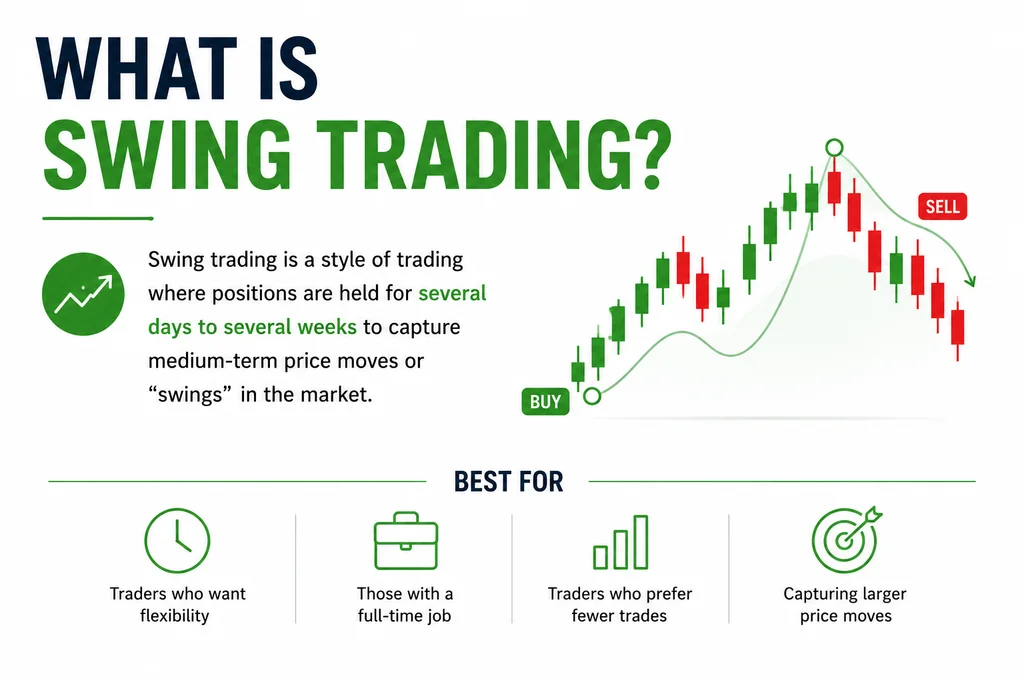
Swing trading is a trading style where you hold a position for a few days to a few weeks, longer than a day trade, but shorter than a typical long-term investment.
For example, say you notice a stock has been trending upward over the past month but just pulled back slightly after a few strong weeks. As a swing trader, you might buy in during that dip, betting the overall uptrend will continue.
If the stock climbs back up and gains 8% over the next two weeks, you sell and lock in that profit, you’re not trying to catch the stock’s entire multi-month run, just that one solid stretch of it.”
The goal is to catch one meaningful “swing” in price, like a stock pulling back within an uptrend and then bouncing, rather than riding the entire multi-year story of a company.
Traders usually enter using one of a few approaches: following an existing trend, betting on a price snapping back after moving too far too fast, or jumping in once price breaks through a key support or resistance level.
Common Swing Trading Styles
Swing traders generally lean on one of a few core approaches to time their entries and exits.
Trend-following swing trades: Identify a stock or asset already in a clear uptrend or downtrend, then enter on a pullback in the direction of that trend.
Mean-reversion: These bet that price has moved too far, too fast in one direction and is due to snap back toward an average or prior level, often used on stocks that look oversold or overbought on shorter timeframes.
Breakout swing trades. Enter when price pushes through a well-established support or resistance level with strong volume, on the theory that the breakout signals the start of a new sustained move.
Pros of Swing Trading
Requires Less Screen Time: Since positions play out over days or weeks, swing traders don’t need to watch charts constantly, a quick check-in once or twice a day is usually enough.
More Flexible Schedule: Trades can be planned and monitored outside market hours, which gives swing traders more control over when they actually sit down to work.
Larger Price Movements Can Be Targeted: Holding a position over several days or weeks gives it room to capture a bigger move than a trade that’s closed within hours.
Cons of Swing Trading
Overnight Market Risk: Positions stay open after the market closes, so a swing trader can’t react to news the moment it happens, only once the market reopens.
Weekend Risk: Positions left open over the weekend are exposed to news or events that occur while the market is fully closed, sometimes for two full days.
Exposure to Unexpected News: Earnings surprises, regulatory announcements, or other headlines can move a position sharply before there’s any chance to exit.
Day Trading vs Swing Trading: Key Differences at a Glance
Aspect
Day Trading
Swing Trading
Screen Time
Needs near-constant monitoring during market hours, you have to be watching to catch fast-moving setups and react in real time
Only needs a few short check-ins a day since positions move slower and don’t need second-by-second attention
Full-Time Job Fit
Hard to combine with a 9-5, since trades happen live during work hours and can’t be managed from a desk job
Fits around a full-time job easily, most of the analysis and order placement can happen before or after work
Trade Frequency
Many trades opened and closed within the same session, sometimes dozens depending on the strategy
Fewer trades overall, since each one is expected to play out over a longer stretch of time
Holding Period
Positions are always closed before the market ends, nothing carries overnight or into the weekend
Positions typically stay open for several days to a few weeks, occasionally longer if the trend holds
Analysis Style
Leans almost entirely on technical analysis, price action, volume, and chart patterns, since there’s no time to weigh fundamentals mid-trade
Combines technical analysis for timing with fundamentals like earnings or sector trends, since the trade has time to develop
Position Sizing
Tends to be larger per trade, which is workable since the exposure is closed out by end of day
Kept smaller and more conservative, since the position needs to withstand several days of normal price swings
Leverage Use
Often higher, because the trade is only exposed to that leverage for a few hours at most
Generally lower, since leverage held open for days multiplies risk if the market moves the wrong way
Stop-Loss Placement
Set tight, close to the entry price, since the strategy is built around small, fast price movements
Set wider, usually at a technical level like a support zone, to give the trade room to breathe through normal volatility
Primary Risk
Slippage and execution risk, the fill price can differ from the intended price during fast market moves
Overnight and weekend gap risk, news breaking while the market is closed can move price sharply before you can react
Tools and Indicators
Leans on moving averages, support and resistance zones, MACD, and price action (candlestick and chart patterns) to read fast-moving price shifts
Uses moving averages, support and resistance zones, RSI, Stochastic Oscillator, Fibonacci retracement, and price action to time entries within a slower-moving trend
Trading Strategies
Common approaches include trend, range, breakout, news, and high-frequency trading, all built around same-day moves
Common approaches include retracement, reversal, breakout, and support/resistance trading, all built around multi-day price swings
The Pattern Day Trader (PDT) Rule Is Gone
FINRA’s long-standing $25,000 minimum for pattern day traders was eliminated in 2026, replaced with a real-time margin framework and a much lower ~$2,000 minimum.
The old 4-trades-in-5-days limit is also gone, traders can now day trade freely, based on their account’s margin rather than a trade count. The change only affects margin accounts; cash accounts remain governed by settlement timing, not the PDT rule.
Brokers have until October 2027 to fully roll out the new system, so it’s worth checking where your broker stands.
Costs and Fees: Day Trading vs Swing Trading
Cost Type
Day Trading
Swing Trading
Commissions
Often $0–$3 per trade with commission-free or discount brokers, but with dozens of trades a day, even small fees add up fast, sometimes $500–$1,000+ per month for active traders
Typically the same $0–$3 per trade range, but with far fewer trades a month, total commission costs usually stay under $50–$100 per month
Bid-Ask Spreads
Paid on every entry and exit, repeatedly
Paid less often, so total cost is lower
Slippage
Higher risk due to fast prices and tight stops
Lower risk, thanks to wider stops and slower moves
Platform/Data Fees
Often $100–$300+/month for real-time data and tools
Usually free or low-cost, using end-of-day charts
Margin Interest
Usually avoided by closing positions same day
Applies if positions are held on margin overnight
Overnight Financing
Not applicable, no overnight positions
Swap/financing charge applies, higher over weekends
How trading frequency affects total costs
The math tends to favor swing trading here. A day trader making 200 trades a month at roughly $5 in round-trip costs per trade is looking at about $1,000 a month in costs, a meaningful drag before any profit is counted.
A swing trader making 20 trades a month at a higher $10 per-trade cost still only pays around $200 a month, simply because there are far fewer trades to pay for. The takeaway: day trading needs a bigger edge just to clear its own costs, while swing trading’s lower frequency gives it more breathing room.
Capital Needs for Swing Trading
Why swing trading has always had a lower practical entry barrier. Swing trading was never subject to the PDT rule in the first place, since it doesn’t involve the same frequency of same-day trades.
That means swing traders have long been able to start with a smaller account and fewer regulatory hurdles than day traders faced under the old $25,000 rule.
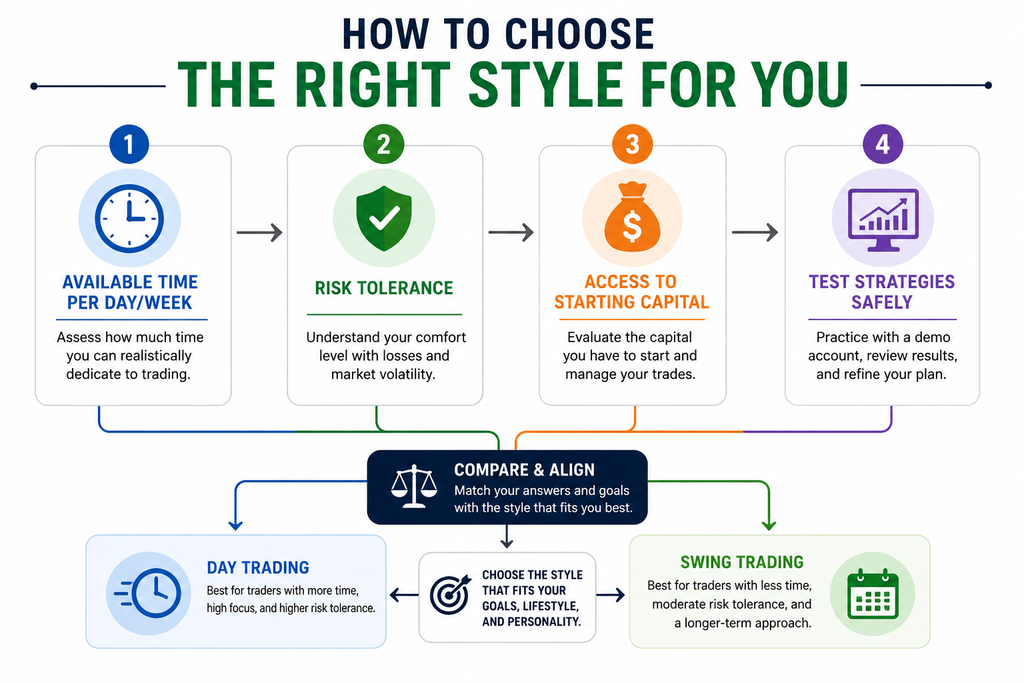
Choosing between day trading and swing trading isn’t about which one performs better on paper, it’s about which one actually fits your time, temperament, and financial situation.
A quick self-assessment, paired with safe testing before committing real capital, can make that decision much clearer.
Available time per day/week
Can you sit and monitor markets for several hours during the trading session, or do you only have short windows before/after work?
Risk tolerance
Are you comfortable with the sharper, faster swings in P&L that day trading brings, or would you rather absorb risk more gradually over days?
Access to starting capital
How much can you afford to trade with, and how much of that could you afford to lose without it affecting your finances?
Stress tolerance and personality
Do you make better decisions under pressure and fast pace, or do you think more clearly with time to sit on a decision?
Testing Strategies Safely
Paper trading and simulators: Practice either style with fake money first, so mistakes cost nothing while you learn how you actually react to wins and losses.
Starting small before scaling size: Once trading real money, begin with small positions and only increase size after proving you can follow your plan consistently.
Conclusion
Both day trading and swing trading can work, but they demand very different things from the person using them.
Day trading rewards speed, discipline under pressure, and the ability to be fully present during market hours; it suits people who can dedicate real time to watching the market and who are comfortable with fast, frequent decisions.
Swing trading rewards patience and the ability to sit with a position while a thesis plays out over days or weeks; it suits people who want exposure to the markets without giving up a full-time job or other daily commitments.
Neither approach guarantees success. Both come with real costs, real risk, and a learning curve that takes time and discipline to work through.
What matters most is being honest about your available time, risk tolerance, starting capital, and how you handle pressure, then choosing the style that actually fits, rather than the one that sounds more exciting.
Join UEEx
Experience the World’s Leading Digital Wealth Management Platform
Is day trading or swing trading better for beginners?
Swing trading is generally considered more beginner-friendly. It requires less screen time, gives you more room to think through decisions, and doesn’t demand the fast, high-pressure reactions that day trading does, making it easier to learn while still working a regular job.
Do I still need $25,000 to day trade?
No. FINRA eliminated the $25,000 Pattern Day Trader minimum in 2026, replacing it with a real-time, risk-based margin system and a lower standard minimum. Requirements can still vary by broker and asset class, so it’s worth checking with your specific platform.
Which style is riskier, day trading or swing trading?
Both carry real risk, just different kinds. Day trading exposes you to slippage and fast, emotionally-charged losses within a single session. Swing trading exposes you to overnight and weekend gap risk, since positions stay open when the market is closed and can’t be exited immediately if news breaks.
Can I do both day trading and swing trading at the same time?
Yes. Some traders keep a portion of their capital in swing positions while actively day trading with another portion, though this requires more experience to manage well and can add complexity to risk management and taxes.
How much money do I need to start swing trading?
There’s no fixed minimum, depending on the asset class and how conservatively you size your positions. Starting smaller while learning is generally safer than committing a large amount right away.
Which trading style makes more money?
Neither style is guaranteed to make more, it comes down to skill and discipline, not the strategy itself. Day trading can produce faster, more frequent gains but comes with higher costs and more room for error. Swing trading tends to bring fewer, larger gains with lower costs. The trader who sticks to a plan that fits them usually does better than one chasing whichever label sounds more profitable.
Hello, welcome to my Profile. I am a passionate content writer, copywriter and fiction writer. I have a zeal to always deliver engaging and high quality content. I’ve perfected the art of blending imaginative thoughts with relatable themes crafting stories that captivates and connects with various audiences.
Disclaimer: This article is intended solely for informational purposes and should not be considered trading or investment advice. Nothing herein should be construed as financial, legal, or tax advice. Trading or investing in cryptocurrencies carries a considerable risk of financial loss. Always conduct due diligence before making any trading or investment decisions.
Trade with proof of Reserves
UEEx publish monthly audits and third party verification on every listed market.