Crypto markets move fast. Headlines, influencers, and social media can send prices surging or crashing within hours often with little connection to the underlying project’s actual quality.
Crypto fundamental analysis is exactly how you cut through all the hype. It’s a grounded way to figure out if a project actually has legs or if it’s just riding a wave that’s eventually going to crash
In this article, we’ll help you simplify how to read cryptocurrency fundamental analysis in crypto trading. Our guide will cover its basic principles, key indicators to keep an eye on, and common mistakes to avoid.
Related Reads: Factors Behind The Volatility of Crypto Market, Privacy Focused Cryptocurrency and Why Is Everyone Suddenly Paying Attention.
What is Crypto Fundamental Analysis and Why is it Important
Cryptocurrency fundamental analysis is the process of evaluating a digital asset’s value based on a range of factors that affect its utility, adoption, and potential for future growth.
The aim of fundamental analysis is for investors to determine whether a crypto asset is undervalued or overvalued. The factors examined include its technology, development team, use case, market potential, and the overall stability of its network.
Investors sometimes confuse fundamental analysis with technical analysis. However, technical analysis relies on historical price patterns and trading volumes.
For instance, imagine you want to buy a piece of land or a building. Fundamental analysis would involve thoroughly evaluating the surrounding neighborhood to assess its potential for growth and long-term value.
This means looking at factors like the quality of local schools, the proximity to hospitals, the availability of transport links, and other amenities that might attract future buyers or tenants.
Additionally, you would inspect the property itself to ensure it’s in good condition and has features that make it a worthwhile investment.
On the other hand, technical analysis would focus solely on the historical price trends of the house and similar properties in that area.
Investors would analyse past sales data, price fluctuations, and market trends over time to determine whether the property is likely to appreciate or depreciate.
This approach relies heavily on statistics and patterns rather than the intrinsic qualities of the property or its surroundings.
In essence, fundamental analysis looks at the broader picture and the inherent value of an investment, while technical analysis focuses on past performance and price trends to make predictions about future value.
Read Also: Mastering Crypto Chart Patterns for Profitable Trading
Key Indicators of Crypto Fundamental Analysis
Fundamental analysis in crypto trading involves a thorough examination of various key indicators. Let’s examine these indicators below:
1. The Whitepaper
A digital asset’s whitepaper is an important document that states its purpose, technology, and the problem it aims to solve. It is often the first point of contact for investors and provides a comprehensive overview of the project’s goals, architecture, and roadmap for development.
When analysing a whitepaper, you should pay attention to various key points, such as:
The problem statement
This shows the aim of the project and points to whether the cryptocurrency addresses a real and significant problem.
For example, Bitcoin Whitepaper claims that the digital asset aims to work as money outside the control of any person or institution.
Technical specifications
This focuses on the technology behind the project, such as Proof-of-work (PoW) or Proof-of-Stake (PoS), and helps determine its interoperability, safety, efficiency, and many more.
These factors also help investors decide whether the project is feasible in the long term.
Tokenomics
The Whitepaper should clearly state the Tokenomics method as it helps to determine how the token supply is managed.
This also underlines whether there are mechanisms to prevent inflation or deflation in place.
Roadmap
This gives investors an insight into whether the project has a clear and realistic timeline for development.
For instance, the Ethereum website has a comprehensive guide for all crypto enthusiasts to follow its roadmap and next plan of action.
However, while a well-written whitepaper with a clear and innovative vision is often a positive indicator, investors should also be wary of overly ambitious promises that may be difficult to deliver on.
Read Also: Encryption Algorithms in Cryptography: An Expert Guide
2. The Development Team
The success of a crypto project heavily depends on the expertise and credibility of its development team. Therefore, you should properly research the background of the team members, looking into their experience in blockchain technology, software development, and business leadership.
Some Key aspects to consider include:
Track record
You need to research the track records of the team.
This helps determine whether they have worked on successful projects before or if they have participated in failed projects.
Transparency
Although some project team members prefer anonymity, it’s still important for investors to put a face to whatever project they are interested in.
Project team members who are accessible and regularly communicate updates to the community are a good boost for the project.
Partnerships
A project that has a team that has established meaningful partnerships with other companies or organizations in the industry is surely a good idea.
For instance, Solana’s success isn’t only due to its technical prowess but also smart partnerships and collaboration.
A strong, experienced, and transparent team is often a good indicator of a project’s potential success.
3. Market Position and Use Case
A digital asset market position and use case are important factors in its valuation. Investors need to understand the specific problem the cryptocurrency aims to solve and how it compares to other projects in the same niche.
For example, the pioneer digital asset Bitcoin (BTC) ranks as number one with a market value of $1.18 trillion at the time of writing.
The asset use case as a decentralized store of value is also well-established. On the other hand, Pepecoin (PEP) ranks at number 5304 and has no intrinsic value as a meme coin.
The clarity and demand for a cryptocurrency’s use case are strong indicators of its long-term viability.
4. On-Chain Metrics
On-chain metrics refer to data that can be obtained directly from a crypto’s blockchain.
These metrics provide valuable insights into the health and activity of a network. Key on-chain metrics to consider include:
Hash Rate
Proof-of-work (PoW) distributed computing systems, like Bitcoin, commonly use cryptographic hashes as part of their PoW algorithm.
The hash rate measures the computational power within a blockchain network, group, or individual miner. It’s determined by the number of guesses (hashes) made per second to solve the cryptographic puzzle.
The mining hash rate is a critical security metric for a blockchain network. A higher hash rate indicates greater computational power, which increases the network’s security and its ability to resist attacks.
Transaction Volume
Transaction volume refers to the total number of crypto transactions executed within a specific time frame.
A high transaction volume typically signifies greater market liquidity, indicating that the cryptocurrency is actively traded and can be bought or sold more easily without significantly affecting its price.
Active Addresses
The number of active addresses can give insight into the level of user engagement and adoption of the cryptocurrency. Active addresses on the blockchain can be traced using explorers like Etherscan or BscScan.
Network Fees
High fees can indicate congestion but can also be a sign of high demand for block space, especially in networks like Ethereum. However, high fees could also deter crypto newbies who might seek alternate assets to invest in.
Overall, these metrics help investors gauge the real-world usage and activity of a cryptocurrency, providing a clearer picture of its adoption and potential growth.
Tokenomics and Distribution
Tokenomics refers to the economic model behind a cryptocurrency.
This includes how tokens are distributed, the total supply, and how new tokens are created or mined. Some key supply metrics include:
- Total Supply vs. Circulating Supply
- Inflation/Deflation Rate
- Burn Mechanisms
5. Community and Ecosystem
The strength and engagement of a cryptocurrency’s community are often overlooked but play a significant role in its success.
A strong community can drive adoption, provide valuable feedback, and even contribute to the development of the project.
Investors should consider the following when evaluating community strength:
- Size and Engagement
- Developer Activity
- Developer Activity
Recommended reading: How To Apply Elliott Oscillator In Crypto Trading
How Is Crypto Fundamental Analysis Different From Technical Analysis?
Most new market participants encounter technical analysis first, candlestick charts, moving averages, RSI levels, and trend lines are visually intuitive and immediately actionable.
But technical analysis has a fundamental limitation: it is entirely backward-looking.
It can tell you where the price has been and sometimes identify patterns that have historically preceded certain moves, but it cannot tell you whether the underlying project deserves any price at all.
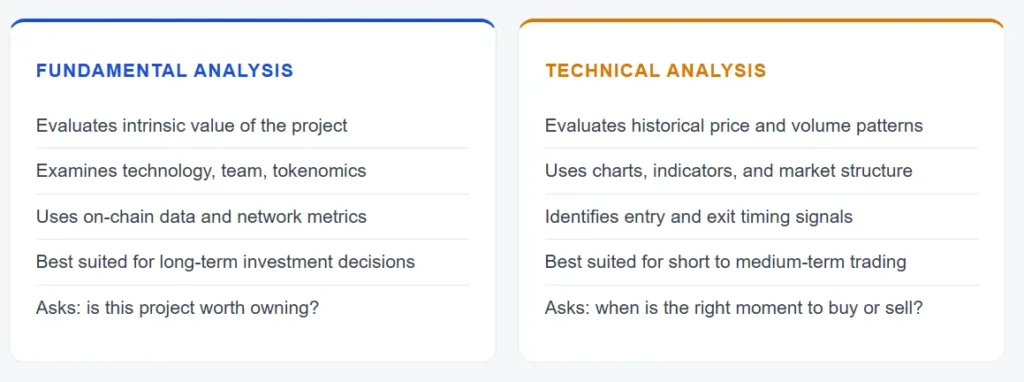
Experienced analysts combine both disciplines.
A common approach is to use fundamental analysis to identify which assets deserve a position in a portfolio, and then use technical analysis to determine the optimal entry point.
Starting with a strong fundamental case and layering technical timing on top produces better risk-adjusted decisions than relying on either method in isolation.
Risks and Challenges in Crypto Fundamental Analysis
While cryptocurrency fundamental analysis is a powerful tool, it is not without its challenges, especially when considering crypto volatility. Some challenges to look out for include:
1. Information Scarcity
The crypto ecosystem is still relatively new, and information can be limited or difficult to verify. This can lead to misinformation or incomplete analysis.
Therefore, investors are advised to carry out thorough investigations before buying an asset.
2. Regulatory Compliance
Regulatory and legal compliance are important factors in determining a cryptocurrency’s long-term value.
Many crypto platforms and token-based projects have failed due to running afoul of legal or regulatory issues.
An example is the case of the United States Securities and Exchange Commission (SEC) vs Ripple, the blockchain developer and creator of the XRP crypto token.
In 2020, the SEC accused Ripple of raising over $1.3 billion in 2013 through the unregistered sale of XRP, alleging it as a security offering to investors.
However, Ripple contested this claim, citing previous statements by an SEC director to support their argument that XRP should not be classified as a security.
While both Ripple and the SEC have won legal battles in this case, the SEC is pursuing remedies against Ripple, including substantial fines.
Investors should carefully analyze whether a cryptocurrency complies with relevant regulations and adheres to industry best practices in all markets it intends to enter or serve.
Non-compliance or unresolved legal matters are significant red flags that pose substantial risks to the project’s viability.
3. Market Manipulation
Investors should be aware that the crypto market is still susceptible to manipulation by large holders or whales, which can distort market prices and lead to inaccurate fundamental assessments.
Due to this, it is advisable to investigate projects that are suddenly making waves in the market without any strong use case.
Which Tools Do Analysts Use to Conduct Cryptocurrency Fundamental Analysis?
Read Also: 5 Best Open-Source Crypto Analysis Software in 2024
Conclusion
If you’re comfortable gambling on the latest social media hype, you probably don’t need this.
But in a $4 trillion market where the “next big thing” can vanish overnight, flying blind is a choice, and usually an expensive one.
Cryptocurrency fundamental analysis isn’t about predicting the future, it is about making sure you aren’t the last one holding the bag when the speculation finally breaks.
Now that the rules have changed and the stakes are higher, you either learn to read the data or you become someone else’s exit liquidity. The choice is yours.