Your bank just charged you $28 to wire money overseas and told you it would arrive in three to five business days.
Meanwhile, someone on the other side of the world received $50,000 in USDT in forty-seven seconds, for less than a cent in network fees. The difference between those two experiences is a peer-to-peer network.
Peer-to-peer networks are not new technology. But in 2026, they have matured from file-sharing curiosities into the backbone of the global digital economy.
Join UEEx
Experience the World’s Leading Digital Wealth Management Platform
This article covers everything, starting from first principles (what a P2P network actually is and how its architecture works) through to how modern P2P crypto trading and remittance rails operate.
A peer-to-peer (P2P) network is a decentralized network architecture where every participating node (peer) can act as both a client and a server simultaneously.
Peers share resources, data, and value directly with each other without routing through a central authority. This distributed structure eliminates single points of failure and single points of control.
The concept emerged from the early internet. Napster, launched in 1999, was the first widely popular P2P platform.
It let users share music files directly with each other, bypassing record labels and distribution servers entirely.
BitTorrent built on this by dividing files into small pieces distributed across multiple peers, which dramatically increased download speeds and made the network impossible to shut down by attacking a single node.
How Does a Peer-to-Peer Network Work at a Technical Level?
The technical mechanics vary by network type, but these four components are present in every P2P system:
1. Peer Discovery
A new node joining the network needs to find other peers. This happens via bootstrap nodes (hardcoded known peers), DNS seeds, or peer exchange protocols.
Once connected to one peer, the node receives a list of others and builds its own peer table.
2. Resource Routing
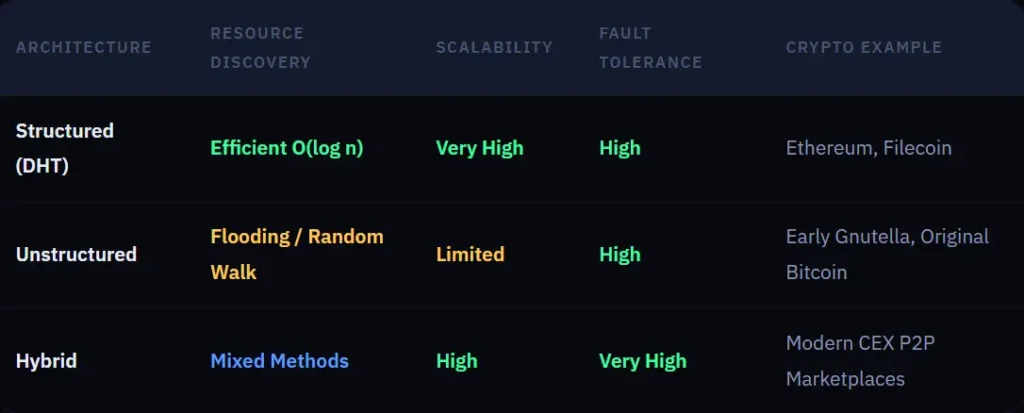
When a node needs a specific resource, it uses either flooding (asking all peers, who ask their peers), random-walk search, or a Distributed Hash Table (DHT) lookup that maps resource identifiers to the specific nodes holding them.
DHTs are the most efficient method and underpin modern P2P crypto networks.
Join UEEx
Experience the World’s Leading Digital Wealth Management Platform
Once a resource is located, the requesting peer downloads it directly from the holding peer.
In blockchain networks, every node independently verifies the validity of data it receives before accepting and propagating it. No trust in the sender is required.
3. Consensus and State Synchronization
Blockchain P2P networks add a consensus layer where nodes agree on the canonical state of the ledger. Proof-of-Work and Proof-of-Stake are the two dominant mechanisms.
This is what allows Bitcoin and Ethereum nodes that have never communicated before to independently arrive at the same account balances and transaction histories.
What Are the Three Types of Peer-to-Peer Networks?
1. Centralized P2P
A central server maintains an index of peers and resources. Peers connect to each other directly, but the index itself is a single point of failure.
Napster used this model, which is why a court order shutting down its servers also shut down the entire network.
2. Decentralized (Pure) P2P
No central server exists. Peers discover each other and route requests independently using flooding or DHT. Bitcoin is a pure P2P network.
Shutting it down would require simultaneously disabling every node in over 190 countries, which is practically impossible.
3. Hybrid P2P
Uses structured overlays for efficient resource discovery while allowing direct peer connections for data transfer.
Most modern P2P crypto exchanges use a hybrid model: on-chain escrow for trustless settlement combined with a platform layer for order matching and dispute resolution.
How Does a P2P Network Compare to a Traditional Client-Server Network?
In a client-server network, all communication routes through a central server that controls access, bandwidth, and availability.
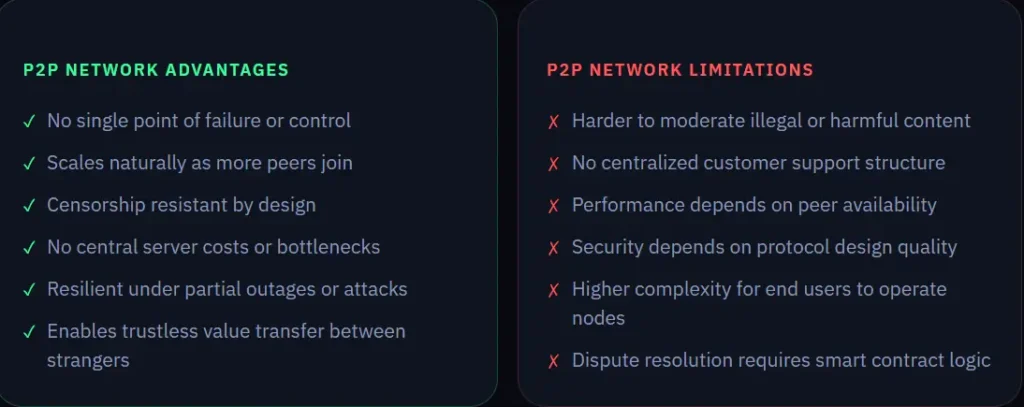
If the server goes down, the service fails. In a P2P network, removing any single node has no effect on overall availability because all peers share the coordination responsibilities equally.
The limitations are real but increasingly solved. Smart contract-based escrow removes counterparty trust requirements.
AI-driven dispute resolution handles most transaction conflicts without human moderators. Layer-2 scaling addresses performance
The P2P model in 2026 retains all the structural advantages while the practical limitations have been engineered away.
How Do Peer-to-Peer Networks Power Crypto Trading and Remittances in 2026?
In crypto, P2P networks enable buyers and sellers to trade digital assets directly without a centralized intermediary holding custody of funds.
Modern P2P crypto platforms use on-chain smart contract escrow to lock assets during trades, Layer-2 networks to reduce settlement costs to under $0.05, and USDT or USDC as the primary trading currency to eliminate price volatility risk.
Classic platforms like LocalBitcoins processed roughly $1.2 billion in weekly volume at their peak but collapsed between 2023 and 2024 under regulatory pressure and technical limitations.
What replaced them is architecturally different in almost every way. USDT and USDC have become the primary settlement rails for P2P trades.
Stablecoins eliminate that entirely while preserving the speed and permissionless nature of blockchain transfers.
The stablecoin market cap exceeded $300 billion in early 2026, and over 85% of all digital cross-border transfers now use stablecoins as the transport layer.
Layer-2 networks including Arbitrum, Polygon, and Base have addressed the cost problem.
Settling a P2P escrow trade on Ethereum mainnet used to cost $15 or more in gas fees.
On Layer-2, the same settlement costs under $0.05.
That brings P2P trading into the practical range for everyday remittance and small-value trades, not just large institutional transactions.
How Do You Actually Execute a Trade on a P2P Crypto Marketplace?
1. Complete identity verification
VASP-compliant P2P platforms require KYC verification before allowing trades.
This takes a few minutes on modern platforms and unlocks higher trading limits, access to verified merchant offers, and dispute resolution protection.
Join UEEx
Experience the World’s Leading Digital Wealth Management Platform
As a buyer, filter offers by currency, payment method, price, and merchant reputation.
As a seller, create an advertisement setting your price (often a small percentage above or below market), minimum and maximum order sizes, and accepted payment methods.
P2P Merchant tools on platforms like UEEX let professional sellers automate pricing with webhook-connected feeds.
3. Initiate the trade and wait for escrow confirmation
Once you select an offer and begin a trade, the seller’s crypto is locked in smart contract escrow on-chain.
Neither party can access those funds until the trade is resolved. This is the critical safety mechanism. You send fiat only after you see the escrow lock confirmed.
4. Send fiat payment using the agreed method
Transfer the fiat to the seller through the agreed payment channel, whether that is a bank transfer, mobile money, PayPal, or another method.
Mark the payment as sent within the platform and upload proof of payment. Do this before the trade timer expires.
5. Seller confirms receipt and escrow releases
Join UEEx
Experience the World’s Leading Digital Wealth Management Platform
The seller verifies the fiat payment and clicks Release. The smart contract escrow automatically releases the crypto to your wallet.
The entire process typically takes under fifteen minutes for bank transfers and under three minutes for instant payment methods.
If the seller does not release after confirmed payment, you open a dispute and the platform’s moderation team investigates using the payment evidence you uploaded.
Advantages of Peer-to-Peer Networks
Distributed architecture
Lack of centralized authority
Cost effectiveness
Stability
Robustness
Real Risks of P2P Crypto Networks and How Do You Stay Safe?
Beyond scam avoidance, there are structural platform risks to consider. Platforms without Proof-of-Reserves audits cannot demonstrate they hold the assets they claim.
Platforms operating as unregistered VASPs are subject to sudden regulatory shutdown, which can freeze user funds indefinitely.
The FTX collapse in 2022 created a lasting shift in how serious traders evaluate custodial and platform risk.
Cold storage architecture and published Proof-of-Reserves are now baseline requirements for any platform trusted with meaningful capital.
Slippage and off-ramp fees are the less dramatic but equally real financial risks in P2P trading. P2P price offers are not always at spot.
Merchants set their own prices, which can be 0.5% to 3% above or below market depending on payment method liquidity in your region.
Always compare the effective exchange rate inclusive of the merchant premium before initiating a trade, and factor in any off-ramp fees your local payment method charges when calculating the true cost of the transaction.
Join UEEx
Experience the World’s Leading Digital Wealth Management Platform
How Does UEEX Make Peer-to-Peer Trading Safe, Instant, and Profitable?
1. On-chain smart contract escrow
Every P2P trade on UEEX locks assets in a verifiable on-chain escrow before any fiat changes hands. Neither party can access the escrowed funds unilaterally, which eliminates the most common P2P scam vectors entirely
2. USDT and USDC primary settlement rails
All P2P trades settle in stablecoins, removing price volatility from remittance and trading transactions. TRC-20 USDT is available for the highest-volume corridors in Southeast Asia, Africa, and the Middle East, keeping off-ramp fees near zero.
3. Layer-2 speed and cost
UEEX routes P2P settlements through Layer-2 networks where applicable, reducing settlement costs to fractions of a cent and confirmation times to under three minutes.
4. VASP-compliant KYC with streamlined onboarding
UEEX meets MiCA, FATF Travel Rule, and regional VASP requirements in every market it operates.
Compliance is built into the platform, not bolted on, which means your funds are protected by regulatory frameworks, not just platform promises.
5. Independent Asset Vault and multi-level verification
User assets are held in segregated cold storage, separate from operational funds. Multi-level verification prevents unauthorized account access.
Proof-of-Reserves audits are published so you can verify the platform’s solvency independently.
6. P2P Merchant tools and webhook pricing
Professional P2P merchants can automate advertisement pricing with live market feeds via webhooks, set automated order management rules, and scale across high-volume corridors without manual intervention.
7. Spot Trading, Futures (up to 125x), and Copy Trading under one roof
Capital that is not deployed in an active P2P trade can earn yield through UEEX Savings or DeFi Cloud Mining, or be deployed in Spot or Futures trading without leaving the platform ecosystem.
Join UEEx
Experience the World’s Leading Digital Wealth Management Platform
Join over one million users across 110 countries who send, trade, and earn through UEEX’s P2P Marketplace. Your first trade takes less than five minutes to set up.
Ayodeji Akingbade is a seasoned content writer with years spent explaining complex financial topics, cryptocurrencies, and investments in easy-to-understand terms. He is passionate about the intersection of money, technology and how individuals can achieve their goals through strategic use of available resources.
Ayodeji strives to create content that is both informative and engaging. Whether the subject is cryptocurrency trading strategies or real estate investment tips, his writing ensures the reader walks away feeling their time was well spent. When not putting pen to paper, Ayodeji enjoys developing sales pitches for real estate clients or cheering on his favorite football team.
Disclaimer: This article is intended solely for informational purposes and should not be considered trading or investment advice. Nothing herein should be construed as financial, legal, or tax advice. Trading or investing in cryptocurrencies carries a considerable risk of financial loss. Always conduct due diligence before making any trading or investment decisions.
Trade with proof of Reserves
UEEx publish monthly audits and third party verification on every listed market.