Most new traders lose money not because they picked the wrong coin, but because they never decided in advance when to get out.
Roughly 88% of active traders use stop-loss orders as part of their routine, according to Quantified Strategies survey, yet a huge share of retail accounts still blow up in their first year. The gap between those two facts is what this guide is about.
Stop loss and take profit orders are the two simplest tools in trading and also the two most misunderstood. This guide breaks down exactly how each one works, when to use which strategy, and why the difference between a 1% stop and a 5% stop can decide whether you’re still trading a year from now.
We’ll walk through real trade math, the Terra LUNA collapse, current Bitcoin volatility data, and the platform settings on Binance, Coinbase, and UEEx so you can set these orders correctly today.
Key Takeaways
- Set your stop loss before you enter the trade, not after
- Aim for a minimum 1:2 risk-to-reward ratio on every position
- Never move your stop loss further away once it’s set
- Widen or tighten your stop based on current volatility, not habit
- Write down every trade so you can see your real numbers, not your memory of them
What Are Stop Loss and Take Profit Orders?
Stop loss and take profit orders are pre-set instructions that automatically close your trade at a specific price.
A stop loss sells your position if the price drops to protect you from further loss. A take profit sells your position once your price target is hit, locking in the gain. Together, they remove the need to watch a screen all day and decide, on the fly, when to sell.
Here’s a plain example: You buy Bitcoin at $100,000. Then, you set a stop loss at $95,000, so if the price falls 5%, you’re out with a small, known loss. You also set a take profit at $115,000, so if the trade works, you lock in a 15% gain automatically. You don’t have to be at your desk for either one to trigger.
Stop loss, in practice
A stop loss sits below your entry price if you’re long (buying) or above it if you’re short (selling first, buying back later). There are a few types worth knowing:
- Stop-market: triggers a market order once the price is hit. Fast, but can fill at a worse price during a fast move.
- Stop-limit: triggers a limit order at a price you set. Guarantees price, but might not fill at all in a crash.
- Trailing stop: moves with the price in your favor, locking in gains as the trade works, but never moves against you.
Take profit, in practice
A take profit sits above your entry for a long position or below it for a short one. Most traders use a straightforward limit order here, since you’re not in a rush to sell into strength the way you are to sell into weakness.
Stop loss vs take profit at a glance
| Feature | Stop Loss | Take Profit |
| Purpose | Limit losses | Lock in gains |
| Placement (long) | Below entry | Above entry |
| Placement (short) | Above entry | Below entry |
| Common order type | Stop-market or stop-limit | Limit |
| Psychological role | Stops panic-holding a loser | Stops greed-holding a winner |
| Typical risk | Slippage in fast markets | Usually fills close to target |
A stop loss isn’t a prediction that you’re wrong. It’s the price of admission for being in the trade at all.
Skipping either order isn’t neutral. It’s a decision to let emotion, not a plan, decide your exit. For a broader view of how this fits into your overall approach, see our crypto risk management guide.
Stop Loss Strategies That Actually Work
Explore these stop loss strategies for better investment
Fixed percentage stop loss
The simplest method: pick a percentage (commonly 1 to 5% for Bitcoin, wider for altcoins) and set your stop that far from entry every time.
Example: You buy Bitcoin at $100,000 with a 3% stop. Your stop sits at $97,000. If the price drops to $97,000, you’re out with a $3,000 loss on a 1 BTC position. It’s simple, consistent, and easy to automate, but it ignores where support and resistance actually sit on the chart, which means you’ll sometimes get stopped out right before a bounce.
Best for: beginners and anyone running a mechanical, rules-based system.
Support and resistance stops
Instead of a flat percentage, you place your stop just past a level the market has already respected. For a long position, that means just below recent support, with a small buffer (often 0.5 to 2%) so a temporary wick (thin line on a candlestick chart that shows the extreme high and low prices reached by an asset during a specific time period) doesn’t take you out.
If Bitcoin has bounced off $66,500 three times in a month, a stop at $66,200 respects that structure. A stop at exactly $66,500 often gets clipped by the wick before the price reverses higher. This method tends to produce a better hit rate than fixed percentages, but it takes chart-reading practice.
Our technical analysis indicators guide covers how to spot these levels.
ATR-based stops
Average True Range (ATR) measures how much an asset typically moves. Instead of guessing a percentage, you set your stop at a multiple of ATR, so it automatically adapts to how choppy the market currently is.
Bitcoin’s realized volatility has actually come down a lot since its early years. Its 2025 historical volatility ran around 42% annualized, and its average true range as a share of price fell from roughly 6.8% to about 3.4% over that period, putting it closer to large, volatile tech stocks than to the wild swings of 2021, according to Charles Schwab’s market research desk.
That’s still far more movement than gold or the S&P 500, so a stop that works on a stock rarely works on Bitcoin without adjustment. A common approach: multiply the 14-day ATR by 2 and set your stop that distance from entry.
In calmer periods this tightens your risk automatically. In volatile periods it widens, so normal noise doesn’t stop you.
Best for: swing traders and anyone trading across different volatility regimes.
Trailing stops
A trailing stop follows the price up (for a long) at a fixed distance but never moves down. If Bitcoin runs from $100,000 to $115,000 with a 5% trailing stop, your stop rises step by step to $109,250. If the price then reverses, you’re taken out with most of the move captured instead of guessing a fixed exit in advance.
Trailing stops are especially useful in crypto because trending moves can run much further than traders expect. For instance, Binance supports trailing stops on both spot trading (with a trailing delta from 0.1% to 20%) and futures (a callback rate up to 10%), so this isn’t a futures-only feature the way it used to be on some platforms.
Best for: trending markets and traders who don’t want to guess a single exit price.
Risk-reward based stop placement
Here you flip the process: find your technically justified stop first (based on structure, not a round number), then size your take profit off that risk to hit your target ratio.
Example: You long Bitcoin at $100,000 with a stop at $97,000 (a $3,000 risk). At a 1:3 target, your take profit sits at $109,000. If that number happens to line up with a real resistance level or a Fibonacci extension, the trade makes sense. If it doesn’t, that’s a signal to skip the trade rather than force it.
Scaling out with multiple take profit levels
Rather than closing 100% of a position at one target, many traders close it in pieces. A common split: 40% at a 1:1 target, 30% at 1:2, and let the final 30% run with a trailing stop.
This does two things. It locks in a real, realized gain early, which reduces the “I gave it all back” feeling if the price reverses, and it still leaves room to catch a bigger move if the trend continues. The tradeoff is more complexity and more transaction fees, so it works best on platforms with low or no maker fees and simple partial-close tools.
Take Profit Strategies Worth Knowing
Explore these take profit strategies for better investment
Fixed price targets
Set your take profit at a level the market has already shown it respects: a prior high, a round psychological number, or a Fibonacci extension (commonly 1.272 or 1.618 times the prior move). These levels attract other traders’ orders too, which is exactly why they tend to hold.
Trailing take profit
The mirror image of a trailing stop. Instead of locking in one fixed target, you let the exit trail behind the price as it climbs, only closing once the market actually turns. Most exchanges don’t offer this natively for take profit the way they do for stop loss, so traders typically approximate it by moving a limit order manually or switching to a trailing stop once an initial target is hit.
Partial profit-taking
Covered above under stop-loss scaling, but worth repeating from the profit side: taking 50% off at a 1:1 target and moving your stop to breakeven on the rest is one of the lowest-stress ways to trade. Worst case after that point, you walk away with a small win instead of a loss.
Time-based exits
Some setups call for closing a trade after a set period regardless of price, particularly around weekends (when crypto liquidity thins out) or ahead of major scheduled events like a Federal Reserve rate decision. This isn’t about predicting direction but avoiding exposure to the kind of gap risk that a normal stop loss can’t fully protect against.
Indicator-based exits
Instead of a fixed price, some traders exit when a signal turns, such as the Relative Strength Index (RSI) moving into overbought territory above 70 or price closing below a key moving average. This adapts better to trending markets than a fixed target, but it depends on screen time and judgment, which makes it harder for beginners to apply consistently.
Risk-Reward Ratio: The Number That Actually Decides If You’re Profitable
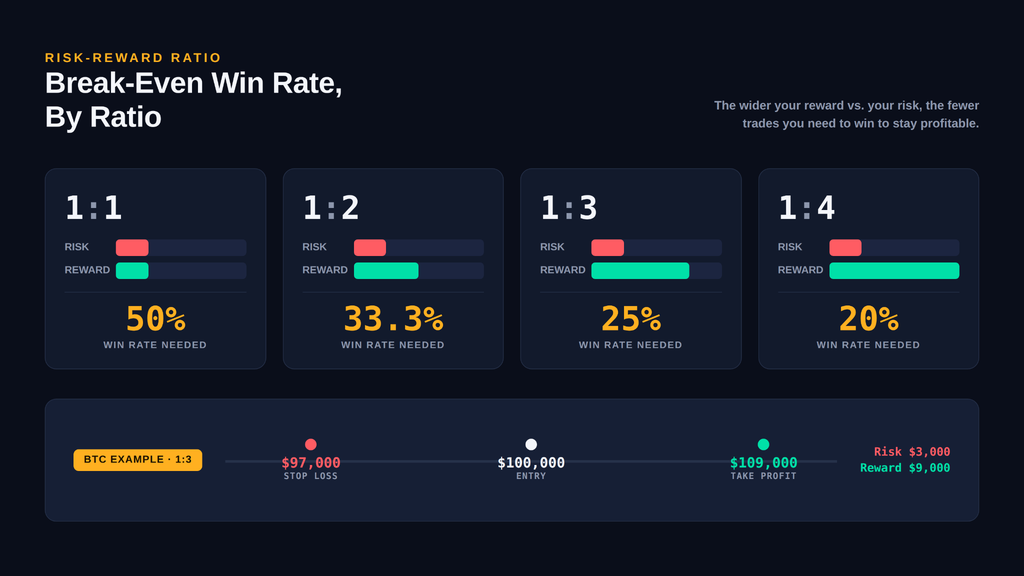
Your risk-reward ratio compares what you’re risking on a trade to what you stand to gain. It matters more than your win rate, and most losing traders have never actually calculated it for their own trading.
Formula: Risk-reward ratio = (Entry price − Stop loss) ÷ (Take profit − Entry price)
Here’s why it matters so much. With a 1:2 ratio, you only need to win about 34% of your trades to break even. At a 1:3 ratio, that drops to 25%. This means a trader who’s wrong most of the time can still come out ahead, as long as the size of the wins outweighs the size of the losses.
| Risk:Reward | Win rate needed to break even |
| 1:1 | 50% |
| 1:2 | 33.3% |
| 1:3 | 25% |
| 1:4 | 20% |
Ten trades at a 1:2 ratio with a 40% win rate: four wins of 200 each ($800) against six losses of 100 each ($600), for a net gain of $200, despite losing more often than winning. Run the same ten trades at a 1:1 ratio, and that same 40% win rate produces a net loss of $200. Same win rate, opposite result, purely because of how the risk and reward were sized.
To improve your own ratio, tighten your stop using structure or ATR instead of a round number, wait for pullback entries instead of chasing price, and be willing to skip trades where the reward doesn’t clear roughly twice the risk.
Track your planned ratio against your actual exit on every trade. Most traders discover they take profit earlier than planned out of fear, which quietly shrinks their edge over time. Tools like TradingView’s built-in trade replay make this easy to check after the fact.
Psychology Behind Stop Loss and Take Profit
Knowing the right level to set isn’t the hard part. Sticking to it is.
Behavioral economists Daniel Kahneman and Amos Tversky’s research on loss aversion found that people feel the pain of a loss roughly twice as intensely as the pleasure of an equivalent gain. That single bias explains most of the bad habits traders develop around exits:
- Moving the stop further away once a trade turns against you, hoping it recovers, which usually turns a small planned loss into a large unplanned one
- Taking profit too early, out of fear the market will reverse and take back an unrealized gain
- Revenge trading immediately after a stop is hit, trying to win back the loss with a bigger, less thought-out position
The fix isn’t willpower but removing the decision from the moment of emotion:
- Set your stop loss and take profit the instant you enter the trade, using an OCO (one-cancels-the-other) order where the platform supports it, so you’re not manually managing either exit mid-trade.
- Write your plan down before you enter: entry, stop, target, and why. If the trade doesn’t go your way, you already know what you’re supposed to do.
- Risk a small enough percentage of your account (many professionals cap it at 1%) that no single trade feels stressful enough to tempt you into breaking your own rule.
- Keep a simple log after every trade: did you follow the plan, and if not, what feeling made you deviate?
The moment a stop loss stops feeling like failure and starts feeling like the system working as designed, trading gets a lot easier.
None of this removes losses from trading. It just keeps a single bad trade from becoming a blown account, which is really the whole point. Our trading psychology and performance hub goes deeper into rebuilding these habits.
Platform-Specific SL/TP Implementation Guide
Take profit (TP) and stop loss (SL) orders help automate exits. However, the exact order types available vary by exchange, account, product, and region, so always check the platform’s current interface before trading.
1. Binance
Spot trading
- Go to Trade → Spot and select your trading pair.
- Choose a “Limit” or supported order type.
- Enter your price and position size.
- Enable TP/SL if available.
- Set your take-profit and stop-loss trigger prices.
- Review the order and submit it.
Binance supports linked order types such as OCO, OTO, and OTOCO, allowing traders to combine entry and exit conditions.
Futures trading
- Open Derivatives → USDS-M Futures.
- Select your trading pair and set leverage.
- Choose a “Market” or “Limit” order.
- Enable TP/SL.
- Enter your TP and SL trigger prices.
- Review your position size and submit the trade.
OCO orders
An OCO (One-Cancels-the-Other) order combines a take-profit and stop-loss. When one side executes, the other is cancelled automatically.
Trailing stops
Trailing stops follow the market as it moves in your favor. Set the required callback or trailing distance where supported.
Binance tips
- Use stop market when getting out of the position is more important than controlling the exact execution price.
- Use stop limit when price control matters, but remember that the order may not fill during a sharp move.
- Use Reduce Only on futures when you want an exit order to reduce an existing position rather than accidentally open or reverse one.
- Set price alerts before key TP/SL levels if you want time to reassess the trade.
UEEx
Setting TP/SL when opening a trade
- Log in and select the asset.
- Choose Spot or Futures.
- Enter your order price and position size.
- Open the Advanced order settings.
- Enable Take Profit and/or Stop Loss.
- Enter the relevant trigger prices and execution method.
- Review the order and confirm it.
Because exchange interfaces and available order types can change, verify UEEx’s current trading documentation before relying on features such as multi-target TP or trailing stops.
Practical tips
- Start with a small position while learning the interface.
- Enable trade notifications so you know when an exit triggers.
- Consider Post-Only orders when your strategy specifically requires maker execution.
- Do not set stops so close to the entry price that normal market volatility repeatedly triggers them.
Coinbase Advanced Trade: Complete SL/TP Guide
Coinbase Pro has been replaced by Coinbase Advanced. Advanced Trade now supports stop-limit, TP/SL, and bracket orders.
TP/SL or bracket order
- Select your trading pair.
- Choose Limit or Market where supported.
- Enable Take Profit/Stop Loss.
- Enter your profit and loss trigger prices.
- Review the order and submit it.
Coinbase’s TP/SL orders work like bracket orders: when one exit condition triggers, the other is cancelled. The activated TP/SL size also adjusts to the amount of the parent order that has filled.
Stop limit order
- Select Stop Limit.
- Enter the Stop Price.
- Enter the Limit Price.
- Enter the order size.
- Confirm the trade.
A stop-limit order becomes a limit order after its stop price is reached. This gives you more price control, but it does not guarantee execution.
Key limitation: Do not describe Coinbase Advanced as having no native TP/SL or bracket functionality. Its current order types include TP/SL and bracket orders. Feature availability can still vary by market and region.
TradingView and API Automation
For traders who need more advanced automation, exchange APIs and TradingView integrations can extend basic TP/SL functionality.
Common uses include:
- Price alerts before a TP or SL level.
- Automated order execution through APIs.
- Strategy-based entries and exits.
- Custom trailing-stop logic.
- Portfolio and risk-management automation.
However, a TradingView alert does not automatically mean an exchange will execute a trade. You need a supported API connection, webhook service, or trading automation platform configured correctly.
Final Tip
TP/SL orders reduce the need to monitor every trade, but they do not eliminate trading risk. Stop orders can experience slippage, especially during fast markets, while stop-limit orders can fail to fill if the market moves beyond the limit price. Choose the order type based on whether execution certainty or price control matters more for the trade.
If you’re still comparing platforms, our guide to the best crypto exchange to start with in 2026 covers order-type support alongside fees and liquidity.
Common Stop Loss Mistakes and How to Avoid Them
A stop-loss protects your trading capital, but using one badly can create problems of its own. Here are seven common mistakes and practical ways to avoid them.
1. Setting Your Stop Loss Too Tight
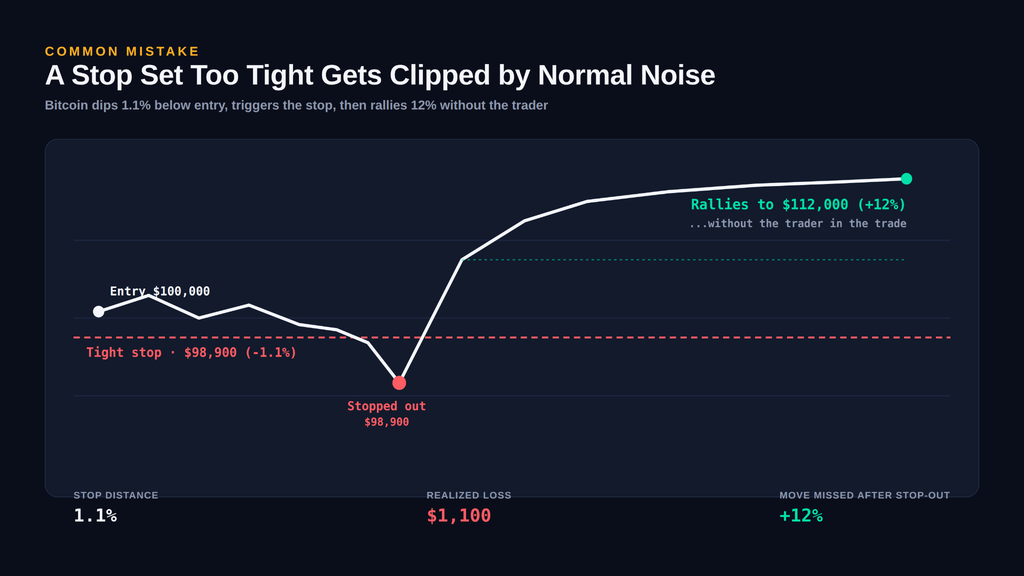
A stop that sits just 1–2% below entry may look safe, but normal crypto volatility can trigger it before your trade has time to develop.
Example: BTC is at $50,000, and you set a 1% stop at $49,500. If BTC briefly falls to $49,450 and then rallies to $53,000, you take a loss and miss the recovery.
Better approach:
- Use ATR (Average True Range) to measure current volatility rather than relying on a fixed percentage. ATR is specifically designed to adapt stop levels to changing market conditions.
- Give the trade enough room to breathe.
- Reduce your position size when you need a wider stop.
Example: With a $10,000 account and 1% risk, your maximum loss is $100. If BTC is $50,000 and your stop is $47,500, a 0.04 BTC position keeps the planned risk around $100.
2. Moving Your Stop Loss Further Away
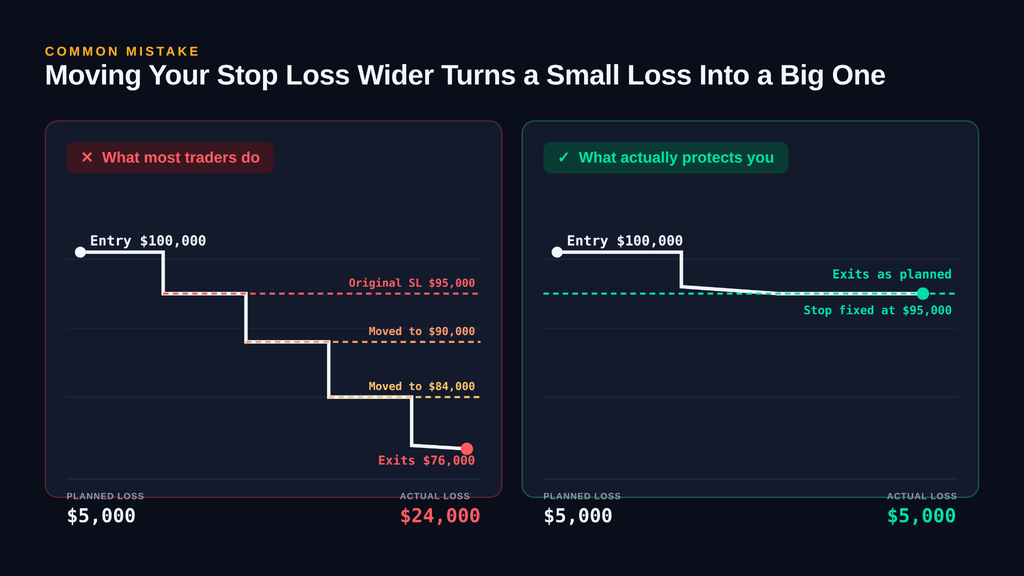
Moving a losing trade’s stop lower because you “need more room” turns a planned loss into an open-ended one.
Rule: Never move a stop farther from your entry after entering a trade.
However, you can:
- Move the stop closer to entry.
- Move it to breakeven when your strategy allows.
- Trail it as the trade moves in your favor.
The goal is to follow your original risk plan, not give a losing trade unlimited chances to recover.
3. Taking Profit Too Early
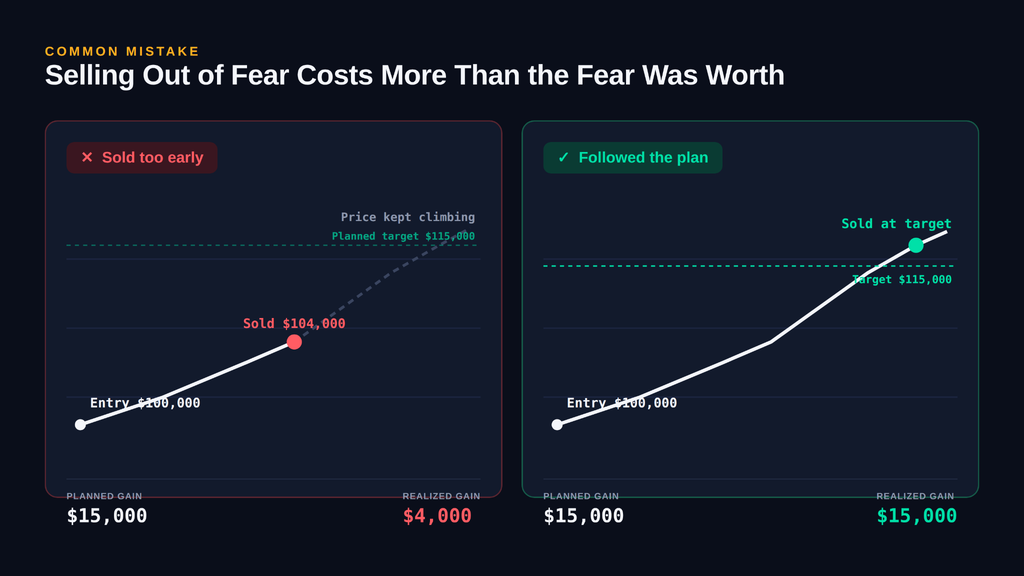
A good strategy can still lose money if you repeatedly cut winners short.
Suppose you risk $100 to target $200. Across 10 trades with five wins and five losses:
- Planned 1:2 R:R: $1,000 gains − $500 losses = +$500
- Early exits at 0.8R: $400 gains − $500 losses = −$100
Fix:
- Set your profit target before entering.
- Consider taking partial profit while leaving part of the position for the full target.
- Record planned versus actual exits in your trading journal.
4. Trading Without a Stop Loss
“I’ll close it manually” sounds reasonable until the market moves too quickly, you lose internet access, or emotions take over.
A preset stop gives you an exit plan without requiring constant monitoring. However, remember that a stop order does not guarantee your execution price. When triggered, it becomes a market order, so fast markets can produce slippage.
Fix: Define your maximum acceptable loss before entering and place the appropriate protective order.
5. Ignoring Slippage and Liquidity
Your stop price is a trigger, not necessarily the price you will receive.
For example, BTC could fall rapidly through a $48,000 stop and fill your position below that level because available liquidity is limited. This risk becomes more important during sharp volatility and in thinly traded markets.
Fix:
- Trade liquid markets when possible.
- Check order-book depth and trading volume.
- Understand how your exchange executes stop orders.
- Remember that a stop limit gives you more price control but can remain unfilled if the market moves beyond your limit price.
6. Using the Same Stop for Every Market
A fixed 5% stop does not make sense for every asset or market condition. ATR measures volatility and can help you adjust your stop to current price movement.
Better approach:
- Check ATR or ATR%.
- Give volatile assets more room.
- Reduce position size when volatility rises so your dollar risk stays within your limit.
- Base the stop on your setup’s invalidation level, not an arbitrary percentage.
7. Revenge Trading After a Stop-Out
One losing trade can quickly become several when frustration takes over.
Typical cycle:
- Trade loses $200.
- You immediately enter another trade.
- Another $200 loss follows.
- You increase position size to recover.
- Losses escalate.
Fix:
- Set a daily loss limit, such as 2–3%.
- Take a short break after a stop-out.
- After several consecutive losses, stop trading for the session.
- Review the trade before entering another one.
A stop-loss is only useful when it is part of a complete risk-management plan. The goal is not to avoid every losing trade. It is to keep individual losses small enough that one bad trade cannot damage your account.
Advanced Topics: AI, Bots & Automated SL/TP
Explore how humans and bots can combine for investment strategies
The Rise of AI Trading Bots in 2026
Automated trading is becoming a bigger part of crypto markets. A 2026 study found that trading activity is heavily concentrated within the first 100 milliseconds of each second, consistent with a major role for algorithmic trading.
Some industry estimates now put automated bots at around 65% of global crypto trading volume, although this figure varies by market and methodology.
Bots offer several advantages:
- 24/7 monitoring: They never sleep or miss a setup.
- Fast execution: They can react in milliseconds rather than waiting for manual confirmation.
- Rule-based discipline: They follow preset SL and TP levels without fear or greed.
- Consistent execution: Backtested strategies can run the same way across thousands of trades.
- Automated risk management: Trailing stops and multiple TP levels can lock in profits as price moves.
Humans still have the edge when markets behave unexpectedly. Traders can interpret news, understand broader market conditions, and change their strategy when a setup no longer makes sense.
The Hybrid Approach
The strongest approach is often human decision-making combined with automated execution.
For example, a trader identifies strong support around $48,000 and decides to take a long position. The bot can then enter near $48,100, place an SL at $47,200, and set a TP at $51,400, giving the trade roughly a 1:2.5 risk-to-reward ratio.
Popular Crypto Trading Bots in 2026
- 3Commas: Supports automated trading, trailing TP, and multiple TP targets. Its current tools support up to six TP targets in some configurations.
- Bitsgap: Offers grid, DCA, and futures bots, demo trading, and backtesting.
- Cryptohopper: Provides automated strategies, marketplace tools, and portfolio automation.
- Pionex: Built-in bots eliminate a separate bot subscription, although normal trading fees still apply. Its bots support TP and SL controls.
Best Practices for Bot Trading
Before using real money:
- Start with demo trading where available.
- Begin small rather than risking your entire account.
- Test one strategy at a time.
- Backtest across different market conditions.
- Include trading fees and slippage in your calculations.
- Review the bot regularly. Automation does not mean risk-free trading.
Avoid over-optimizing a strategy simply to produce impressive backtest results. A bot can execute a bad strategy perfectly.
When to Use Bots vs. Manual Trading
Bots work best for:
- Scalping and high-frequency strategies
- Grid and range trading
- Trailing SL/TP management
- Mechanical, rules-based systems
- Strategies that require constant monitoring
Manual trading works better for:
- Major market turning points
- News-driven events
- Low-liquidity assets
- Complex multi-timeframe setups
- Trades requiring subjective judgment
The key lesson for 2026 is simple: let humans choose the trades and let bots handle execution. Automation can improve discipline and speed, but it cannot remove market risk or replace good strategy selection.
Tax Implications of Stop-Loss and Take-Profit
The tax treatment depends on your country, holding period, and whether you trade as an investor or business.
How SL and TP Are Taxed
In the US, crypto is treated as property. Selling or exchanging it can create a capital gain or loss.
- Short-term: Assets held for one year or less are generally subject to short-term capital gains rules.
- Long-term: Assets held for more than one year qualify for long-term capital gains treatment.
- SL/TP triggers a disposal: When an order sells your crypto, you generally calculate the resulting gain or loss for tax purposes.
- You do not need to withdraw cash: Reinvesting the proceeds does not normally erase the taxable event.
Example: Buy BTC for $40,000 and sell it through a TP order for $50,000. Your taxable gain is $10,000, subject to the rules and rates that apply to you. Note that your capital gains amount is added to your income, and you are then taxed according to the bracket you fall in.
The UK similarly treats most individual crypto investing as subject to Capital Gains Tax when crypto is disposed of.
How Trading Frequency Affects Tax
Frequent SL/TP trading can create more taxable transactions and make record-keeping harder.
- Frequent trading: More short-term disposals and potentially higher tax exposure.
- Longer holding periods: In countries such as the US, holding for more than one year can qualify gains for long-term treatment.
- Losses: A stop-loss that closes a position below your cost basis can create a capital loss that may offset eligible gains, subject to local rules.
Ways to Manage Your Tax Bill
- Plan your holding periods: Avoid unnecessary disposals when tax efficiency matters.
- Harvest losses: Realizing eligible losses can reduce taxable gains, but check local rules before selling and rebuying.
- Keep detailed records: Track purchase price, sale price, dates, fees, and transaction history.
- Use tax software: Tools such as CoinTracker, Koinly, and CryptoTaxCalculator can simplify reporting.
- Check local rules: EU tax treatment varies by country, while DAC8 now requires crypto service providers to collect and report certain transaction data from 2026.
Tax rules change frequently. For example, the UK is planning changes to eligible stablecoin taxation from April 2027. Always check your local tax authority or consult a qualified tax professional before changing your trading strategy.
For a deeper walkthrough, see our full crypto tax guide.
Conclusion
Stop-loss and take-profit orders are not optional extras. They are core tools for protecting capital and enforcing discipline in crypto trading. In 2026, with markets still prone to sharp swings and crypto derivatives trading expanding, predefined exits matter more than ever.
This guide covered how SL and TP orders work, strategies for setting them, risk-reward ratios, exchange-specific execution, common mistakes, real market examples, automated trading, and tax considerations.
The key lesson is simple: protect your capital first, control your position size, and let your winners run without letting losses spiral. Whether you trade manually or use a bot, a clear exit plan removes emotion from decisions and gives every trade a defined risk before you enter.
Frequently Asked Questions
What is a good risk-reward ratio for trading?
Most professional traders target a minimum of 1:2, meaning the potential reward is at least twice the amount risked. At that ratio, you only need to win about a third of your trades to break even, which gives you real room for error.
Should I always use both a stop loss and a take profit?
Yes, on nearly every trade. A stop loss protects you from an open-ended loss, and a take profit protects your gains from evaporating while you wait for “just a bit more.” Skipping either one hands the exit decision to emotion instead of a plan.
How do I stop moving my stop loss when a trade goes against me?
Set it using an OCO or platform-attached order at entry, so changing it mid-trade takes a deliberate extra step rather than a single panicked click. Writing your stop level down before entering and treating “further away” as the one direction you’re never allowed to move also helps.
What’s the difference between a stop-loss order and a stop-limit order?
A stop-loss (or stop-market) order becomes a market order once triggered, guaranteeing an exit but not a price. A stop-limit order becomes a limit order once triggered, guaranteeing a price but not that it will actually fill, which matters in fast, thin markets.