A typical U.S. savings account still offers little interest, while platforms such as Coinbase currently advertise up to 3.50% rewards on USDC for eligible customers. That gap is precisely why learning about the best low-risk yield strategies in 2026 is so important.
DeFi has also become more selective. DeFiLlama reported total DeFi TVL at about $86 billion in August, while stablecoin market capitalization remained above $300 billion. The contrast shows that capital has stayed in stablecoins even as investors have become more cautious about speculative yield opportunities.
This guide focuses on the safer end of the market, covering Aave, Curve, Coinbase, and tokenized Treasury products. You’ll learn how each strategy works, what risks to watch, and how yield may be taxed. No unrealistic 20% APYs or unaudited forks. Just established strategies worth considering in 2026.
Key Takeaways
- Low-risk yield in 2026 means 3% to 8% APY on stablecoins, not the 20%+ APYs that wrecked portfolios in 2021 and 2022.
- Start with a centralized platform like Coinbase (around 3.5% APY) or a tokenized treasury product before touching DeFi lending or liquidity pools.
- Never put more than 30% of your yield portfolio on one platform. Split it across a few, so one bad week at one protocol doesn’t wreck your whole plan.
- Use Layer-2 networks like Arbitrum, Base, or Optimism if your portfolio is under $20,000. Ethereum mainnet gas fees can eat your entire monthly yield.
- Every dollar of yield you earn is taxable income the moment you receive it, whether you sell it or not. Keep records from day one.
What “Low Risk” Actually Means in Crypto
Nothing in crypto is risk-free. Even a bank savings account carries some risk (inflation, for one). So when this guide says “low risk,” it means something specific: strategies built on protocols with years of track record, heavy audit coverage, and yields that come from real economic activity instead of a token printer.
APY vs APR, in Plain Words
APR (Annual Percentage Rate) is the simple yearly rate. On the other hand, APY (Annual Percentage Yield) includes compounding, meaning interest earning interest. A 5% APR paid daily works out to roughly 5.1% APY. Platforms usually advertise APY because it looks bigger, so always compare like for like.
The Four Ways Crypto Yield Gets Made
1. Lending: You supply stablecoins to a pool. Borrowers pay interest to use them. You get a cut.
2. Liquidity provision: You deposit a pair of tokens (say, USDC and USDT) into a trading pool and earn a slice of every swap fee.
3. Holding a yield-bearing token: Some stablecoins, like sDAI, quietly grow in value while sitting in your wallet. No staking button required.
4. Real-world asset (RWA) exposure: Your stablecoins get converted into short-term U.S. Treasuries behind the scenes, and you earn a version of the Treasury yield on-chain.
Risk Tiers, Roughly Sorted
| Tier | Typical APY | Examples |
| Ultra low-risk | 3% to 5% | CeFi savings, tokenized Treasuries |
| Low-risk | 3% to 7% | Blue-chip DeFi lending (Aave, Compound, Morpho) |
| Moderate | 5% to 10% | Stablecoin liquidity pools, yield aggregators |
| High-risk (not covered here) | 15%+ | New protocols, leveraged farms, algorithmic stablecoins |
If you see a stablecoin strategy advertising 20% or more, treat it as a red flag, not a bargain. Sustainable yield in 2026 tracks pretty closely with short-term interest rates and real lending demand, not marketing.
Why 2026 Is a Different Market Than 2021
Three things changed the picture:
Regulation Finally Exists
The GENIUS Act became U.S. law in July 2025, setting reserve and audit requirements for stablecoin issuers. Federal regulators, including the OCC, are finalizing implementing rules through late 2026, with the law’s full effect date set for January 2027.
In the EU, Markets in Crypto-Assets Regulation (MiCA) has already been setting licensing rules for stablecoin issuers since 2024. This doesn’t make yield safe, but it does mean issuers face real oversight for the first time.
Yields Are Lower And More Honest
Aave’s USDC supply rate on Ethereum currently sits in the 3% to 5% range, a far cry from the double-digit and triple-digit APYs common in 2021. However, that’s not a downgrade but a correction. Those old numbers were mostly paid in inflationary governance tokens, not real interest.
Security is still a real problem
DeFi recorded roughly 207 hacks and about $972 million in losses through the first half of 2026 alone, according to TRM Labs report. Two attacks in April, on Drift Protocol and KelpDAO, accounted for more than half a billion dollars combined.
This is exactly why this guide sticks to protocols with long track records and heavy audit histories and why our Smart Contract Audit guide is worth reading before you deposit anything.
Note: Yield in 2026 is smaller than the headline numbers people remember from 2021, and that’s the whole point. Sustainable rates come from real lending demand and Treasury yields, not from a protocol printing tokens to attract deposits it can’t actually support.
Best Low-Risk Yield Strategies 2026
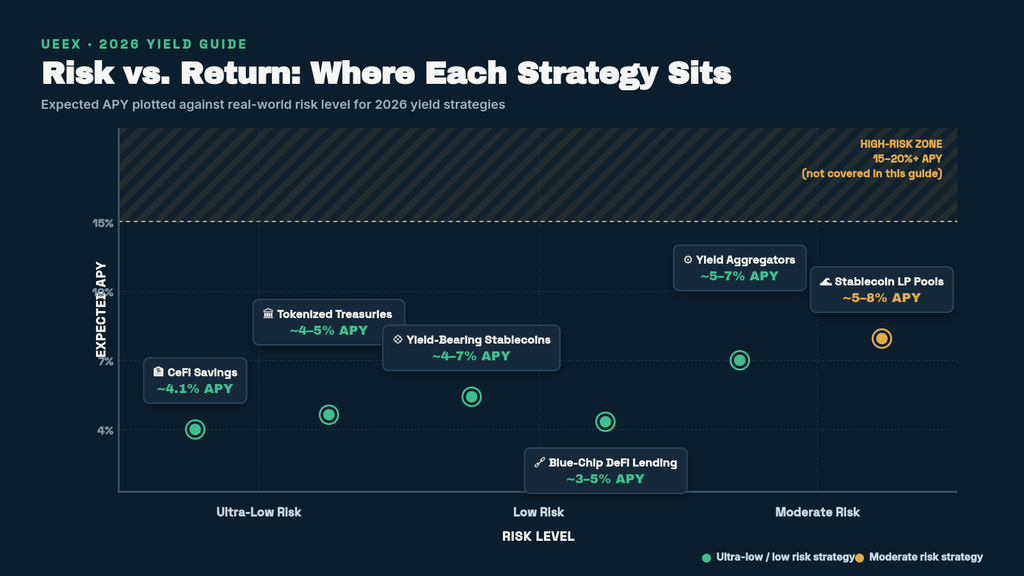
Let’s explore the best low-risk yield strategies
Strategy 1: Centralized Stablecoin Savings (Ultra Low-Risk)
This is the easiest entry point, and it looks a lot like a savings account. You deposit USDC or USDT on a platform like Coinbase, Kraken, or Nexo. The platform lends it out or invests the reserves and pays you a share back. No wallet, no gas fees, no smart contract to trust beyond the platform itself.
Current rates (August 2026):
- Coinbase: around 3.50% APY on USDC, paid weekly, with a modest bump for Coinbase One subscribers.
- Kraken: typically 1.75% to 3.7%, depending on the asset and account type.
- Nexo: rates vary by loyalty tier and lock-up choice, often landing in the high single digits for flexible USDC.
What can go wrong:
Platform bankruptcy is the real risk here, not a hack. Celsius and Voyager collapsed in 2022, and depositors recovered only a fraction of their funds, on a long delay. Stablecoins held this way are not FDIC insured. Only the cash portion converted to U.S. dollars in a bank account might carry deposit insurance, and even that has limits.
How to do this safely:
- Stick to platforms that have operated for several years and publish proof-of-reserves.
- Don’t put more than 30% of your stablecoin savings on any single CeFi platform.
- Understand the difference between flexible accounts (lower rate, withdraw anytime) and locked terms (higher rate, funds tied up).
Strategy 2: Blue-Chip DeFi Lending
This is the next step up in complexity and the classic “low-risk DeFi” move.
You connect a wallet like MetaMask to a lending protocol, deposit stablecoins, and receive an interest-bearing token in return, like aUSDC on Aave, for example. That token’s balance grows as interest accrues. Borrowers on the other side put up more collateral than they borrow, which is what keeps the system solvent.
Aave v3, the largest lending protocol by supply, currently pays roughly 4% to 5% APY on USDC on the Ethereum mainnet, with rates fluctuating based on how much of the pool is currently borrowed. Aave has been through more than a dozen third-party audits since launch and has operated since 2020 without a protocol-level exploit of its core lending markets.
Other blue-chip options worth knowing:
- Compound v3: A similar model, USDC rates are generally in a comparable range, with a long operating history dating to 2018.
- Morpho Blue: Curated vaults that route deposits across underlying lending markets, often landing a point or two above plain Aave or Compound.
- Fluid: A newer entrant that’s grown quickly and, as of September 2026, has been posting some of the more competitive USDC rates among audited lenders.
What can go wrong
Smart contract bugs are the headline risk, even in audited code. Utilization risk is the quieter one: if almost all of a pool is currently lent out, withdrawals can be temporarily delayed until borrowers repay or new lenders arrive. Check a pool’s utilization rate before depositing. Above 90% utilized is a signal to wait or spread your deposit elsewhere.
Practical tip: Gas fees on Ethereum mainnet can run $5 to $30 per transaction. If you’re depositing less than a few thousand dollars, use Layer 2 protocols like Arbitrum, Base, or Optimism instead. Both Aave and most major lending protocols run on these networks with the same audited code and fees closer to a few cents.
Strategy 3: Stablecoin Liquidity Pools
Liquidity pools work differently than lending. Instead of lending to borrowers, you deposit a pair of stablecoins, say USDC and USDT, into a trading pool. Every time someone swaps between those two assets, a small fee gets split among everyone in the pool.
Curve Finance built its reputation on exactly this. Its stablecoin-focused pools, like the well-known 3pool (USDC, USDT, and DAI), use a swap formula designed to minimize slippage between assets that are all supposed to be worth $1.
Base APY on Curve’s stablecoin pools typically runs in the low single digits from trading fees alone, with additional CRV token rewards on top pushing combined yields higher depending on current emissions and lockup choices.
Impermanent loss, explained simply:
Impermanent loss happens when the prices of your two deposited assets drift apart. Since stablecoins are all meant to track $1, this loss is usually tiny, unless one of them depegs. That’s exactly what happened briefly to USDC in March 2023, when it dipped to around $0.87 during the Silicon Valley Bank crisis, before recovering within days.
It’s worth reading our Why Stablecoins Depeg explainer if you want to understand that mechanism before providing liquidity.
What can go wrong:
Curve itself was hacked in 2023 through a bug in the Vyper programming language used by some of its pools, resulting in tens of millions in losses on affected pools. Stick to Curve’s largest, oldest, most audited pools (like 3pool) rather than newer or experimental pairs, and avoid pairing a major stablecoin with an algorithmic one.
Strategy 4: Yield Aggregators (Set It and Let It Rotate)
Yield aggregators, sometimes called vaults, take the manual work out of chasing the best rate. You deposit stablecoins once, and the protocol’s strategy automatically moves funds between lending markets and liquidity pools to capture the best available yield, compounding rewards along the way.
Yearn Finance is the oldest name in this space, running vaults like yvUSDC that route deposits across Aave, Compound, and Curve depending on which is paying the best at the time.
Beefy Finance does something similar across multiple blockchains, auto-compounding rewards several times a day rather than requiring you to manually claim and reinvest.
The tradeoff is added complexity. Every extra protocol layer between you and your money is one more place a bug could exist, and most aggregators charge a management fee plus a cut of profits, typically shaving a percentage point or two off your net return.
Strategy 5: Tokenized Treasuries and Real-World Assets
This is the newest category on this list and, arguably, the most conservative. Instead of lending to crypto borrowers or providing liquidity to traders, your stablecoins get converted into short-term U.S. Treasury exposure, held by a licensed custodian, with the yield passed back to you as a token.
Ondo Finance’s USDY is a widely used example: deposit USD or USDC, and it’s used to purchase short-term Treasuries through a regulated custodian, with the resulting yield reflected in the token’s value. Rates here track closely with prevailing short-term Treasury yields, since that’s literally the underlying asset.
The appeal is obvious: this is about as close as crypto gets to a traditional money market fund, with regulatory compliance and KYC built in. The tradeoff is custodian risk (you’re trusting a third party to actually hold what they say they hold) and, usually, mandatory identity verification that CeFi savings accounts don’t require.
Strategy 6: Yield-Bearing Stablecoins You Just Hold
Some stablecoins are designed to grow in value automatically, with no staking, no claiming, and no separate transaction required.
sDAI, from MakerDAO’s savings rate mechanism, is the best-known example. You wrap DAI into sDAI, and its value versus DAI increases over time based on the protocol’s savings rate, which itself tracks broader interest rate conditions. Unwrap anytime to get DAI back, plus whatever accrued.
This is the closest thing on this list to true “set and forget” yield. It suits people who want simple exposure without checking a dashboard every week, though rates here move with the same broader conditions driving every other strategy on this list, so don’t expect a fixed number forever.
Platform Comparison & Selection Guide
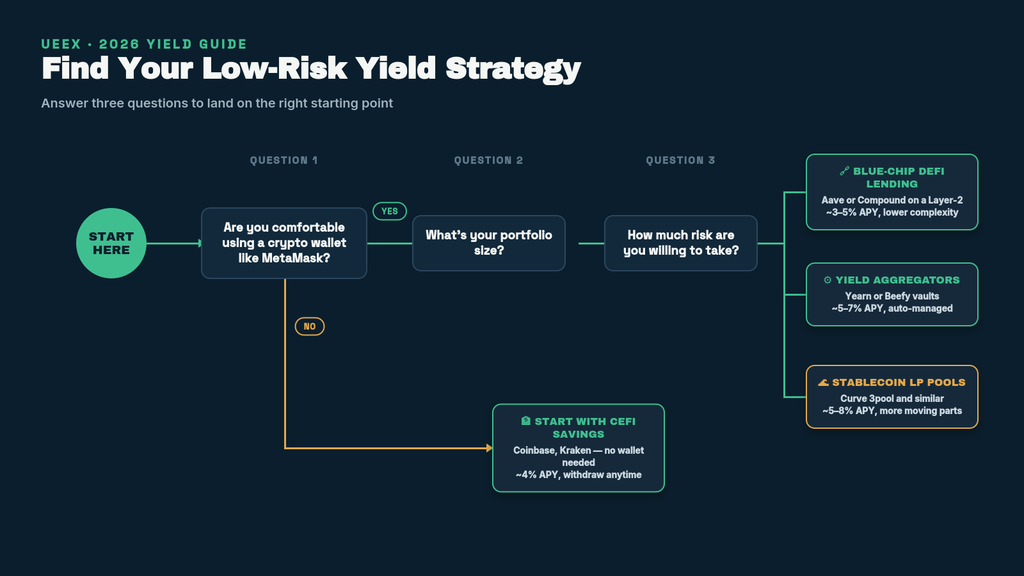
Here’s how to choose the right strategy for you
How to Choose the Right Strategy
The right yield strategy depends on your risk tolerance, DeFi experience, capital size, and how much complexity you can manage.
Risk tolerance
- Ultra-conservative: Prioritize regulated CeFi products and tokenized real-world assets (RWAs). Target roughly 3–5% APY, depending on the product and market.
- Conservative: Focus on established lending protocols and yield-bearing stablecoins. Typical returns can range around 4–10% APY, but rates are variable.
- Moderate: Consider stablecoin liquidity pools and established yield aggregators. Returns can reach 7–12% APY, with added smart-contract and liquidity risks.
- Aggressive: Leveraged and newer protocols can offer 10–30%+ APY, but the risk of permanent capital loss is much higher.
These ranges are guides, not guaranteed returns. DeFi rates change with market demand, liquidity, and protocol parameters. For example, Aave’s supply rates adjust dynamically based on pool utilization.
Technical experience
- Beginner: Start with simple CeFi products such as Coinbase Earn.
- Comfortable with wallets: Use established lending markets such as Aave.
- Intermediate: Explore liquidity pools and established yield strategies.
- Advanced: Consider multi-protocol strategies only after understanding smart contract, liquidity, and liquidation risks.
Capital size
- Under $5,000: Favor low-cost L2 networks or CeFi. Ethereum mainnet fees can make small positions inefficient.
- 5,000 – 50,000: Spread capital across two or three established strategies rather than relying on one protocol.
- $50,000+: Diversify across several strategies and consider custody, tax, and counterparty risks before chasing higher yields.
Platform Comparison Matrix
| Strategy | Platform | Indicative Yield | Difficulty | Typical Cost | Best For |
| CeFi savings | Coinbase | 3.5% USDC rewards* | Very easy | $0 platform fee | Beginners |
| CeFi savings | Nexo | Variable | Easy | $0 platform fee | Users seeking higher CeFi yields |
| DeFi lending | Aave | Variable | Medium | Network-dependent | Established DeFi lending |
| DeFi lending | Aave on L2s | Variable | Medium | Usually low | Lower-cost DeFi |
| Liquidity pools | Curve | Variable | Hard | Network-dependent | Experienced LP users |
| Yield aggregator | Yearn Finance | Variable | Medium | Network-dependent | Automated strategies |
| Yield aggregator | Beefy | Variable | Medium | Usually low on supported L2s/chains | Multi-chain users |
| RWA yield | Ondo USDY | Variable | Medium | Varies | RWA-focused investors |
| Yield-bearing stablecoin | Sky sDAI | Variable | Easy | Network-dependent | Simpler passive strategies |
Note: Coinbase currently advertises 3.50% APY on USDC rewards, but availability and rates vary by region and account type. Coinbase also offers USDC lending through Morpho at rates that can reach higher levels, but those rates are variable.
No single platform deserves 100% of anyone’s stablecoin savings, no matter how long it’s been operating. Spreading deposits across two or three well-audited venues costs you almost nothing in yield and meaningfully limits the damage if any single one has a bad week.
Complete DeFi Security Checklist
Below are security checklists to keep your investment safe
Before Depositing Funds
1. Review security audits: Look for recent audits, formal verification, bug bounties, and reviews from reputable firms. More audits do not automatically mean lower risk.
2. Check TVL and liquidity: Large, stable TVL can signal stronger adoption, but do not treat $1 billion as a safety guarantee.
3. Assess the protocol’s track record: Prefer protocols with a long operating history and evidence of surviving major market stress.
4. Review governance: Check recent proposals, upgrades, admin permissions, and any upcoming changes that could affect your funds.
5. Start small: Test with a small amount before committing significant capital.
6. Verify the URL: Use the protocol’s official website and bookmark it. Phishing sites can mimic legitimate DeFi apps.
7. Secure your accounts: Enable 2FA on centralized exchanges and use a hardware wallet for larger self-custodied holdings.
8. Check available cover: Where appropriate, consider DeFi protection against smart-contract exploits, oracle failures, governance attacks, and other covered risks. Nexus Mutual currently offers protocol and multi-protocol cover, although coverage is subject to specific terms and exclusions.
Ongoing Monitoring
1. Track TVL and liquidity: Watch for sharp, unexplained declines.
2. Watch APY: Sudden yield spikes can signal temporary incentives or elevated risk.
3. Monitor governance: Follow proposals, security announcements, and contract upgrades.
4. Follow official channels: Use the protocol’s Discord, Telegram, X account, and governance forum for timely updates.
5. Check utilization: Extremely high utilization can make withdrawals or borrowing more difficult during market stress.
6. Review your cover: Confirm that your coverage remains active, adequate, and applicable to your specific position.
Emergency Exit Strategy
Exit or Reduce Exposure When:
- A major exploit or security breach is confirmed.
- A malicious governance proposal passes or an unauthorized upgrade is detected.
- TVL falls sharply without a clear explanation.
- A major stablecoin in your strategy loses its peg.
- A protocol faces serious regulatory or operational action.
- Withdrawals become delayed, restricted, or unexpectedly unavailable.
Prepare Before an Emergency
- Keep some funds in readily accessible assets for liquidity.
- Maintain enough ETH or the required native token for gas fees.
- Know where you can move your funds if the protocol becomes unsafe.
- Understand unstaking and withdrawal periods before depositing.
- Keep centralized exchange accounts verified if you may need to convert or move funds quickly.
- Do not wait for an official announcement if your funds are already at risk.
Portfolio Allocation Framework
Conservative: Safety First
- 40%: Regulated or established CeFi stablecoin products
- 30%: Blue-chip DeFi lending such as Aave or Compound
- 20%: Established yield-bearing stablecoin strategies
- 10%: RWA-backed yield products
Target: Prioritize capital preservation over maximum yield. Do not assume a fixed APY.
Balanced: Growth + Safety
- 30%: Blue-chip DeFi lending across established chains
- 25%: Established stablecoin liquidity pools
- 20%: Mature yield strategies or aggregators
- 15%: CeFi liquidity reserve
- 10%: Higher-risk or experimental protocols
Target: Balance yield with diversification and liquidity rather than chasing a specific APY.
Our Crypto Risk Management guide goes deeper into ongoing monitoring, including how to spot early warning signs before an exploit becomes public knowledge.
Tax Planning for DeFi Yield
DeFi yield can create tax obligations even when you never convert your rewards to fiat. The key is to identify when income arises, establish the correct cost basis, and keep records for every transaction.
How DeFi Yield Is Taxed
U.S. tax treatment as of 2026
For U.S. taxpayers, the IRS generally treats crypto rewards as taxable income when they are received or otherwise become available to you, depending on the activity and circumstances. The IRS specifically states that staking rewards are included in gross income when the taxpayer gains dominion and control over them.
- DeFi lending yield: Generally taxable as ordinary income when received.
- Staking rewards: Generally taxable at their fair market value when you gain control of the rewards. The relevant IRS guidance is Revenue Ruling 2023-14, not a 2024 ruling.
- Reward tokens: Their USD value when received generally becomes the cost basis for a later sale.
- Selling or swapping rewards: Can create a capital gain or loss based on the difference between the sale proceeds and your cost basis.
- Depositing or withdrawing your original principal: Generally not a taxable event by itself, provided you are simply moving your own assets and not disposing of them.
The IRS’s 2026 Form 1099-DA rules also matter. Brokers must report qualifying digital-asset sales, but DeFi users should not assume that a lack of a 1099-DA means an activity is tax-free. The IRS requires taxpayers to report taxable digital-asset income, gains, and losses even when they do not receive a form.
Example: Suppose you deposit $10,000 USDC into Aave.
- January 1: Deposit $10,000 USDC. Generally no tax.
- March 31: Receive $200 USDC in yield. Generally $200 of taxable income.
- June 30: Receive 50 AAVE worth $4,000 when you gain control of the rewards. Generally $4,000 of taxable income and a $4,000 cost basis.
- September 30: Sell the 50 AAVE for $5,000. You have a $1,000 capital gain.
That produces $4,200 of ordinary income plus a $1,000 capital gain, before considering applicable deductions, fees, and your individual tax rates.
DeFi Tax Record Keeping
Good records are essential because DeFi activity can span multiple wallets, protocols, chains, and exchanges. The IRS has emphasized that taxpayers may need to calculate their own basis, particularly because DeFi and some foreign brokers may not provide Form 1099-DA.
Track:
- Deposit and withdrawal dates, amounts, tokens, and USD values
- Yield and reward receipts, including the token and USD fair market value
- Claim, harvest, and restaking transactions
- Token swaps and sales
- Transaction fees and gas costs
- Wallet addresses and transaction hashes
- Cost basis and acquisition dates for reward tokens
Useful tools include CoinTracker, Koinly, TokenTax, and ZenLedger. Export transaction data from wallets and block explorers when necessary, then reconcile it against your tax software.
DeFi Tax Optimization Strategies
1. Harvest losses
Selling an asset below its cost basis can create a capital loss that may offset capital gains, subject to applicable rules. Crypto wash-sale treatment remains an area where taxpayers should get professional advice rather than assume stock wash-sale rules apply automatically.
2. Plan reward timing carefully
If a protocol gives you control over when rewards become taxable, the timing of a claim may affect the tax year in which you recognize income. Do not delay a claim simply to avoid tax unless the applicable rules clearly support that treatment.
3. Consider entity structures for large operations
For substantial or business-related DeFi activity, an LLC or other structure may provide administrative or tax advantages, but it does not automatically reduce taxes. Business classification, deductions, reporting, and state rules can all affect the outcome. Speak with a qualified tax professional before restructuring.
4. Consider your tax residency
Crypto taxation varies significantly by country:
- Portugal: Certain crypto gains may be exempt when qualifying assets are held for at least 365 days, but staking and other crypto income can receive different treatment.
- Germany: Private crypto sales are generally taxable when the asset is sold within one year. After the one-year holding period, qualifying private-sale gains can generally fall outside this tax regime. Staking rewards have separate income-tax rules.
- UAE: There is currently no personal income tax, although individuals conducting a business can become subject to UAE corporate tax when business turnover exceeds AED 1 million. Personal investment income is excluded from that turnover test.
Common DeFi Tax Mistakes to Avoid
- Assuming unsold rewards are automatically tax-free. Receiving or gaining control of rewards can create taxable income.
- Ignoring small rewards. Small amounts can still create reporting obligations.
- Losing track of cost basis. Every reward needs a defensible acquisition value and date.
- Ignoring gas and transaction fees. Fees can affect the tax calculation, but their treatment depends on the transaction and jurisdiction.
- Assuming Form 1099-DA covers everything. DeFi transactions may not appear on the form, and taxpayers remain responsible for reporting taxable activity.
- Waiting until tax season. Reconcile wallets, protocols, and exchanges throughout the year to avoid missing taxable events.
Bottom line: DeFi tax planning starts with accurate records. Track every reward, swap, claim, deposit, withdrawal, and fee as it happens. The tax rules can change based on your country, the type of DeFi activity, and whether you operate personally or as a business, so use this as a planning guide rather than individualized tax advice.
For a full walkthrough of reporting requirements, entity structures, and common mistakes, see our Crypto Tax Guide.
Getting Started: A Simple First Move
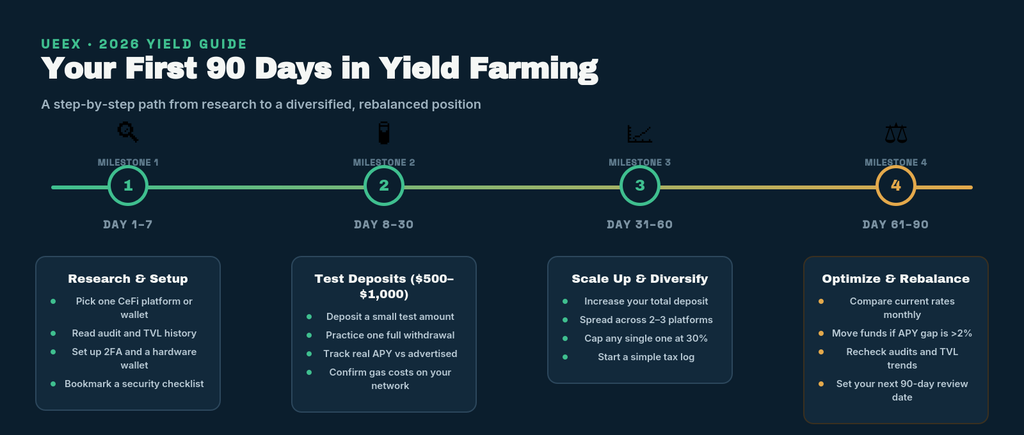
For most people starting out, the lowest-friction path looks like this:
- Pick one centralized platform with a long track record and open an account.
- Convert a modest amount, whatever you’re comfortable holding, into USDC or USDT.
- Turn on the platform’s yield or rewards feature.
- Let it run for a month, and use that time to read up on wallets, gas fees, and audits before considering DeFi lending.
- Once comfortable, split a portion into a blue-chip DeFi lending protocol on a Layer-2 network to diversify beyond a single platform.
What to Avoid Right Now
- Yields advertising more than 15% on stablecoins: These usually run on unsustainable token emissions rather than real revenue.
- Protocols younger than six months with no meaningful audit history.
- Algorithmic stablecoins that aren’t backed 1:1 by real assets. The 2022 collapse of TerraUSD remains the clearest warning on this front.
- Platforms currently in bankruptcy proceedings, however familiar the name. Celsius and Voyager are reminders that brand recognition isn’t the same as safety.
Frequently Asked Questions
What is the safest way to earn yield on stablecoins in 2026?
Centralized platforms with long operating histories, like Coinbase, offer the lowest-friction, lowest-complexity option, currently paying around 3.5% APY on USDC. For an option closer to traditional finance, tokenized Treasury products like Ondo’s USDY convert your stablecoins into short-term U.S. Treasury exposure through a licensed custodian.
How much can I realistically earn with low-risk strategies?
Expect roughly 3% to 8% APY across CeFi savings, blue-chip DeFi lending, and tokenized Treasuries in 2026. Anything advertising significantly more usually involves added risk, whether that’s a newer protocol, a less-audited pool, or rewards paid in a volatile token rather than the stablecoin itself.
Do I have to pay taxes on DeFi yield?
Yes, in the U.S., yield from lending, liquidity pools, or similar mechanisms counts as ordinary income at the moment you receive it, regardless of whether you sell it. Selling a reward token later can trigger an additional capital gains event if its value has changed since you received it.
What’s the difference between APY and APR?
APR is the simple annual interest rate. APY includes the effect of compounding, so it’s usually a slightly higher number for the same underlying rate. When comparing platforms, check whether they’re quoting APY or APR, since mixing the two makes rates look more different than they actually are.