Cryptocurrency portfolio diversification is the practice of spreading investments across multiple digital assets, sectors, and strategies to reduce the risk that any single asset’s poor performance dominates overall returns. In 2025, institutional portfolios allocate 60 to 70% to core assets (Bitcoin and Ethereum), 20 to 30% to fundamentals-driven altcoins, and 5 to 10% to stablecoins for liquidity. With Bitcoin’s 5-year average correlation to the S&P 500 at approximately 0.38, crypto can add genuine diversification to a broader portfolio when sized appropriately.
Key Takeaways
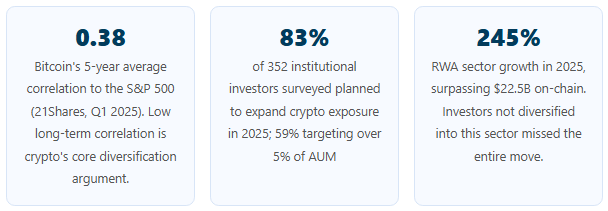
- 75% of institutional investors planned to increase crypto allocations in 2025. 83% of 352 institutional investors surveyed said they planned to expand crypto exposure, with 59% already targeting over 5% of AUM.
- Bitcoin’s 5-year average correlation to the S&P 500 is approximately 0.38, with correlations around 0.20 over the full period from 2014 to April 2025 (21Shares). At modest allocation sizes, crypto can reduce overall portfolio volatility rather than increase it.
- Institutional portfolios in 2025 allocate 60 to 70% to Bitcoin and Ethereum combined, 20 to 30% to fundamentals-driven altcoins, and 5 to 10% to stablecoins for liquidity and yield.
- Real-world assets surged 245% in 2025, surpassing $22.5 billion on-chain. Investors concentrated in a single asset class missed this entire rotation. Sector diversification across DeFi, RWAs, Layer-2, and smart contract platforms captured different return drivers.
- Many altcoins carry high correlation to Bitcoin (often above 0.7 per CME Group research). XRP has notably lower correlation to Bitcoin, Ethereum, and Solana, making it a potentially valuable diversification addition within crypto.
- Over-diversification (“diworsification”) is a real risk. Owning 50 highly correlated, low-quality altcoins provides far less genuine diversification than 8 to 15 well-researched projects across different sectors with different value drivers.
What Is Cryptocurrency Portfolio Diversification?
Cryptocurrency portfolio diversification is the practice of spreading investments across multiple cryptocurrencies rather than focusing on a single asset. The goal is to reduce risk by balancing different types of digital assets, such as Bitcoin, Ethereum, altcoins, stablecoins, and tokenized real-world assets, which perform differently under various market conditions.
Diversifying limits the impact of a sharp decline in any single asset while potentially benefiting from gains in others. In a market defined by high volatility and sharp sector rotations, concentration risk is one of the most avoidable threats to long-term returns. The principle is not new: it is the same logic that drives diversification in traditional portfolios. But in crypto, it requires additional nuance because most digital assets are more correlated with each other than equities in different sectors typically are.
What Are the Benefits of Diversifying a Crypto Portfolio?
Risk Mitigation Across Market Conditions
The primary benefit of diversification is reducing the impact of any single asset’s poor performance on the overall portfolio. During the late-2025 correction, Bitcoin and Ethereum experienced 25 to 30% drawdowns from their peaks. However, certain sectors like real-world assets surged 245% during the same period, surpassing $22.5 billion on-chain. Investors concentrated in a single asset class missed these rotation opportunities entirely. A well-diversified portfolio capturing multiple sectors can experience significantly smoother return profiles than single-asset concentration.
Exposure to Different Sectors of Blockchain Technology
The crypto market consists of genuinely different sectors with distinct value drivers: store of value (Bitcoin), smart contract platforms (Ethereum, Solana, Cardano), decentralized finance, payment tokens (XRP, Litecoin), Layer-2 scaling solutions (Polygon, Arbitrum), infrastructure (Chainlink, Filecoin), and real-world asset tokenization. Each sector responds differently to news, regulatory developments, and technology milestones. Diversifying across sectors means that a regulatory crackdown on one use case or a technology failure in one platform does not simultaneously devastate all positions.
Portfolio-Level Diversification Benefits
At the total portfolio level, adding a modest crypto allocation improves risk-adjusted returns in conventional equity and bond portfolios. Bitcoin’s average correlation with the S&P 500 sits at approximately 0.38 over the 5-year period through Q1 2025, falling to around 0.20 over the full period from 2014 to April 2025 according to 21Shares research. Grayscale’s Monte Carlo simulations suggest that an allocation of approximately 5% to a market-cap-weighted basket of crypto assets including Bitcoin and altcoins could maximise expected risk-adjusted returns without disproportionately increasing overall portfolio risk.
Opportunities for Higher Sector-Specific Returns
Sector rotations in crypto create windows where specific sectors dramatically outperform Bitcoin. During the 2024 to 2025 cycle, AI tokens generated 185% sector growth. Real-world assets surged 245%. Ethereum rallied nearly 42% year-to-date at one point. Investors who diversified across these sectors captured returns that pure Bitcoin holders missed entirely. When Bitcoin dominance falls below 60%, capital typically rotates into altcoins, and historically 75% of the top 50 altcoins have outperformed Bitcoin over 90-day periods during these alt-season phases.
Read Also: Understanding Crypto Market Cycles
What Are the Risks of Crypto Portfolio Diversification?
Over-Diversification and Diluted Gains
One of the most common mistakes is what practitioners call “diworsification”: owning dozens of random coins without a strategy, thinking more equals safer. Owning 50 highly correlated, low-quality altcoins is far riskier than owning 8 to 15 well-researched projects across different sectors. If one asset experiences a 500% gain in a 30-asset portfolio, its impact on overall returns is limited. Over-diversification also makes meaningful monitoring impossible, increasing the probability of missing critical developments affecting individual positions.
High Internal Correlation During Market Stress
Crypto assets tend to be moderately to highly correlated during market-wide downturns. CME Group research finds that many altcoins have correlation coefficients above 0.7 with Bitcoin, meaning they typically fall together when Bitcoin falls. Rolling correlations spike during stressed markets: Bitcoin’s correlation with equities rose toward 0.70 during the early 2025 drawdowns. During these periods, the diversification benefits of owning multiple cryptos within the same portfolio are partially offset by this co-movement. True risk reduction in stressed markets requires also holding uncorrelated assets like stablecoins or traditional defensive assets outside the crypto allocation.
Liquidity Risk in Small-Cap Positions
Low-cap coins offer high potential returns but introduce liquidity risk: thin order books mean large sells move price significantly. In 2025, memecoins lost $40 billion in market cap and AI tokens dropped roughly $35 billion despite early hype, demonstrating how quickly low-conviction capital can exit speculative positions. Small-cap allocations should never exceed 10 to 20% of total crypto portfolio, and investors should be prepared to lose 100% of these investments.
Regulatory and Security Risks Across Sectors
Diversifying into DeFi, privacy coins, or emerging token categories exposes a portfolio to regulatory risks that may not apply to simply holding Bitcoin. Different protocols face different audit qualities, governance risks, and smart contract vulnerability profiles. DeFi protocols lost billions to exploits in 2024 and 2025. Diversification across protocols requires due diligence on each one’s security posture, not just its return potential.
What Are the Core Strategies for Crypto Diversification?
Diversification Across Asset Classes and Market Caps
The most fundamental diversification layer is spreading across market-cap tiers. Large-cap assets like Bitcoin and Ethereum are more liquid, less volatile, and more institutionally supported. Mid-cap assets like Solana and XRP offer higher growth potential with moderate risk. Small-cap altcoins offer the highest potential returns with the highest risk and lowest liquidity. A sound baseline is to anchor the portfolio with large-cap assets and add progressively smaller allocations to mid-cap and small-cap positions as your risk tolerance and knowledge allow.
Diversification by Blockchain Sector
Beyond market-cap tier diversification, sector diversification ensures exposure to different return drivers within the crypto ecosystem:
- Store of value: Bitcoin remains the dominant play. Strategy (formerly MicroStrategy) and other corporate treasuries continue accumulating, creating steady institutional demand and a structural bid that was absent in prior cycles.
- Smart contract platforms: Ethereum leads, but Solana (280% gains in the 2024 to 2025 cycle driven by Firedancer optimisation) and Cardano offer exposure to competing architectures. Ethereum’s Pectra upgrade reduced transaction fees to $0.001, improving its competitive position.
- DeFi: Lending protocols like AAVE and Compound allow users to earn yield on deposited crypto. Understanding staking and DeFi fundamentals is essential before allocating to this sector.
- Real-world assets: This sector surged 245% in 2025, surpassing $22.5 billion on-chain. Tokenized Treasuries, bonds, and credit instruments provide exposure to traditional financial returns with crypto-level liquidity.
- Infrastructure: Chainlink for oracle services and cross-chain data; Filecoin for decentralised storage. These projects serve as utilities for the broader ecosystem.
- Layer-2 scaling: Polygon, Arbitrum, and Optimism improve Ethereum’s scalability. As the Ethereum network grows, Layer-2 usage scales with it.
Diversification by Investment Horizon
A well-structured portfolio combines positions across different time horizons. Core long-term holdings (Bitcoin, Ethereum) form the foundation and are intended to be held through multiple market cycles. Medium-term tactical positions in altcoins with clear catalysts can be managed over weeks to months based on sector rotations. A portion in stablecoins maintains liquidity to deploy opportunistically during corrections. This layered approach allows the portfolio to generate returns across different market conditions without forcing all-or-nothing decisions during volatility.
Stablecoins as a Strategic Component
Stablecoins like USDC and USDT serve a critical role in a diversified crypto portfolio that goes beyond simply “holding cash.” In DeFi lending protocols, stablecoin positions can generate 3 to 8% APY through interest yield. They provide a liquidity buffer to deploy when corrections create buying opportunities. During the late-2025 correction, investors who maintained stablecoin allocations were able to buy Bitcoin at $80,000 and Ethereum at $2,200. The stablecoin market surpassed $305 billion in 2025, confirming mainstream acceptance of this approach. Institutional frameworks recommend 5 to 10% stablecoin allocation in crypto portfolios.
Read Also: Layer-2 Scaling Solutions: What Investors Need to Know
What Allocation Frameworks Do Institutional Investors Use in 2025?


“A well-structured institutional portfolio allocates 60 to 70% to core assets like Bitcoin and Ethereum, 20 to 30% to altcoins with strong fundamentals, and 5 to 10% to stablecoins for liquidity. Active risk management and dynamic rebalancing are critical.”
| Asset | Correlation to BTC | Correlation to S&P 500 | Diversification Role |
|---|---|---|---|
| Bitcoin (BTC) | 1.0 (benchmark) | ~0.38 (5-year avg) | Core anchor; store of value; cross-portfolio diversifier vs equities |
| Ethereum (ETH) | High (~0.80) | ~0.38 (similar to BTC) | Smart contract exposure; DeFi and RWA growth; different catalysts from BTC |
| XRP | Notably lower than most altcoins | Lower than BTC/ETH | Potentially valuable diversifier within crypto due to lower BTC correlation |
| Most Altcoins | High (often above 0.70) | Moderate | Growth potential but limited intra-crypto diversification; mainly sector diversification benefit |
| Stablecoins | Near zero | Near zero | Liquidity buffer, DeFi yield (3 to 8% APY), tactical redeployment during corrections |
| Gold | ~0.20 (low) | ~0.10 | Strong cross-portfolio diversifier; defensive in stress events when crypto may sell off |
What Are the Advanced Diversification Strategies?
Portfolio Weighting Approaches
The most common institutional weighting approach for crypto in 2025 is a modified market-cap weighting adjusted for concentration risk. In practice, this means holding Bitcoin at roughly its market-cap-implied share (currently 57 to 64% of crypto market cap), but capping any single altcoin position at 10 to 15% of the crypto allocation to avoid over-concentration. Equal weighting across 10 to 15 positions is a common individual investor approach that avoids over-concentration but may underweight Bitcoin relative to its liquidity and institutional support. The right weighting approach depends on your conviction in individual assets and your ability to monitor them actively.
Dynamic Rebalancing
Rebalancing frequency significantly affects long-term performance. Most individual investors rebalance quarterly or after significant price movements. Dynamic allocation adjusts portfolio allocations based on changing market conditions: when Bitcoin dominance rises above 60%, capital shifts toward safety in BTC and stablecoins. When dominance drops into the 40s, portfolio exposure to altcoins expands to capture sector rotations. Automated tools like Shrimpy and 3Commas can execute rebalancing rules programmatically without requiring constant manual monitoring.
Risk-Adjusted Diversification Using the Sharpe Ratio
The Sharpe Ratio measures return relative to risk. Investors can use it to compare different cryptocurrencies and allocate proportionally to those with the best risk-adjusted returns. Bitcoin historically outperforms most altcoins on Sharpe ratio despite its high volatility, because its returns have been large enough to justify the risk. Ethereum’s Sharpe ratio has been lower than Bitcoin’s in recent cycles due to higher drawdowns. DeFi tokens and small-cap altcoins often have very poor Sharpe ratios due to high volatility with inconsistent returns. A volatility-adjusted approach that favours assets with higher Sharpe ratios tends to produce more stable portfolio performance.
Diversification with Derivatives and Options
Futures, perpetual contracts, and options provide tools for managing risk in a diversified portfolio. Short futures positions can hedge existing long exposure during high-risk periods without requiring the sale of underlying positions. Options can limit downside through protective puts while retaining upside. The October 2025 flash crash, which wiped $19 billion in leveraged long positions in a single day, demonstrated both the risk of unhedged concentrated long exposure and the value of having hedges in place during periods of elevated leverage in the market.
Tokenized Real-World Assets as a Diversification Layer
Tokenized real-world assets, representing bonds, Treasuries, equities, and real estate on blockchain rails, represent an entirely new diversification layer in 2025. They offer returns linked to traditional financial instruments (T-bill yields, corporate credit spreads, real estate income) while maintaining blockchain-level liquidity and 24/7 settlement. This sector grew 245% in 2025 to over $22.5 billion, and analysts project it could reach $2 trillion by 2030. For investors who want crypto portfolio exposure without full dependence on crypto-native price action, RWA tokens provide an attractive bridge.
Read Also: Long-Term Cryptocurrency Value Investing Strategies
What Tools and Platforms Help Manage a Crypto Portfolio?
| Tool / Platform | Category | Key Features and Best For |
|---|---|---|
| UEEx | Exchange and Portfolio | 200-plus trading pairs; real-time analytics; customisable price alerts; 20x margin and 100x futures; advanced order types including stop-loss and take-profit |
| CoinTracking | Portfolio Tracker | Multi-wallet and multi-exchange tracking; real-time P&L; tax reporting features for capital gains compliance |
| Shrimpy | Auto-Rebalancing | Set target allocations; automated rebalancing when drift exceeds threshold; connects to major exchanges; maintains strategic diversification without manual intervention |
| 3Commas | Auto-Trading and Rebalancing | Smart trading bots; custom rebalancing strategies; DCA bots; integrates with major exchanges including UEEx for seamless execution |
| Zapper / DeBank | DeFi Portfolio Tracker | Tracks DeFi positions across liquidity pools, staking, lending, and yield farming; essential for anyone with DeFi exposure in their diversified portfolio |
| Koinly | Tax Reporting | Connects to exchanges and wallets; calculates capital gains; generates tax reports for multiple jurisdictions; essential for managing tax implications of active rebalancing |
| Exodus | Multi-Currency Wallet | Built-in portfolio tracking across multiple cryptocurrencies; secure self-custody; supports staking and basic DeFi interaction; easy interface for individual investors managing diversified holdings |
Note on Blockfolio: The original article mentioned Blockfolio. This product was rebranded and integrated into the FTX platform, which collapsed in November 2022. It no longer exists as a standalone portfolio tool. Delta is a comparable modern alternative for mobile portfolio tracking.
Read Also: Essential Cryptocurrency Risk Management Techniques
What Are the Most Common Diversification Mistakes to Avoid?
- Diworsification: Buying dozens of random coins without a strategy. Owning 50 highly correlated altcoins is not diversification; it is complexity without benefit. Limit positions to 8 to 15 well-researched projects across genuinely different sectors.
- Confusing sector diversity with true diversification: Ten different DeFi tokens on Ethereum are not a diversified portfolio; they will all fall together in a DeFi-specific downturn. True diversification requires assets with different underlying value drivers.
- Ignoring correlation: Checking that your assets actually have different correlation profiles before treating them as diversifiers. XRP has notably lower correlation to Bitcoin than most altcoins; Ethereum does not.
- Forgetting to rebalance: A perfect starting allocation drifts dramatically over time as prices move. A position that starts at 10% of your portfolio and triples in value becomes 30% of your portfolio if unchecked, creating concentration you did not intend.
- Ignoring stablecoins: In a bull market, holding stablecoins feels like missing out. But during a crash, that liquidity is your most powerful tool. Investors who held stablecoin allocations into the late-2025 correction deployed capital at 30 to 40% discounts from cycle highs.
- Over-allocating to small-cap speculation: Small-cap and meme positions should never exceed 10 to 20% of total crypto portfolio. In 2025, memecoins lost $40 billion in market cap. The expected value calculation for unresearched speculative positions is deeply negative.
Read Also: Ultimate Guide to Understanding DeFi
Frequently Asked Questions
Can diversification lower my risks in cryptocurrency?
Yes, though with important nuance. Diversification reduces risk by spreading exposure across assets and sectors that do not all move in lockstep. If one cryptocurrency declines sharply, losses may be partially offset by gains or stability in others. However, most cryptocurrencies have moderate-to-high internal correlation, particularly during market-wide downturns. True risk reduction requires diversifying across genuinely different asset types, sectors, and market caps, not just owning many coins from the same category.
How many cryptocurrencies should I have in my portfolio?
Most experienced crypto investors consider 8 to 15 carefully researched positions a good range for individual portfolios. Owning 50 highly correlated altcoins provides far less genuine diversification than 8 well-researched projects across different sectors with different value drivers. Institutional portfolios typically hold fewer positions but with higher conviction and more active risk management. The key is quality and sector breadth, not quantity of positions.
Should I diversify across different blockchain sectors?
Yes. Sector diversification is one of the most effective ways to reduce correlation risk within a crypto portfolio. Different sectors including store of value, smart contract platforms, DeFi, real-world assets, Layer-2 scaling, and infrastructure have different value drivers and react differently to market events. During the late-2025 correction, real-world assets surged 245% while Bitcoin and Ethereum corrected 25 to 30% from their peaks. Investors not diversified across sectors missed this entire rotation opportunity.
How often should I rebalance my cryptocurrency portfolio?
Most individual investors rebalance quarterly or after significant price movements that push any single asset significantly above or below its target allocation. Automated tools like Shrimpy or 3Commas can maintain target allocations continuously. The optimal frequency depends on your strategy, tax situation, and transaction costs. Over-rebalancing in a bull market can generate taxable events and reduce returns by cutting winning positions too soon; under-rebalancing allows accidental concentration to develop.
What allocation split do institutional investors use for crypto portfolios?
In 2025, institutional crypto portfolios typically allocate 60 to 70% to core assets (Bitcoin approximately 40%, Ethereum approximately 20%), 20 to 30% to fundamentals-driven altcoins including Layer-1 protocols, Layer-2 solutions, DeFi tokens, and real-world asset tokens, and 5 to 10% to stablecoins for liquidity and yield. This framework mirrors the logic of a traditional 60/40 portfolio adapted for crypto: core exposure anchors the portfolio while growth positions and a liquidity buffer add flexibility.
Can stablecoins be part of a diversified portfolio?
Yes. Stablecoins serve a critical strategic role in a diversified crypto portfolio beyond simply holding cash. In DeFi lending protocols, stablecoin positions can generate 3 to 8% APY. They provide a liquidity buffer to deploy when corrections create buying opportunities. During the late-2025 correction, investors with stablecoin allocations bought Bitcoin at $80,000 from its $126,200 peak. Institutional frameworks recommend 5 to 10% stablecoin allocation. With $305 billion in the stablecoin market in 2025, this approach has mainstream institutional endorsement.