The Short Answer; No. Illicit transactions represented only 0.14% of all attributed cryptocurrency volume in 2024 (Chainalysis 2025 Crypto Crime Report), and even with record 2025 illicit volumes driven by state-linked sanctions evasion, illicit activity still accounted for less than 1% of total on-chain volume. The remaining 99%+ is investment, payments, remittances, DeFi, institutional settlement, and everyday commerce.
Key Takeaways
- Only 0.14% of all attributed cryptocurrency transactions were linked to illicit activity in 2024, down from 0.61% in 2023, as legitimate adoption expanded faster than criminal use (Chainalysis 2025 Crypto Crime Report).
- In 2025, illicit volumes hit a record $154 billion, but this was overwhelmingly driven by a 694% surge in sanctions evasion activity by nation-states including Russia, North Korea, and Iran-linked networks. Strip out state-linked actors and the crime picture is more moderate, and still below 1% of total volume.
- Blockchain is more transparent than cash, not less. Every on-chain transaction is permanently recorded on a public ledger, giving law enforcement traceability tools that do not exist for physical currency.
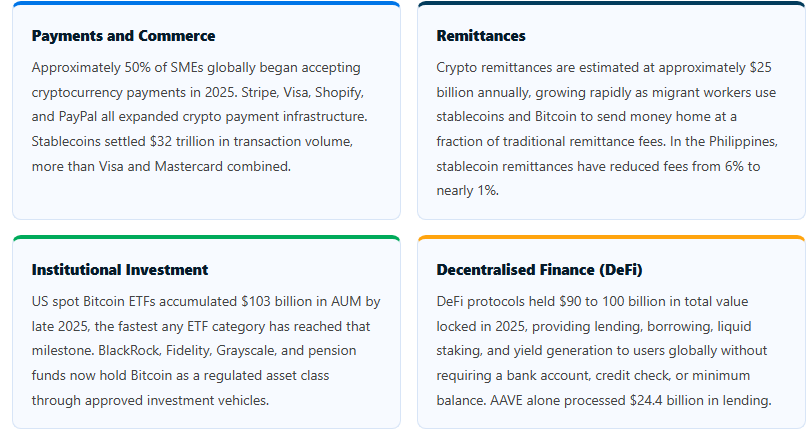
- Stablecoins settled over $32 trillion in legitimate transaction volume in 2025. Institutional Bitcoin ETFs accumulated $103 billion in AUM. These are documented, legal activities at scale.
- Multiple regulatory frameworks including the GENIUS Act (US, 2025) and MiCA (EU, 2024) now require KYC and AML compliance from crypto service providers, raising the compliance floor across major markets.
- The FBI’s Operation Level Up, blockchain analytics firms, and international law enforcement successfully disrupted multiple large illicit crypto networks in 2025, demonstrating that crypto is not the untraceable criminal tool it is sometimes portrayed as.
Read Also: Cryptography in Blockchain Technology: A Beginner’s Guide
What Do the Actual Crime Statistics Say?
The claim that crypto is primarily used for illegal activities does not survive contact with data. Chainalysis, the leading blockchain analytics firm, has published its Crypto Crime Report annually since 2017. The numbers are consistent: the overwhelming majority of cryptocurrency transactions are entirely legal.

The decline from 0.61% in 2023 to 0.14% in 2024 illustrates the most important dynamic in this space: legitimate crypto adoption is growing far faster than criminal use. As the total legitimate volume of crypto transactions expands, illicit activity shrinks as a proportion of the whole even as it grows in absolute dollar terms. The same pattern applies across the financial system broadly: absolute financial crime grows over time, but crime as a percentage of all financial activity stays small.
Why Did Illicit Volume Spike in 2025?
The 2026 Chainalysis Crypto Crime Report covering 2025 data showed a headline figure of $154 billion in illicit crypto activity, a 162% increase from 2024. This number requires important context. The spike was overwhelmingly driven by a 694% increase in activity from sanctioned entities, dominated by three state-linked actors:
- Russia’s A7A5 stablecoin: Russia launched a ruble-backed stablecoin in February 2025 following international sanctions, which processed over $93.3 billion in transactions in under one year. This single instrument accounted for the majority of the nominal increase in illicit volumes.
- North Korea: North Korean-linked hackers stole $2 billion in 2025, their most destructive year on record, with the majority coming from the $1.46 billion Bybit exchange exploit, the largest digital heist in history.
- Iran-linked networks: Iran’s proxy networks facilitated over $2 billion in on-chain activity for money laundering, oil sales, and arms procurement.
Strip out state-linked sanctions evasion and the 2025 crime picture is meaningful but proportionally far smaller. Even with all of this included, illicit activity remained below 1% of total crypto transaction volume, a figure that would benchmark well against the estimated 2 to 5% of global GDP flowing through illicit channels in traditional finance each year (UNODC estimates).
“These illicit volumes are still dwarfed by the broader crypto economy, which largely consists of legitimate transaction volumes. Our estimate for the illicit share of all attributed crypto transaction volume increased slightly from 2024 but remains below 1%.”
Why Is Blockchain More Traceable Than Cash?
One of the most persistent misconceptions about crypto and crime is the idea that cryptocurrency is anonymous and therefore ideal for criminals. This misunderstands how blockchain technology actually works.
The Public Ledger Advantage
Every transaction on a public blockchain like Bitcoin or Ethereum is permanently recorded on a distributed ledger that anyone can inspect. The transaction amount, the sending wallet address, the receiving wallet address, and the timestamp are all visible to any user anywhere in the world. This creates an immutable audit trail that physical cash simply cannot provide. A $100 bill can change hands hundreds of times with zero record of each transaction. A Bitcoin transaction at any dollar amount is permanently on the public blockchain from the moment it is confirmed.
How Law Enforcement Uses Blockchain Traceability
Law enforcement agencies and blockchain analytics firms have capitalised on this transparency. Firms like Chainalysis, TRM Labs, and Elliptic map wallet clusters to known entities, track fund flows across thousands of transactions, and identify money laundering patterns that would be invisible in cash-based systems. Some documented law enforcement successes include:
- The FBI’s 2013 seizure of Bitcoin held by Silk Road operator Ross Ulbricht, using on-chain tracing to identify wallets
- The 2022 recovery of $3.6 billion in Bitcoin stolen from the 2016 Bitfinex hack, the largest financial seizure in US Department of Justice history, made possible entirely through blockchain analysis
- The 2024 Samourai Wallet case, where blockchain analytics were used to prosecute a Bitcoin mixer service facilitating money laundering
- Operation Level Up in 2025, where the FBI used on-chain intelligence to identify and notify over 3,780 active pig butchering victims, preventing over $225 million in losses
Read Also: Crypto Is for Money Laundering: Addressing the Misconception
Why Sophisticated Criminals Prefer Cash
The blockchain’s transparency is precisely why professional, sophisticated financial criminals have not abandoned cash for crypto as their primary vehicle. Cash is truly anonymous: notes are untraceable once circulated. In contrast, every on-chain transaction is permanent evidence. While privacy coins like Monero offer enhanced anonymity and mixing services add friction to tracing, law enforcement’s blockchain analytics capabilities continue to advance faster than privacy techniques can outpace them. The UNODC estimates that 2 to 5% of global GDP is laundered through traditional financial systems annually. Crypto’s documented illicit share of under 1% of on-chain volume compares favourably to this baseline.
What Are the Legitimate Uses of Cryptocurrency in 2025?
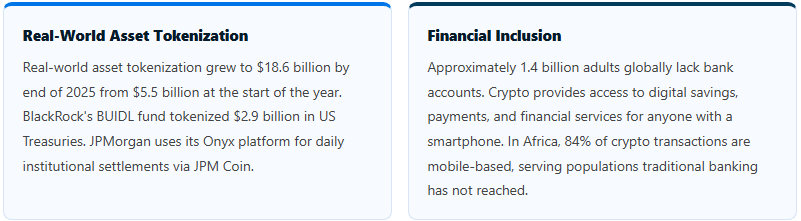
The breadth and scale of legitimate cryptocurrency use in 2025 makes the “only for illegal activities” framing increasingly difficult to sustain. These are not marginal or niche activities: they represent trillions of dollars in economic activity conducted by regulated institutions, businesses, and individuals:
How Is Cryptocurrency Revolutionising Industries Beyond Finance?
The legitimate applications of cryptocurrency extend well beyond investment and payments into the transformation of entire industries:
Supply Chain Transparency
Blockchain technology provides unprecedented transparency and traceability in supply chains, allowing companies to prove the authenticity of their products and track them from production to final delivery. In pharmaceutical supply chains, blockchain enables verification that medications have not been counterfeited or tampered with at any point. In food supply chains, companies can trace a product back to its origin farm within seconds rather than days, enabling faster recall responses when contamination is discovered.
Healthcare Data Security
Blockchain can secure and streamline the sharing of medical records while ensuring data integrity and confidentiality. Healthcare data breaches compromised approximately 276 million records in the US in 2024, at an average cost of $9.8 million per breach, the highest of any industry. Blockchain’s decentralised architecture eliminates the single point of failure that makes centralised medical databases so vulnerable. Estonia has used blockchain to secure its national health records since 2012, with zero successful data breaches against the blockchain layer.
Digital Ownership and NFTs
Non-Fungible Tokens enable provable, transferable ownership of digital content: art, music, gaming items, collectibles, and intellectual property. Artists can now sell digital work directly to collectors without galleries or record labels capturing the majority of revenue. Musicians embed royalty-sharing smart contracts that automatically pay them a percentage of every secondary sale. These legitimate creative economy applications have nothing to do with illegal activity.
Smart Contracts and Automation
Smart contracts are self-executing agreements coded on blockchain networks that automatically carry out terms when conditions are met. Insurance companies use smart contracts to automate claim payouts for parametric products like flight delay insurance, where payment triggers automatically when the flight data confirms a qualifying delay. This eliminates the administrative overhead and potential for human error or bias in claims processing. In cross-border trade finance, smart contracts replace paper letters of credit with code, reducing settlement from weeks to hours at a fraction of the cost.
Read Also: How to Diversify Your Cryptocurrency Portfolio to Minimize Risks
How Do Regulatory Frameworks Prevent Illegal Crypto Use?
The regulatory environment for cryptocurrency has transformed significantly in 2024 and 2025, moving from fragmented and uncertain to increasingly structured and enforceable:
Know Your Customer and Anti-Money Laundering Requirements
All regulated cryptocurrency exchanges now require KYC verification: users must provide government-issued ID, proof of address, and in many jurisdictions, source of funds documentation for large transactions. AML procedures require exchanges to monitor transaction patterns for suspicious activity and report large or unusual transactions to financial intelligence units. These requirements are now enforced in the US, EU, UK, Singapore, Japan, UAE, and most major crypto markets. The result is that a significant portion of the crypto ecosystem operates under financial compliance requirements comparable to traditional banking.
Read Also: The Impact of Crypto Regulations and Government Policies
The GENIUS Act and US Stablecoin Framework (2025)
The GENIUS Act of 2025 established the first comprehensive federal stablecoin framework in the US, requiring all stablecoin issuers to maintain full reserve backing, comply with AML and KYC obligations, and register with federal regulators. This framework closes a significant gap that previously allowed unregulated stablecoins to operate as potential vectors for illicit finance. The Act effectively brought the largest segment of crypto by transaction volume (stablecoins) under formal regulatory supervision.
MiCA: The EU’s Comprehensive Framework
The Markets in Crypto Assets (MiCA) regulation came into full force across all 27 EU member states by December 2024, creating the world’s first comprehensive unified licensing regime for crypto service providers. Under MiCA, exchanges, wallet providers, and token issuers must obtain authorisation to operate in EU markets, maintain minimum capital requirements, and comply with full AML and consumer protection rules. Non-compliant operators must exit EU markets. This regulatory floor raises the compliance standard across the largest developed-economy market globally.
The FATF Travel Rule
The Financial Action Task Force’s Travel Rule requires regulated crypto exchanges to collect and share sender and recipient information for transactions above a threshold amount, mirroring the information-sharing requirements applied to traditional wire transfers. Compliance with the Travel Rule has expanded significantly since 2021 and is now enforced in most major jurisdictions. This requirement makes large crypto transactions as traceable as traditional wire transfers from a compliance perspective.
| Framework | Jurisdiction / Status | Impact on Illicit Activity Prevention |
|---|---|---|
| GENIUS Act | US, passed 2025 | Federal stablecoin framework; reserve, KYC, and AML requirements; brings $32T annual stablecoin volume under regulated supervision |
| MiCA | EU, full force Dec 2024 | Unified licensing across 27 member states; unregulated operators must exit EU markets; consumer protection and AML enforcement |
| FATF Travel Rule | Global; expanding compliance | Requires exchanges to share sender/recipient info for transactions above threshold, matching traditional wire transfer traceability |
| Exchange KYC/AML | US, EU, UK, Singapore, Japan, UAE, and more | Identity verification before trading; transaction monitoring; suspicious activity reporting; reduces anonymous on-ramps to financial system |
| Blockchain Analytics | Global; used by FBI, Europol, DOJ, and others | On-chain tracing identifies illicit wallet clusters; supports prosecution; enabled $3.6B Bitfinex seizure (2022) and multiple 2025 network dismantlements |
What Does the 2025 Crypto Crime Data Actually Show?
A nuanced reading of the 2025 crime data reveals several important points that headlines often miss:
The $154 Billion Number Needs Decomposing
Of the $154 billion in illicit crypto activity identified in 2025, the dominant driver was state-linked sanctions evasion. Russia’s A7A5 stablecoin alone contributed $93.3 billion. These are not ordinary crimes committed by users against other users; they are sovereign states using crypto infrastructure to circumvent international financial restrictions. This is a geopolitical phenomenon as much as a crime phenomenon, and it represents a fundamentally different category from retail crime, fraud, or dark web drug markets.
North Korea’s Crypto Theft Concentrated in One Event
North Korean hackers stole $2 billion in 2025, their worst year on record. However, approximately $1.46 billion of that came from a single event: the Bybit exchange exploit in February 2025. This concentrated the headline figure in one attack on one institution rather than representing a broad wave of retail user losses. The attack exploited operational security vulnerabilities at the exchange level, not weaknesses in blockchain protocol security. This distinction matters: the Bitcoin and Ethereum protocols themselves were not compromised.
Most Illicit Activity Does Not Involve Ordinary Crypto Users
The organised criminal networks and nation-states driving the 2025 crime statistics are specialised actors operating on a different scale and with different techniques than ordinary crypto users. For the vast majority of people who hold Bitcoin in an ETF, use USDC for payments, or participate in DeFi protocols, these state-level crime statistics are as remote from their experience as the activities of international drug cartels are from someone using a regular bank account.
| Illicit Category (2025) | Estimated Volume | Key Context |
|---|---|---|
| Sanctions evasion (Russia A7A5) | $93.3B (Russia alone) | State-launched ruble stablecoin for sanctions circumvention; dominant driver of 2025 headline figure |
| North Korea hacks | $2B | $1.46B from single Bybit exploit; state-sponsored, not ordinary crime; exchange-level security failure |
| Investment fraud (pig butchering) | $14B+ on-chain | Long-con romance scams; US DOJ Strike Force formed in 2025 specifically targeting these networks in Southeast Asia |
| Darknet markets | ~$2B | Declining from $2.3B in 2023; major US-Dutch takedown of UAPS payment processor disrupted hundreds of fraud shops |
| All illicit combined vs total volume | Under 1% of total | Despite record nominal amounts, illicit activity remains below 1% of all attributed on-chain transaction volume (Chainalysis 2026 Report) |
What Are the Genuine Challenges That Remain?
Acknowledging that crypto is not primarily for illegal activities does not mean the challenges are trivial. Several real issues deserve serious attention:
Price Volatility
Cryptocurrencies excluding stablecoins are subject to significant price fluctuations. Bitcoin experienced a 36% correction from its October 2025 all-time high within weeks. This volatility creates risk for investors, complicates use as everyday payment currency, and can destabilise DeFi protocols through cascading liquidations. The trend toward lower volatility as institutional adoption deepens is encouraging, but volatility remains a meaningful risk that every user needs to understand.
Security Concerns at the User and Exchange Level
While the blockchain protocols themselves have not been compromised, the broader infrastructure around them can be. The Bybit hack of $1.46 billion in 2025 was an exchange-level security failure, not a protocol failure. Users remain vulnerable to phishing attacks, malware targeting private keys, and social engineering. Robust security practices including hardware wallets, strong authentication, and healthy scepticism toward unsolicited investment opportunities are essential for any crypto user.
The Need for Continued Education
Many people who hold the “crypto is for criminals” misconception have simply not been exposed to accurate information about how the technology works and what the actual data shows. Education and awareness remain important: not just about how to use crypto safely, but about what it actually is, what the documented risks are, and how it compares to the alternatives. Misinformation in both directions, whether dismissing crypto as purely criminal or promoting it as perfectly safe and risk-free, harms users and slows the productive evolution of financial technology.
The cash comparison: Cash is still the dominant medium for most illegal financial transactions globally. UNODC estimates that 2 to 5% of global GDP, equivalent to $1.6 to $4 trillion annually, is laundered through traditional financial systems. Crypto’s documented illicit share of under 1% of on-chain volume compares favourably to this baseline, and unlike cash, every crypto transaction leaves a permanent trail.
Read Also: Blockchain Technology Adoption Around the World
Frequently Asked Questions
What percentage of cryptocurrency transactions are illegal?
The vast majority of cryptocurrency activity is entirely legal. In 2024, illicit transactions represented only 0.14% of all attributed cryptocurrency transaction volume according to Chainalysis, down from 0.61% in 2023 as legitimate adoption expanded faster than criminal use. Even with the record 2025 illicit volumes driven primarily by state-linked sanctions evasion, illicit activity still accounted for less than 1% of total on-chain transaction volume. The overwhelming majority of crypto flows are legal payments, investments, remittances, and financial services.
Is crypto harder to trace than cash for illegal activities?
No, the opposite is true. Every cryptocurrency transaction on a public blockchain is permanently recorded and visible to anyone, creating an immutable audit trail that cash cannot provide. Law enforcement agencies and blockchain analytics firms can trace fund flows across thousands of transactions to identify illicit actors. The FBI’s 2022 recovery of $3.6 billion from the Bitfinex hack, the largest financial seizure in US DOJ history, was made possible entirely through blockchain analysis. Professional criminals still prefer cash for their most sensitive operations precisely because it leaves no traceable record.
What are the legitimate uses of cryptocurrency?
Legitimate uses are extensive: stablecoins settled over $32 trillion in transaction volume in 2025 for cross-border payments and commerce; DeFi protocols held $90 to 100 billion in TVL providing lending and yield; Bitcoin ETFs accumulated $103 billion in institutional AUM; real-world asset tokenization reached $18.6 billion; 50% of SMEs globally began accepting crypto payments; JPMorgan uses blockchain for daily institutional settlements; and approximately 1.4 billion unbanked adults access financial services through crypto that traditional banking has not provided them.
Why is crypto associated with illegal activities?
The association comes from several high-profile historical cases that received intense media coverage: Silk Road’s dark web marketplace (shut down by the FBI in 2013), early Bitcoin adoption on dark web markets, and ransomware demands in Bitcoin. These cases disproportionately shaped public perception. In reality, they represent a tiny fraction of all crypto activity. As blockchain analytics have matured and law enforcement has become more sophisticated, crypto has proven to be a poor tool for serious criminals because every transaction leaves a permanent public record.
How does cryptocurrency regulation prevent illegal use?
Multiple regulatory frameworks now require cryptocurrency exchanges to implement KYC and AML procedures. The GENIUS Act of 2025 established a federal stablecoin framework with reserve and compliance requirements. The EU’s MiCA regulation requires all crypto service providers to hold licenses and maintain AML compliance across 27 member states. The FATF Travel Rule requires exchanges to share sender and recipient information for transactions above thresholds. Combined with blockchain analytics tools that can trace funds across the public ledger, these frameworks make regulated crypto significantly more traceable than cash for law enforcement purposes.