Definition
Accumulated Proof of Stake (APoS) is a consensus mechanism and validator selection model that extends the foundational Proof of Stake (PoS) model by incorporating a temporal dimension into stake weighting: rather than selecting validators based solely on the quantity of tokens locked at a single point in time, APoS factors in the cumulative duration and continuity of a validator’s staking commitment, allowing staking power and reward eligibility to accumulate over time for consistent, long-term participants.
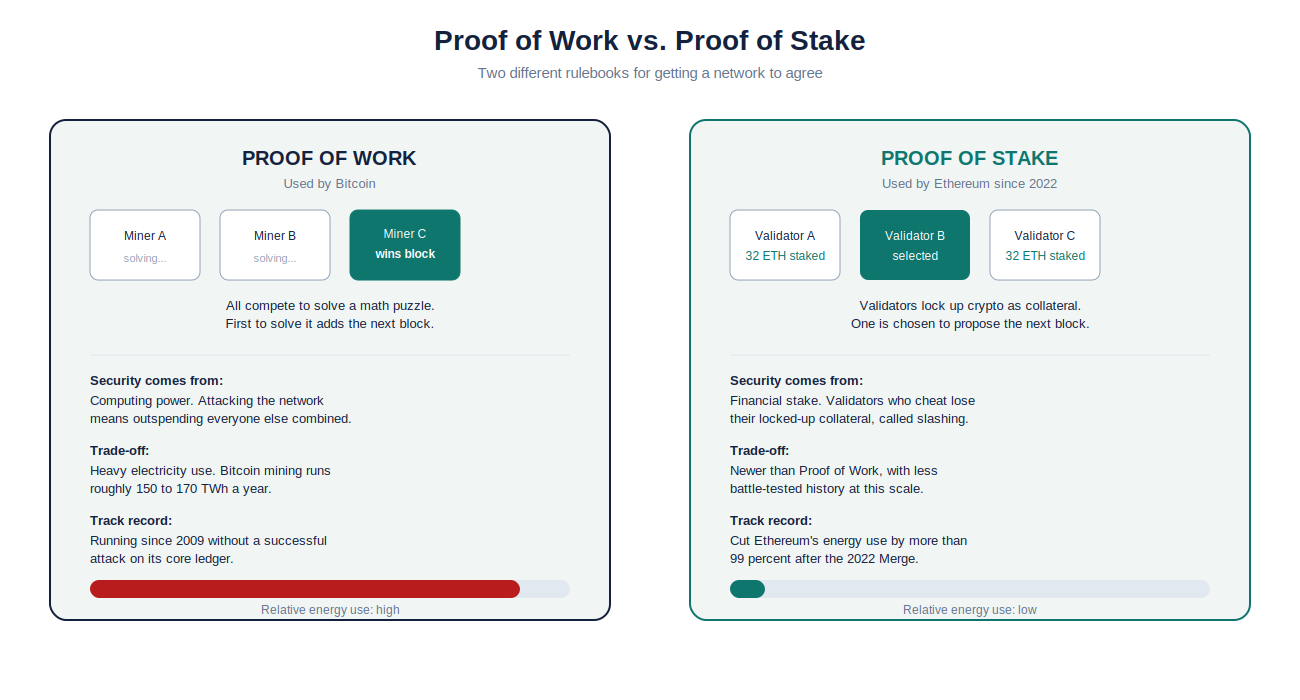
In a standard PoS system, the probability of being selected as the next block producer is roughly proportional to the current size of a validator’s stake relative to the total staked supply. This creates a snapshot-based selection model that does not distinguish between a validator who has staked for one hour and one who has staked for one year. APoS addresses this by maintaining a running accumulation score – sometimes called accumulated stake, staking age, or coin age – that increases the longer a validator continuously keeps their stake active without withdrawing. When the selection algorithm runs, it weights candidates by this accumulated score rather than (or in addition to) their raw token balance, giving long-term committed validators a proportionally greater chance of being chosen as block producers and earning the associated block rewards.
The concept has historical roots in Peercoin (PPC), the first cryptocurrency to implement a Proof of Stake consensus mechanism, whose whitepaper was published on August 19, 2012 by Sunny King and Scott Nadal. Peercoin introduced the concept of “coin age” – calculated as the number of coins multiplied by the number of days they had been held without being moved – as the primary determinant of staking weight. When a validator successfully minted a new block, their coin age was reset to zero, requiring them to re-accumulate staking weight before becoming eligible for the highest reward tiers again. This coin-age mechanism is widely recognized as the conceptual ancestor of APoS. Modern APoS implementations refine this foundation by applying it to validator node operations in proof-of-stake blockchain networks, encouraging network stability by economically rewarding validators who do not frequently withdraw and re-stake their tokens in pursuit of short-term yield optimization.
APoS is particularly valuable for blockchain protocols that prioritize validator stability and long-term network security. By making accumulated stake a meaningful input to block production probability, APoS reduces the incentive for validators to engage in frequent stake churning – repeatedly unstaking and re-staking to game reward distributions – and instead creates conditions where patient, consistent validators are systematically advantaged. This supports a more stable validator set, more predictable block production, and a stronger alignment of validator economic incentives with the long-term health of the network.
Origin & History
| Date | Event |
| 2008-10-31 | Satoshi Nakamoto publishes the Bitcoin whitepaper, introducing Proof of Work (PoW); the energy costs of PoW inspire researchers to seek alternative consensus mechanisms |
| 2012-08-19 | Sunny King and Scott Nadal publish the Peercoin (PPCoin) whitepaper, introducing Proof of Stake and the concept of “coin age” – the direct conceptual ancestor of APoS; Peercoin becomes the first cryptocurrency to implement a PoS-based consensus mechanism |
| 2013 | Peercoin mainnet launches, putting coin-age-weighted PoS into live production; coin age resets upon successful block minting, creating the first accumulation-reset staking cycle |
| 2014–2016 | Numerous PoS variants emerge (Delegated PoS in BitShares/EOS, Leased PoS in Waves, Tendermint BFT); the blockchain industry explores many dimensions of stake weighting beyond simple token balance |
| 2017 | Ethereum’s Casper research begins formalizing PoS for the world’s second-largest blockchain; stake duration and validator commitment become active research topics |
| 2020 | Ethereum Beacon Chain launches (December 1, 2020), marking Ethereum’s transition to PoS staking; 32 ETH minimum stake requirement and slashing penalties for early withdrawal create duration-incentive alignment |
| 2022-09-15 | Ethereum Mainnet completes The Merge, fully transitioning from PoW to PoS; the world’s largest smart contract platform now runs on stake-based consensus, significantly increasing industry interest in all PoS variants including duration-weighted models like APoS |
| 2023–present | Multiple emerging blockchain protocols incorporate accumulated stake or stake-duration weighting into their validator selection models as a stability-preserving evolution of standard PoS |
“Coin age is a measure of time in Peercoin’s Proof-of-Stake, where the criterion for selecting validators is how long they have owned their coins. Coin age was implemented to prevent coin-rich stakers from dominating the rewards.” – Peercoin documentation and historical analysis of the PPCoin whitepaper (Sunny King & Scott Nadal, 2012)
How It Works
ACCUMULATED PROOF OF STAKE – VALIDATOR SELECTION MODEL ═══════════════════════════════════════════════════════════════ Validator A: 1,000 tokens staked for 90 days Accumulated Score = 1,000 × 90 = 90,000 stake-days
Validator B: 5,000 tokens staked for 5 days Accumulated Score = 5,000 × 5 = 25,000 stake-days
Validator C: 2,000 tokens staked for 30 days Accumulated Score = 2,000 × 30 = 60,000 stake-days
Total Accumulated Scores: 90,000 + 25,000 + 60,000 = 175,000
Block Production Probability: ┌─────────────────────────────────────────────────────────┐ │ Validator A: 90,000 / 175,000 = ~51.4% ← SELECTED │ │ Validator C: 60,000 / 175,000 = ~34.3% │ │ Validator B: 25,000 / 175,000 = ~14.3% │ └─────────────────────────────────────────────────────────┘
After Validator A produces a block → Accumulated Score RESETS to 0 Validator A must re-accumulate before regaining high selection weight ═══════════════════════════════════════════════════════════════ “`
| Feature | Standard PoS | Accumulated PoS (APoS) | Delegated PoS (DPoS) |
| Selection basis | Current token balance | Accumulated stake × time | Delegated votes |
| Long-term staker advantage | Minimal | Significant | Indirect (reputation) |
| Stake churning incentive | High | Low | Low |
| New large staker power | Immediate | Delayed (must accumulate) | Immediate (via delegation) |
| Validator set stability | Moderate | High | Moderate |
| Reset mechanism | None | Score resets after block production | Periodic elections |
In Simple Terms
- APoS rewards patience over raw wealth. In standard PoS, a wealthy validator who stakes today competes equally with one who has staked for years. In APoS, the long-term staker has built up accumulated weight that gives them a proportionally better chance of producing blocks and earning rewards – loyalty is quantified and rewarded.
- Think of it like a savings account with compound seniority. The longer you keep your stake active without withdrawing, the higher your staking score climbs. The higher your score, the more frequently you are selected to validate transactions and earn block rewards. Withdrawing resets your score – so premature withdrawal has a real cost.
- It discourages stake churning. Some validators in standard PoS systems repeatedly unstake and re-stake tokens to game reward distributions or move between protocols chasing higher yields. APoS makes this behavior costly because every withdrawal resets the accumulated score, erasing all the time-based weight the validator had built up.
- It improves network security through validator consistency. A validator set populated by long-term, committed participants is more predictable and harder for adversarial actors to disrupt. APoS creates economic incentives that naturally favor this kind of stable validator composition over one that changes dramatically from epoch to epoch.
- It is an evolution of Peercoin’s coin-age concept. The idea that stake duration should matter in block selection was first implemented in Peercoin in 2012. APoS generalizes and formalizes that concept for modern validator-node-based blockchain architectures, applying it as an explicit accumulation mechanism rather than a simple multiplier.
Real-World Examples
| Scenario | Implementation | Outcome |
| Long-term validator vs. new entrant | Validator A has staked 500 tokens for 180 days (score: 90,000). Validator B stakes 2,000 tokens today (score: 2,000). Under APoS, Validator A still has higher selection probability despite smaller token balance. | Long-term commitment is rewarded; new capital cannot immediately dominate block production |
| Stake churning disincentive | A yield-chasing validator unstakes from Protocol X to chase a short-term APY spike on Protocol Y, then returns. Upon return, their accumulated score is zero. | Validator loses all built-up time-weight; must spend weeks or months re-accumulating before regaining competitive selection probability |
| Network stability during market volatility | During a market downturn, validators in a standard PoS network rapidly unstake and sell. In an APoS network, validators are incentivized to maintain stake to preserve their accumulated score. | APoS network maintains a more stable validator set and more consistent block production during periods of market stress |
| Peercoin’s historical coin-age model | Peercoin validators accumulate coin-age at a rate of coin balance × days held. Upon successful block minting, coin-age resets. | Creates natural rotation: once a validator mints, others with accumulated coin-age become the most likely next block producers; no single party dominates indefinitely |
Advantages
| Advantage | Description |
| Rewards long-term commitment | Validators who maintain continuous stake build compounding weight, aligning economic incentives with network loyalty |
| Reduces stake churning | Accumulated score resets upon withdrawal, making frequent unstaking economically costly and discouraging short-term yield-chasing |
| Improves validator set stability | Long-term committed validators produce a more predictable, stable block-producing set, improving network reliability |
| Reduces plutocracy risk | Pure token-balance PoS can be dominated by whoever holds the most tokens. APoS gives long-tenured validators competitive advantages over newly wealthy entrants, distributing influence more equitably over time |
| Natural validator rotation | Score resets after block production create organic rotation among high-accumulated validators, preventing any single entity from monopolizing block production indefinitely |
| Aligns incentives with network security | Validators with significant accumulated stake have strong economic incentives to behave honestly – they stand to lose not just their staked tokens but their accumulated time-weight through slashing or withdrawal |
Disadvantages & Risks
| Risk | Description |
| Barrier to new validators | New validators must accumulate time-weight before competing effectively, potentially making it difficult for legitimate new participants to achieve meaningful block production probability |
| Reduced flexibility | Validators who want to respond to market opportunities or technical issues by unstaking face the cost of losing their accumulated score, reducing responsiveness |
| Implementation complexity | Tracking and managing per-validator accumulated scores adds computational and storage overhead compared to simple balance-based PoS |
| Stake concentration over time | Very large, very patient stakers can still dominate if both their token balance and accumulated score are large, potentially recreating centralization over multi-year time scales |
| Score reset exploitation | If score resets are predictable (e.g., always after exactly N days), sophisticated validators may time withdrawals and re-stakes to minimize lost accumulation while still gaming reward curves |
Risk Management Tips:
- When evaluating a blockchain that uses APoS, check whether the accumulation formula is publicly documented and auditable in the protocol specification.
- Assess whether the APoS implementation includes slashing conditions – mechanisms that penalize validators for dishonest behavior – to complement the accumulation incentives.
- Long-term delegators should understand how their delegated stake interacts with validator accumulated scores, particularly whether delegation continuity also benefits from time-based accumulation.
- Monitor whether the protocol has implemented any anti-Sybil measures to prevent validators from fragmenting stake across many wallets to accumulate scores simultaneously across multiple identities.
FAQ
Q: What is the difference between APoS and standard Proof of Stake?
Standard PoS selects block producers based on their current token balance relative to total stake. APoS adds a time dimension: the longer a validator continuously maintains their stake without withdrawing, the more selection weight they accumulate. This accumulated weight, not just the raw token balance, determines block production probability.
Q: Is Ethereum’s Proof of Stake the same as APoS?
No. Ethereum’s post-Merge PoS is a standard balance-based PoS with a fixed 32 ETH minimum stake, combined with slashing penalties and attestation rewards. It does not implement an explicit accumulated score that grows over time. However, Ethereum’s withdrawal queue and exit delays create some implicit incentives for long-term staking.
Q: Where did the APoS concept originate?
The direct conceptual ancestor of APoS is the “coin age” mechanism introduced in Peercoin’s whitepaper (Sunny King and Scott Nadal, August 19, 2012). Peercoin calculated staking weight as coin balance × days held, resetting it to zero upon successful block minting. APoS generalizes this principle into an explicit accumulation model for modern validator-node architectures.
Q: Does APoS prevent large token holders from controlling block production?
APoS reduces (but does not eliminate) the advantage of large token holders. A validator with 100x more tokens but who is new to staking will initially have lower selection probability than a smaller but long-tenured validator. Over time, however, if the large holder maintains their stake, their accumulated score will also grow – so APoS redistributes advantage temporally rather than eliminating wealth-based advantages entirely.
Q: What happens to accumulated stake if a validator is slashed?
This depends on the protocol’s implementation. In most designs where APoS includes slashing, a slashing event results in loss of both the staked tokens and the accumulated score – providing a strong disincentive against validator misbehavior, since dishonest validators lose not just their stake but all the time-based weight they have built up.
Sources
- PPCoin: Peer-to-Peer Crypto-Currency with Proof-of-Stake – Sunny King & Scott Nadal (August 19, 2012)
- The History and Evolution of Proof-of-Stake – CoinTelegraph
- Peercoin – Wikipedia
- Proof-of-Stake Consensus Mechanisms for Future Blockchain Networks – IEEE/ResearchGate
- Proof-of-Stake (PoS) – Ethereum.org Developer Documentation
UEEx Tip: If you are a long-term believer in a blockchain project that uses Accumulated Proof of Stake, continuous staking is your compounding advantage – every day your stake remains active, your validator weight grows. Frequent withdrawals to chase short-term opportunities reset your accumulated score and erase that advantage. In APoS systems, patience is not just a virtue; it is a quantified, economically rewarded strategy.
Disclaimer: This glossary entry is for educational purposes only and does not constitute financial or investment advice. Cryptocurrency markets are highly volatile. Always conduct your own research before making any investment decisions.
UEEx – Defining the Language of Crypto