Imagine a small radio device sitting quietly in the corner of your living room. It’s not mining anything in the traditional sense: no fans, no heat, no GPU screaming through calculations.
Instead, it’s listening for signals from nearby smart devices, a delivery company’s asset tracker three blocks away, a farmer’s soil sensor across town, a phone in the coffee shop downstairs looking for a signal boost.
Every time it picks up and relays one of those signals, it earns a small crypto reward. That’s a Helium miner, in practice.
In simple terms, a Helium miner (also called a Helium hotspot) is a physical device that provides wireless network coverage for IoT devices or mobile data in exchange for HNT, Helium’s native cryptocurrency.
Instead of solving math problems like a Bitcoin miner, it’s solving a real-world connectivity problem, and getting paid for it.
It’s a simple idea, but the details matter a lot if you’re thinking about buying one. Not every device qualifies. Not every location earns meaningfully. And the reward system itself has changed more than once since Helium launched in 2019.
Key Takeaways
- A Helium miner is hardware, not a computer rig. It’s a low-power radio device (hotspot) that provides wireless coverage and earns HNT in return.
- Rewards are now usage-based. As of 2025–2026, hotspots earn for actual data transferred, not just for being “witnessed” by neighbors.
- Location matters more than hardware price. A budget hotspot in a good spot out-earns an expensive one in a saturated area.
- HNT price volatility affects real income. Rewards are paid in tokens, so the same earnings can be worth more or less depending on the market.
What is a helium miner?
Helium miner is a specialized wireless device, also called a Helium Hotspot, that helps provide wireless coverage for the Helium Network.
It is a compact, low-power device that broadcasts and receives radio signals to help build a decentralized wireless network for Internet of Things (IoT) devices, think asset trackers, environmental sensors, and smart city equipment.
Instead of using advanced computer hardware to solve complex mathematical problems like Bitcoin miners do, Helium miners contribute wireless network coverage and data connectivity, earning HNT tokens in return.
Unlike other blockchain systems where miners use computing power, Helium miners use RF radio signals to provide coverage in exchange for HNT. No hash rate, no mining rig, no chips racing to guess numbers.
Helium miner vs. “hotspot”
“Helium miner” and “Helium hotspot” refer to the same piece of hardware, the terms get used interchangeably across the ecosystem.
A Helium miner is a sophisticated assembly built to create a decentralized wireless network for IoT devices, commonly referred to as a hotspot.
You’ll see “hotspot” used more in official Helium documentation and community spaces, while “miner” shows up more in crypto content since it draws a comparison to Bitcoin or Ethereum mining. Functionally, there’s no difference, one device, two names.
Practical Example: Cold Chain Logistics
Picture a small produce distributor running refrigerated trucks between a regional warehouse and a handful of grocery stores.
Each truck carries a temperature sensor clipped to the cargo door, sending a reading every few minutes, nothing heavy, just a tiny packet confirming the cold chain hasn’t broken.
Along the delivery route, a Helium hotspot mounted on the warehouse roof picks up those signals as trucks pass within range, relaying them to the company’s monitoring dashboard. If a trailer’s temperature drifts outside the safe zone, the dispatcher gets an alert before a shipment of berries or dairy turns into a write-off.
No cell plan, no proprietary tracking hardware, no monthly SIM card fees per sensor. The distributor pays for LoRaWAN Data Credits instead, a fraction of the cost of a traditional IoT connectivity contract, while the hotspot operator earns HNT for relaying that traffic.
It’s a small, unglamorous use case, but it’s exactly the kind of low-bandwidth, infrequent-data scenario LoRaWAN was built for, and it’s a more realistic picture of Helium’s IoT side in 2026.
What Is the Helium Network?
The Helium Network is a blockchain-coordinated wireless network built and maintained by everyday people instead of a single telecom company.
Rather than owning towers and routers itself, Helium uses community-owned hardware to provide real-world connectivity, and by mid-2026 it operates across two main layers: a global LoRaWAN network for IoT devices, and a mobile carrier offload network built on Wi-Fi and 5G hotspots.
What Problem Does Helium Solve?
Traditional wireless infrastructure, cell towers, fiber backhaul, IoT gateways, is expensive to build and slow to deploy, especially in low-density or underserved areas.
Helium’s pitch is that token incentives can coordinate distributed hardware deployment at lower cost than centralized providers, letting individuals fill in coverage gaps that big carriers have little financial incentive to fix on their own.
How Does the Helium Network Work?
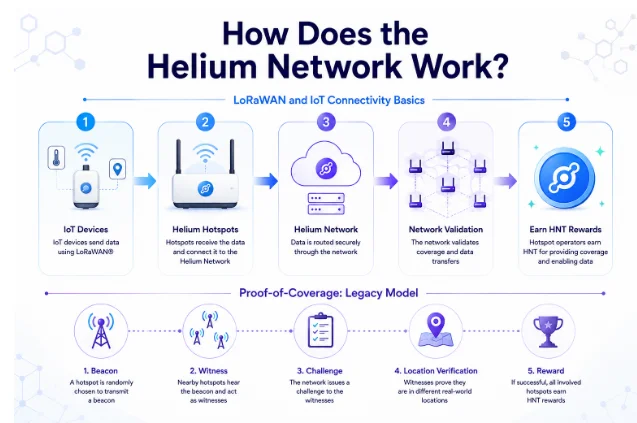
Helium calls itself “The People’s Network” because its coverage comes from individual operators deploying hotspots, not a telecom company building towers.
Each hotspot broadcasts and receives wireless signals, and the network verifies that coverage is real before paying out rewards, that verification step is what separates Helium from just handing out tokens for owning hardware.
LoRaWAN and IoT connectivity basics
LoRaWAN (Long Range Wide Area Network) is the wireless protocol Helium’s IoT layer runs on. It’s built for small, infrequent data packets, the kind sent by asset trackers, sensors, and similar low-power devices, rather than high-bandwidth traffic like video or browsing.
That’s the tradeoff: long range and low power draw, in exchange for limited data throughput.
Proof-of-Coverage: legacy model
For most of Helium’s history, hotspots earned rewards primarily through Proof-of-Coverage (PoC), a system where hotspots would “beacon,” and nearby hotspots would witness that beacon to confirm real coverage exists in that location.
It was a clever way to prevent people from faking coverage to farm rewards, but it paid operators for having infrastructure in place rather than for that infrastructure actually being used.
Is Helium Mining Profitable?
Profitability depends on a few key variables:
- Hotspot location: Areas with real demand but not oversaturated with other hotspots, tend to earn more.
- Initial investment: Hardware, onboarding fees, internet, and (minimal) electricity all factor into your break-even point.
- Market conditions: HNT’s price swings independently of network activity, directly affecting what your rewards are worth.
The often-cited “$10–$50 per day” figure is outdated and no longer reflects reality. By 2026, a well-placed IoT hotspot typically earns between 0.07 and 0.30 HNT per day, roughly $3 to $12 per month at recent HNT prices.
Mobile hotspots without confirmed carrier offload traffic often earn even less, sometimes under $1 a month, while high-traffic Mobile placements with genuine offload can do meaningfully better.
Checking your local network density and coverage gaps before investing is still the best way to set realistic expectations.
Also Read: Types of Distributed Ledgers: A Complete Guide
What Are the Different Types of Helium Hotspots?
Helium hotspots aren’t a one-size-fits-all category. The network has gone through several structural changes since 2019, and understanding which hotspot types are current versus legacy will save you from buying outdated hardware or chasing rewards that no longer exist.
IoT Hotspots
IoT hotspots run Helium’s original LoRaWAN network, transmitting low-power, low-bandwidth data on behalf of connected devices like sensors and trackers.
You need hardware from an approved manufacturer and rewards now come from actual data transfer rather than coverage witnessing alone
Pros:
- Lower hardware cost than Mobile/CBRS equipment
- Works well in rural or low density areas where LoRaWAN range advantages matter
- Supports a genuinely useful IoT use case
Cons:
- Limited real-world device demand in most areas, coverage doesn’t guarantee usage
- Rewards depend heavily on nearby sensor activity, which you don’t control
- Narrower earning ceiling than Mobile hotspots in high-traffic locations
Mobile Hotspots
Mobile hotspots serve Helium Mobile’s carrier offload network, connecting nearby phones to Wi-Fi or CBRS instead of cellular data.
Pricing is straightforward, indoor units run $249, outdoor units run $499 and rewards now track real data served to real users via Passpoint-based offload.
Pros:
- Meaningfully higher earning ceiling in the right location
- Simple plug-and-play setup through the Helium Mobile app
- Growing carrier demand as offload volume increases network-wide
Cons:
- Highly location-dependent, a bad spot can earn close to nothing
- No guarantee of being “selected” for real (paid) offload even with good foot traffic
- Higher upfront cost than most IoT hardware
Full Hotspots
This was the original hotspot architecture, each device stored a full copy of the Helium blockchain locally, issued Proof-of-Coverage challenges, and handled consensus group work alongside earning rewards. It was resource-heavy by design.
Pros:
- Fully self-contained, no dependency on validators
- Directly participated in network consensus
Cons:
- Long blockchain sync times, sometimes days, as the network grew
- Heavier compute/storage requirements drove up hardware cost and power draw.
Light Hotspots
Light Hotspots were introduced to offload blockchain storage and challenge creation to dedicated Validators, letting the hotspot itself focus on beaconing, witnessing, and data transfer.
Light Hotspots could still earn PoC rewards while no longer storing the full blockchain, issuing challenges, or joining consensus groups.
Pros:
- Faster setup and sync than Full Hotspots
- Lower hardware requirements, cheaper to manufacture
- Helped the network scale past its early growing pains
Cons:
- Slightly lower rewards than Full Hotspots since challenge-related rewards moved to Validators
- Still dependent on network-wide validator health
Data-Only Hotspots
Data-only hotspots are a stripped-down category that skips Proof-of-Coverage entirely. Data-only hotspots only get rewarded for forwarding data, they don’t participate in PoC and lack the secure element that stores the network’s swarm key.
Pros:
- Cheaper and simpler hardware, sometimes DIY-buildable
- Straightforward if your only goal is relaying sensor data, not chasing PoC rewards
Cons:
- No PoC earnings at all, income is capped to data-forwarding rewards only
- Generally the lowest-earning hotspot category
- Less relevant now that PoC itself has been phased out for usage-based rewards network-wide
Also Read: A Complete Guide to Bitcoin Trading Strategies in 2026
How to Set Up a Helium Miner
Setting up a Helium miner takes about 30–45 minutes if you’ve got your hardware and location sorted, here’s the full process, step by step.
Step 1: Choose a Compatible Hotspot
Buy from a Helium-approved manufacturer only, Helium’s documentation listed 15 approved IoT Makers as of May 2026, and Mobile hotspots have their own approved lineup sold directly through Helium Mobile.
Step 2: Check Your Location Before Buying
Don’t buy hardware before checking whether your area is already saturated or genuinely underserved. Tools like Helium’s official Coverage Map, HeliumGeek’s Explorer Map, and third-party planning tools like HotspotRF let you check nearby hotspot density and simulate potential earning before you commit to a purchase.
Step 3: Choose the Right Antenna
For IoT hotspots, a higher-gain antenna generally extends range, but the right choice depends on your surroundings; dense urban areas often do better with lower-gain, wider-angle antennas, while rural or elevated spots benefit from higher-gain directional ones.
Step 4: Set Up Your Helium Wallet
Download the official Helium Wallet app and create a new wallet, this generates a 24-word seed phrase that’s the only way to recover your account. Write it down and store it somewhere secure; it can never be reissued if lost, and anyone who has it controls everything in your wallet.
Step 5: Connect the Antenna
For IoT hotspots, attach the antenna securely before powering on, running the device without an antenna connected can damage the radio. Mobile hotspots with built-in antennas skip this step entirely.
Step 6: Connect the Hotspot to the Internet
Connect via Ethernet where possible for a more stable connection, or Wi-Fi if that’s your only option. Note that Helium hotspots can’t detect hidden Wi-Fi networks, so your SSID needs to be discoverable during setup.
Step 7: Power On the Hotspot
Plug in the power adapter and wait for the firmware to update automatically, this typically takes about 3 minutes, and is complete once all LEDs are solid or blinking green. Devices bought secondhand or sitting in inventory for a while sometimes need a manual firmware flash if the auto-update fails.
Step 8: Onboard the Hotspot
Pair your phone with the hotspot via Bluetooth using your manufacturer’s onboarding app (Helium Wallet, Hotspotty Connect, or a manufacturer-specific app), then link it to your wallet.
Step 9: Assert the Hotspot’s Location
Set the hotspot’s physical location, elevation, and antenna details in the app accurately, and only once it’s actually installed at its final spot. Asserting a location that doesn’t match where the hotspot is really transmitting from is one of the more common reasons operators get flagged for review.
Step 10: Configure and Verify the Hotspot
Confirm the app shows your hotspot as online and synced. For IoT devices, this means confirming blockchain sync status; for Mobile hotspots, confirming a stable internet connection and successful Wi-Fi/CBRS broadcast.
Risks and Challenges of Helium Mining
Like any crypto-adjacent venture, Helium mining comes with tradeoffs that hardware specs alone won’t tell you. Here’s what to weigh before you invest.
Network saturation in dense areas
More hotspots in one area means thinner rewards, not more. Densely saturated areas dilute Proof-of-Coverage witnessing rewards on the IoT side, while Mobile hotspots in low-footfall areas often earn under $1 a month without real carrier offload traffic, regardless of how many neighbors you have.
Hardware depreciation
Outdoor units take weather damage over time, and cables and antennas need periodic replacement. There’s also a functional risk: reward models have changed multiple times since 2019, so hardware built for one era’s rules isn’t guaranteed to perform the same under the next.
Regulatory and location-based uncertainty
This has improved somewhat, a U.S. court dismissed the SEC’s lawsuit against Helium, ruling HNT isn’t a security. But risks remain: spectrum regulations, hardware supply chains, and telecom rules in key markets can all shift, and carrier offload deals aren’t guaranteed to expand in any given area.
HNT price volatility
HNT’s history is volatile, from an all-time high near $55 in 2021 to roughly $1.20 by late 2022, with sharp swings continuing into 2026. Since rewards are paid in tokens, a strong month of network activity can still mean weak earnings if HNT’s price drops.
Conclusion
A Helium miner is, at its core, a small piece of hardware doing something bigger than it looks, trading spare bandwidth and coverage for a shot at earning crypto, without the noise, heat, or power draw people usually associate with mining.
It’s not solving equations. It’s filling coverage gaps that traditional carriers have little incentive to fix, one hotspot at a time.
But the version of Helium mining worth pursuing in 2026 looks a lot different from the one that went viral back in 2021. Rewards no longer come from simply owning hardware and getting “witnessed” by nearby hotspots, they’re tied to real data moving through your device, whether that’s IoT sensor traffic or genuine carrier offload.
That shift means location matters more than ever, hardware alone won’t guarantee a return, but none of that makes Helium mining pointless, it just makes it something you should go into with more informed decisions.
FAQs
Can I mine Helium with my phone or a regular computer?
No. Helium mining requires dedicated hotspot hardware from an approved manufacturer, you can’t participate using a smartphone, laptop, or general-purpose computer. The device needs specific radio hardware (LoRaWAN or Mobile/CBRS radios) that regular consumer electronics don’t have.
Do I need to keep my hotspot running 24/7?
Yes, for meaningful rewards. Uptime and consistent sync affect both IoT witnessing and Mobile offload eligibility, a hotspot that’s frequently offline earns little to nothing during that downtime, and prolonged inactivity can eventually get it flagged or dropped from the coverage map.
How long does it take to start earning after setup?
It varies, but new hotspots typically need anywhere from a few hours to a few days before they start appearing on witness lists (IoT) or serving real offload traffic (Mobile), depending on local network density and how quickly the device syncs and gets recognized by nearby infrastructure.
Is Helium mining legal where I live?
In most places, yes, but check local rules first. Regulatory clarity has actually improved recently, since a U.S. court dismissed the SEC’s lawsuit against Helium, ruling that HNT is not a security. That said, spectrum usage rules and import restrictions on radio hardware can vary by country, so it’s worth a quick local check before buying