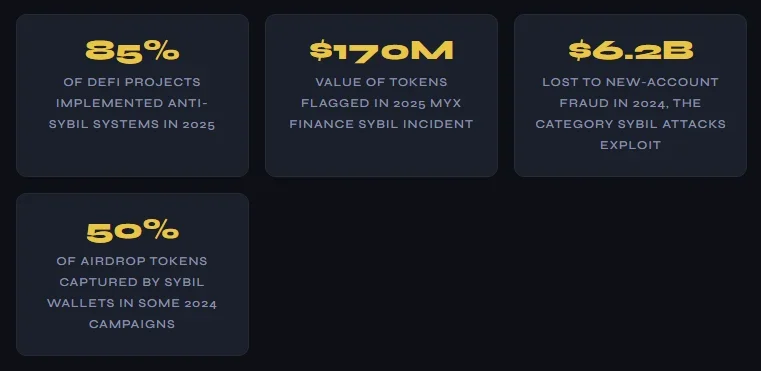
A Sybil attack happens when a single actor creates and controls many fake identities within a network to gain disproportionate influence, disrupt consensus, or steal resources. Named after a 1973 book about a woman diagnosed with multiple personality disorder, this attack type persists across peer-to-peer systems, blockchain networks, DeFi protocols, and airdrop programs. As of Q1 2026, Sybil operations have grown more automated and financially targeted – the Arbitrum ARB airdrop alone saw analysts identify hundreds of thousands of coordinated fake wallets, and dedicated on-chain detection pipelines have become standard practice at major protocols.
What Exactly Is a Sybil Attack?
A Sybil attack is a network security exploit where one person or group operates many fake identities – called Sybil nodes – to manipulate a system that treats each identity as an independent participant. The name comes from the 1973 book Sybil by Flora Rheta Schreiber, which told the story of a woman diagnosed with dissociative identity disorder. Microsoft researcher John Douceur formally applied it to network security in a 2002 paper showing that open, decentralized networks are particularly vulnerable because they rely on the assumption that each node represents a distinct entity.
In practice, a single laptop running automated scripts can impersonate thousands of “users,” each with a separate wallet address, email account, or IP address. The network cannot easily tell that all these identities trace back to one source – giving the attacker voting weight, token rewards, or influence far beyond what they would earn as a legitimate participant.
How Does a Sybil Attack Work Step by Step?
The attack unfolds in three stages that build on each other.
Stage 1 – Identity creation. The attacker generates large numbers of fake accounts, wallet addresses, or network nodes. Scripting tools make this fast and cheap. On a blockchain, creating a new wallet takes seconds and costs nothing but a small transaction fee.
Stage 2 – Network infiltration. The fake identities join the target system – a blockchain network, a DeFi protocol’s airdrop list, a DAO governance vote, or a peer-to-peer reputation system. Because most networks accept new participants freely, Sybil nodes blend in alongside real users.
Stage 3 – Exploitation. Once embedded, the attacker uses coordinated control of their fake identities to manipulate outcomes. In a blockchain consensus mechanism, enough Sybil nodes can approve fraudulent transactions. In an airdrop, they claim multiple shares of token rewards. In a governance vote, they outvote legitimate holders to push through changes that benefit the attacker.
Join UEEx
Experience the World’s Leading Digital Wealth Management Platform
What Are the Main Targets of Sybil Attacks in 2026?
Sybil attacks hit any system that rewards or empowers individual identities. These were the most active attack surfaces as of 2026:
Token airdrops:Projects distribute free tokens to early users. Sybil farmers create hundreds or thousands of wallets, run identical transaction sequences on each, and claim multiple shares. In the Arbitrum ARB airdrop, wallets controlled by coordinated actors received close to 48% of all tokens distributed before detection algorithms were deployed.
DAO governance:Decentralized autonomous organizations let token holders vote on protocol changes. An attacker with many wallets holding small amounts of governance tokens can swing votes in their favor, alter fee structures, or drain treasuries.
DeFi liquidity incentives:Yield farming programs reward addresses that provide liquidity. Sybil actors split capital across many addresses to claim a larger share of reward pools than their actual contribution justifies.
Social media and reputation systems:Fake accounts inflate follower counts, spread coordinated misinformation, or manipulate trending topics. Studies have estimated that around 12% of Twitter/X accounts are bots or inauthentic profiles.
Peer-to-peer networks:In file-sharing or content delivery systems, Sybil nodes can intercept traffic, isolate target users, or manipulate routing tables to redirect data flows.
How Do Sybil Attacks Threaten Blockchain Consensus?
Blockchain networks depend on honest participants reaching agreement on the valid state of the ledger. Most consensus mechanisms assume that no single party controls a majority of the network’s participants or computing power. A successful Sybil attack breaks this assumption.
On a proof-of-work chain, an attacker who controls enough fake mining nodes could attempt a 51% attack – rewriting transaction history and double-spending coins. On proof-of-stake networks, the equivalent is accumulating enough staked tokens across many validators to dominate block validation. Some blockchain networks have reported that over 20% of their nodes were part of coordinated Sybil clusters during active attack periods.
The financial barrier is a key natural defense. As of 2026, attacking Bitcoin through Sybil-linked nodes would cost tens of millions of dollars per day in equipment and electricity – making it economically irrational against well-established chains. Smaller networks with fewer validators are far more exposed because the cost to dominate them is much lower.
Sybil Attack vs. 51% Attack vs. Bot Attack: What Is the Difference?
Feature
Sybil Attack
51% Attack
Bot Attack
Core method
Many fake identities controlled by one actor
Controlling majority of hash rate or stake
Automated scripts performing actions at scale
Primary goal
Influence, token farming, data theft
Double-spending, transaction reversal
Spam, scraping, credential stuffing
Fake identity creation
Yes – core defining feature
Not necessarily
Not necessarily
Main target
Open networks, airdrops, governance
Blockchain consensus layer
Web applications, APIs
Detection difficulty
Moderate – behavioral patterns reveal clusters
Easier – hash rate / stake concentration is visible
Moderate – rate limiting and CAPTCHAs help
Cost to execute
Low to moderate (scripts + wallets)
Very high (hardware + energy or large token holdings)
Low (commodity botnet infrastructure)
Relationship
Can enable a 51% attack by controlling nodes
May begin with Sybil-style node takeover
Often used to manage Sybil identities at scale
What Real-World Examples Show How Damaging Sybil Attacks Can Be?
Several high-profile cases from recent years illustrate the scale of the problem:
Optimism (2022): When the OP token airdrop launched, thousands of wallets coordinated to farm eligibility criteria. The team filtered many suspicious wallets but acknowledged that a significant number of Sybil actors still successfully claimed tokens, reducing the share available to genuine users.
Arbitrum (2023): The ARB airdrop drew massive Sybil activity. Analysis found that wallets controlled by coordinated actors received close to 48% of all distributed tokens. The team used the Louvain community detection algorithm to identify wallet clusters with suspicious behavioral overlap and disqualified tens of thousands of addresses – but many passed the filters.
zkSync (2024): On-chain analysts identified thousands of wallet clusters that had executed identical transaction sequences – bridging the same amounts, using the same protocols in the same order – across hundreds of addresses each. Analysis of the ZKsync rollup found that 76% of all analyzed accounts were marked as likely Sybils. The project disqualified a large portion of flagged addresses, but the episode showed how sophisticated airdrop farming had become.
MYX Finance (2026): Roughly 100 newly created wallets claimed 9.8 million MYX tokens in a single coordinated operation. The wallets were funded nearly simultaneously from OKX and displayed identical transaction fingerprints – a textbook case of automated Sybil execution.
LayerZero (2024): LayerZero implemented a public Sybil bounty-hunting program before its airdrop, inviting community members to report suspected clusters in exchange for a share of the flagged tokens. The program identified and excluded a significant volume of coordinated wallets while generating community engagement – a model several later projects adopted.
Detection has become a specialized discipline. As of 2026, projects deploy several overlapping methods:
On-chain behavioral analysis examines transaction timing, amounts, and sequences. Wallets that bridge identical amounts to the same protocols in the same order on the same day are flagged as likely belonging to a single operator. Machine learning models can identify these clusters across millions of addresses faster than manual review. Research published in 2026 has explored subgraph-based LightGBM algorithms that capture structural features of address subgraphs and extract key event sequence features based on Sybil address lifecycles.
Network graph analysis maps connections between wallet addresses – shared funding sources, token flows, and contract interactions. Algorithms like Louvain and OPTICS detect tightly connected clusters suggesting a single controlling party.
IP address correlation catches Sybil actors who operate multiple wallets from the same machine or network. While sophisticated attackers use VPNs and proxies, many basic operations are caught at this layer.
Account age and activity depth filters out wallets created shortly before an airdrop snapshot with no organic transaction history. Genuine users tend to have months or years of varied on-chain activity across multiple protocols.
Social verification requires linking wallets to verified accounts (GitHub, Discord, ENS) or holding specific NFTs that require a real person to acquire. This raises the cost and effort of maintaining large Sybil farms.
What Defense Mechanisms Prevent Sybil Attacks?
No single defense eliminates Sybil risk entirely, but layering multiple approaches significantly reduces exposure:
Proof-of-work and proof-of-stake make identity creation expensive. On a PoW network, each “vote” in consensus requires real computational resources. On PoS, influence is proportional to staked tokens – so multiplying fake identities without real capital does not multiply influence.
Decentralized identity systems such as BrightID, Proof of Humanity, and Worldcoin link blockchain accounts to verified unique humans. BrightID uses a social graph approach where users vouch for each other’s uniqueness. Proof of Humanity requires video verification. Worldcoin uses iris biometrics to confirm each account belongs to a distinct individual.
Zero-knowledge proofs allow users to prove they are unique humans without revealing personal data. ZK-based identity protocols can confirm “this address belongs to a person who has not registered another address” without exposing any real-world identity.
KYC requirements for high-value token distributions require phone numbers, government IDs, or credit card verification. These raise the practical cost of Sybil farming significantly at scale.
Stake-weighted governance ties voting power to economic stake rather than identity count. An attacker splitting tokens across many wallets gets the same total vote as they would with one wallet – eliminating the Sybil multiplier effect for governance.
Behavior-based reward criteria require sustained long-term activity – consistent liquidity provision, regular governance participation, protocol usage over months – instead of one-time snapshot actions that Sybil actors can easily replicate in bulk.
Practical Tips for Staying Safe in a Sybil-Prone Ecosystem
Use verified identity tools when participating in governance. Protocols that integrate BrightID, Proof of Humanity, or Worldcoin offer stronger guarantees that your vote counts alongside real humans rather than being diluted by Sybil clusters. Connecting these credentials to your wallet takes minutes and meaningfully increases your influence in honest governance systems.
Build genuine on-chain history before major airdrops. Projects increasingly screen for wallet age and organic activity depth. A wallet with 18+ months of varied transactions – different protocols, different contract types, regular activity – is far less likely to be filtered as a Sybil node than one created a week before the snapshot.
Avoid “airdrop farming” services that promise to maximize your allocation. Many run Sybil-style operations across shared wallet clusters. Using them risks disqualification and may expose your funds to third-party control during the farming period.
Check a project’s Sybil detection methodology before participating in its token distribution. Reputable projects publish post-distribution reports explaining how they identified and excluded fake wallets. If a project has no visible process, Sybil actors are likely to claim a disproportionate share – reducing the value of tokens distributed to genuine participants.
Support DAO proposals that implement stake-weighted or identity-verified voting. Pure one-wallet-one-vote systems are trivially exploitable. Governance designs that tie voting power to verifiable stake or identity create a much harder target and produce outcomes that better reflect actual community preferences.
Join UEEx
Experience the World’s Leading Digital Wealth Management Platform
What does “Sybil” mean in the context of a network attack?
The term comes from the 1973 book Sybil, which depicted a woman with multiple distinct personalities. Researcher John Douceur borrowed the name in a 2002 Microsoft paper to describe attacks where one entity presents multiple fake identities to a network. The name captures the core concept: one actor wearing many masks to deceive a system that assumes each participant is genuinely independent.
Can Sybil attacks happen on Bitcoin or Ethereum?
Yes, though large established chains are more resistant at the consensus layer. Bitcoin’s proof-of-work makes each “node identity” worth only as much computing power as backs it – fake nodes without real hash rate have no consensus influence. Ethereum’s proof-of-stake ties influence to staked ETH. Both networks remain vulnerable to Sybil attacks at the application layer, however, including token distributions, reputation systems, and governance votes built on top of the base chain.
Are Sybil attacks illegal?
In most jurisdictions, deliberately creating fake identities to defraud a token distribution or manipulate a financial system falls under fraud or computer misuse laws. Enforcement is difficult given the pseudonymous nature of blockchain transactions and the cross-border reach of most DeFi protocols. Many high-profile Sybil farming cases have been treated as terms-of-service violations rather than criminal matters, with disqualification from the airdrop as the primary consequence – though this may shift as regulatory clarity around crypto assets improves.
What is Sybil resistance?
Sybil resistance refers to a network’s ability to limit or eliminate the advantage an attacker gains from controlling many fake identities. A system is considered Sybil-resistant when creating additional fake identities provides no meaningful increase in influence, because influence is tied to something scarce – computing power, staked tokens, verified human identity, or real-world reputation. Strong Sybil resistance is a core design goal for serious blockchain and DeFi protocols, and it directly determines how fairly token distributions and governance votes reflect genuine community preferences.
How do I know if a project I’m using has good Sybil protection?
Look for projects that publish transparent airdrop eligibility criteria based on long-term on-chain behavior, integrate identity verification layers like BrightID or Proof of Humanity, apply algorithmic cluster detection before distributions, and stake-weight their governance votes. Projects that announce snapshot dates far in advance with no activity requirements tend to attract heavy Sybil farming – and distribute tokens less fairly to genuine participants. A project that publishes a post-distribution report explaining how they identified and excluded fake wallets is worth more trust than one that does not.
What is the difference between a Sybil attack and a 51% attack?
A Sybil attack is about identity – one actor controlling many fake participants to gain influence within a network. A 51% attack is about resource control – one actor accumulating enough hash rate or staked tokens to dominate block production. The two are related: a well-executed Sybil attack on a small network can be a stepping stone toward a 51% attack by letting one party appear to control many independent nodes. On large chains, however, a 51% attack is economically prohibitive regardless of how many fake identities an attacker can create.
Oluwadamilola Olaniyan is a certified content writer. As a content writer and marketer, she is passionate about creating content that engages and inspires audiences. She is also skilled in turning complex ideas into impactful and easy to read content.
Disclaimer: This article is intended solely for informational purposes and should not be considered trading or investment advice. Nothing herein should be construed as financial, legal, or tax advice. Trading or investing in cryptocurrencies carries a considerable risk of financial loss. Always conduct due diligence before making any trading or investment decisions.
Trade with proof of Reserves
UEEx publish monthly audits and third party verification on every listed market.