AI trading signals are changing how traders make decisions. They transform complex market data into clear insights that even beginners can understand and profit from. Unlike human-generated trading signals, AI trading signals can analyze thousands of data points in milliseconds and spot patterns that human traders may miss.
Research from top quantitative hedge funds shows that AI-driven strategies often outperform traditional methods by 15 to 20 percent annually. The best part is, you don’t need a finance degree to understand the tools and enjoy the benefits. In this article, you will understand how AI can improve your trading .
Key Takeaways
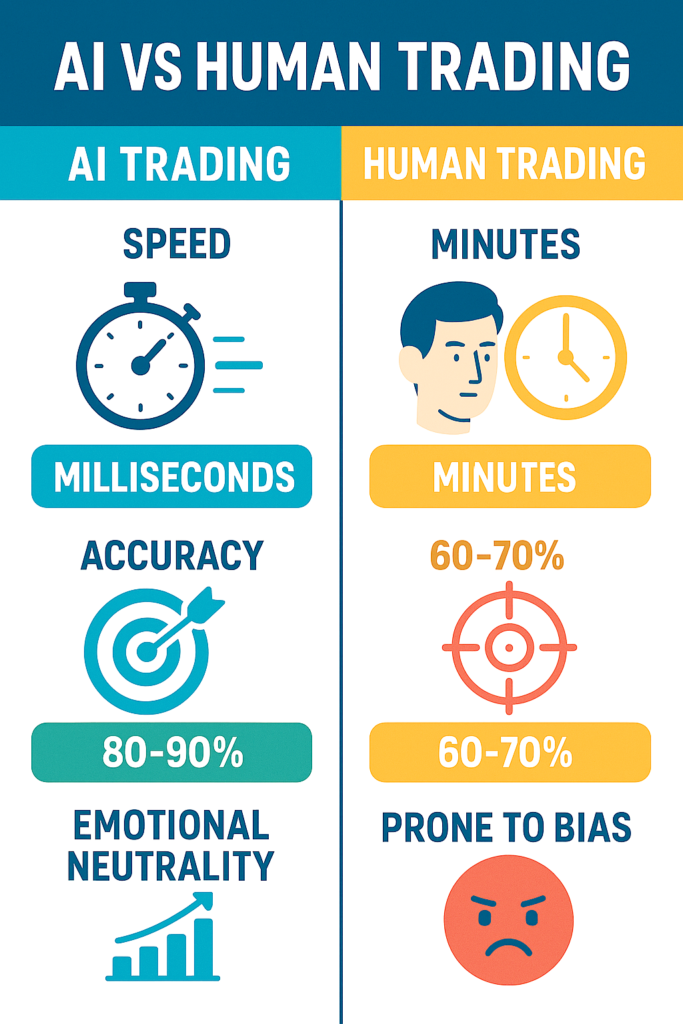
AI trading signals process vast datasets in milliseconds, achieving 80-90% accuracy, far outpacing manual analysis, which is critical for volatile markets like crypto and forex.
Platforms like TradeRiser ($29/month) cater to beginners with user-friendly interfaces, while advanced tools like SignalStack offer automation for professionals, aligning signals with individual risk profiles.
Reinforcement learning and sentiment analysis are advancing AI trading, while regulatory mandates ensure transparency.
Combining AI trading signals with fundamental research enhances decision-making.
What Are Trading Signals?
Trading signals are indicators or alerts that suggest when to buy or sell a financial asset, such as stocks, cryptocurrencies, or forex, based on specific criteria. These signals often come from technical analysis, which includes price patterns and indicators like RSI or MACD, fundamental analysis, or AI-driven insights. Signals can be either manual, created by humans, or automated, generated by algorithms or bots. They usually provide entry points, exit points, stop-loss levels, or other trade details.
What Are AI Trading Signals?
AI trading signals are data-driven buy/sell recommendations created by machine learning algorithms. They analyze large amounts of market data, such as price trends, trading volume, and news sentiment, to find profitable trading opportunities. In addition, AI can adapt to changing market conditions and improve accuracy over time.
How Do AI Trading Signals Work?
AI trading signals operate by processing real-time and historical data through algorithms. The key steps include:
Data Collection: AI gathers data from price charts, economic reports, and social media.
Pattern Recognition: Machine learning models identify trends, such as breakouts or reversals, using indicators like RSI or moving averages.
Signal Generation: The AI produces actionable alerts, for example, “Buy Bitcoin at $50,000 with a 70% confidence score.”
Types of AI Trading Signals
AI trading signals primarily fall into three categories, and they are:
Technical Signals: These signals are based on chart patterns and technical indicators like MACD divergence, Bollinger Bands, or Relative Strength Index (RSI). For instance, an AI might identify a bullish MACD crossover, indicating a possible buy opportunity.
Predictive Signals: By using time-series analysis or reinforcement learning, predictive signals forecast future price movements. For example, an AI might predict a 5 percent price increase for Bitcoin within 48 hours based on historical volatility and order book data.
Sentiment Signals: Derived from natural language processing (NLP), these signals analyze news articles, earnings calls, and social media platforms to assess market sentiment. For example, a spike in optimistic posts about Tesla could trigger a buy signal.
3 Benefits of AI Trading Signals
Here’s why traders should embrace AI trading signals :
Accuracy and Speed
AI can process vast amounts of data, including price trends, trading volumes, news, and social media sentiment, in seconds, far exceeding human capabilities. Machine learning algorithms can spot complex patterns and predict market movements accurately, often achieving accuracy rates of 80 to 90 percent. This speed helps traders seize fleeting opportunities, which is crucial in volatile markets like forex and crypto.
Reduced Emotional Bias
Emotional trading, prompted by fear or greed, often leads to costly mistakes. AI trading signals remove this emotional aspect by relying solely on data and set rules. A 2024 case study from BlackRock’s Aladdin system demonstrated that AI-driven sentiment analysis reduced impulsive decisions, enhancing portfolio stability.
Customization
Modern AI platforms adjust signals to fit individual risk profiles and trading styles, whether scalping, swing trading, or long-term investing. Traders can set limits for risk tolerance, asset classes, or specific indicators like RSI or MACD. This flexibility allows traders to align AI insights with their goals.
Top AI Trading Signal Tools of 2025
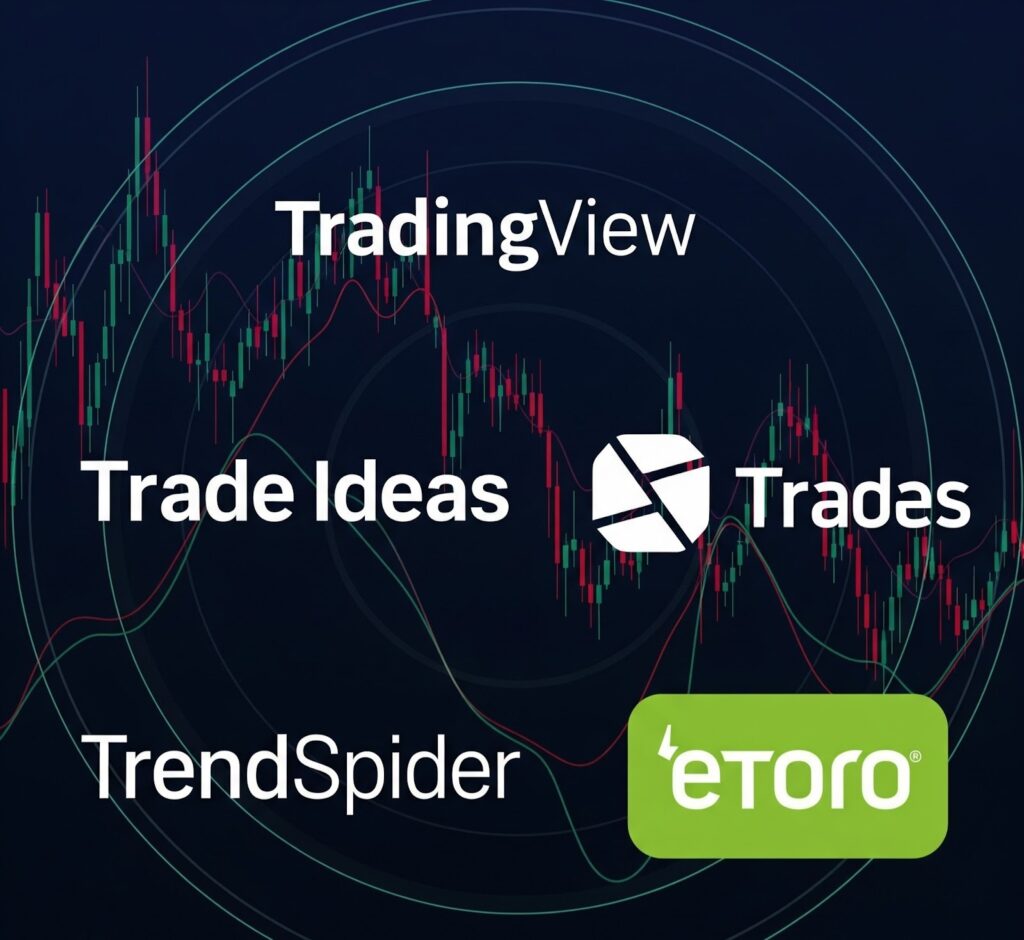
Since AI trading signal platforms are changing how traders make decisions by offering speed, precision, and automation, here’s a curated list of leading platforms , designed for traders seeking reliable tools:
Trade Ideas
Trade Ideas is a leading AI-based stock scanning and charting platform for active traders. It offers real-time AI-generated trading signals, automated trade execution, and tools for portfolio management. It is well-regarded for its algorithmic trading capabilities and serves both retail and institutional investors.
Holly, Trade Ideas’ AI engine, analyzes massive market data like price, volume, and technical indicators to generate high-probability trading signals in real time. Holly is like a “Vegas card counter” for its predictive ability.
TrendSpider
TrendSpider is an AI-driven technical analysis platform for stocks, ETFs, crypto, forex, and futures. It automates chart analysis, signal generation, and strategy development without the need for coding.
Its AI Strategy Lab uses machine learning methods to train custom models on up to 50 years of historical data. These models generate predictive signals for market movements based on user-defined inputs like technical indicators or chart patterns.
TradingView
TradingView is a top web-based charting and social trading platform for stocks, cryptocurrencies, forex, futures, and more. It is known for its powerful charting tools, community-driven insights, and AI features for creating trading signals.
With over 50 million users, it helps traders of all skill levels through its easy-to-use interface and Pine Script programming language for custom strategies. TradingView uses AI and machine learning to create trading signals through its Pine Script language, built-in indicators, and third-party integrations.
eToro
eToro is a multi-asset trading platform that offers stocks, cryptocurrencies, forex, and more, emphasizing social trading and AI-driven insights. It is beginner-friendly, requiring only a $50 minimum deposit.
Powered by TipRanks, eToro’s Research Tab uses AI to assess data from investment banks and financial analysts. It generates buy/sell signals for “Buy” or “Strong Buy” recommendations. These signals use machine learning to analyze market trends and analyst consensus.
Comparison Table Between Different AI Trading Signals Platforms
Feature
TradingView
Trade Ideas
TrendSpider
eToro
AI Signal Generation
AI via Pine Script, automated pattern recognition, and scanners. Community-driven scripts use ML for signals (e.g., RSI, MACD, trendlines). Signals for breakouts, reversals, or momentum.
Advanced AI via Holly engine (ML, genetic algorithms). 60% win rate for buy signals over 3 months. Signals for momentum, mean reversion, breakouts, gaps.
Advanced AI via Strategy Lab (Random Forest, Logistic Regression). Auto-detects patterns (e.g., head and shoulders) and generates signals based on indicators or fundamentals.
AI-driven signals via TipRanks (60%+ win rate for Buy/Strong Buy). Social trading signals via CopyTrader. Supports technical indicators (RSI, MACD).
Automation
High: Webhooks integrate with SignalStack or brokers (e.g., Alpaca, Interactive Brokers) for automated execution in <1s. Requires middleware.
High: Direct broker integration (e.g., Interactive Brokers, TradeStation) for automated trades. Trade Automation feature executes signals instantly.
High: Webhooks via SignalStack/TradersPost for automated execution in <0.45s. No direct broker integration.
Moderate: CopyTrader automates trades by copying experts. Manual execution for other signals. No API for full automation.
Key Strengths
50M+ user community with shared AI scripts; Affordable (free to ~$59.95/month); Multi-asset (stocks, crypto, forex, futures); User-friendly interface
Powerful Holly AI with high win rate; Real-time scanning; Institutional-grade tools; Simulated trading environment
No-code AI strategy creation; Robust backtesting (50 years of data); Precise pattern recognition; Broad asset support
Beginner-friendly with $50 minimum; Social trading via CopyTrader; AI-powered Alpha Portfolios; TipRanks signals
Key Limitations
Advanced AI requires Pine Script coding; No direct broker integration; Free plan limits real-time alerts
High cost (~$118–$228/month); Complex for beginners; Requires broker setup for automation
Expensive (~$107–$447/month); Steep learning curve; No direct broker integration
No API for automation; High CFD risk (61% lose money); Limited U.S. availability; No crypto insurance
Robust via Pine Script Editor. Tests AI strategies against historical data.
Strong backtesting for Holly strategies. Validates signal performance.
Advanced backtesting (50 years of data) via AI Strategy Lab.
Limited; relies on TipRanks or manual analysis. No native backtesting tool.
User Suitability
Beginners to advanced; ideal for community-driven traders and coders
Intermediate to advanced; suits active traders and institutions
Intermediate to advanced; best for systematic traders
Beginners; ideal for social trading and passive investors
Emerging AI Trading Signal Trends
The AI-driven trading landscape is altering how both retail and institutional investors engage with the markets. To remain competitive and profitable , traders need to understand and use the latest innovations that are defining this new era of smart investing. Here are the most significant AI trading trends to watch this year:
Reinforcement Learning for Real-Time Strategy Adaptation
AI trading systems are evolving beyond traditional machine learning models by incorporating reinforcement learning (RL). This type of AI learns by interacting with its environment and getting feedback through rewards or penalties. As a result, trading algorithms can continually improve their strategies based on real-time market outcomes.
Platforms like Alpaca and QuantConnect use RL to create bots that can adjust quickly to market volatility, macroeconomic news, and changing investor behavior. This adaptability leads to better risk management and quicker trade execution, which is crucial in today’s fast-paced financial environment.
Advanced Sentiment Analysis for Predictive Market Insights
Modern AI tools are moving beyond just technical indicators and price charts; they are now tapping into the emotions driving the market. Through advanced natural language processing (NLP) models, sentiment analysis scrapes and decodes information from various sources like real-time social media feeds (X/Twitter, Reddit, Discord), news articles and press releases, and more.
Explainable AI (XAI) and Regulatory Compliance
As global regulators like the SEC (U.S. Securities and Exchange Commission), ESMA (European Securities and Markets Authority), and MAS (Monetary Authority of Singapore) increase scrutiny, there is a growing need for AI systems to be clear and auditable. This demand has led to the rise of Explainable AI (XAI), which aims to make its predictions and reasoning understandable to people. , XAI will be essential as it helps traders and firms meet compliance standards and reduce legal risks.
AI-Powered Portfolio Personalization
AI can now customize portfolios for individual traders based on their risk tolerance, financial objectives, sector preferences, and behavioral patterns. This personalized approach, driven by deep learning and user data analysis, enables retail traders to access the tailored strategies that were once available only to high-net-worth individuals.
Low-Code & No-Code AI Trading Platforms
AI trading is becoming more accessible to users without technical backgrounds through low-code and no-code platforms. Tools like Tradetron, AdeptAlgo, and TuringTrader provide drag-and-drop interfaces for building, testing, and launching AI-powered trading bots without the need for complex coding. These platforms are also adding ChatGPT-style assistants to guide users in creating strategies, profiling risks, and even backtesting.
While AI trading signals provide significant benefits, it’s important to recognize their limitations. A balanced approach requires acknowledging both the opportunities and risks involved. Here are the biggest challenges and risks of using AI trading signals in today’s market:
Overfitting and False Precision in Predictive Models
Many AI trading systems, especially those using deep learning, are trained on past data to forecast future price changes. However, this can result in overfitting, where the model performs well in backtests but fails in live trading due to changes in the market. Overfit models typically react too sensitively to noise in the data and seem highly accurate during simulations, but struggle in reality.
Black Box Behavior and Lack of Transparency
Many AI systems, particularly deep neural networks, act like “black boxes” that make decisions that are hard to explain or interpret. Although some platforms now offer explainable AI (XAI), many retail-focused tools still lack transparency.
Market Shifts and AI Rigidity
Many AI models struggle to adjust to regime changes or unfamiliar conditions they haven’t been trained on. Without ongoing model retraining and human oversight, AI trading systems can become inflexible and outdated, leading to performance declines.
Security, Hacking, and System Vulnerabilities
As AI trading platforms grow more interconnected and cloud-based, cybersecurity risks are heightening. Hackers increasingly target trading bots, signal APIs, and brokerage accounts with greater sophistication. Potential threats include manipulating AI signals by inserting false data.
Regulatory Uncertainty and Legal Risks
AI trading, particularly when used by retail investors, often operates in unclear regulatory areas. As authorities like the SEC, FCA, and ESMA implement stricter rules around algorithmic decisions, traders could face penalties for using unlicensed or unregistered trading software, depending on models that don’t meet transparency requirements, or not disclosing automated strategies during tax audits or compliance checks.
AI trading signals are changing markets . They are powered by reinforcement learning and sentiment analysis, allowing for accurate, real-time predictions. These tools analyze large datasets, giving both retail and institutional traders an advantage in stocks, forex, and crypto.
Regulatory shifts, such as requirements for explainable AI, are guiding development and ensuring transparency. Regardless, adoption is rising among beginners and experienced traders alike.
FAQs
What Are AI Trading Signals?
AI trading signals are recommendations based on data analyzed by algorithms that look at market data, including price trends, volume, and sentiment. They help traders decide when to buy, sell, or hold assets like stocks, forex, or crypto.
Are AI Trading Signals Reliable for Beginners?
Yes, AI trading signals can be reliable for beginners if used with trusted platforms. They simplify complex analysis, but beginners should practice with demo accounts and apply risk management to prevent losses.
How Much Do AI Trading Signal Platforms Cost?
Prices vary. Trade Ideas starts at $84 per month, SignalStack charges between $0.59 and $1.49 per signal, and TradeRiser’s AI Signals costs $29 monthly. Many platforms offer free trials, so check their websites for detailed information.
Can AI Trading Signals Replace Human Traders?
AI signals support but do not replace human traders. They help lessen emotional bias but depend on human input for aligning strategies.
Are AI Trading Signals Reliable?
No signal is 100% guaranteed, but AI’s data-focused approach reduces errors compared to human analysis. Many platforms mix AI accuracy with human oversight for the best results. Nonetheless, traders should test signals in demo accounts and implement strong risk management.
Peace is an experienced content writer into cryptocurrency, blockchain, and most importantly, Web3 technologies. With vast experience in crafting search engine optimization-friendly and audience-oriented content, I am good at breaking down complex crypto concepts into engaging and accessible narratives. Having worked with various cryptocurrency payment gateways, blockchain development services, and AI-driven crypto platforms, I’ve created insightful articles, blogs, and marketing materials that encourage engagement and build trust in the Web3 ecosystem.
Disclaimer: This article is intended solely for informational purposes and should not be considered trading or investment advice. Nothing herein should be construed as financial, legal, or tax advice. Trading or investing in cryptocurrencies carries a considerable risk of financial loss. Always conduct due diligence before making any trading or investment decisions.
Trade with proof of Reserves
UEEx publish monthly audits and third party verification on every listed market.