Risk appetite and risk tolerance are two distinct but closely linked concepts every crypto investor must understand before building a portfolio. Risk appetite describes how much risk you are willing to take on in pursuit of financial goals – it is a strategic, forward-looking stance. Risk tolerance describes how much risk you can actually handle, both financially and emotionally, without making poor decisions under pressure. Getting the difference wrong can cost you real money in one of the most volatile asset classes on earth.
What Is Risk Appetite in Crypto Investing?
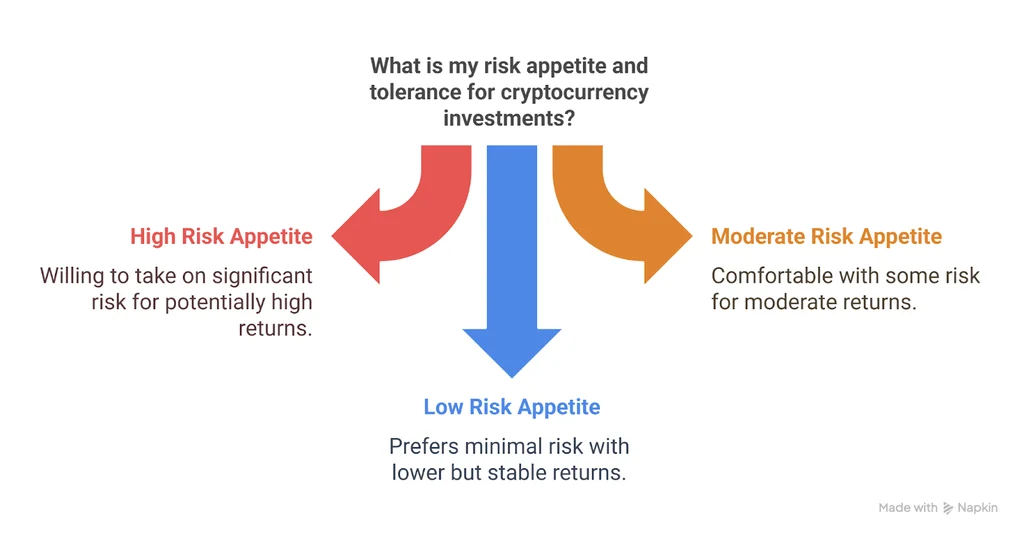
Risk appetite is the amount of uncertainty and potential loss you are prepared to accept in exchange for the chance of higher returns. In crypto, it shows up in the choices you make before you invest: which assets you select, how much capital you deploy, and whether you pursue high-yield altcoins or stick to established tokens like Bitcoin and Ethereum.
A high risk appetite might lead an investor to put 40% of their portfolio into small-cap DeFi tokens, open liquidity positions on new protocols, or use leverage in futures trading. A low risk appetite might mean holding only Bitcoin and Ethereum, keeping crypto exposure under 5% of total net worth, and avoiding derivatives entirely.
Risk appetite is shaped by:
- Investment goals (wealth building vs. income generation vs. speculation)
- Time horizon (months vs. years)
- Knowledge of the market and specific assets
- Personal attitude toward uncertainty and opportunity
As of 2026, a Coinbase survey of more than 350 professional investors found that over 75% plan to increase their crypto allocations, with 59% targeting more than 5% of assets under management. That signals a broadly elevated institutional risk appetite – but institutional investors also have formal frameworks, stop-loss protocols, and diversified books that most retail participants lack.
What Is Risk Tolerance in Crypto Investing?
Risk tolerance is the actual capacity – financial and psychological – to absorb losses without abandoning your strategy. It is less about ambition and more about reality. Someone with low savings, high fixed expenses, or a short investment window has objectively low risk tolerance regardless of how much they want high returns.
The psychological dimension matters just as much as the financial one. Bitcoin’s 30-day annualized volatility ranged between 35% and 65% through much of 2026, far above gold or the S&P 500. Bitcoin was roughly eight times more volatile than a standard 60/40 portfolio over the same period. If a 20% single-day drop causes you to sell at a loss and exit the market, your effective risk tolerance is lower than you thought – and your strategy needs to reflect that reality.
Factors that determine risk tolerance:
- Current income, savings, and emergency fund size
- Outstanding debts and fixed financial obligations
- Dependents and life-stage considerations
- Past experience with market drawdowns and how you responded
- Emotional stability under financial stress
Also Read: How to Make Money with Bitcoin for Beginners (2026 Guide)
How Do Risk Appetite and Risk Tolerance Differ?
The clearest way to see the difference is this: risk appetite is a choice; risk tolerance is a constraint. You choose your risk appetite. Your circumstances and psychology set your risk tolerance. When the two are aligned, investing becomes disciplined and sustainable. When they diverge, trouble follows.
| Dimension | Risk Appetite | Risk Tolerance |
| Nature | Strategic willingness to take risk | Actual capacity to absorb risk |
| Driven by | Goals, ambition, market outlook | Financial situation, psychology, experience |
| Changes with | Market conditions, investment thesis | Life circumstances, savings, emotional state |
| High misalignment risk | Overtrading, chasing pumps | Panic selling, exiting at the bottom |
| Measured by | Asset allocation choices, leverage use | Questionnaires, drawdown reaction history |
| Example (low) | Only holding BTC/ETH, no leverage | Can only afford to lose 5% of invested capital |
| Example (high) | Allocating 30%+ to altcoins or DeFi | Comfortable holding through a 50% drawdown |
Why Does Misalignment Between the Two Cause Problems?
When risk appetite exceeds risk tolerance, investors take on positions they cannot emotionally or financially sustain. They buy aggressively during bull markets, then sell at significant losses the moment prices drop sharply. This is the most common pattern that destroys retail crypto portfolios. The investor’s stated goal was growth, but their actual behavior was panic-driven.
The reverse – tolerance exceeding appetite – is less dangerous but still inefficient. An investor who could comfortably hold through volatility but keeps everything in stablecoins is leaving real return potential unused. In Q1 2026, Bitcoin climbed above $125,000, and investors who had exited the market in late 2024 out of excessive caution missed significant appreciation without a sound fundamental reason for doing so.
Also Read: 5 Proven Ways to Earn Crypto Rewards
How Do You Assess Your Own Risk Profile?
Building an accurate personal risk profile requires honest answers to questions most people avoid. Start with the financial side:
- What percentage of my total net worth am I investing in crypto?
- Do I have at least three to six months of expenses in liquid, non-crypto savings?
- Could I absorb a 50% drop in this investment without affecting my daily life?
- Am I investing money I might need within two years?
- Do I have high-interest debt that should be prioritized first?
Then assess the psychological side with equal honesty: How did you respond the last time the market dropped sharply? Did you hold, buy more, or sell? Your reaction to past drawdowns is a reliable indicator of your true risk tolerance – more reliable than any questionnaire.
Portfolio management tools like CoinTracking help you track exposure across assets. Volatility monitoring platforms like Altrady give real-time signals when your portfolio’s risk profile drifts outside your targets. Sentiment tools like CryptoMood can help you stay objective during market extremes.
What Are Common Risk Profiles in Crypto?
Most investors fall into one of four broad profiles, though the boundaries are not fixed:
| Profile | Risk Appetite | Typical Allocation | Suitable Instruments |
| Conservative | Low | 1–5% in crypto, mostly BTC | Bitcoin ETFs, stablecoins, large-cap only |
| Moderate | Medium | 5–15% split BTC/ETH/select alts | Spot holdings, some staking, no leverage |
| Aggressive | High | 15–30% with altcoin exposure | DeFi, emerging layer-1s, modest leverage |
| Speculative | Very high | 30%+ including micro-caps | Memecoins, new protocols, high leverage |
Research from Morningstar and XBTO suggests that a 1–10% crypto allocation, focused on BTC and ETH, typically improves risk-adjusted returns in a diversified portfolio. Beyond 5%, efficiency gains tend to decline as volatility increases faster than expected returns. This supports a moderate profile for most long-term investors who want crypto exposure without destabilizing their overall finances.
Also Read: How to Get an Entry-Level Job in Crypto: Roles, Salaries, and Tips for 2026
How Does Portfolio Strategy Reflect These Two Concepts?
Once you understand your risk appetite and tolerance, practical portfolio construction becomes clearer. A broadly cited institutional model allocates roughly 60% of crypto holdings to core blue-chips (approximately 40% Bitcoin, 20% Ethereum), with the remainder in vetted mid- and small-cap assets. For retail investors, the appropriate split depends on their individual profile.
Stop-loss orders are one of the most effective tools for managing the gap between appetite and tolerance. Setting a stop at 15–20% below entry removes the emotional decision when markets move against you. Dollar-cost averaging – buying fixed amounts at regular intervals – removes timing pressure and smooths out entry prices across volatile periods.
As of 2026, spot Bitcoin ETFs managed more than $115 billion in combined assets, led by BlackRock’s IBIT at $75 billion and Fidelity’s FBTC at over $20 billion. These products now offer conservative investors a regulated, custody-managed path to Bitcoin exposure, with risk characteristics closer to traditional securities than direct spot holdings.
How Should You Reassess Your Risk Profile Over Time?
Risk appetite and risk tolerance are not static. They change when your financial situation changes, when the market environment shifts, and when your investment experience grows. A job loss, a major expense, or a change in family circumstances can all lower your effective tolerance overnight. A sustained bull market can inflate risk appetite beyond what is actually sustainable.
A practical rule is to formally reassess your risk profile every six months, or after any major life or market event. Check whether your current allocation still reflects your goals, and whether the emotional experience of holding it over the past period matched your expectations. If you found yourself checking prices every hour or losing sleep, your real tolerance is lower than your stated appetite.
Practical Tips for Aligning Risk Appetite and Tolerance
- Write down your risk profile before you invest.Putting your targets on paper – maximum allocation percentage, maximum tolerable loss, target time horizon – makes it harder to abandon them under market pressure.
- Use position sizing to keep individual bets proportional.No single asset should represent more than 10–15% of your crypto allocation unless you have specific conviction and expertise in that asset.
- Set stop-losses at entry, not after a loss has already started.Pre-defined exits reduce the chance that fear drives you to hold a losing position too long or sell at the worst moment.
- Keep your emergency fund completely separate from investment capital.Money you might need within 12 months should never be in volatile assets. This boundary is what makes genuine risk tolerance possible in the first place.
- Track how you actually behaved during the last major drawdown, not how you think you would behave.Real behavior under stress is the most reliable measure of true tolerance.
- Revisit your allocation after large price moves.A 50% BTC rally may have pushed your crypto weight from 10% to 15% of your portfolio without any new purchases. Rebalancing keeps your actual exposure aligned with your intended risk level.
Also Read: Top 10 Providers Offering Crypto IRAs
Frequently Asked Questions
What is the simplest way to explain risk appetite vs. risk tolerance?
Risk appetite is how much risk you want to take – it reflects your ambition and investment goals. Risk tolerance is how much risk you can actually handle – both financially, based on your savings and obligations, and emotionally, based on how you respond to losses. The two must be aligned for a strategy to hold up when markets turn against you.
Can someone have a high risk appetite but low risk tolerance?
Yes, and this mismatch is one of the most common problems in crypto investing. A person may be highly motivated to seek large gains but have insufficient savings, high debt, or a strong emotional reaction to losses that prevents them from holding through volatility. This disconnect typically results in buying high during euphoria and selling low during downturns – the exact opposite of sound strategy.
How does crypto volatility in 2026 affect risk tolerance assessments?
As of 2026, Bitcoin’s 30-day annualized volatility ranged between 35% and 65%, significantly higher than traditional asset classes. Bitcoin reached above $125,000 before experiencing sharp multi-thousand-dollar intraday drops. This level of volatility means that even moderate crypto allocations can produce large swings in portfolio value, making accurate tolerance assessment more important than it was in earlier, lower-volatility markets.
Should beginners in crypto have a high or low risk appetite?
Beginners should generally start with a lower risk appetite until they have direct experience managing a real portfolio through a market cycle. Starting with a small allocation – typically 1–5% of investable assets – in established assets like Bitcoin and Ethereum gives real market exposure without creating the financial or emotional pressure that leads to poor decisions under stress. Knowledge and experience can justify higher appetite over time.
How often should I update my crypto risk profile?
A formal review every six months is a reasonable baseline. You should also reassess immediately after major life events – a job change, large expense, or new financial obligations – and after significant market events such as a crash exceeding 30% or a sustained rally that has pushed your crypto allocation well above your target percentage. Keeping the profile current is what keeps behavior aligned with intention.
What tools can help me stay within my risk limits?
Stop-loss orders enforce exit points automatically so emotions do not override strategy. Dollar-cost averaging reduces timing risk by spreading purchases over time. Portfolio tracking platforms like CoinTracking show your real exposure across assets. Volatility dashboards like those offered by Altrady help you monitor when market conditions are moving outside your normal parameters so you can adjust positions before losses exceed your tolerance threshold.