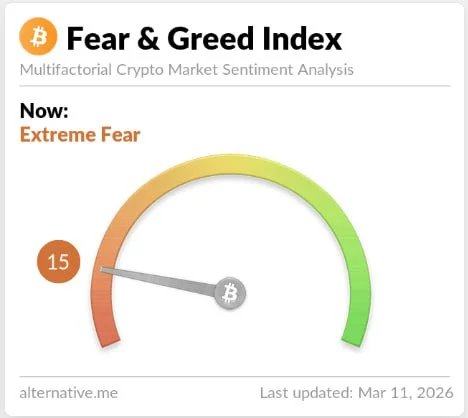
The cryptocurrency market is currently experiencing one of its longest stretches of investor anxiety in recent years. The widely tracked Crypto Fear & Greed Index shows that sentiment has remained in the “Extreme Fear” zone for 40 consecutive days, with the latest reading sitting at 15.
The index measures market psychology on a scale from 0 (extreme fear) to 100 (extreme greed). A reading below 25 indicates heavy pessimism among traders, often reflecting reduced risk appetite, declining confidence, and elevated market volatility.
This extended period of negative sentiment highlights growing caution among both retail and institutional investors as the digital asset market navigates macroeconomic uncertainty, regulatory concerns, and shifting trading behavior.
Market Sentiment Remains Deeply Negative
Despite a slight improvement from the previous day, the current score of 15 still places the market firmly in pessimistic territory. The sentiment gauge initially slipped from “Fear” into “Extreme Fear” on January 30, and it has largely remained there ever since.
Recent data also suggests the broader market has struggled to regain confidence in the short term. Earlier reports showed the index hovering near similar lows for weeks, marking one of the longest streaks of extreme fear since the market turmoil that followed the Terra ecosystem collapse in 2022.
The index is designed to reflect collective investor psychology by analyzing several indicators that influence trading behavior.
“The Crypto Fear & Greed Index serves as a crucial barometer for digital asset market sentiment, aggregating multiple data points into a score between 0 and 100.”
Key Takeaways
The Crypto Fear & Greed Index has remained in the Extreme Fear zone for 40 consecutive days, with the current score standing at 15, signaling widespread investor anxiety.
The index evaluates market sentiment using six factors, including volatility, trading volume, social media trends, investor surveys, Bitcoin dominance, and search data.
Persistent fear in the market is being driven by macroeconomic uncertainty, regulatory concerns, and reduced investor confidence.
Despite weak sentiment, some on-chain and derivatives data suggest long-term holders are not aggressively selling, hinting at underlying market stability.
Historical trends show that prolonged periods of extreme fear have sometimes preceded significant market recoveries, although they do not guarantee an immediate rebound.
How the Fear & Greed Index Is Calculated
The index combines data from several market signals to determine whether investors are acting cautiously or aggressively. These include price volatility, trading activity, social sentiment, investor surveys, Bitcoin’s market dominance, and Google search trends.
Each factor contributes a weighted portion to the final score:
Volatility (25%) – Measures unusual price swings in major cryptocurrencies
Trading volume (25%) – Tracks buying and selling momentum across exchanges
Social media sentiment (15%) – Monitors discussions and engagement across crypto communities
Investor surveys (15%) – Captures confidence levels among market participants
Bitcoin dominance (10%) – Evaluates shifts in capital concentration within the market
Search trends (10%) – Tracks public interest in crypto-related queries
Together, these inputs help paint a broader picture of how traders are feeling and behaving.
“Readings below 25 signal ‘Extreme Fear,’ suggesting that investors are highly cautious and markets may be experiencing heavy selling pressure.”
What Is Driving the Current Fear
Several factors appear to be fueling the current pessimistic mood in the crypto sector.
Heightened market volatility has caused large price swings across major cryptocurrencies such as Bitcoin and Ethereum. These movements often trigger defensive trading strategies as investors attempt to manage risk.
Trading activity also reflects this cautious environment. On many exchanges, sell orders have outpaced buying demand, reinforcing downward price pressure and contributing to weaker short-term sentiment.
Social media data further confirms the shift in mood. Discussions across crypto forums increasingly focus on potential market downturns, risk management, and speculation about where the next market bottom might form.
Search engine data shows similar patterns, with rising interest in terms related to crypto crashes and market declines.
Institutional Signals Show Mixed Outlook
While retail sentiment remains weak, some structural indicators suggest the market may be stabilizing beneath the surface.
Market analysts note that leverage in derivatives markets has declined, indicating that traders are reducing risk exposure. At the same time, certain on-chain metrics suggest long-term holders are selling less aggressively than during previous downturns.
Exchange reserve trends have also shown early signs of accumulation in some cases, which can occur when investors gradually move assets into long-term storage.
These signals do not necessarily indicate an immediate recovery, but they do show that the broader market structure is not deteriorating across all metrics.
When Extreme Fear Becomes a Market Signal
Historically, prolonged periods of extreme fear have often preceded significant market moves.
For example, the sentiment gauge dropped into similar territory during major events such as the March 2020 pandemic-driven crash and the 2022 FTX collapse. In several cases, the market eventually rebounded once selling pressure began to ease.
However, analysts caution that sentiment indicators alone cannot predict price direction.
Extreme fear can persist for extended periods, particularly during structural market adjustments or when global financial conditions remain uncertain.
The Road Ahead
For now, the market remains in a defensive posture.
The 40-day streak of extreme fear reflects lingering uncertainty among traders who are closely watching macroeconomic developments, regulatory changes, and broader financial market trends.
While historical patterns suggest that deep pessimism can sometimes create opportunities for contrarian investors, sentiment alone rarely determines the market’s next move.
As the Crypto Fear & Greed Index continues to fluctuate near historic lows, the coming weeks may reveal whether this prolonged stretch of fear marks a temporary phase—or the early stages of a deeper shift in crypto market sentiment.
Akindele T. Francis is a versatile content writer with extensive experience spanning various sectors. Specializing in blog posts, website content, service pages, compelling sales copy, etc., Akindele has collaborated with numerous agencies to deliver engaging and effective written material. With a keen eye for detail and a passion for crafting impactful narratives, Akindele consistently exceeds client expectations, driving results and enhancing brand messaging across diverse platforms.
Disclaimer: This article is intended solely for informational purposes and should not be considered trading or investment advice. Nothing herein should be construed as financial, legal, or tax advice. Trading or investing in cryptocurrencies carries a considerable risk of financial loss. Always conduct due diligence before making any trading or investment decisions.
Trade with proof of Reserves
UEEx publish monthly audits and third party verification on every listed market.