In October 2025, DeFi saw Total Value Locked (TVL) climb to about $170 billion, still below its 2021 peak of around $255 billion, according to various market analyses and reports from DeFiLlama. This surge was fueled by rapid growth in multichain ecosystems, new token launches, and increasing interest from institutions, benefiting DeFi farming rewards in 2026.
Historically, conservative stablecoin yield farming strategies, such as lending on Aave, supplying to Curve stable pools, or using auto-compounding vaults, provided reliable returns in the peak range of 5-15% APY. These rates surpassed traditional bank savings accounts, which generally offered less than 2% in most areas.
At the same time, yield farmers across various protocols earned an estimated $8-12 billion each year from transaction fees, borrowing interest, governance token giveaways, and other incentives.
However, the situation is clear: despite the appealing numbers, about 50-60% of liquidity providers (LPs) in automated market makers (AMMs) like Uniswap V3 end up losing money.
Research from Bancor, IntoTheBlock, and community analyses indicates that impermanent loss often outweighs earned fees and rewards in volatile pairs, wiping out profits for many participants.
Challenges like poor reward optimization, high gas fees on the Ethereum mainnet, misunderstanding of compounding benefits, and exposure to token price volatility add to the problem. This often turns what appears to be passive income into a net loss for most farmers.
The main issue for many yield farmers is their focus on flashy DeFi and governance token rewards without understanding the different yield farming rewards types and their interactions. Many miss key aspects, including:
- The difference between transaction fee sharing and governance token distributions.
- How authentic yield from protocol usage differs from inflationary token emissions.
- The exact impact of Impermanent loss vs rewards calculation.
- Answers to search requests like “yield farming APY explained, “How often are yield farming rewards paid?”, and “Best APY for stablecoin yield farming 2025.”
- Why APY (with compounding) performs much better than simple APR in practice.
Without this knowledge, even experienced users miss chances to maximize returns while reducing risks. This article aims to clarify these concepts.
You will also learn the exact difference between APY and APR, including compounding formulas that show true earnings in auto-reinvesting environments.
Additionally, the article highlights how governance tokens, such as COMP (Compound), CRV (Curve), and AAVE, provide dual benefits and outlines advanced reward optimization strategies used by top farmers. These strategies include cross-chain farming, concentrating liquidity, and prioritizing real yield.
Key Takeaways
- Fee sharing beats token emissions every time. It’s best to go for protocols that pay you real trading fees or interest, not the ones that just print new governance tokens.
- Impermanent loss is part of the deal with volatile pairs, as your real profits equal rewards, minus impermanent loss, and minus gas fees.
- With governance tokens, you have two options. Either lock them up for the long haul for boosts and voting power (think veCRV), or sell them as soon as you get them before the price drops.
- Stablecoin pools are the rock-solid choice. They allow you to avoid impermanent loss, earn 6-12% APY, and enjoy steady returns. They are perfect for people just starting out or anyone who wants to play it safe.
What Are Yield Farming Rewards?
Yield farming rewards are payments given to users who provide liquidity to DeFi protocols. These rewards come in seven forms:
- Transaction fee sharing from token swaps.
- Governance tokens like COMP or CRV.
- Interest income from lending.
- Boosted incentives for locking tokens.
- Liquidity mining programs.
- Spread capture in concentrated liquidity.
- Protocol partnership incentives.
These forms differentiate yield farming vs staking rewards. Also, annual returns typically range from 5 to 15% for conservative strategies, while higher-risk approaches can go beyond 20-30%.
In March 2026, with DeFi TVL around $95 billion and the stablecoin market cap around $315 billion, according to DeFiLlama, conservative stablecoin strategies yielded 4-8% APY. Higher-risk strategies might exceed 20% during spikes in demand but come with risks like impermanent loss and volatility.
APY vs APR in Yield Farming
APR (Annual Percentage Rate) reflects simple interest without compounding. It shows what you would earn if you withdrew rewards right away. APY (Annual Percentage Yield) includes compound interest, which represents what you’d earn by continuously reinvesting rewards.
For example, a 10% APR with daily compounding becomes 10.52% APY. Most yield farmers focus on APY because protocols typically auto-compound rewards, making APY a more accurate measure of earnings.
APY vs APR Yield Farming Comparison Table
| APR | Daily Compound (APY) | Weekly Compound (APY) | No Compound (APR) |
| 5% | 5.13% | 5.11% | 5.00% |
| 10% | 10.52% | 10.45% | 10.00% |
| 20% | 22.13% | 21.94% | 20.00% |
| 50% | 64.82% | 63.21% | 50.00% |
How Rewards Work
Liquidity providers (LPs) deposit assets into DeFi protocols like DEX pools (Uniswap, Curve), lending markets (Aave, Morpho), or yield vaults. In return, they receive LP tokens that represent their share of the pool.
These tokens entitle users to proportional rewards based on their contributions relative to the total liquidity.
Rewards build up continuously (often with every block on chains like Ethereum or Solana) or become available periodically through protocol dashboards. Multiple reward streams can occur at once:
- Swap fees from trading volume (typically 0.05-0.3% per trade shared among LPs).
- Governance tokens given as incentives (e.g., COMP in Compound based on borrowing or lending activity.
- Interest from borrowers in lending protocols (with variable APY linked to utilization rates).
- Boosted rewards from locking governance tokens (e.g., veCRV in Curve for up to 2.5x multipliers).
Why Rewards Matter
DeFi protocols rely entirely on incentivized liquidity provision to operate. Without enough liquidity, trading becomes costly or impossible (due to high slippage), lending dries up (resulting in low utilization), and protocols struggle to attract users or maintain operations.
Rewards serve as the economic engine: they kickstart new protocols by drawing in initial capital during launches and sustain established ones by rewarding ongoing participation in a competitive market.
This creates sustainable economic cycles: traders pay fees, LPs earn shares, and protocols increase usage, leading to more fees and deeper liquidity. Without rewards, DeFi would lack the capital efficiency necessary for permissionless, global finance, making yield farming key for ecosystem health and user adoption.
Historical Context
Yield farming surged during “DeFi Summer” in 2020 when Compound launched its COMP token rewards distribution in June and rewarded lenders and borrowers with governance tokens based on their activity. This innovation in liquidity mining sparked excitement, as users “farmed” tokens across protocols for massive returns, often exceeding 1,000% APYs in early pools.
Historical APY Trends (simplified yearly averages for graphing)
| Year | Stablecoin Yields (avg APY) | ETH Pool Yields (avg APY) | Governance Token Yields (avg APY) | Major Event |
| 2020 | 15-50 | 50-200 | 50-500+ | DeFi Summer (Compound launch) |
| 2021 | 10-30 | 20-80 | 100-1000+ | Peak emissions & TVL surge |
| 2022 | 5-15 | 10-35 | 20-150 | Market correction & Terra collapse |
| 2023 | 4-10 | 8-20 | 10-60 | Normalization & protocol maturation |
| 2024 | 5-12 | 10-25 | 8-40 | Real Yield movement begins |
| 2025 | 6-15 | 12-30 | 10-50 | Sustainable models dominate |
TVL skyrocketed from under $1 billion to around $255 billion by late 2021, driven by speculation and interconnected protocols. However, from 2022 to 2023, the market faced a sharp downturn: market declines, protocol hacks, and unsustainable emissions resulted in normalized APYs and widespread impermanent loss.
By 2025-2026, DeFi had matured significantly, emphasizing real yields from fees and borrowing (e.g., Aave and Morpho), institutional participation (via RWAs and restaking like EigenLayer), cross-chain growth (Solana, Base, and Arbitrum), and sustainable models.
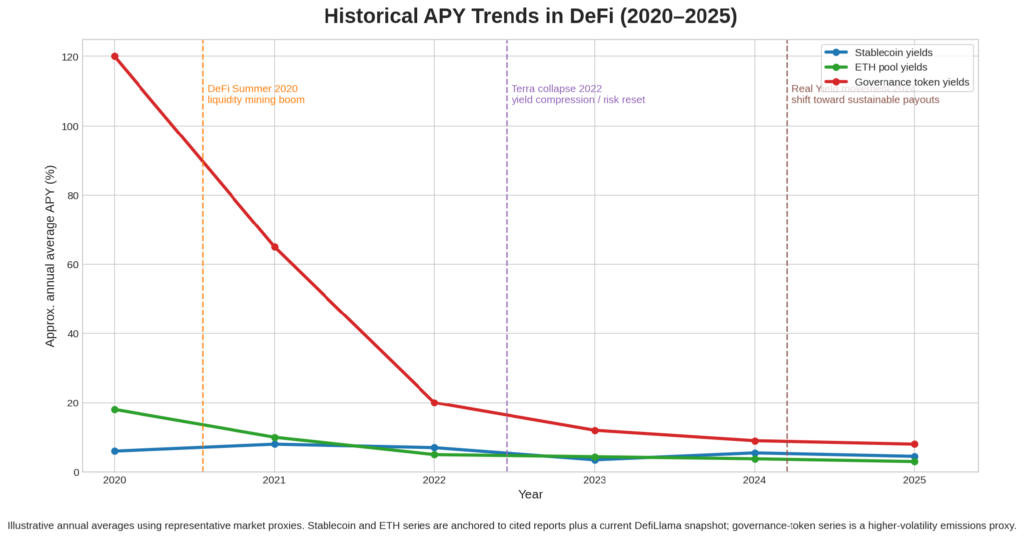
TVL stabilized around $95 billion in March 2026, focusing on audited protocols, lower-risk stablecoin strategies (4-8% APY base), and tools like concentrated liquidity (Uniswap V3) for greater efficiency. The market shifted from hype-driven booms to professional, risk-adjusted yield optimization.
The 7 Types of Yield Farming Rewards
Yield farming rewards come in various forms tied to different DeFi mechanics. In March 2026, with DeFi TVL at around $95 billion, with chain-level highs such as Ethereum at around $55 billion and Solana at around $6.8 billion, with overall ecosystem growth, and stablecoin market cap reaching a record around $315 billion, these rewards stress sustainable, usage-driven yields rather than purely emissions. Below is a complete breakdown of the seven types.
Type 1: Transaction Fee Sharing
How It Works
Every token swap on a decentralized exchange (DEX) incurs a fee, usually 0.05-0.3% on Uniswap V3 pools or 0.04-0.4% on Curve stable swaps. These fees are shared among liquidity providers (LPs) in the pool, with no governance tokens or emissions involved.
If you hold 1% of the pool’s liquidity, you earn 1% of all fees generated by trades in that pool. Fees accumulate continuously per block and can be claimed at any time, often auto-compounded in vaults.
This represents the purest form of real yield, directly linked to actual trading volume and protocol usage, rather than inflationary token minting.
Example: Uniswap V3 ETH/USDC Pool
Assume a pool with $100 million TVL (your $100,000 contribution = 0.1% share).
- Daily trading volume: $50 million.
- Fee tier: 0.3%.
- Daily fees generated: $50 million × 0.3% = $150,000.
- Your daily earnings: $150,000 × 0.1% = $150.
- Spread across the pool’s full liquidity, a $100,000 position earns only a small share of these fees. Realistic fee APYs for ETH/USDC are closer to 10-25%, before accounting for impermanent loss.
In practice, the Uniswap V3 stablecoin pools (e.g., USDC/USDT) averaged 10-25% APY from fees in concentrated ranges, as reported by DeFiLlama and analytics, due to high stablecoin routing volume. Volatile pairs like WBTC/ETH often provided 8-15% fee APY over 30 days.
Yield farming reward calculation formula.
Daily Fee Revenue = (24-hour Trading Volume × Fee Percentage) × Your Pool Share
APY ≈ (Daily Fee Revenue × 365) / Deposited Capital
(Adjust for compounding if reinvested.)
Why It’s Sustainable
Fee sharing depends on genuine demand; more trading means more fees for LPs. In 2026, with DEX volume in the billions daily (e.g., Uniswap + Jupiter + others), this remains a reliable reward stream, unaffected by token dilution. Concentrated liquidity (Uniswap V3) enhances efficiency, though it requires range management to avoid out-of-range periods.
Type 2: Governance Token Emissions
How It Works
Protocols create and distribute native governance tokens to users supplying liquidity or engaging in borrowing and lending. This process decentralizes ownership and encourages participation. Tokens grant voting rights on proposals (such as fee adjustments or new pools) and often carry market value. Are governance token rewards worth it? Here’s a case study that sheds more light.
Case Study: Compound (COMP) Rewards
On Compound, lenders and borrowers earn COMP along with interest. Distribution happens every Ethereum block (around 12-15 seconds), with rates determined by governance (historically, 50% to lenders and 50% to borrowers). More activity leads to more COMP.
In 2026, lending $10,000 USDC might yield an interest rate of around 4-7% APY (based on utilization) plus COMP emissions equivalent to an additional 1-3% APY (this is variable; recent data indicates low emissions as the program winds down).
Total: 5-10% APY. That’s around a $500-$1,000 a year figure, $400-$700 in interest, plus $100-$300 in COMP tokens. With COMP, each token equals one vote in governance. You can sell these tokens or stake them somewhere else. Price moves around a lot; late 2025 and early 2026 estimates put it in the $40-$50 range.
Case Study: Curve (CRV) Rewards
Curve really stands out because of its vote-escrowed model. As a liquidity provider, you earn CRV from stable pools. You can lock those as veCRV for anywhere from a week up to four years and get a reward boost.
What do you get with veCRV?
- Up to a 2.5x multiplier on your CRV rewards curve finance
- Voting power to steer where emissions go
- A cut of protocol fees
- Real input in governance
For example, base CRV rewards run 8-12% APY. Look for the max boost, and you’re looking at 20-30% APY, sometimes higher. In 2026, top Curve pools like sdUSD/frxUSD paid 20-35% without any boost and even more if you used veCRV or Convex.
Sustainability Analysis
High emissions inflate supply and can push prices down if there’s not enough demand. Strong protocols fight back with fee sharing, token burns, capped supplies, and making sure holding veCRV is actually useful (voting and fee cuts). By 2026, the trend shifted and protocols started cutting emissions and focusing more on fees for rewards.
Type 3: Interest Income from Lending
How It Works
You deposit assets into lending protocols like Aave or Compound. Borrowers pay variable interest based on what’s available and what’s being borrowed. Lenders pick up that interest directly.
Utilization Rate
Here’s the basic formula: Utilization = Total Borrowed / Total Supplied.
Interest Rate = Base Rate + (Utilization × Slope)
Take Aave, for example: In early 2026, Aave’s USDC market had roughly $3 to $4 billion supplied and $2 to $3 billion borrowed, around two-thirds utilization. Lenders earned around 1.7-3% APY (USDC borrow/supply spread hit 1.74-2.94%). When utilization spikes (80-90%+), rates jump to bring in more deposits.
Typical Returns
- Stablecoins (lower risk): 2-8% APY (recent Aave USDC: 1.7-6% depending on demand)
- ETH (medium risk): 1-5%
- Volatile assets: 5-20%+ during peak demand
Risks? If utilization suddenly drops, you might have to wait to withdraw, though on audited protocols like Aave, that’s not common.
Bottom line: This approach gives you a pretty stable, usage-driven yield. It’s a solid pick if you want something more predictable.
Type 4: Boosted Rewards & Staking
How It Works
You lock up governance or LP tokens to get reward multipliers. With Curve’s veCRV, you lock CRV to mint veCRV, which gives your LP rewards a boost (up to 2.5x), plus a share of fees and governance rights.
Curve veCRV Boost In Action
- Provide liquidity and start earning CRV
- Lock CRV (anywhere from 1 week to 4 years) and get veCRV.
- The longer you lock, the higher your boost, and it maxes out at 2.5x.
For example, a base 10% APY can jump to 25% with max boost. In 2026, top stable pools offered 20-35% unboosted, with boosts pushing yields even higher.
Trade-offs? You get higher rewards and more say in governance, but your tokens are locked up, so there’s some opportunity cost.
Alternative: Convex Finance
Instead of locking your own CRV, you can deposit Curve LP tokens on Convex. Convex pools its own veCRV and gives you a boost without long-term lockups. Plus, you earn CVX tokens on top. It’s become a popular choice because it’s just easier.
Boosts definitely lift sustainable yields, but you take on more risk with the lockup.
Type 5: Liquidity Mining Programs
How It Works
These short-term campaign protocols hand out extra tokens to certain pools, often to kick off a launch or attract liquidity fast.
Real Example: New DEX on Arbitrum
On launch, it might offer 100-300% APY in native tokens for a couple of months (60-90 days) on big trading pairs. After that, rates drop to a more realistic 10-20%.
What should raise a red flag?
- Wild APYs (500%+)
- No real token use
- Unlimited token supply
- No audits or anonymous teams
By 2026, most mining programs shifted toward audited, utility-focused campaigns. The space favors real yield now, not just token printing.
Type 6: Spread Capture in Concentrated Liquidity
How It Works
Uniswap V3 lets you set your own price range for liquidity. If the price stays in your range, you get more fees.
Example: Uniswap V3 USDC/USDT
If you provide liquidity across the full price range, you might earn 10-15% APY from fees. But if you concentrate your liquidity tightly (say, $0.998-$1.002), APY can hit 25-40%. That’s 2-4x more efficient.
Risk? If the price leaves your set range, you stop earning fees. You need to rebalance more often.
In 2026, stablecoin pools with tight price bands and big trading volumes saw the best returns.
Type 7: Partnership & External Incentives
How It Works
Sometimes, projects sweeten the pot by adding their own token rewards (think 20-100% APY on top of base yield) to attract liquidity on platforms like Uniswap or Curve. Here’s how to size up these programs:
- Good: The project has a real product, a useful token, audits, and a transparent team
- Caution: High APYs, low utility, small-cap projects
- Avoid: No audits, anonymous teams, or wild, unsustainable yields
APY vs. APR: The Math Behind Compound Returns
Let’s break down APR vs. APY in plain language. APR, or Annual Percentage Rate, is just the basic interest rate you earn if you cash out your rewards right away and never reinvest. APY, or Annual Percentage Yield, goes a step further.
It shows your real return if you keep reinvesting your rewards over time, thanks to compounding. In DeFi, most platforms make compounding easy or even automatic, so APY ends up being the more useful number for anyone chasing yield.
This yield farming rewards calculator lets you calculate APR to APY :
APY = (1 + APR / n)^n – 1
“n” is how many times per year you compound. Take a 10% APR with daily compounding, plug in 365 for “n,” and you get about 10.52% APY. That little 0.52% bump gets even bigger if you crank up the rate or compound more often.
Auto-Compounding Strategies
Manual compounding is a hassle; you have to claim rewards, maybe swap them, and then redeposit. It eats up gas fees (especially on Ethereum) and takes time. That’s why auto-compounding vaults like Yearn Finance or Beefy Finance are popular. They do all that work for you, often multiple times a day, which squeezes even more out of your returns.
Also, compounding frequency really matters. If you go from weekly to daily compounding, that can add an extra 0.5–1% or more to your returns, especially when APRs are high. In 2026, stablecoin yields usually sit around 4–8% (think Aave or Morpho), and riskier pools offer 15–30% or more.
If you’re chasing yields above 10–15% APR, auto-compounding yield farming isn’t just a nice bonus; it’s a must. It helps cover your gas costs and actually lets you capture those bigger returns.
| APR | Daily Compound (APY) | Weekly Compound (APY) | No Compound (APR) |
| 5% | 5.13% | 5.11% | 5.00% |
| 10% | 10.52% | 10.45% | 10.00% |
| 20% | 22.13% | 21.94% | 20.00% |
| 50% | 64.82% | 63.21% | 50.00% |
Quick tips: For yields over 15% APR, use auto-compounding vaults (after accounting for fees). If you’re under 10–15%, and you’re on a chain with high gas fees, auto-compounding probably isn’t worth it.
Go for protocols on cheaper chains (like Solana or Layer 2s), or just compound less often. And always double-check your real APY on DeFiLlama or on the protocol’s dashboard, as numbers can look better than they really are if you’re not careful.
Governance Tokens: The Dual-Reward System
Governance tokens give you a double benefit: instant value you can sell or stake for more rewards, and long-term power through voting on how a protocol runs, how fees are set, or how the treasury gets used.
In the DeFi world of 2026, where everyone’s focused on “real yield,” the best governance tokens combine regular rewards with actual revenue sharing from real protocol use, not just inflation.
Major Governance Token Breakdown
The following tokens can boost your yields, but they’re not risk-free as prices swing, sometimes a lot. Hence, stick with tokens that actually do something useful in protocols that make real money. That’s where you’ll find the best mix of rewards and staying power.
CRV (Curve) is right at the center of the “Curve Wars”; it’s the token everyone’s fighting for, because whoever owns the most veCRV gets to steer where new CRV rewards go. You can earn CRV by providing liquidity to Curve pools (especially those with stablecoins). If you’re in it for the long haul, lock up your CRV for veCRV for anywhere up to four years. That unlocks a 2.5x boost on your base rewards, lets you vote on where CRV emissions go, and earns you a cut of the protocol’s trading fees.
The two main ways to play are:
- Lock for the max boost if you really believe Curve will keep dominating stable swaps.
- Deposit your LP tokens on Convex Finance, which gives you inherited boosted rewards plus some CVX tokens, all without personally locking up your CRV.
AAVE is another big name. You earn it by lending, borrowing, or staking in the Safety Module (stkAAVE). Holding AAVE lets you vote on protocol decisions, get staking rewards (around 7% APY lately), enjoy fee discounts, and even get insurance for losses.
The Safety Module is a big deal because if there’s a hack or shortfall, up to 30% of staked AAVE can be slashed to cover losses and protect users. So, you can stake AAVE in the Safety Module for both yield and insurance, or just hold it to have a say in how the protocol runs.
SUSHI works a bit differently. You get it by providing liquidity on SushiSwap, and then you can stake it to get xSUSHI. That xSUSHI earns you 0.05% of all platform swap fees, and you get voting rights too. The usual play: farm SUSHI in high-volume pools, then stake it for a stream of passive fees. It’s a good set-it-and-forget-it option if you want exposure to SushiSwap without babysitting your position.
Impermanent Loss vs. Rewards
Many APYs can be totally misleading. You might see a pool promising 20% returns, but if impermanent loss (IL) eats up 25% of your capital, you’re actually down 5%. The people who make money in DeFi know how to handle this trade-off; the rest just see their high yields vanish.
Impermanent loss happens when you’re in an AMM pool and one asset’s price moves. Take an ETH/USDC pool: you deposit equal value in ETH and USDC. If ETH doubles, the pool keeps the 50/50 ratio by selling some of your ETH for USDC.
So, when you pull out, you have less ETH and more USDC than if you’d just held. It’s called “impermanent” loss because it doesn’t lock in until you exit, but at that point, it’s very real. Volatile pairs get hit hardest by IL; stablecoin pairs barely feel it.
Here’s how to calculate impermanent loss vs rewards.
Net Return = Rewards Earned – Impermanent Loss – Gas Fees
A quick example with an ETH/USDC pool:
You deposit 1 ETH ($2,000) and 2,000 USDC, which is a total of $4,000.
ETH jumps 50% to $3,000.
Your impermanent loss is around 2%, so let’s call it 2%. That’s $80 gone.
You earn 12% APY over three months, so about $120 in rewards.
Gas to get in and out costs $40.
Final tally: $120 (rewards) – $80 (IL) – $40 (gas) = $0. Even with a juicy headline APY, you only break even.
So, are there yield farming rewards without impermanent loss, and when do rewards actually beat IL? Here are three main scenarios:
- Stablecoin pairs (like USDC/USDT or DAI/USDC): IL is almost zero, so rewards are basically pure profit.
- High-volume pools: Transaction fees can offset moderate IL.
- Boosted rewards: If you score a 2.5x veCRV or Convex boost, you can outpace 5-10% IL even in balanced pairs.
| Pool Type | IL Risk | Reward Potential | Best For |
| Stablecoin/Stablecoin | Very Low (0-0.1%) | Low (5-12% APY) | Conservative, avoid IL entirely |
| ETH/Stablecoin | Medium (2-5%) | Medium (10-18% APY) | Balanced risk-reward |
| Altcoin/ETH | High (5-15%) | High (20-40% APY) | Aggressive, accept IL for high rewards |
| Altcoin/Altcoin | Very High (10-30%) | Very High (40-100%+ APY) | Speculative only |
Cross-Chain Reward Comparison
DeFi’s TVL sits around around $95 billion, with stablecoins at about $315 billion. But yields vary a lot from chain to chain. That’s because gas fees, liquidity, protocol maturity, and transaction speed all of it changes depending on where you are. Ethereum is still king for security and depth, but L2s and alt-L1s like Arbitrum, Solana, and BNB Chain give better net yields for smaller amounts, mostly because gas is so much cheaper.
Here’s a snapshot of the main chains and what they offer:
- Ethereum (Mainnet)
Ethereum is still the heavyweight. It leads in TVL of $53-56 billion, about 55-60% market share, and its DeFi protocols are about as battle-tested as it gets. Security is top-notch: think deep audits, insurance funds, and real institutional trust.
Pros: Deep liquidity, so trades don’t move the market much. Security is the best. Tons of strategies, from lending and DEXs to restaking with EigenLayer.
Cons: Gas fees are brutal, as it costs $10-50+ per transaction when things get busy. For small farmers, those fees eat up their yield. Not ideal for compounding or frequent trading unless you have serious capital.
Best protocols: Uniswap (for concentrated liquidity), Curve (especially stable pools with veCRV boosts), Aave (lending at 2-8% for stablecoins), and Compound (interest plus COMP rewards).
Typical APYs: 5-20%. Stable lending lands at 4-8%; volatile pairs or boosted pools can hit 15-30%+ when demand spikes.
Bottom line: Ethereum is best for big players ($50K and up) since fees barely matter at that scale.
- BNB Chain
BNB Chain (which used to be BSC) is all about low-cost DeFi. It’s a top 3-5 chain with about $6 billion in TVL, and it dominates in DEX and lending activity.
Pros: Ultra-low gas fees ($0.20–$2), super quick confirmations, and some big incentive programs (think CAKE emissions) make BNB Chain pretty attractive. On the flip side, it’s more centralized (Binance has a lot of control), and the ecosystem just isn’t as deep as Ethereum. Sometimes you run into worries about bridges or how much control is really decentralized.
Best protocols: If you’re looking for top picks, PancakeSwap is the go-to for yield farming and CAKE rewards. Venus is strong for lending and borrowing.
Typical APYs: It sits around 15–50% (often juiced by CAKE rewards or liquidity mining). Stable pools usually land in the 10–25% range, but if you’re chasing higher returns in riskier farms, those numbers can go up fast. It’s honestly a sweet spot for smaller positions where saving on gas fees really adds up.
- Solana
This protocol has taken off in DeFi. Total value locked is hovering around $6.7–$7 billion, making it the second-biggest non-Ethereum chain.
Pros: What’s driving Solana is its sheer speed and a growing ecosystem. Transactions are lightning fast (we’re talking under a second), and fees are basically nothing, less than a penny. Trading volume on DEXs is huge, sometimes even beating Ethereum.
Cons: But it’s not all perfect: there have been network outages (though that’s improving), and liquidity pools aren’t as big as Ethereum’s, so you can get more slippage. People also raise centralization flags now and then.
Best protocols: Raydium is great for AMM and farming; Orca does concentrated liquidity well; and Jito is known for MEV-boosted staking and yields.
Typical APYs: It is typically 10–30%. Stable or liquid staking sits near 5–10% (with some boosts), while high-volume DEX pools can hit 15–40% with fees and emissions. Solana works especially well for high-frequency trading or regular users who value speed.
- Arbitrum and other Ethereum layer 2s (like Base and Optimism)
These options blend Ethereum security with way better scalability.
Pros: Arbitrum’s got around $2 billion in TVL, and it’s growing thanks to low fees. You still get that Ethereum-level security because of rollups, and fees are cheap, usually $0.10–$0.50. 1. Protocol and liquidity growth are fast.
Cons: You do need to watch for some bridge risks (though these are getting better), and liquidity on L2s is still smaller than on the Ethereum mainnet. Sometimes withdrawals take a little longer, too.
Best Protocols: If you’re looking for solid protocols, check out GMX for perps and yield, Camelot for DEX farming, and the usual Aave or Uniswap forks.
Typical APYs: They fall in the 12–35% range. Leveraged trading and perps can go 20–50% or more, while stable lending or DEX yields settle around 10–25%. Overall, L2s offer a strong mix of efficiency and cost savings while still letting you use familiar Ethereum protocols.
Cross-chain yield farming rewards comparison Table
| Chain | Stablecoin Pools | ETH/Stable Pools | Altcoin Pools |
| Ethereum | 5-12% | 8-18% | 15-30% |
| BNB Chain | 10-25% | 15-35% | 25-50% |
| Arbitrum | 8-20% | 12-28% | 20-40% |
| Solana | 8-22% | 12-30% | 20-45% |
Tax Implications of Yield Farming Rewards
If you’re looking for how to maximize yield farming rewards or you are currently earning yield farming rewards, transaction fees, governance tokens like COMP or CRV, lending interest, or other DeFi incentives, expect to pay a yield farming rewards tax. Most countries treat these as taxable income. DeFi’s TVL is projected to be around $95 billion, and with regulations tightening, you can’t afford sloppy reporting. Here’s what you need to know, mainly for the U.S. (since the IRS is basically setting the tone worldwide) and other countries.
U.S. Tax Treatment
The IRS sees crypto as property, based on rules like Notice 2014-21 and Rev. Rul. 2023-14. When you get yield farming rewards, you pay income tax on the fair market value (in USD) of the moment you have control over them when they hit your wallet or become claimable. This covers staking rewards, governance tokens, liquidity mining, and all those DeFi earnings.
There are two main tax moments:
- When you get your rewards: That’s ordinary income, taxed at your usual rate (up to 37% federal, plus state). You report this on Form 1040, Schedule 1, under “Other Income.”
- When you sell, swap, or trade those rewards, you deal with capital gains or losses. Your cost basis is the Fair Market Value (FMV) when you get them. If you hold it for less than a year, it’s taxed at ordinary rates. Hold it for more than a year, and you get the long-term capital gains rate (0–20%). You’ll need Form 8949/Schedule D for this.
Here’s a quick example:
Say you earn 10 COMP tokens when they’re worth about $220 total. You report $220 as ordinary income; if your rate is 24%, that’s about $53 in taxes. Hold those tokens for six months and sell for $270. You’ve got a $50 gain, taxed as short-term capital gains (so, ordinary rates again). Hold longer than a year before selling, and you get the better, long-term rate.
Some specific situations:
- LP tokens: When you deposit assets into a pool, you might be swapping your tokens for LP tokens, potentially a taxable event. Withdrawing is another disposal. The IRS hasn’t nailed down every detail for DeFi, so opinions vary, but lots of people treat these as taxable. Track everything.
- Auto-compounding vaults (like Yearn or Beefy): Every time rewards get reinvested, that’s a new taxable event at the FMV, even if you never click “claim.” The IRS counts reinvested rewards as income. Keep records of every single compounding event so you know your cost basis.
Note that the new Form 1099-DA generally applies to regulated brokers and exchanges. Because DeFi and self-custody farming do not always involve a broker, this form may not cover all yield farming activity, so you will need to rely on solid records.
FMV in USD (grab data from CoinGecko or CoinMarketCap), how many tokens, what kind, and the transaction hash. Tools like CoinLedger or Koinly make this a lot easier.
International Tax Rules
Tax rules abroad are all over the place:
- UK (HMRC): Staking and yield farming rewards are usually taxed as income (20–45%) when you get them. Later, selling triggers capital gains tax (18–24% for 2025/26, with a £3,000 allowance). You have to report everything through self-assessment.
- EU: Every country has its quirks. A lot of places, think Germany or France, treat DeFi rewards as regular income. Others let you skip capital gains tax if you hold your assets long enough, sometimes over a year.
New DAC8 reporting rules kick in for the EU in 2026, so you’ll want to keep your records tight. Some spots, like Portugal (with its NHR regime) or Germany (if you’re patient enough to hold), still offer tax breaks for crypto, but honestly, these rules shift all the time.
Here’s how you can keep your tax bill in check
- Tax-loss harvesting: Sell off those governance tokens that never took off and use the losses to offset your gains.
- Timing: If you can, claim or compound rewards when your income is lower, which keeps you in a friendlier tax bracket.
- Retirement accounts: If you qualify (like with a self-directed IRA), route some of your crypto moves there for tax deferral. DeFi options are still limited, but it helps.
- Global tip: If you’re in Nigeria or elsewhere, check your local rules because crypto is sometimes taxed as an asset and as income.
Reward Optimization Strategies (2026)
DeFi’s total value is projected to hover around $95 billion, with stablecoins clocking in at $314.8 billion. The pros aren’t chasing every new farm; they’re after steady, risk-adjusted yields that actually stick around. The best strategies layer rewards, squeeze out extra returns, and keep risks in check. Here’s how the smart money plays it now.
- The Layered Yield Stack
Layering lets you stack rewards from different sources, interest, fees, compounding, and even leverage, for a fatter yield. Let’s say you’re big on stablecoins:
- Start by depositing USDC into Aave for a base 4-7% APY.
- You get a USDC (an interest-bearing token). Drop that into a Yearn or Beefy vault. That adds another 0.5-1% APY, bringing you to 5-8%.
- Use aUSDC as collateral on Aave or Morpho and borrow more stablecoins at 3-5% APY.
- Take those borrowed coins to a high-volume Curve pool, and you’re earning fees plus CRV rewards.
All in, your original capital could pull in a 10-16% APY after borrowing costs. When it comes to risks, you are exposed to smart contract bugs across multiple platforms. However, borrowing against your crypto brings liquidation risk that keeps your loan-to-value under 60%. Gas fees on Ethereum can sting, so use Layer 2s like Arbitrum to save money. This approach works best when markets are stable and borrowing demand stays steady.
- Governance Token Accumulation and Boost
Instead of dumping governance tokens as soon as you earn them, try holding and locking them for bigger rewards down the line.
Take Curve:
- Year one, you provide liquidity and rack up CRV rewards (8-12% APY). Don’t sell; instead, stack them up.
- Year two: Lock those CRV tokens for four years. Now you get veCRV, which boosts your earnings up to 20-30% APY, plus a cut of trading fees and voting rights.
The payoff comes from patience, turning short-term token emissions into long-term, which boosts yield. Watch out for price swings on locked tokens and keep an eye on what other yields pop up elsewhere.
- Cross-Chain Arbitrage Farming
Yields aren’t the same everywhere. Sometimes the same pool pays more on a different chain, especially on Layer 2s or alt-L1s.
Example:
- On Ethereum Uniswap V3, ETH/USDC might pay 10-15% APY, but gas fees eat into profits.
- That same pair on Arbitrum or a Uniswap fork? You could get 16-25% APY, with lower fees and faster compounding.
Move funds over bridges like Stargate or Hop to chase those better yields. Just know, as more people catch on, returns start to level out, so you’ll need to rebalance. Use dashboards like DeFiLlama and Zapper to keep tabs on yields across chains. This works best if you’re farming with $5,000 to $50,000, as smaller positions get crushed by Ethereum gas.
- Dynamic Rebalancing
Don’t just set it and forget it. Shift your capital to the best yield opportunities every month or quarter. Here’s how it looks:
- Week 1: Park USDC in a Yearn vault, earning 8%.
- Week 3: Aave’s USDC APY jumps to 12%, which means you pull out and move over.
- Week 6: Curve launches new incentives, pushing a stable pool up to 15-20%, giving you time to migrate again.
Track everything with DeBank or Zapper, and set up APY alerts with Yield Watch or DeFiLlama. In 2026, the best returns go to those who move fast and smart. Don’t overdo it, though; stick to four to six moves a year on low-fee chains to avoid racking up costs.
- The Barbell Strategy
Split your capital: 80% goes into safe, predictable yields; 20% into high-risk, high-reward plays. For the safe chunk, lend stablecoins on Aave or Morpho or provide liquidity to Curve stable pools. You’ll get 5-10% APY, almost no impermanent loss, and low volatility. Use the other 20% to chase more aggressive opportunities, knowing your core is safe.
Now, if you’re chasing bigger numbers, you can put about 20% of your portfolio into new protocol launches, emerging farms, or leveraged plays. Here, APYs can shoot up to 30-100% or even more. But let’s be real, these are risky. You’re staring down the barrel of potential rug pulls, token crashes, or heavy impermanent loss.
Why does this mix make sense? If that risky 20% goes completely south, your loss stops at 20%. But if those moonshots pay off, maybe there are early incentives or the protocol takes off, you can see a 10-40% bump across your whole portfolio.
So you keep your downside in check but still have a shot at catching the upside. In a more mature market like what we expect in 2026, this blends reliable returns with just enough speculation to keep things interesting.
Advanced Topics: Real Yield vs. Token Emissions
Real yield is a big deal these days. It means your rewards come straight from things like trading fees, borrowing interest, or liquidation penalties. Token emissions, on the other hand, are just platforms printing and handing out fresh tokens to attract users. Over time, the comparison between “real yield vs token rewards” lies in the value of every token out there.
People started paying attention to this after the 2021-2022 DeFi cycle. Those wild APYs from inflationary rewards almost always ended with the token price falling off a cliff, which wiped out the real value of your gains.
By 2025-2026, most serious protocols moved toward models where rewards are funded by real economic activity. This creates a flywheel: more usage brings in more fees, which means higher rewards, which attract more users, and so on.
Token emissions can help get things started, but they usually mean constant sell pressure as farmers dump their rewards, which drags prices down and leaves long-term holders holding the bag.
Let’s make it concrete. Picture two protocols in March 2026:
Protocol A is all about token emissions. It promises 100% APY but pays you entirely in its own governance token. Over the years, that token supplied balloons, and the price tanks 80%. So even if you “earned” 100% in tokens, your real gain is only 20% after the dust settles.
Protocol B pays a lower but real 15% APY, coming from trading fees in a popular ETH/USDC pool. No new tokens, just a cut of actual revenue. That 15% APY holds steady, and you keep the full 15%. Some real-yield standouts in 2025-2026 are:
- GMX gives about 70% of perpetual trading fees directly to GLP and staked GMX holders, paid in ETH or AVAX.
- Synthetix shares its protocol fees with SNX stakers, so your rewards depend on actual trading volume.
- MakerDAO pays a DAI Savings Rate from protocol revenue, so your stablecoin yield is steady and predictable.
To spot a solid real-yield opportunity, watch for the following signs:
- Protocol revenue beats token emissions.
- A clear fee-sharing setup.
- Even token buybacks or burns.
- Climbing TVL and user numbers.
- Revenue comes from a mix of sources.
Real Yield vs Token Emissions – Evaluation Framework
| Category | Positive Signs | Red Flags |
| Revenue Model | Revenue > token emissions | Infinite token supply |
| Reward Mechanism | Fee sharing mechanism | Rewards 10x higher than revenue |
| Token Economics | Token buyback and burn | No clear value accrual to token |
| Usage Metrics | Growing protocol usage/TVL | Declining TVL despite high APY |
| Diversification | Diversified revenue streams |
Conclusion
Yield farming still gives people a shot at solid passive income. You’ll see APYs anywhere from 5% to 30%, depending on your appetite for risk and strategy. With about $95 billion locked in DeFi and stablecoins topping $314 billion, you can feel the impact of both big and small players and the presence of deeper liquidity and beefed-up security.
But you can’t just throw money at the next shiny protocol and expect to win because not all of them last. Also, keep in mind that fees and borrowing revenue stick around, while inflationary token rewards usually crash in value.
Also, don’t forget impermanent loss that can eat up those tempting double-digit yields in volatile pools if you don’t do the math and set up the right offsets.
So what you should do is figure out your risk tolerance. Decide if you want to stick with stablecoins or go for a 70/30 stable-to-volatile split.
Pick two or three protocols (Aave, Curve, and Uniswap are great) and really learn the ins and outs instead of scattering your funds everywhere. Set up a tracker like Zapper or DeBank to keep tabs on your APYs, impermanent loss, and open positions.
Start with $500 to $1,000 on a low-fee chain so you can learn without burning too much on gas. Log every reward and claim from the start (you’ll thank yourself at tax time). Don’t go it alone; join the UEEx.com community for live APY alerts, strategy talks, and insights from people who are farming right now.
At the end of the day, yield farming isn’t about luck; it’s about discipline and real know-how. Start small, chase real yield, watch your risks, and keep compounding. If you stay smart, DeFi is still full of opportunities in 2026 and beyond.
FAQs – Frequently Asked Questions
How often do you get yield farming rewards?
Most rewards rack up nonstop. On Ethereum, that’s every 12-15 seconds; Solana is even faster. You can claim whenever you want through the protocol’s dashboard. Some setups auto-compound for you.
Gas fees matter, though. If it costs $20 to claim but you’ve only earned $15, just wait. A good rule: claim when your rewards are at least 3-5 times the gas fee, so you’re not burning money.
Are these rewards guaranteed?
Nope. APYs swing around, thanks to changes in trading volume, borrowing demand, token prices, incentive programs, and how much money is in the pool. That sweet 20% APY today can turn into 8% next week if things cool off or more people pile in. Past results don’t mean much for the future.
What’s better: a high APY from token rewards or a lower APY from fee sharing?
Go with the lower APY that comes from real fees. It’s almost always more reliable in the long run. Token emission APYs, those eye-catching 50-100%+ numbers, sound great at first, but they usually come with a lot of inflation and price drops.
Fee-sharing yields, sitting in the 10-20% range, aren’t as flashy, but they’re based on real protocol activity and tend to hold their value better. The smart play is to put about 80% of your capital into stable, fee-based yields and the other 20% into riskier, high-APY farms if you want to chase bigger returns.
How much do you need to start yield farming and actually make money?
On the Ethereum mainnet, you’ll want at least $5,000 to $10,000. Gas fees there are steep and can be anywhere from $30 to $80 per transaction, so small deposits get eaten up fast.
If you’re using L2s or alt-L1s like Arbitrum, Base, BNB Chain, or Solana, you can start with $500 to $1,000 since the fees are much lower, often just a few cents or a couple bucks. Just make sure your gas costs stay under 1% of your total investment, or else your profits get wiped out.
Do you owe taxes on unclaimed yield farming rewards?
In the U.S., yes. The IRS usually treats those rewards as ordinary income, taxed at the fair market value when they hit your wallet, even if you haven’t claimed them yet. Some people argue you only owe taxes when you actually claim the tokens, but that’s still up for debate.
To be safe, report rewards as income as soon as they show up in your wallet. There’s not much specific IRS guidance for DeFi, so it’s always smart to check with a tax pro.
Can you lose your initial deposit in yield farming?
Absolutely. Risks include smart contract hacks (they’re rare on audited protocols, but they happen), impermanent loss in volatile pools, governance token crashes that make your rewards worthless, and liquidation if you’re using leverage.
If you want to play it safe, stick with stablecoin strategies on well-known platforms like Aave, Compound, or Curve. Only put in money you’re fine with losing entirely.
Disclaimer & Risk Warning
This content is for educational purposes only and should not be considered financial advice. Yield farming carries substantial risks, including smart contract exploits, impermanent loss, token price volatility, and potential loss of principal. All APY figures mentioned are historical and not guaranteed. Past performance does not indicate future results. Always conduct your own research (DYOR), verify protocol audits, and never invest more than you can afford to lose entirely. Consult qualified financial and tax advisors before making investment decisions. UEEx.com makes no guarantees about yield farming profitability and is not liable for any losses.