Picture sending money to someone on the other side of the world and having it land in seconds, with no bank in the middle and no form to fill out. Picture earning real interest on your savings instead of the 0.5% your bank offers.
That’s the promise behind DeFi, short for decentralized finance, and it’s no longer a niche experiment. Even after a rough year for crypto markets, DeFi protocols are still holding more than $70 billion in user funds as of mid-2026, according to DeFiLlama.
So what is DeFi, really? And how does it work once you get past the buzzwords? This guide walks through it in plain language, with real examples, honest numbers, and a step-by-step path if you want to try it yourself.
Key Takeaways
- DeFi replaces banks with code. Smart contracts on a blockchain handle lending, borrowing, and trading automatically.
- You control your own money through a crypto wallet. That’s freedom, but it also means there’s no one to call if something goes wrong.
- DeFi holds roughly $70 billion in user funds as of mid-2026, smaller than its 2021 peak but far more tested.
- Start small, use established protocols, and treat any unusually high yield as a red flag rather than an opportunity.
What Is DeFi? A Simple Definition
DeFi stands for decentralized finance. It’s a set of financial tools such as lending, borrowing, trading, and saving that run on blockchain networks instead of banks. Instead of a bank employee approving your loan, a piece of software called a smart contract does it automatically, following rules anyone can read in advance.
In plain terms: DeFi lets you use financial services without asking a company for permission first. The idea traces back to 2018, when a group of Ethereum developers coined the term in a group chat.
Bitcoin had already shown the world that money could work without a central bank. DeFi took that a step further, using Ethereum’s ability to run small programs (smart contracts) to rebuild banking-style services in code.
DeFi by the Numbers: 2026 Snapshot
Source: AI-generated
It’s worth being honest about where DeFi stands right now rather than repeating outdated hype.
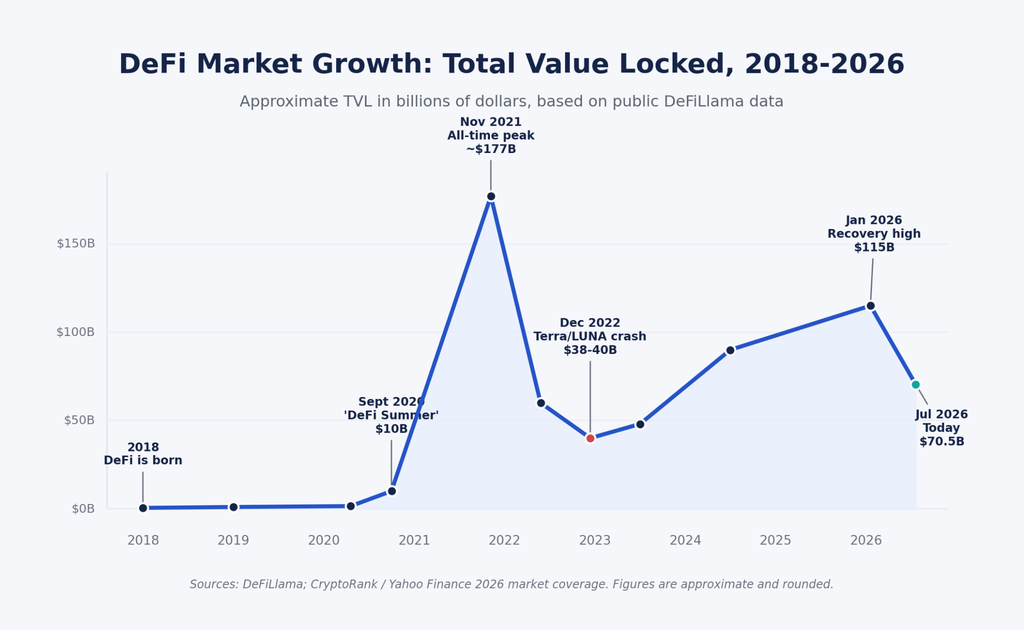
- Total value locked across DeFi protocols sits at roughly $70.5 billion as of mid-2026, down about 39% from January’s $115 billion, according to data compiled by DeFiLlama and reported by Yahoo Finance.
- Aave, the largest single protocol and biggest lending platform, holds about $12.5 billion, while Lido, the leading liquid-staking protocol, holds about $12.1 billion.
- Stablecoins, the backbone of most DeFi activity, have a combined supply of roughly $310 billion. While the stablecoin market cap contracted by roughly $10 billion from its Q2 peak, transactional velocity has surged, with USDC handling over $1.2 trillion in adjusted monthly volume, outpacing USDT.
- 2026 has also been a costly year for security. Reported hacks and exploits across the sector have run into the hundreds of millions of dollars, including the April 2026 Aave crisis, where a $290 million KelpDAO/LayerZero cross-chain exploit resulted in $200 million in bad debt.
“TVL is not a perfect measure of DeFi health because it moves with token prices as well as user deposits, but a sustained decline still tells a useful story,” TradingView analysis noted of the 2026 pullback.
None of this means DeFi is failing. It means the easy money era of 2021, when yields of 50% or more were common, is over, and what’s left is a smaller, more battle-tested ecosystem. That’s arguably a healthier foundation, even if the headline numbers look less exciting.
How Does DeFi Work? The Building Blocks
Source: AI-generated
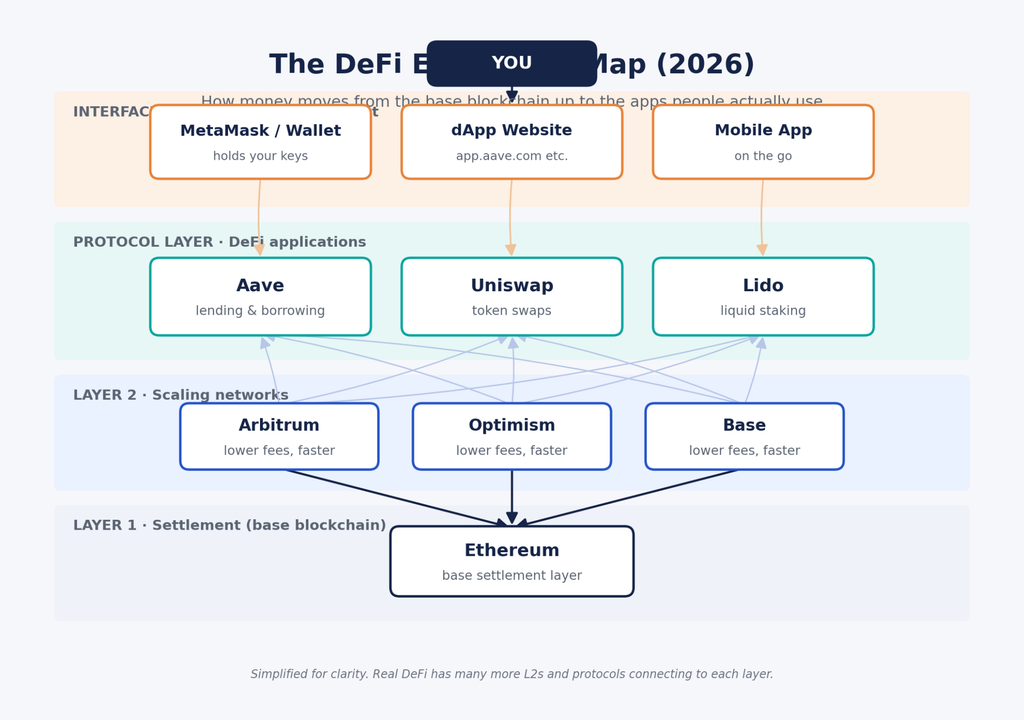
DeFi rests on three things working together. Once you understand these, the rest of DeFi starts to make sense quickly.
1. The Blockchain Is the Record Book
A blockchain is a shared record of transactions that lives on thousands of computers at once, instead of one company’s server. Nobody can quietly change an entry after the fact, and anyone can look up any transaction using a tool like Etherscan.
Most DeFi activity still happens on Ethereum, though cheaper and faster networks such as Solana, Arbitrum, and Base have picked up a growing share of users who want lower fees.
2. Smart Contracts Do the Work
A smart contract is a program that runs exactly as written, with no one able to step in and change the outcome. If you deposit money into a lending pool, the smart contract handles the interest calculation, the collateral checks, and the repayment automatically every time.
Think of it like a vending machine. You put money in, the machine follows its programming, and out comes what you paid for. No cashier, no manager, no negotiation.
3. Wallets and Apps Connect You to It All
You interact with DeFi through a crypto wallet, like MetaMask, and a website called a dApp (decentralized application). The wallet holds your private keys, which prove ownership of your funds. The dApp is just the front door. The actual financial logic happens in the smart contract behind it.
“Not your keys, not your crypto” is the closest thing DeFi has to a golden rule. If you don’t control your private keys, you don’t truly own the funds.
Gas Fees and Transaction Costs
Source: AI-generated
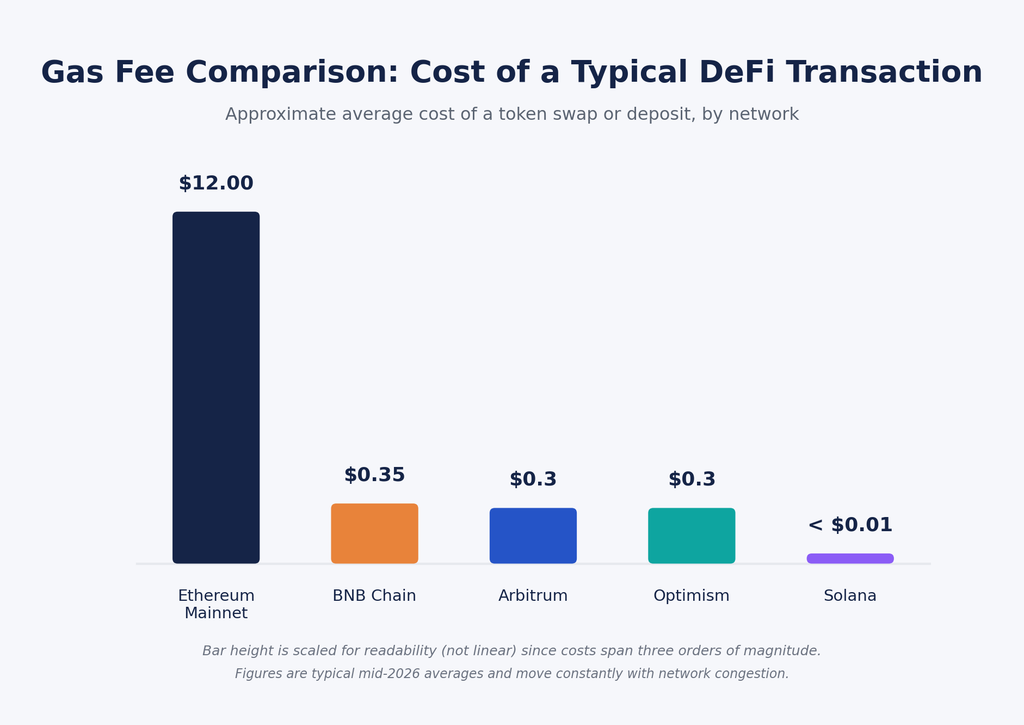
Every DeFi transaction requires a gas fee, the cost of processing transactions on a blockchain. On Ethereum, gas fees consist of a base fee (which is burned) and an optional priority fee paid to validators. More complex transactions, such as token swaps or lending, consume more gas than simple transfers.
Thanks to Ethereum’s Dencun and Pectra upgrades, gas costs in 2026 are far lower than in previous years. A basic ETH transfer typically costs just a few cents, while a Uniswap swap often costs well under $1 on mainnet, although fees can still spike during periods of heavy network activity.
For even lower costs, most users rely on Layer 2 (L2) networks such as Arbitrum and Optimism, where transactions often cost less than a cent while retaining Ethereum’s security through mainnet settlement. Besides reducing fees by more than 90%, L2s also offer faster confirmations and support leading DeFi protocols like Uniswap, Aave, and GMX.
Other blockchains also provide low-cost alternatives. Solana processes most transactions for a fraction of a cent but makes trade-offs in decentralization and has experienced occasional network outages. BNB Chain typically charges only a few cents per transaction and offers faster processing than Ethereum, although it relies on a smaller validator set.
To minimize transaction costs:
- Use Layer-2 networks for routine DeFi activity.
- Batch transactions instead of making frequent small ones.
- Check live gas prices before submitting transactions.
- Preview transaction costs in your wallet before confirming.
- Avoid interacting with the network during periods of unusually high congestion
DeFi vs Traditional Finance: What’s Actually Different
The easiest way to understand DeFi is to compare it side by side with a bank.
| Feature | Traditional Finance | DeFi |
| Who’s in control | A bank holds and manages your money | You hold your own funds in a wallet |
| Getting approved | Credit checks, paperwork, waiting | Anyone with a wallet can join |
| Hours | Business hours, closed weekends | Runs 24/7, including holidays |
| Sending money abroad | 1 to 3 days, high fees | Minutes, often under $1 in fees |
| Transparency | You can’t see the bank’s books | Every transaction is publicly viewable |
| Who’s responsible if something goes wrong | Bank, regulator, deposit insurance | You; there’s no customer service line. |
A real example makes this concrete. Sending $500 through a traditional remittance service can cost $15 to $25 in fees and take a few days to arrive. Sending the same value in a stablecoin like USDC over a low-fee network can cost less than a dollar and land in seconds. That single difference is why stablecoins have become a genuine lifeline in countries dealing with high inflation or shaky banking systems.
The tradeoff is real too. Banks offer fraud protection, chargebacks, and a number to call. DeFi does not. If you send funds to the wrong address or lose your recovery phrase, there’s no one to reverse it.
What Can You Actually Do With DeFi?
DeFi isn’t one product but closer to a toolbox. Here are the main things people use it for.
Lending and Borrowing
Platforms like Aave let you deposit crypto and earn interest or put up crypto as collateral to borrow against it. On Aave, deposited assets currently earn variable rates in the low single digits, well above what most savings accounts pay, though rates move constantly with supply and demand.
Say you own $3,000 worth of ETH and want cash without selling it. You can deposit that ETH as collateral and borrow a portion of its value in a stablecoin. You keep your ETH exposure, pay interest on the loan, and can repay whenever you want. If the collateral’s value drops too far, though, the protocol will automatically sell it to protect lenders. That’s a real risk, not a footnote.
Trading on Decentralized Exchanges
A decentralized exchange, or DEX, lets you swap one token for another without a company like Coinbase in the middle. Uniswap is the best-known example. Instead of matching buyers and sellers with an order book, it uses pools of tokens supplied by other users, with prices adjusting automatically based on the pool’s balance.
How DEXs Differ from Centralized Exchanges:
| Feature | Centralized Exchange (CEX) | Decentralized Exchange (DEX) |
| Custody | The exchange holds your crypto | You hold crypto in your wallet |
| KYC/AML | Required (passport, address) | Not required (anonymous) |
| Trading | Order book matching | AMM liquidity pools |
| Fees | 0.1-0.5% trading fee | 0.05-0.3% swap fee + gas costs |
| Asset Listing | Exchange approval needed | Anyone can list any token |
| Downtime | Yes (maintenance, outages) | No (runs 24/7 on blockchain) |
| Hacks | Exchange risk (Mt. Gox, FTX) | Smart contract risk (code audits critical) |
Staking and Liquid Staking
“Staking” means locking up crypto to help secure a blockchain network in exchange for rewards. Ethereum’s minimum for running your own validator is 32 ETH, out of reach for most people.
Liquid staking services like Lido solve that by letting you stake any amount and receive a token back that represents your stake and keeps earning rewards while staying usable elsewhere in DeFi. Lido currently holds more DeFi value than any other single protocol.
Yield Farming
Yield farming means supplying tokens to a pool and earning a mix of trading fees and reward tokens. It can pay off, but it also carries a lesser-known risk called impermanent loss, where providing liquidity to a pool of two different assets can leave you worse off than if you’d simply held them separately. It’s a real cost, and one a lot of newcomers don’t find out about until after the fact.
Benefits of DeFi vs. Traditional Finance
Let’s explore the DeFi benefits compared to traditional finance.
1. Greater Financial Inclusion and Global Access
Despite increased global account ownership, 1.3 billion adults remain financially excluded, according to the World Bank’s 2025 Global Findex. High minimum balances, strict documentation, limited banking access, and costly remittance services continue to restrict access to traditional finance.
Decentralized finance (DeFi) addresses these challenges by enabling anyone with a smartphone and internet connection to access financial services through a crypto wallet, without credit checks, minimum deposits, or geographic barriers. Users can lend, borrow, save, trade, and send money globally.
Stablecoins further enhance DeFi by providing faster, lower-cost cross-border payments, helping entrepreneurs, migrant workers, and individuals in emerging markets access a more inclusive financial system.
2. Transparency and Auditability
Unlike traditional banks, DeFi protocols operate on public blockchains, making every transaction verifiable through blockchain explorers like Etherscan and Arbiscan. Leading protocols also publish real-time data on reserves, TVL, lending rates, and activity, enabling users to independently verify their financial health.
This transparency reduces reliance on trust and highlights a key advantage of DeFi over opaque centralized systems, as demonstrated by the collapse of firms like FTX.
3. Lower Costs and Better Returns
By removing intermediaries and automating transactions with smart contracts, DeFi can significantly reduce costs.
Compared with traditional finance:
- International transfers: Traditional bank wires often cost $25–$50 plus foreign exchange markups and can take several business days. Stablecoin transfers usually settle within minutes for a fraction of the cost.
- Savings: Many traditional savings accounts still pay below 1% APY, while established DeFi lending protocols often offer 3–8% on stablecoins, depending on market conditions.
- Lending: Traditional loans require credit checks, paperwork, and lengthy approval processes. DeFi collateralized loans can be accessed almost instantly without credit history.
- Trading: Decentralized exchanges allow users to trade directly from their wallets without relying on centralized brokers.
Because DeFi eliminates many operational costs, including physical branches, manual approvals, and multiple intermediaries, a larger share of returns can flow directly to users rather than financial institutions.
4. Programmability and Composability
One of DeFi’s greatest strengths is composability, often called “money Legos,” which allows blockchain protocols to integrate smoothly. Users can trade, stake, borrow, and earn yield across multiple platforms without leaving the blockchain ecosystem.
This interoperability also powers automated strategies like portfolio rebalancing, recurring payments, and yield optimization through smart contracts, creating a connected financial system where decentralized applications work together efficiently rather than operating in isolation.
5. 24/7 Availability and Faster Settlement
Unlike traditional finance, which is limited by business hours and slow settlement times, decentralized finance (DeFi) operates 24/7 without weekends or holidays. Transactions are typically completed within seconds or minutes, enabling users to trade, transfer funds, or access loans anytime, anywhere.
This always-on infrastructure provides individuals and businesses with faster, more accessible financial services across different time zones.
Risks and Challenges of DeFi
Before investing, it’s important to understand the main risks and how to reduce them.
Smart contract vulnerabilities
DeFi protocols rely on smart contracts, and infrastructure threats remain a significant concern. In April 2026, the CoW Swap domain hijacking demonstrated the risk of front-end vulnerabilities, while the $290 million KelpDAO/LayerZero bridge exploit highlighted the ongoing security challenges of cross-chain infrastructure.
To reduce risk, stick to audited, well-established protocols such as Aave, Uniswap, and MakerDAO. Check for independent audits from firms like CertiK, Trail of Bits, or OpenZeppelin, start with small deposits, and consider DeFi insurance providers such as Nexus Mutual for additional protection.
Market volatility and liquidation risk
Cryptocurrencies remain highly volatile, making DeFi lending and liquidity provision inherently risky. If the value of collateral falls below a protocol’s required threshold, borrowers can face automatic liquidation and additional penalty fees. Likewise, liquidity providers may experience impermanent loss when token prices diverge sharply.
Keeping loan-to-value (LTV) ratios below 50%, using stablecoins where appropriate, and monitoring collateral closely can significantly lower these risks.
Regulatory uncertainty
Regulations continue to evolve worldwide. The European Union’s MiCA framework has introduced clearer rules for crypto businesses. In the U.S., the GENIUS Act has been signed into law and serves as the active driver behind 2026 compliance. Agencies like FinCEN and the OCC are actively rolling out joint rules implementing Section 4 of the GENIUS Act to enforce Customer Identification Programs (KYC) on permitted stablecoin issuers.
Self-custody requires caution
Unlike traditional banks, DeFi offers no customer support or transaction reversals. Losing your private keys, sending funds to the wrong address, or approving a malicious smart contract can result in permanent losses. Using hardware wallets, verifying wallet addresses, backing up seed phrases securely, and revoking unused token approvals are essential security practices.
User experience and scalability
Although DeFi has become easier to use thanks to Layer 2 networks, better wallets, and lower transaction fees, it still presents a steeper learning curve than conventional finance. Managing wallets, gas fees, and assets across multiple blockchains can be confusing for beginners, making education and careful research essential before investing.
Getting Started with DeFi: A Step-by-Step Guide
Source: AI-generated
If you want to try it yourself, go slowly and treat your first transactions as a learning exercise, not an investment.
1. Learn Before You Invest
DeFi has no FDIC insurance, no customer support, and no safety net; you’re on your own. Before committing funds, understand smart contracts, gas fees, and private keys. Good starting points: Bankless, Finematics, and Whiteboard Crypto on YouTube, plus the documentation for any protocol you plan to use.
2. Get a Non-Custodial Wallet
MetaMask is the standard choice; install it, create a password, and write your 12-word seed phrase on paper (never digitally; whoever holds it controls your funds). Add low-fee networks like Arbitrum, Optimism, and Polygon.
Rainbow and Argent offer friendlier onboarding, while Rabby suits advanced users. If you’re holding $5,000+, pair MetaMask with a hardware wallet like Ledger or Trezor for offline key storage.
3. Fund Your Wallet
Buy ETH or stablecoins (USDC/USDT) on an exchange, like Coinbase, Kraken, or Binance, then withdraw to your MetaMask address. Double-check the address and network before sending, and keep $20–50 in ETH for gas.
4. Make Your First Move
Start small and low-risk: earn interest on stablecoins via Aave, swap tokens on Uniswap, or stake ETH through Lido. Once comfortable, explore liquidity provision on Curve.
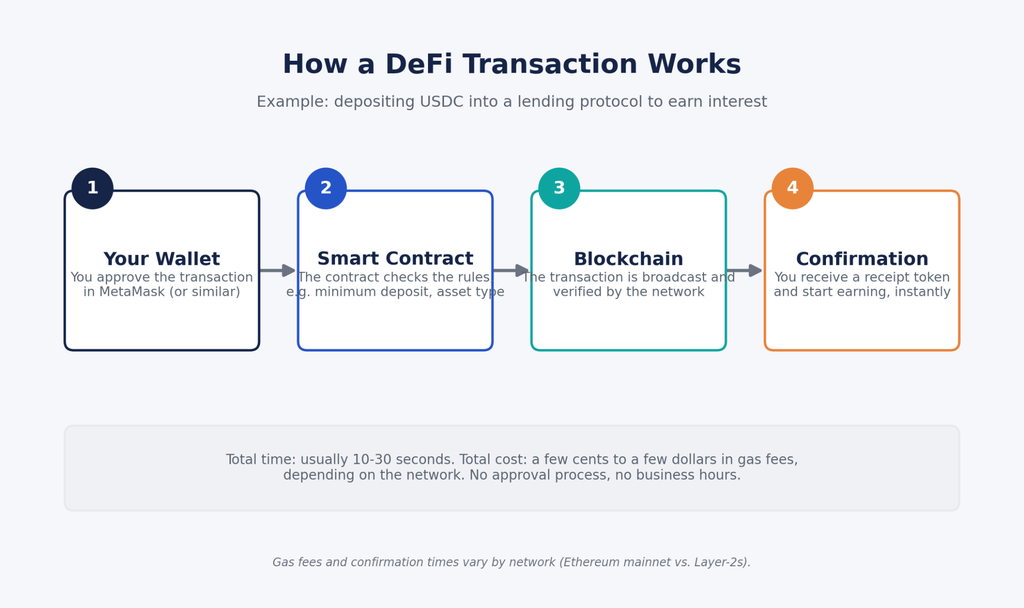
5. Execute a Transaction
Connect your wallet to the protocol, approve token spending, confirm the deposit, and watch your funds start earning immediately.
6. Protect Yourself
Use separate hot and cold wallets, verify every transaction before confirming, stick to audited protocols with real track records, revoke unused approvals via Revoke. Cash, and diversify across platforms and chains.
The Future of DeFi: 2026 Trends and Beyond
Here is the vision and roadmap DeFi hopes to achieve in 2026 and beyond
Layer-2 Scaling Drives Mass Adoption
Layer-2 networks are making DeFi faster and cheaper than ever. Platforms such as Arbitrum, Base, Optimism, zkSync, and Starknet now support low-cost transactions and near-instant settlement, allowing major protocols like Aave and Uniswap to scale efficiently. As cross-chain connectivity improves, users will enjoy a smooth experience without worrying about the underlying blockchain.
Real-World Assets Enter the Mainstream
Tokenization is bringing traditional finance on-chain. Treasury bills, private credit, real estate, and other real-world assets (RWAs) are becoming key sources of yield and collateral in DeFi. Leading institutions are launching tokenized funds, while platforms continue expanding fractional ownership opportunities, making previously inaccessible assets available to global investors.
Institutional Adoption Accelerates
Institutional participation is no longer experimental, with BlackRock launching a tokenized money market fund on Ethereum and J.P. Morgan experimenting with DeFi liquidity pools. Asset managers, banks, and payment providers are embracing tokenized funds, regulated stablecoins, and permissioned DeFi products.
Regulatory frameworks such as Europe’s MiCA are also creating clearer rules while the U.S. debuts its GENIUS Act, encouraging greater institutional capital to flow into decentralized finance.
AI and Automation Improve User Experience
Artificial intelligence is simplifying DeFi by automating portfolio management, detecting fraud, optimizing yields, and monitoring smart contract risks. These tools reduce complexity, making decentralized finance more accessible to everyday users.
Cross-Chain DeFi Becomes the Standard
The future of DeFi is increasingly multi-chain. Technologies like Chainlink CCIP and LayerZero are improving interoperability, enabling assets and liquidity to move smoothly across blockchains.
Over time, users are expected to interact with DeFi applications without needing to know which network powers the transaction, creating a more unified financial ecosystem.
None of this guarantees smooth sailing. But it does suggest DeFi is settling into something more durable than the speculative frenzy of a few years ago.
Frequently Asked Questions
Is DeFi safe?
DeFi carries real risks, including smart contract bugs, sharp price swings, and scams, and there’s no bank or government backstop if something goes wrong. It can be reasonably safe if you stick to long-established, audited protocols, start with small amounts, and never share your wallet’s recovery phrase.
How much money do I need to start using DeFi?
You can start with as little as $20 to $50. Most protocols have no minimum deposit, though you’ll also need a small amount of crypto set aside just to cover network transaction fees.
Can I lose money in DeFi?
Yes. You can lose money through hacked protocols, a sharp drop in the value of collateral you’ve borrowed against, sending funds to the wrong address, or falling for a scam. None of these losses can be reversed or refunded.
What’s the difference between DeFi and a centralized crypto exchange?
A centralized exchange, like Coinbase, holds your crypto for you and requires identity verification, similar to a bank. DeFi runs on smart contracts, lets you keep control of your own funds in your own wallet, and generally doesn’t require identity checks to use.
This article is for educational purposes only and isn’t financial advice. DeFi protocols carry real risks, including smart contract failures, market volatility, and permanent loss of funds. Always research a protocol independently, start with an amount you can afford to lose, and consider speaking with a qualified financial advisor before committing significant funds.