You open Twitter and see ten different opinions in ten minutes, one thread says Bitcoin is the only safe bet, another says you’re late unless you buy some obscure AI token right now.
That expansion is exactly why picking the best crypto investments isn’t a one-size-fits-all answer.
Bitcoin’s stability, Ethereum’s DeFi dominance, Solana’s speed, and XRP’s regulatory tailwinds each serve different goals and stacking them against newer AI tokens or DePIN networks means weighing very different risk levels side by side.
This guide walks through how to evaluate any crypto asset on its merits and breaks down the strongest options across major categories right now.
Read also: Must-Know Crypto Investment Tips
Best Crypto Investments to Invest In Right Now
Prices move fast, but the fundamentals behind a good crypto investment don’t change overnight. Here’s a closer look at each one, along with the trade-offs to weigh before you buy.
Bitcoin (BTC)
Bitcoin is the largest and most liquid crypto asset, with the total market near $2.7-2.8 trillion and Bitcoin alone making up roughly 57% of it.
Bitcoin’s 21 million fixed supply, deepest liquidity, and longest track record make it the most established and conservative asset in the digital asset class.
Pros
- Deepest liquidity of any crypto asset; fixed, predictable supply; longest security track record; easiest to buy/sell without moving the price.
Cons
- Slower, more limited smart contract functionality than ETH or SOL; still volatile relative to traditional assets; upside potential is generally lower than smaller-cap coins given its size.
Ethereum (ETH)
Ethereum is the dominant platform for DeFi, tokenization, and smart contracts, and the second-largest crypto by market cap.
Ethereum’s DeFi TVL share slipped from about 63.5% in early 2025 to roughly 56% by September 2026, though it still leads with close to $50 billion locked and a $165 billion+ stablecoin base.
Pros
- Largest DeFi ecosystem and developer base; deepest institutional tokenization activity; strong network effects.
Cons
- Losing ground to specialized chains (BNB, Tron, Hyperliquid); higher fees than newer competitors; declining TVL share trend.
Solana (SOL)
Solana is now used for stablecoin payments, DePIN, and tokenized assets, with daily active addresses holding above 3 million through much of 2026.
Solana has also maintained over 30 months without a network-wide outage as of September 2026.
Pros
- Fastest, lowest-fee major chain; real reliability improvement after past outage history; growing real-world usage.
Cons
- Full Firedancer rollout (1M+ TPS) is still not complete network-wide; historically more volatile and exploit-prone than ETH; still rebuilding trust after past network halts.
XRP
XRP is built around cross-border settlement, with Ripple positioning it as infrastructure for institutional payment rails rather than a general-purpose smart contract platform.
The SEC and CFTC jointly classified XRP as a digital commodity on March 17, 2026, binding federal classification.
Pros
- Major regulatory overhang removed, established ETF access, clear real-world use case in payments.
Cons
- Long-term legal certainty still depends on CLARITY Act passage, price has been volatile even after the commodity ruling.
BNB
BNB is the native token of the Binance ecosystem. It is used for trading fee discounts, transactions on BNB Chain, and activities across decentralized exchanges and other applications.
BNB has strong utility, but its performance is closely connected to Binance. If Binance continues to grow, BNB could benefit. However, regulatory issues, legal problems, or a loss of market share could negatively affect BNB.
- Pros: Strong utility and a large ecosystem.
- Cons: High exposure to Binance’s regulatory and business risks.
Read Also: Bitcoin vs Ethereum
Step-by-Step: How to Start Investing in Crypto
1. Choosing a reputable exchange or platform
Pick an exchange licensed in your jurisdiction, with a solid security history, transparent fees, and enough liquidity to avoid slippage.
UEEx, Coinbase, Kraken, and Binance are common starting points, but verify current licensing and any recent incidents before funding an account.
2. Completing KYC/verification
Regulated exchanges require ID verification (government ID, proof of address ), a legal anti-money-laundering requirement, not optional. Usually takes minutes to a few days.
3. Making your first purchase
Fund via bank transfer or card, then place your buy order. Bank transfers are usually cheaper than cards. Start with a small test purchase, and compare the exchange’s spread/fees against market price before going bigger.
4. Moving assets off the exchange
Crypto sitting on an exchange is in their custody, not fully yours if they’re hacked or go insolvent, your funds are at risk. For anything beyond a small trading balance, withdraw to your own wallet. Always send a small test amount first.
5. Setting up a secure wallet
A wallet holds the private keys that prove ownership, lose them, and there’s no customer support to recover your funds.
Hot wallets, like MetaMask or Trust Wallet, are free and convenient for frequent use, but since they’re always connected to the internet, they’re more exposed to hacks and phishing.
Cold wallets, like Ledger or Trezor, keep your keys offline, making them far harder to hack and better suited for long-term storage, though they cost money upfront, are less convenient for frequent trading, and losing the device without a backup means losing access entirely.
A common approach is keeping a small amount in a hot wallet for active use and holding the rest in cold storage.
Read also: Best Strategies for Long-Term Crypto Investing
When to use self-custody vs. use a custodian
Self-custody suits investors who want full control and are comfortable managing their own security (seed phrases, phishing awareness).
Using a custodian suits those who’d rather not manage keys, hold smaller amounts, or want easier trading access, trading some control for convenience.
How to Evaluate the Best Crypto to Invest In
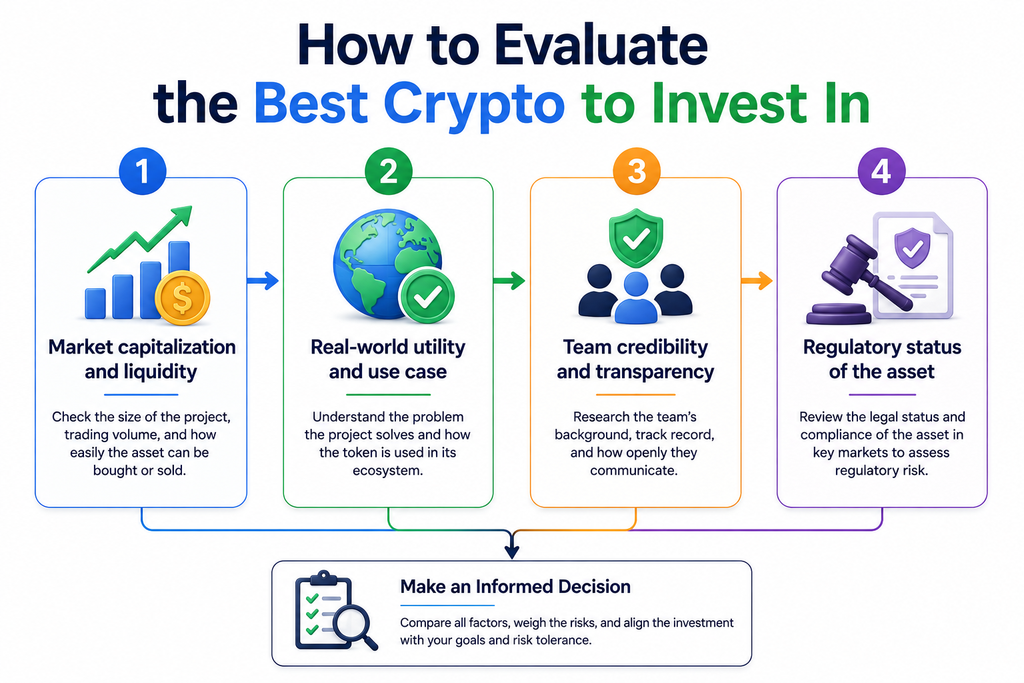
Before you buy anything, it helps to run it through a consistent checklist. These are the factors that separate a durable long-term holding from a coin that’s just riding hype.
Market capitalization and liquidity
Market cap (price × circulating supply) shows an asset’s size; liquidity shows how easily you can buy or sell without moving the price. Large-caps like Bitcoin and Ethereum have deep order books and tight spreads.
Real-world utility and use case
A coin’s price eventually needs to be justified by actual use payments, DeFi collateral, gas fees, or tokenized asset ownership.
Ask: “would people still need this token if the price stopped rising?”
Team credibility and transparency
Look for public, verifiable identities and a track record of delivering on the roadmap. Anonymity alone isn’t disqualifying (Bitcoin’s creator is anonymous), but anonymity plus vague docs, no audits, and unverifiable claims is a red flag.
Institutional and exchange adoption
Which exchanges list a coin, and who’s buying it, matters. Exchange listings involve due diligence, so a listing on a well-regulated platform is a mild quality signal.
Regulatory status of the asset
Legal standing affects both risk and long-term access. A joint SEC-CFTC guidance in March 2026 already classified 16 digital assets, offering some clarity ahead of full legislation. In the EU, MiCA is already fully in force.
Risks of Crypto Investing
Crypto offers real upside, but it comes with risks that don’t apply the same way to traditional assets, sharp price swings, unsettled regulation, and security threats unique to digital ownership.
1. Volatility and drawdown risk
Crypto can swing sharply in short periods, Bitcoin fell 33% in the first half of 2026 alone before recovering. Even large-cap assets aren’t immune to double-digit drawdowns, so position sizing matters more than in most traditional asset classes.
2. Custody and security risk
DeFi exploits and hacks remain a real threat. Risk applies both to platforms (exchange hacks, insolvency) and to individuals (lost keys, phishing). Security isn’t optional at any investment size.
Common Mistakes to Avoid
| Common Mistake | Key Risk / Impact | Better Approach |
| Chasing Hype & FOMO | Buying near local tops; skipping rational evaluation. | Wait for cool-offs; conduct objective research before entering. |
| Overconcentration | Magnifies single-project risk and potential portfolio wipeout. | Diversify across asset classes and distinct crypto sectors. |
| Ignoring Security | Exchange hacks, account breaches, and irreversible loss. | Enable 2FA, use unique passwords, and use cold storage. |
| Skipping DYOR | Investing in weak projects, inflated tokenomics, or scams. | Verify team, tokenomics, utility, and roadmaps independently. |
| Market Timing | Underperformance from chasing tops and selling bottoms. | Follow a systematic approach like Dollar-Cost Averaging (DCA). |
Read also: Crypto vs Stocks: Which Investment Is Right for You
Conclusion
There’s no single best crypto investment that fits everyone, the right pick depends on your risk tolerance, time horizon, and how much attention you’re willing to give it.
What matters more than any specific coin is the process: evaluate fundamentals before buying, diversify instead of concentrating on one asset, match your strategy to your temperament (DCA and long-term holding suit most people better than active trading), and treat security as non-negotiable.
Crypto in 2026 is more mature than a few cycles ago, with clearer regulation and deeper institutional participation, but it’s still volatile.
Start small, stay consistent, and let your allocation grow as your understanding does. Crypto investments carry risk, including the potential loss of your full investment, do your own research and consider consulting a licensed financial advisor before investing.