More than 42 million ETH, representing about 34% of Ethereum’s supply, was staked according to Ethereum.org’s published staking data. That is a huge amount of cryptocurrency committed to securing the network while earning staking rewards.
So, what exactly is crypto staking, and why are so many investors choosing to stake their assets instead of simply holding them?
Crypto staking allows holders of Proof-of-Stake cryptocurrencies to put their assets to work by helping validate transactions and secure a blockchain. In return, they can earn rewards, although the amount they receive varies by network, validator performance, fees, and other conditions.
Staking has also moved beyond individual crypto wallets. By 2026, staking had become part of institutional crypto products, including Ethereum ETFs that distribute staking rewards to investors.
But staking is not simply a way to just earn passive income. Your choice of staking method can affect how much control you have over your assets, the fees you pay, how quickly you can access your funds, and the risks you take.
Slashing, lock-up and unbonding periods, validator performance, smart-contract vulnerabilities, and platform or custodial failures can all affect your experience.
Understanding how staking works, where the rewards come from, and what you could lose is therefore just as important as knowing how much you can earn.
Key Takeaways
- Staking locks up crypto to help secure a PoS network, earning rewards from new token issuance and fees.
- Your method solo, delegated, exchange, or liquid trades off yield, control, and convenience differently.
- Rewards aren’t fixed; they depend on total stake, validator performance, and network conditions.
- Main risks: slashing, lock-up periods, platform failure, and price volatility outweighing yield.
- U.S. regulators now treat most staking as non-securities, paving the way for staking ETFs in 2026.
What Is Crypto Staking?

Crypto staking is the process of locking up cryptocurrency to help operate and secure a blockchain that runs on Proof-of-Stake (PoS).
In exchange for putting your tokens to work, the network pays you staking rewards, typically a mix of newly issued tokens and a share of transaction fees collected on the network.
It’s a bit like earning interest in a savings account, but that comparison only goes so far.
A bank uses your deposit to lend money elsewhere, a PoS network uses your stake as collateral that keeps the system honest. If a validator misbehaves, part of that stake can be dismissed, something no savings account does to you for late payments.
Rewards on most networks come from two sources: protocol issuance (new coins created according to the network’s monetary policy) and transaction fees paid by users. The exact mix and rate depend on the specific blockchain, Ethereum, Solana, and Cardano each set this differently.
Proof-of-Work vs. Proof-of-Stake
Proof-of-Work (PoW), used by Bitcoin, secures the network through computational competition, miners race to solve cryptographic puzzles, and the winner adds the next block.
Proof-of-Stake replaces that competition with collateral: validators are chosen to propose and confirm blocks based on how much cryptocurrency they’ve staked, not how much computing power they own.
How Crypto Staking Works

Every PoS network relies on validators participants who lock up crypto and run software that proposes and confirms new blocks. Not everyone becomes a validator directly, though. There are two broad ways to participate:
Solo/Self-Validating vs. Delegating to a Pool or Exchange
Solo staking means running your own validator node. On Ethereum, that requires 32 ETH per validator, along with a dedicated machine that stays online continuously and up-to-date client software.
It gives you full control and the highest rewards, but it’s a real operational commitment, not passive income, missed attestations from downtime directly reduce your yield, and misconfiguration is the most common cause of slashing.
Delegating skips that barrier. Instead of running a node yourself, you assign your tokens to a validator run by someone else, through a staking pool, a liquid staking protocol, or a centralized exchange.
How Rewards Are Calculated
Staking rewards aren’t a fixed interest rate. They scale with three variables:
Reward = (your stake ÷ total staked on the network) × network rewards × validator performance
- Your stake relative to total staked: rewards are distributed proportionally, so your share shrinks as more people stake the same asset, and grows if others withdraw.
- Network rewards: the pool of new issuance plus fees available for validators that period, set by each blockchain’s protocol rules.
- Validator performance: a multiplier based on uptime and correctness. A validator that’s offline or votes on the wrong data earns less, or gets penalized even if the stake amount is identical to a well-run validator.
That’s why two people staking the same amount of ETH can end up with different returns: one delegated to a validator with near-perfect uptime, the other to one that’s missed attestations.
As of early 2026, typical Ethereum staking APY runs roughly 3.2% to 4.5%, depending on the method and current network conditions.
What Cryptocurrencies Can You Stake?
Not every cryptocurrency can be staked, it comes down to how the network is built and secured. Here’s a look at the major coins you can actually stake and what disqualifies the rest.
Ethereum (ETH)
The largest staked network by value, with roughly 35 million ETH staked. Ethereum’s staking yield is the lowest among major chains, around 3.5% APY, but it’s backed by the deepest liquidity and the most mature liquid staking infrastructure of any PoS network, through tokens like stETH and rETH.
Solana (SOL)
Solana’s headline rate sits around 6–8% APY with a short 2–3 day unbonding window, but inflation affects that, real yield after inflation is closer to 0–3%. Liquid staking can push effective returns higher by capturing MEV revenue on top of base rewards.
Cardano (ADA)
Cardano stakes without any lock-up or slashing risk, tokens stay spendable and transferable while earning, with roughly 3–4% APY and 2–4% real yield. It’s widely considered the most beginner-friendly setup, since you delegate directly from your wallet and never lose custody.
Avalanche (AVAX)
Running a validator on Avalanche requires a 2,000 AVAX minimum, though delegation has no minimum, making it accessible for smaller holders even though solo validating has a high capital bar.
Polkadot (DOT)
Polkadot uses a nominated Proof-of-Stake model where holders choose up to 16 validators to back. Headline APY runs 7–14%, with real yield closer to 2–5%.
Cosmos (ATOM)
Cosmos advertises the highest headline APY among major chains, 10–19%, but high inflation of 10–14% and a 21-day unbonding period bring real yield down to roughly 2–8% a reminder that the highest advertised number isn’t always the best deal.
What Should You Check Before Staking a Cryptocurrency?
- Consensus mechanism: Confirm the network actually uses PoS or a variant (DPoS, NPoS) before assuming it’s stakeable.
- Minimum staking requirement: Varies widely, from none (Cardano, delegated Avalanche) to thousands of dollars in native tokens for solo validating.
- Reward rate: Look at both headline APY and real yield after inflation, the gap between the two can be significant.
- Lock-up/unbonding period: Ranges from none to several weeks, directly affecting how quickly you can access funds.
- Validator requirements: Solo staking may require specific hardware, uptime, and minimum stake; delegating avoids this but shifts the responsibility to whoever you choose.
- Slashing rules: Understand what triggers a penalty and whether delegators share in that risk, since this varies by network.
- Network inflation: A high nominal APY on a highly inflationary token can still mean weak or negative real returns once dilution is accounted for.
Types of Crypto Staking
Crypto staking isn’t a single, uniform process, it comes in several distinct forms, each with its own trade-offs in cost, control, and risk.
From running your own validator to letting a liquid staking token do the work for you, the method you choose determines both your returns and your exposure.
Solo Staking
Solo staking means running your own validator node directly on the network, no pool, no exchange, no intermediary. You lock up the required minimum stake yourself, run the validator software, and are personally responsible for proposing and confirming blocks when selected.
Solo staking has real technical overhead: a dedicated machine that stays online continuously, sufficient storage and RAM to run both execution and consensus clients, a stable internet connection, and ongoing maintenance to keep client software updated.
Pro
- Highest possible rewards, since there’s no pool or provider commission
- Full control over your keys and validator behavior
- Directly strengthens network decentralization
Cons
- Slashing if your validator double-signs or goes offline for extended periods, often caused by misconfiguration rather than intent
- High capital requirement (32 ETH on Ethereum)
- Operational risk: hardware failure, missed updates, or connectivity issues can reduce rewards even without slashing
Delegated Staking
Delegation lets you contribute your tokens to a validator’s stake without running the infrastructure yourself. The validator does the technical work; you share in the rewards proportional to what you delegated.
Pros
- No minimum stake requirement in most cases, accessible to smaller holders who can’t meet solo-staking thresholds
- No hardware, uptime, or technical maintenance required, the validator handles all of that
- Simpler entry point than solo staking, while still earning direct protocol-level staking rewards (unlike exchange custodial products)
- You typically retain custody of your own tokens, depending on the network and delegation mechanism used
Cons
- Validator commission reduces your net yield compared to solo staking
- Your returns depend entirely on the validator’s performance, downtime or errors on their end lower your rewards even though you did nothing wrong
- Slashing risk still applies: if the validator you delegated to double-signs or goes offline for extended periods, delegators can share in the penalty depending on the network’s rules
Staking Pools
A staking pool combines many small stakers’ funds into a single, larger stake, letting people who don’t hold the minimum required for solo staking participate anyway. The pool operator runs one or more validators on behalf of everyone in the pool and distributes rewards proportionally.
Pros
- No minimum stake requirement to participate meaningfully
- No need to run or maintain hardware
- Rewards are typically more predictable since pool size smooths out individual validator variance
Cons
- Pool operator error or downtime affects everyone in the pool, not just one person
- Centralization risk if a small number of pools control a large share of total stake
- Smart contract risk if the pool is managed on-chain
Exchange-Based Staking
Centralized exchanges like Coinbase, Binance, and Kraken let users stake directly from their exchange account. The exchange holds custody of the assets, handles validator operations, and credits staking rewards to the user’s account.
Pros
- Simplest entry point with a few clicks, no wallet setup or technical knowledge required
- No minimum stake in most cases
- Combines staking with an existing trading account
Cons
- The exchange takes a commission, often higher than a standalone validator
- Less transparency into exact validator performance
- You don’t control the private keys
Liquid Staking
Liquid staking lets you stake an asset while receiving a separate, tradable token in return that represents your staked position, so your capital isn’t fully locked and illiquid the way it is with most other staking methods.
You deposit tokens with a liquid staking protocol, which stakes them on your behalf. The protocol issues a staking receipt token on a one-for-one basis against the deposited assets, and that token evidences ownership of the underlying deposit and its accrued rewards.
You can hold, trade, or use that receipt token elsewhere while your original stake keeps earning rewards in the background.
Pros
- No lock-up on the receipt token, you can sell, trade, or use it elsewhere even while your underlying stake keeps earning rewards
- Usable as collateral or a trading asset across DeFi protocols, so your capital isn’t sitting idle
- Low entry barrier, typically no minimum stake required
- Still earns genuine protocol-level staking rewards, unlike some centralized “yield” products
Cons
- Smart contract risk: a bug or exploit in the protocol’s code can put deposited funds at risk, separate from anything happening at the blockchain level
- Depeg risk: the liquid staking token’s market price is meant to track the underlying staked asset, but isn’t guaranteed to. It has historically traded below that value during periods of market stress or thin liquidity
- Validator risk: the protocol still relies on real validators behind the scenes; if those validators are slashed or underperform, that loss can pass through to token holders
How to Start Staking Crypto
- Choose an asset: Pick a PoS network you’re comfortable holding long-term, staking ties your returns to the token’s price, so the asset matters more than the yield percentage alone.
- Choose a method: Decide between solo staking (highest reward, highest technical commitment), delegating to a validator, staking through an exchange, or using a liquid staking protocol, based on how much capital, technical skill, and liquidity you need.
- Check lock-up terms and fees: Before committing funds, confirm the unbonding period, any minimum stake required, and the commission or platform fee, these directly affect your real, net return.
- Monitor validator performance: If you’re delegating or pooling, keep an eye on your validator’s uptime and slashing history. Poor performance on their end lowers your rewards even if you’ve done nothing wrong, switch validators if needed.
Risks of Crypto Staking
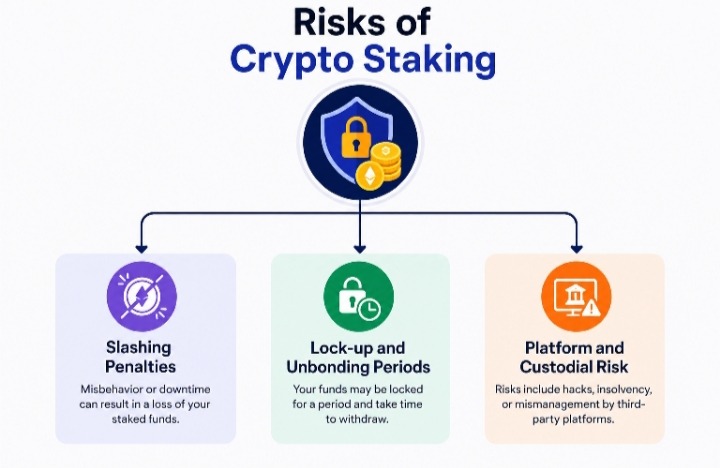
Crypto staking isn’t risk-free, locking up funds and trusting validators or platforms introduces its own set of exposures.
From slashing penalties to price swings that outpace your yield, here’s what to weigh before you stake.
Slashing penalties
Validators that go offline for extended periods or double-sign conflicting blocks can have a portion of their staked funds dismissed as a penalty.
Delegators aren’t immune either, depending on the network, a slashed validator can reduce the rewards or principal of everyone who delegated to them.
Lock-up and unbonding periods
Staked funds usually aren’t instantly liquid. Exiting a validator and withdrawing funds can take anywhere from minutes to weeks depending on network congestion.
On Ethereum, for example, new validators faced roughly a 62-day wait to enter the active set due to entry queue backlogs, even though exits were processed almost instantly at the same time, a reminder that staking timelines can shift sharply based on network demand, in either direction.
Platform and custodial risk
Staking through an exchange, pool, or liquid staking protocol means trusting that platform’s security and solvency.
Exchange hacks, insolvency, or withdrawal halts can affect staked funds regardless of how secure the underlying blockchain is. Smart contract bugs carry the same risk for liquid staking and pooled staking protocols, a flaw in the code can be exploited independent of validator behavior.
Conclusion
Staking has grown from a niche technical activity into a mainstream, well-regulated way to earn a return on crypto, but there’s no single “best” method.
Solo staking rewards technical commitment with the highest yield, delegating and pooling trade some return for simplicity, exchange staking prioritizes convenience over control, and liquid staking adds flexibility at the cost of extra smart contract risk.
Before staking any asset, look past the advertised APY. Check the lock-up terms, understand who or what you’re trusting with your funds, and remember that a token’s price movement will usually affect your position more than the yield itself.
Choose an asset you’d hold regardless of rewards, and treat validator or platform performance as something worth monitoring, not a “set and forget” decision.
Frequently Asked Questions
Is crypto staking safe?
It carries real risks slashing, platform failure, and price volatility, but choosing reputable validators or platforms and understanding lock-up terms significantly reduces exposure. No staking method is entirely risk-free.
Can you lose money staking crypto?
Yes. Slashing penalties can reduce your principal, and even without slashing, a drop in the token’s price can easily outweigh whatever yield you earned.
What’s the difference between staking and mining?
Mining (Proof-of-Work) secures a network through computational competition and specialized hardware. Staking (Proof-of-Stake) secures it through locked-up capital instead, using far less energy.
Do you need a minimum amount to stake?
It depends on the method. Solo staking often has a high minimum (32 ETH on Ethereum), while delegating, exchange staking, and liquid staking typically have little to no minimum.
Is staking regulated in the U.S. as of 2026?
The SEC has issued guidance stating that solo, delegated, custodial, and liquid staking generally don’t count as securities offerings. This has enabled staking ETFs, though it remains staff guidance rather than binding statute.
Can you unstake at any time?
Not instantly in most cases. Networks impose unbonding or exit queue periods before funds become withdrawable, and wait times can vary significantly based on network demand.