Calling cryptocurrency “just a digital currency” is the same mistake as calling the internet “just email.” The monetary layer is real, but it sits beneath a programmable financial infrastructure that BlackRock, Stripe, and JPMorgan are now building on.
Cryptocurrency is a broad category of digital assets secured by cryptography and recorded on decentralised blockchain ledgers. It encompasses simple peer-to-peer digital money (Bitcoin, stablecoins), programmable platforms that execute self-enforcing agreements (Ethereum, Solana), decentralised financial services (DeFi), verifiable digital ownership records (NFTs), and on-chain representations of traditional assets (tokenised RWAs). The “just a digital currency” framing describes only a fraction of what the technology now does.
Key Takeaways
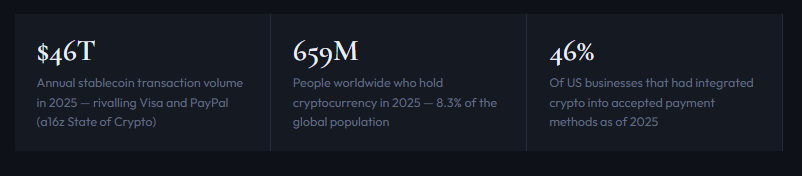
Stablecoins processed $46 trillion in annual transactions in 2025 rivalling Visa and PayPal, demonstrating that the monetary layer of crypto is operating at genuine payment-network scale.
The tokenised real-world asset (RWA) market reached $30 billion in 2025 (up 4x in two years), with BlackRock, JPMorgan, and Fidelity all operating tokenised financial products on public blockchains.
DeFi protocols held over $112 billion in TVL by mid-2025; the on-chain lending market reached $73.6 billion representing genuine financial infrastructure, not just speculation.
The global NFT market reached $34.1 billion in 2025, shifting from speculative digital art to practical applications in gaming, ticketing, music royalties, and credential verification.
87% of global financial services firms are integrating blockchain into back-end operations; 659 million people worldwide now hold cryptocurrency which is about 8.3% of the global population.
Crypto’s programmability; the ability to embed rules, conditions, and logic into an asset , is what separates it from every prior form of digital money and from traditional currency entirely.
Where Does the “Just a Digital Currency” Misconception Come From?
Bitcoin was introduced in 2008 with a specific stated goal: a peer-to-peer electronic cash system. Satoshi Nakamoto’s original whitepaper is titled exactly that. For the first three years of Bitcoin’s existence, its primary use case and the primary lens through which the public understood it was as digital money for online transactions. The “digital currency” framing was accurate for Bitcoin circa 2010.
The problem is that the framing crystallised before the technology evolved. Ethereum launched in 2015 with smart contract functionality turning blockchain from a payment ledger into a programmable computing platform. DeFi emerged between 2018 and 2020. NFTs became mainstream in 2021. Tokenised real-world assets entered serious institutional consideration in 2023 and reached $30 billion in market value by 2025. Each development expanded what “crypto” encompasses, but the “just digital currency” mental model persisted in popular discourse, anchored to a version of the technology that is now 15 years old.
The accurate 2026 framing is that cryptocurrency is a category containing multiple fundamentally different things: simple digital money (stablecoins), scarce digital commodities (Bitcoin), programmable smart contract platforms (Ethereum, Solana), decentralised financial infrastructure (DeFi), verifiable ownership systems (NFTs), and on-chain representations of traditional financial assets (RWAs). They share a technical foundation in blockchain, they don’t share a single use case.
“Crypto grew up in 2025. Traditional incumbents like Visa, BlackRock, Fidelity, and JPMorgan and tech-native challengers like PayPal, Stripe, and Robinhood are now offering or launching crypto products.”
– a16z State of Crypto 2025
Is Cryptocurrency Actually Money?
Whether crypto qualifies as “money” depends on which cryptocurrency you’re asking about and which classical criteria you apply. Money traditionally serves three functions: medium of exchange, unit of account, and store of value. Different crypto assets satisfy these to very different degrees.
Does Crypto Function as a Medium of Exchange?
Stablecoins pegged 1:1 to fiat currencies function as effective mediums of exchange. USDT, USDC, and their peers processed $46 trillion in annual transactions in 2025, according to a16z’s State of Crypto report. Stablecoin-linked card spending reached $4.5 billion in 2025, up 673% from 2024. Stripe integrated stablecoin settlement into its payment stack; Shopify, Visa, and Mastercard all expanded stablecoin acceptance. For stablecoins, the medium-of-exchange function is substantiated by actual transaction volume at payment-network scale.
For Bitcoin, the picture is more complex. Approximately 46% of US businesses have integrated cryptocurrency into accepted payment methods as of 2025. The 2025 PayFi Report found that 35–36% of crypto users chose it for gaming purchases, everyday purchases, and travel bookings. But Bitcoin’s volatility; swinging between $76,000 and $126,000 in 2025 alone, makes it a poor medium of exchange for everyday transactions, where price certainty matters.
Does Crypto Serve as a Unit of Account?
This is the weakest function for most cryptocurrencies. A unit of account requires sufficient price stability for goods and services to be reliably denominated in it. No major economy prices goods in Bitcoin or Ethereum. Some DeFi protocols use stablecoins as their native unit of account and in those contexts, the function is met. But for volatile crypto assets, a stable unit of account function remains aspirational rather than current reality.
Does Crypto Work as a Store of Value?
Bitcoin’s “digital gold” narrative is the most contested area. The thesis is compelling in theory: a fixed supply of 21 million coins, secured by cryptographic proof, not printable by any government. In practice, Bitcoin has shown increasing correlation with risk assets like the Nasdaq in short-term periods, during the 2025 market turbulence, Bitcoin and technology stocks fell together. As one wealth management analyst noted, Bitcoin is “still going to have to prove itself as that digital store of value over a longer period of time” it behaves more like a high-beta risk asset than gold during equity drawdowns.
That said, in hyperinflationary economies (Venezuela, Argentina, Zimbabwe), crypto has functioned demonstrably as a store of value relative to local currencies. In Argentina and Venezuela, over 30% of digital wallets held stablecoins for daily savings in 2025. The store-of-value function is real but depends heavily on the reference currency and the economic context of the holder.
What About Legal Tender Status?
Most cryptocurrencies are not recognized as legal tender, meaning no one is legally obligated to accept them as payment of a debt in most jurisdictions. El Salvador’s Bitcoin legal tender experiment, launched in 2021, was reformed in 2025 to scale back mandatory acceptance while retaining optional use and remittance tools. Japan recognizes Bitcoin as legal property. The EU, US, UK, and most major economies treat crypto assets as property or commodities for tax and legal purposes, not as currency.
How Is Cryptocurrency Different From Traditional Currency?
The differences between crypto and fiat go beyond the obvious (digital vs. physical). The most consequential difference is one traditional comparisons miss entirely: programmability.
Characteristic
Cryptocurrency
Fiat Currency
Issuing Authority
Decentralised — issued by code and network consensus
Centralised — issued by governments and central banks
Supply Control
Fixed or algorithmic cap (Bitcoin: 21M max; currently ~94% mined)
Theoretically unlimited — central banks control supply
Transaction Process
Peer-to-peer on a public ledger; no intermediary required
No — cash and bank transfers carry no embedded logic
Counterfeiting Risk
Cryptographically impossible to counterfeit or double-spend on properly designed networks
Physical currency can be counterfeited; digital forms are vulnerable to fraud
Cross-border Fees
Under 1% via stablecoins vs. 6.49% global average for traditional remittances (Stripe, 2025)
Average 6.49% globally; 8.78% in sub-Saharan Africa (World Bank)
The programmability row deserves emphasis because it has no equivalent in traditional currency. A smart contract can hold funds and release them only when a delivery is confirmed by GPS data. It can automatically split royalty payments across five rights holders the moment a song is streamed. It can liquidate a borrower’s collateral when a price threshold is breached, without any human intervention. No paper note, no bank transfer, and no SWIFT message can do any of these things. This is what makes blockchain technology a genuine infrastructure layer rather than just a faster payment rail.
Join UEEx
Experience the World’s Leading Digital Wealth Management Platform
How Does Cryptocurrency Work at a Technical Level?
Cryptocurrency operates on blockchain technology; a distributed ledger replicated across thousands of computers (nodes) worldwide. Each node holds a complete copy of the transaction history. New transactions are grouped into blocks, verified by the network using a consensus mechanism, and permanently appended to the chain in chronological order. Once recorded, a block cannot be altered without rewriting every subsequent block and outpacing the entire network’s computing power — an astronomically expensive attack on mature networks.
What Is the Difference Between Proof of Work and Proof of Stake?
Proof of Work (Bitcoin’s consensus model) requires miners to solve computationally intensive mathematical problems to validate transactions. Miners are rewarded with new cryptocurrency, providing economic incentive to maintain network security. This approach is highly secure but energy-intensive.
Proof of Stake; Ethereum’s model since its 2022 Merge, requires validators to lock up (“stake”) cryptocurrency as collateral rather than expend computing power. Validators are chosen to propose and verify blocks proportionally to their stake. Ethereum’s shift reduced its energy consumption by approximately 99.95%, addressing one of the most significant environmental criticisms of proof-of-work networks. Ethereum’s network surpassed 3 million daily transactions in Q1 2025, making it one of the most active smart contract platforms globally.
What Role Do Smart Contracts Play?
Smart contracts are the technological step that transforms blockchain from a payment ledger into a programmable computing platform. They are programs stored on-chain that execute automatically when predetermined conditions are met. No party needs to trust the other, the code enforces the agreement. Smart contracts power DeFi lending protocols, NFT marketplaces, decentralized exchanges, prediction markets, insurance payouts, tokenized asset transfers, and DAO governance systems. The global smart contract market is growing at a CAGR exceeding 80% and is the foundational layer on which most of what makes crypto “more than just a currency” is built.
What Are Cryptocurrency’s Real Use Cases Beyond Payments?
The 2025/2026 data maps a use case landscape that extends well across six distinct categories, each of which operates largely independently of whether any specific cryptocurrency is rising or falling in price.
Payments and Remittances: Stablecoins cut the 6.49% global average remittance fee to under 1%, settling in minutes 24/7. $18.6 billion in stablecoin remittances flowed to Southeast Asia in H1 2025. In Sub-Saharan Africa, stablecoins accounted for 43% of all crypto transactions in 2025, primarily for remittances and inflation hedging. 35–36% of crypto users chose it for everyday purchases and travel bookings (2025 PayFi Report).
Smart Contracts and Automation: Self-executing programs that automatically enforce legal agreements, royalty splits, trade settlements, insurance payouts, and payroll without intermediaries. UniCredit issued a tokenised structured note on a public blockchain in late 2025. Ethereum processed 3M+ daily transactions in Q1 2025, predominantly smart contract executions. Smart contracts are being embedded in everything from trade finance (81% faster processing) to clinical trial data integrity.
Decentralized Finance (DeFi):DeFi replicates banking; lending, borrowing, trading, savings without banks. TVL reached $112 billion by mid-2025; on-chain lending hit $73.6 billion. Nearly one-fifth of all spot crypto trading now happens on decentralised exchanges. DeFi yields of 4–8% APY on stablecoins serve as dollar-denominated savings alternatives for people in high-inflation economies without access to US banks.
NFTs and Digital Ownership: NFTs encode verifiable, transferable ownership of unique digital or physical assets. Global NFT market: $34.1 billion in 2025, projected $60.82 billion in 2026. Applications: gaming assets (38% of NFT volume), music royalties ($520M+ in 2025, artists earn ~85% of primary sales), event ticketing (scalping-resistant via smart contract price caps), credentials (12M+ identity NFTs issued in 2025), and physical asset tokenisation.
Tokenised Real-World Assets: Traditional financial assets; US Treasuries, real estate, private credit, bonds represented on-chain as tokens. RWA market: $30 billion in 2025 (4x growth in two years). BlackRock’s BUIDL tokenised Treasury fund: $2.5 billion AUM, listed as collateral on Binance. JPMorgan extended JPM Coin to public blockchains. Tokenised money market funds grew from $2B to $7B+ in AUM in 12 months. BlackRock: “Tokenisation can greatly expand the world of investable assets.”
Investment and Portfolio Allocation: Crypto has become a legitimate asset class for institutional portfolios. Bitcoin ETFs held $60B+ in AUM by early 2026; 172+ public companies hold Bitcoin as a treasury reserve. 55% of traditional hedge funds now allocate to crypto (up from 47% in 2024). Harvard Management Company, Wisconsin pension fund, and major sovereign wealth funds are allocating. Bitcoin’s fixed supply and 17-year track record have established it as a viable portfolio diversifier and inflation hedge in many institutional frameworks.
The 2025 inflection point: In 2025, stablecoins “went mainstream,” tokenised RWAs crossed $30 billion, and traditional institutions including Visa, Stripe, PayPal, BlackRock, Fidelity, and JPMorgan built active crypto products for the first time. The a16z State of Crypto 2025 describes this as “the year crypto grew up.” The question is no longer whether crypto has uses beyond digital currency, it’s how quickly those uses will scale into the existing financial system.
What Are the Genuine Advantages Over Traditional Finance?
Does Crypto Actually Provide Financial Inclusion?
Approximately 1.4 billion adults globally remain unbanked, without access to a bank account, credit history, or formal financial services. Crypto wallets require none of these. Anyone with a smartphone and internet connection can hold, send, and receive funds, access lending and savings products through DeFi, and participate in the global financial system. In Sub-Saharan Africa, crypto is primarily used for remittances and savings rather than speculation. In Vietnam, 19.2% of the population actively uses crypto. In El Salvador, 35% of the population uses Bitcoin, driven by remittance incentives and government-backed wallet infrastructure.
Are Cross-Border Transactions Actually Cheaper?
Yes, substantively. Traditional international wire transfers average 6.49% in fees globally and up to 8.78% in sub-Saharan Africa. Stablecoin transfers cost under 1%, often fractions of a cent per dollar on efficient networks like Solana, where fees typically run below $0.01 per transaction. They settle in seconds, not days, and operate 24/7 regardless of banking hours or public holidays. This cost structure has made stablecoins the practical remittance mechanism of choice in dozens of high-fee corridors.
What Does Decentralisation Actually Mean in Practice?
Decentralisation means no single entity can freeze your funds, reverse a transaction, censor a payment, or inflate the currency supply. These properties matter most in environments where institutional trust is low: countries with authoritarian governments, economies with high inflation, or populations historically excluded from formal banking. They also matter for business: a company paying 50 international contractors in different countries can do so in a single stablecoin transaction without running 50 separate wire transfers through 50 different banking relationships.
What Are the Real Challenges and Risks of Cryptocurrency?
Price Volatility: Bitcoin swung between $76,000 and $126,000 in 2025. This volatility makes non-stablecoin crypto unsuitable as everyday currency for most people. Crypto volatility can produce significant financial losses and creates uncertainty for businesses attempting to price goods and services in crypto.
Security Vulnerabilities: Crypto thefts reached $2.6 billion in 2025, up 18% year-over-year. North Korean actors stole $1.58 billion alone. Unlike banks, crypto wallet losses are typically unrecoverable, no FDIC equivalent exists for most jurisdictions. Smart contract exploits can drain protocol funds in seconds if code contains bugs.
Regulatory Fragmentation: While the GENIUS Act (US) and MiCA (EU) have provided frameworks for stablecoins and exchanges, DeFi protocols, self-custody wallets, and NFTs sit largely outside formal regulatory perimeters. The regulatory landscape varies dramatically by country and continues to evolve, creating compliance complexity for businesses.
Limited Merchant Acceptance: Despite growing adoption, crypto is not accepted for most everyday purchases. 30% of Americans own crypto but few use it for routine spending. The infrastructure for frictionless crypto payments at point-of-sale is improving (stablecoin-linked cards, merchant integrations), but widespread adoption for everyday retail use remains a work in progress.
Environmental Impact: Proof-of-work mining (Bitcoin) consumes substantial energy. However, Ethereum’s 2022 shift to proof-of-stake cut its energy consumption by 99.95%. Eco-friendly blockchains (Solana, Cardano, Tezos) use proof-of-stake by design. The environmental impact argument applies primarily to Bitcoin mining, not to the broader crypto ecosystem.
Complexity and Literacy Barriers: Private key management, wallet security, gas fees, smart contract interactions, and distinguishing legitimate projects from scams require substantial learning. These barriers limit crypto’s accessibility to non-technical users, despite significant UI improvements over the past five years. Crypto wallet installations exceeded 1.1 billion in 2025, but active usage remains a smaller fraction.
Join UEEx
Experience the World’s Leading Digital Wealth Management Platform
Cryptocurrency mining remains a complex and evolving field that embodies the cutting-edge intersection of finance and technology.
While it offers the potential for substantial rewards, it also carries inherent risks and challenges, from fluctuating market values and high energy demands to regulatory uncertainties and technological advancements.
Aspiring and established miners alike must navigate these multifaceted aspects with informed strategies and a proactive approach to adapt to the dynamic nature of cryptocurrencies.
Ultimately, the art of crypto mining not only requires technical expertise and robust equipment but also a keen understanding of the economic and environmental implications that shape this fascinating digital landscape.
Frequently Asked Questions
Is cryptocurrency just a digital currency?
No. While some cryptocurrencies function primarily as digital money (especially stablecoins), the broader ecosystem is much larger: smart contracts automate legal and financial agreements; DeFi replicates banking without banks; NFTs encode digital ownership; tokenised real-world assets (now $30 billion in market value) bring traditional finance on-chain; and Bitcoin functions as a digital store of value for institutional portfolios. Calling crypto “just a digital currency” is comparable to calling the internet “just email”, it describes the most familiar function while missing the transformative infrastructure layer beneath it.
How is cryptocurrency different from traditional currency?
Five key differences: (1) Control; crypto is decentralised, governed by code and network consensus rather than governments; (2) Supply; most cryptos have fixed or algorithmic supply caps, unlike fiat which can be printed freely; (3) Transparency; all transactions are publicly verifiable on a blockchain ledger; (4) Transaction process; peer-to-peer, without banks or payment processors, typically settling in seconds; (5) Programmability; crypto assets can carry executable code that automatically enforces conditions, something no form of traditional money can do. This last point is the most consequential distinction.
Is cryptocurrency considered money?
It depends on the specific cryptocurrency. Stablecoins (USDT, USDC) process $46 trillion in annual transactions and function effectively as money, serving as medium of exchange, unit of account, and store of value with minimal volatility. Bitcoin is primarily a store of value and speculative asset, its volatility makes it a poor everyday medium of exchange or unit of account. Most jurisdictions classify crypto as property or a commodity for tax purposes, not as currency. El Salvador’s Bitcoin legal tender experiment was reformed in 2025. No major economy has adopted any private cryptocurrency as legal tender.
What are smart contracts and why do they matter?
Smart contracts are self-executing programs stored on a blockchain that automatically enforce agreement terms when specified conditions are met; no lawyers, banks, or manual processes required. They are the technology that transforms blockchain from a payment ledger into programmable financial infrastructure. Applications include DeFi lending and borrowing, NFT royalty enforcement, automated trade settlement, insurance payouts triggered by verifiable events, tokenised asset management, and DAO governance voting. Ethereum’s network surpassed 3 million daily transactions in Q1 2025, driven primarily by smart contract activity. The smart contract market is growing at a CAGR exceeding 80%.
What is DeFi and why does it matter for crypto beyond currency?
Decentralized Finance (DeFi) uses smart contracts to replicate financial services; lending, borrowing, trading, savings, insurance, without requiring banks or brokers. DeFi protocols held over $112 billion in TVL by mid-2025. The on-chain lending market reached $73.6 billion by late 2025. Nearly one-fifth of all spot crypto trading volume now happens on decentralized exchanges. DeFi is relevant beyond speculation because it provides genuine financial access to populations excluded from traditional banking, offers stablecoin yields of 4–8% APY as dollar-denominated savings alternatives, and processes real credit transactions with on-chain collateral management.
What are tokenised real-world assets and how big is this market?
Tokenized real-world assets are traditional financial instruments; US Treasuries, real estate, private credit, bonds, money market funds, represented as tokens on a blockchain, enabling fractional ownership, 24/7 trading, instant settlement, and programmable compliance. The RWA market (excluding stablecoins) reached approximately $30 billion in 2025, up nearly 4x in two years (a16z). BlackRock’s BUIDL tokenized Treasury fund reached $2.5 billion in AUM and is listed as collateral on Binance. JPMorgan extended its JPM Coin to public blockchains in November 2025. Deutsche Bank estimates the broader tokenized market (including stablecoins) at $331 billion. BlackRock’s leadership has publicly stated that tokenization “can greatly expand the world of investable assets beyond listed stocks and bonds.”
Are NFTs still relevant in 2025/2026?
Yes, though the market has matured significantly from the 2021 speculative boom. The global NFT market reached $34.1 billion in 2025, projected to grow to $60.82 billion in 2026. Applications have diversified beyond digital art: gaming NFTs account for 38% of total transaction volume; music NFTs generated $520 million in 2025, with artists earning up to 85% of primary sales; NFT ticketing eliminates scalping via smart contract price caps; and over 12 million identity NFTs were issued in 2025 for credentials, certifications, and KYC compliance. Over 80% of NFT contracts now automatically enforce royalty payments. Enterprise-branded NFTs are used by 28% of Fortune 100 companies for loyalty and community engagement.
What are the main risks of cryptocurrency in 2025/2026?
Six primary risk categories persist: (1) Volatility; Bitcoin swung between $76,000 and $126,000 in 2025, making non-stablecoins unsuitable for everyday monetary functions; (2) Security; crypto thefts reached $2.6 billion in 2025, smart contract exploits can be irreversible; (3) Regulatory fragmentation; DeFi and self-custody wallets remain largely unregulated globally; (4) Limited merchant acceptance; crypto is not accepted at most everyday retailers; (5) Environmental concerns; Bitcoin proof-of-work mining remains energy-intensive, though Ethereum’s shift to proof-of-stake cut its energy use by 99.95%; (6) Complexity barriers; private key management, wallet security, and smart contract risks require significant user education.
Orebiyi Eniola is a writer whose soul work is content marketing with a focus on the cryptocurrency industry. Equipped as a marketing storyteller and driven by a passion for crafting impactful stories, she helps businesses connect with their audiences via strategic and thought-provoking writing. Orebiyi assists businesses in projecting their stories and actualizing their ambitions through the force of words. She likes to settle in with her favorite fiction novels when not pounding on her keyboard.
Disclaimer: This article is intended solely for informational purposes and should not be considered trading or investment advice. Nothing herein should be construed as financial, legal, or tax advice. Trading or investing in cryptocurrencies carries a considerable risk of financial loss. Always conduct due diligence before making any trading or investment decisions.
Trade with proof of Reserves
UEEx publish monthly audits and third party verification on every listed market.