
Bitcoin grabbed global attention after surging to a record high of $126,198 during the October 2025 “Uptober” rally, driven by strong institutional demand and record inflows into spot Bitcoin ETFs. BlackRock’s iShares Bitcoin Trust (IBIT) alone approached the $100 billion mark in assets, underscoring Bitcoin’s growing role in mainstream finance.
But after the rally came a sharp correction, with Bitcoin spending much of 2026 trading well below its peak in the $58,000 to $65,000 range. As the market moves deeper into 2026, an important year positioned 12-18 months after the April 2024 halving, investors are asking what comes next.
In this guide, we’ll examine realistic Bitcoin price forecasts for 2026, the 2024 halving’s lasting impact, institutional demand, key market drivers, and the risks that could shape Bitcoin’s next major move.
Key Takeaways
- Bitcoin trades around $62,000 to $64,000 as of August 2026, down roughly 50% from its October 2025 peak of $126,198.
- Analyst price targets for 2026 range widely, from around $75,000 on the low end to $225,000 on the high end, with most serious forecasts clustering between $120,000 and $175,000.
- The Federal Reserve has paused rate cuts and is now leaning toward holding or even raising rates, which is a headwind Bitcoin did not face for most of 2024 and 2025.
- Public companies now hold close to 1.4 million BTC, about 6% of all coins that will ever exist.
What Can We Expect from Bitcoin in 2026?
Bitcoin surged to an all-time high of more than $126,000 in October 2025 before reversing course and sliding to around $80,000 later in the year. As of mid-August 2026, the world’s pioneer cryptocurrency trades at about $63,000, leaving it roughly 50% below its record peak, according to CoinMarketCap.
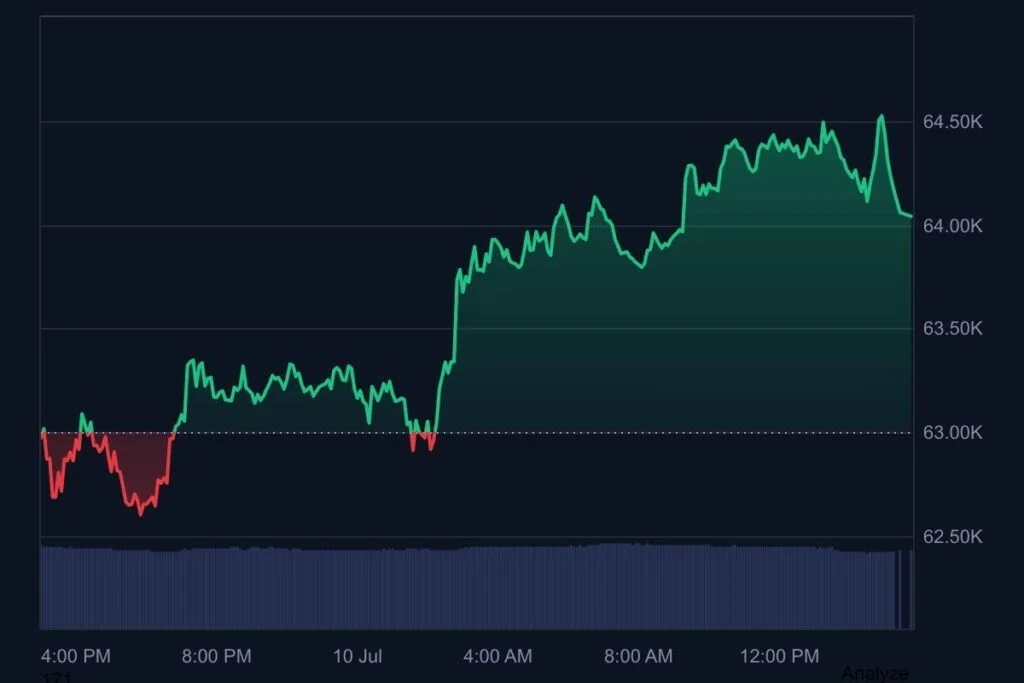
Source: Coinmarketcap.com
Much of last year’s rally was fueled by expectations of a more crypto-friendly regulatory environment under U.S. President Donald Trump after the Senate passed the GENIUS Act bill.
This landmark bill for the first time establishes federal guardrails for U.S. dollar-pegged stablecoins and creates a regulated pathway for private companies to issue digital dollars with the blessing of the federal government.
As a result, major asset managers, banks, and public companies expanded their exposure to digital assets, reinforcing Bitcoin’s position as a mainstream investment alongside growing institutional demand.
“The GENIUS Act will protect consumers, enable responsible innovation, and safeguard the dominance of the U.S. dollar,”
Another defining trend was the rapid rise of digital asset treasury (DAT) companies, such as Michael Saylor’s Strategy, which accumulated substantial Bitcoin and other cryptocurrencies as part of their corporate treasury strategies.
At the same time, investors began questioning the lofty valuations of technology stocks and whether the artificial intelligence boom had become saturated. That combination of macroeconomic uncertainty and shifting investor sentiment triggered a sharp crypto sell-off toward the end of the year.
As investors rotated away from risk assets, many crypto holders rushed to lock in profits or cut losses, sparking a wave of forced liquidations that intensified the downturn. The correction has left the market facing a far more challenging environment in 2026.
“We are in a complex investing environment. Equity valuations are stretched, the geopolitical environment is chaotic and evolving, there are fears about the near-term durability of AI capex deployment, monetary policy conditions appear to be shifting, and the U.S. midterm elections are on the horizon,”
Given those headwinds, Thorn added that Bitcoin’s outlook for 2026 remains difficult to predict, as macroeconomic conditions continue to outweigh many of the bullish fundamentals supporting the digital asset.
How Is the 2024 Halving Still Shaping Bitcoin in 2026?
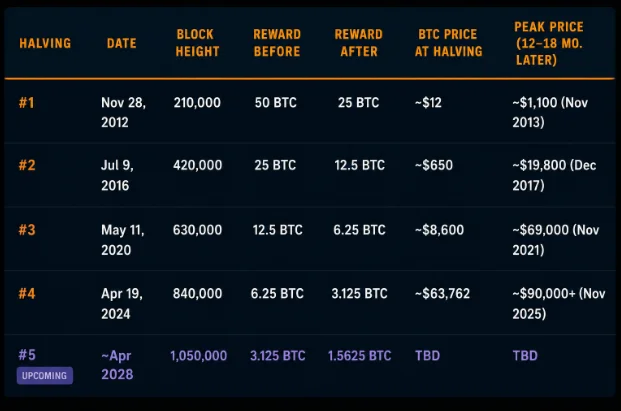
Source: Chatgpt
The April 2024 Bitcoin halving cut BTC’s new supply from 900 coins a day to 450. Historically, the big price moves from a halving show up 12 to 18 months later, once the slower supply growth meets steady or rising demand. That window lines up almost exactly with the second half of 2026.
Think of it like a bakery that suddenly starts making half as many loaves each day. If people keep showing up wanting bread, prices for the loaves that do exist start climbing. Bitcoin works the same way. Miners now produce roughly 450 new BTC daily, worth about $28 million at current prices, a much smaller flow than the market absorbed in 2023.
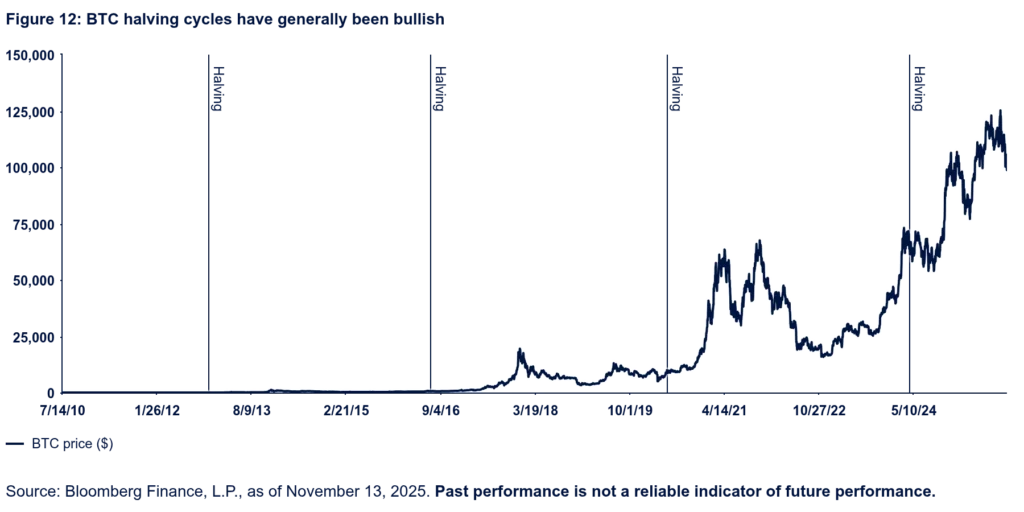
In the 2016 and 2020 cycles, this lagged supply squeeze eventually produced rallies of roughly 8 to 30 times the pre-halving price over the following year and a half. Nobody expects a repeat of those exact multiples this time, since Bitcoin is a much bigger, more mature asset now.
However, the underlying mechanic, less new supply meeting a bigger buyer base, is still in play for late 2026.
Also Read: Beyond the Hype: The Dark Side of AI in Crypto Nobody’s Talking About in 2026
Bitcoin Mining in 2026: Hashrate, Profits, and Energy
A higher hashrate makes the network more secure, but it also raises the bar for how much electricity and hardware a miner needs just to break even. With Bitcoin trading well below its 2025 highs, margins have gotten tighter for miners who took on debt during the bull run.
Bitcoin’s mining difficulty surged to 144.4 trillion in February, marking a 15% increase, the largest upward adjustment since 2021, when China’s mining ban triggered a major network disruption.
The jump came just weeks after an 11–12% decline caused by a sharp drop in network hashrate following severe winter storms in the U.S. that forced several large mining operations to temporarily shut down. As miners returned online, the network quickly recalibrated, pushing difficulty sharply higher.
Mining difficulty is automatically adjusted every 2,016 blocks (roughly every two weeks) to keep Bitcoin producing new blocks at an average of one every 10 minutes, regardless of fluctuations in network computing power.
The recovery in mining activity has been equally notable. Bitcoin’s hashrate climbed back to around 1.02 zettahashes per second (ZH/s) after falling to 826 exahashes per second (EH/s) as Bitcoin retreated from its October 2025 all-time high of approximately $126,200 to nearly $60,000.
However, miners continue to face profitability pressure, with hashprice, the estimated daily revenue per unit of hashrate, remaining near multi-year lows at roughly $0.000836/W/day.
Despite shrinking margins, large mining firms with access to low-cost electricity continue expanding operations, helping keep Bitcoin’s hashrate resilient. At the same time, many publicly listed miners are diversifying into AI and high-performance computing (HPC) to improve returns.
Companies such as Bitfarms have expanded their AI focus, while activist investor Starboard Value has urged Riot Platforms to accelerate its AI data center strategy, reflecting a broader shift across the mining industry.
Expect continued consolidation in 2026, with smaller or less efficient mining operations getting bought out or shutting down, while larger operators with access to cheap power keep expanding. Energy transition is part of this story too, as more large mining operations chase stranded or renewable power sources to keep costs down.
What Do the On-Chain Numbers Say About Supply and Demand?
Bitcoin’s total supply is capped at 21 million coins, and that number is not up for debate or a vote. As of 2026, roughly 20 million BTC have already been mined, leaving a shrinking pool of new coins entering circulation each year.
Bitcoin’s “OGs,” or long-term holders who have kept their coins for at least five years, have significantly slowed their selling activity, which reduces one major source of sell pressure just as the halving’s supply cut is fully felt.
According to CryptoQuant, the 90-day moving average of BTC spent by these veteran investors has fallen to just 962 BTC, its lowest level since November 2024. The sharp decline suggests that long-term holders remain confident in Bitcoin’s upside and are choosing to hold rather than take profits.
Whale accumulation has also picked up. CoinDesk Market Analysis reports large wallets adding more than 270,000 BTC over a two-week stretch in mid-2026, even as retail sentiment stayed cautious.
That kind of quiet accumulation during a price dip is often a signal that bigger players see current prices as a buying opportunity, though it is not a guarantee.
How Much Are Institutions Actually Buying?
This is where the numbers get concrete instead of vague. Since the first U.S. spot Bitcoin ETFs launched in January 2024, they have pulled in a combined $51.19 billion in net inflows. That is not a projection but money already in the door.
Here is the current ownership breakdown:
- ETFs and funds hold about 1.47 million BTC, roughly 7% of all coins that will ever exist.
- Public companies hold over 1.34 million BTC, about 6% of total supply, spread across more than 170 publicly traded firms.
- Governments hold around 647,000 BTC globally. While a handful of countries actively acquire Bitcoin through strategic purchases or state-backed mining, most government-held BTC originates from law enforcement operations targeting criminal organizations, darknet marketplaces, and illicit financial networks.
Large-scale asset seizures have transformed several governments into some of the world’s biggest Bitcoin holders. The largest known government Bitcoin holders include:
- United States: The world’s largest sovereign Bitcoin holder, with approximately 329,000 BTC. Most of its holdings stem from high-profile seizures linked to cases such as Silk Road and other major criminal investigations.
- China: Holds an estimated 190,000 BTC, largely confiscated from the PlusToken Ponzi scheme, making it the second-largest known government holder.
- United Kingdom: Controls around 61,000 BTC, primarily seized during investigations into international money laundering and financial crime.
- Ukraine: Publicly reported holdings exceed 46,000 BTC, much of which comes from crypto donations and digital assets disclosed by public officials following Russia’s invasion.
- El Salvador: Holds more than 7,700 BTC, accumulated through the country’s ongoing Bitcoin purchasing strategy after adopting BTC as legal tender.
- Bhutan: Maintains a growing Bitcoin reserve through state-backed hydroelectric-powered mining, making it one of the few countries to build its treasury primarily through domestic mining rather than seizures.
A Grayscale research report estimates that less than 0.5% of U.S. advised wealth is currently allocated to crypto, which means the institutional story is still in its early innings, not its final chapter. As more wealth platforms finish their due diligence and add Bitcoin to model portfolios, that allocation has real room to grow.
What Could Push Bitcoin Higher or Lower in 2026?
Instead of one forecast, it helps to think in scenarios. Here are the realistic paths for the rest of 2026.
Fundamental Analysis: FOMC Impact on Bitcoin Price
On July 8, the Federal Reserve published the minutes from its June 16–17 FOMC (the Federal Open Market Committee) meeting, led by new Fed Chairman Kevin Warsh. The reveal offered the first detailed look at why policymakers kept interest rates unchanged at 3.50%–3.75%.
The minutes struck a hawkish tone, revealing that nine of the 18 officials who submitted rate projections expect at least one rate hike before the end of 2026, a notable shift from earlier expectations of rate cuts.
While the vote to pause rate adjustments was unanimous, officials remain concerned about elevated inflation caused by supply chain disruptions, tariffs, and Middle East tensions. At its July 28–29 meeting, a divided Fed again held rates steady, leaving the September meeting as the next big decision point.
For Bitcoin, the timing is significant. Trading around $63,000, the crypto remains highly sensitive to Federal Reserve policy, and its next major move could depend on how interest rate expectations evolve over the coming months.
The relationship is straightforward: higher interest rates increase the opportunity cost of holding a non-yielding asset like bitcoin. When the Fed signals a tighter policy path, institutional money tends to rotate toward Treasuries and out of speculative assets.
The inverse is also true: a dovish signal from the Fed, or data that reduces hike expectations, tends to lift bitcoin alongside other risk assets. This is exactly what happened on 3 July: the weak NFP print (57,000 jobs added vs 110,000 expected) cut September hike odds from 65% to 50%, and Bitcoin rallied from $57,750 to $62,000 in under 48 hours. However, Wednesday’s hawkish FOMC minutes partially reversed that dynamic.
The Case for Bulls
Bulls point to Bitcoin’s Sharpe ratio sitting at its worst level since 2022, historically a contrarian buy signal. Meanwhile, corporate treasuries kept accumulating through the dip, and July has historically been a strong seasonal month for Bitcoin.
The biggest swing factor: the monthly US CPI (Consumer Price Index) prints through the fall. If inflation data softens and the Fed avoids a rate hike, risk assets, including Bitcoin, likely catch a bid. This is the path that supports the $120,000 to $175,000 range analysts are watching.
The Case for Bears
Bears note that falling open interest during the recent bounce suggests short-covering rather than genuine conviction buying. ETF outflows topped billions in June, and sentiment remains stuck in “Extreme Fear” territory despite the price recovery.
A hot CPI print, renewed hike bets, or an escalation tied to the collapsed Iran ceasefire, pushing oil and inflation higher, could all pressure prices lower.
Bottom Line
With CPI, PPI (Producer Price Index), retail sales, and Fed meetings landing every few weeks through the fall, volatility is guaranteed, but direction isn’t. As a result, Bitcoin’s fate through H2 2026 rests less on crypto-specific news and more on the macroeconomics, such as whether inflation cools enough for the Fed to blink.
Note that heading into the Fed’s July 2026 meeting, futures markets put roughly a 30% chance on a rate hike, a sharp reversal from the rate-cutting mood of 2025; the Fed ultimately held rates steady, and a September hike remains a live debate. Inflation has been running near 4.2% year over year, well above the Fed’s 2% target.
If the Fed actually raises rates, expect Bitcoin to stay under pressure, likely testing the $50,000 to $58,000 zone before any recovery.
Technical Analysis: BTC Price Struggles
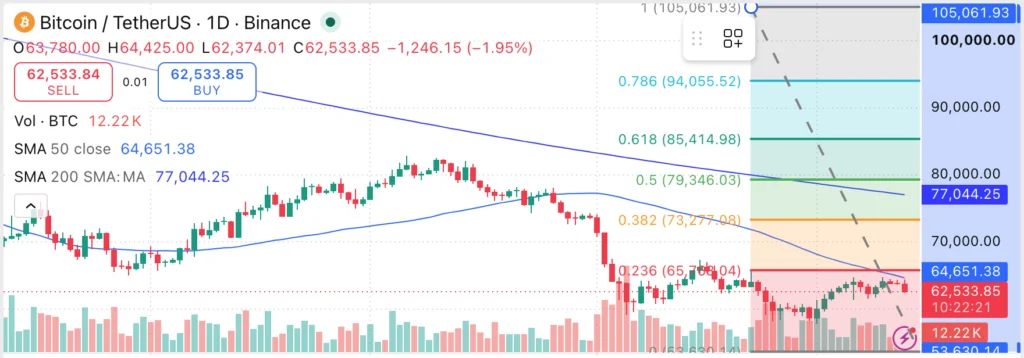
Source: tradingview.com
As of mid-August 2026, the Bitcoin price sits near $63,400. The asset’s current price action displays a bearish stance as it sits below both simple moving average (SMA) indicators, ranging from the 50-day SMA value of $64,651 for the short term and the 200-day SMA value of $77,044 for the long term.
Its other metrics show that the BTC asset has met resistance at the 23.6% Fibonacci retracement level of $65,708. Bitcoin continues to trade sideways after nearly two months of consolidation, allowing momentum indicators to reset following its late-2025 surge.
The current range reflects a battle between buyers and sellers, with the eventual breakout or breakdown expected to determine whether the market is in an accumulation or distribution phase.
Also Read: Crypto Trading Journal: How to Build One That Actually Improves Your Trading
What Are Bitcoin’s Predictions for 2026?
Most credible 2026 forecasts put Bitcoin somewhere between $120,000 and $175,000 by year end, though the full range of expert opinion runs from about $75,000 to $225,000.
Here are some notable Bitcoin price predictions for 2026:
Carol Alexander: $75,000 and $150,000
Carol Alexander, professor of finance at the University of Sussex, expects Bitcoin to remain highly volatile in 2026, forecasting a trading range of $75,000 to $150,000, with a midpoint of around $110,000.
She believes the market is shifting from retail-driven cycles to one increasingly shaped by institutional liquidity, a transition that could keep prices volatile while supporting higher long-term valuations.
Alexander has made several notable Bitcoin forecasts in recent years. While her earlier prediction of a $200,000 Bitcoin by 2026 did not materialize, she accurately anticipated Bitcoin trading above $100,000 during the summer of 2025.
CoinShares: $120,000–$170,000
James Butterfill, head of research for crypto-focused asset manager CoinShares, forecasts Bitcoin will trade between $120,000 and $170,000 in 2026, with stronger price momentum likely emerging in the second half of the year.
He believes investor sentiment will largely depend on U.S. monetary policy, particularly the Federal Reserve’s leadership transition, and regulatory developments such as the proposed CLARITY Act, which could provide long-awaited legal certainty for digital assets.
Butterfill also argues that persistent inflation or policy mistakes could strengthen demand for alternative assets like Bitcoin. Although his 2025 bullish target proved too optimistic, he correctly anticipated Bitcoin’s decline toward the $80,000 level.
Maple Finance: $175,000
Sidney Powell, CEO of Maple Finance, has a $175,000 price target for Bitcoin in 2026, citing expected interest rate cuts and accelerating institutional adoption as the main drivers.
He also expects Bitcoin-backed lending to surpass $100 billion, allowing investors to borrow against their BTC instead of selling it, which could reduce selling pressure and support prices.
While Powell’s 2025 target of $180,000–$200,000 wasn’t reached, he correctly predicted the market would experience significant corrections during the year.
Bit Mining: $75,000–$225,000
BIT Mining Limited Chief Economist Youwei Yang expects Bitcoin to trade within a broad $75,000 to $225,000 range in 2026, reflecting continued macroeconomic uncertainty.
He believes potential interest rate cuts and a more crypto-friendly regulatory environment could drive gains, although geopolitical tensions and broader economic risks are likely to keep volatility elevated.
Yang’s previous outlook was partially accurate. He successfully predicted a pullback toward $80,000 in 2025, although his upper target of $180,000–$190,000 was not reached.
“2026 could be a strong year for Bitcoin, supported by potential rate cuts and a more accommodating regulatory stance toward crypto,” Yang said. “However, heightened volatility is likely amid ongoing macroeconomic and geopolitical uncertainties.”
Is Bitcoin a Good Investment Right Now? A Risk-Adjusted Look
Bitcoin’s return potential looks exciting on paper. Its risk profile tells a different story.
Bitcoin remains far more volatile than stocks or gold. Its price has swung by tens of thousands of dollars within a matter of months, multiple times, over the past two years. That kind of swing means a Bitcoin position needs to be sized carefully, not treated like a savings account.
Financial advisors generally frame Bitcoin as a small satellite position rather than a core holding. A common range discussed by portfolio strategists is 1% to 5% of a diversified portfolio, sized so that even a 50% drawdown, which has happened before and could happen again, would not derail your broader financial plan.
The math is simple. If Bitcoin drops 50% and it is 2% of your portfolio, you lose 1% overall. If it is 20% of your portfolio, you lose 10% overall. Decide your number before the next big swing, not during it.
Also, keep in mind that geopolitical flare-ups, a debt-driven dollar wobble, or a recession scare could cut both ways. Bitcoin sometimes acts like a safe haven when confidence in the dollar drops and sometimes gets sold off with every other risk asset during a panic. Its behavior during the last real stress test will tell us which pattern holds in 2026.
Frequently Asked Questions
What is the Bitcoin price prediction for 2026?
Most analyst forecasts for 2026 cluster between $120,000 and $175,000, with a wider range of expert opinion running from about $75,000 to $225,000 depending on Fed policy and ETF demand.
Will Bitcoin go up or down in 2026?
Bitcoin has traded down for most of 2026 so far due to a hawkish Federal Reserve, but many analysts expect a recovery in the second half of the year as the delayed effects of the 2024 halving take hold.
Is Bitcoin a good investment in 2026?
Bitcoin can be a reasonable small allocation, often discussed in the 1% to 5% of portfolio range, for investors who understand its volatility and can handle large price swings without panic selling.
How does the 2024 halving affect Bitcoin in 2026?
The April 2024 halving cut new Bitcoin supply in half. Past halvings have produced their biggest price effects 12 to 18 months later, a window that lines up with the second half of 2026.