Put your money where your mouth is except in crypto staking, you put your coins where the network is, and the network pays you back for showing up.
More than 42 million ETH, roughly a third of Ethereum’s entire supply, didn’t move into staking contracts because holders got lucky. It moved because participation has a price tag in Proof-of-Stake systems, and that price tag comes with a yield attached.
Staking turns holding into contributing. But the method you choose — solo, delegated, exchange, or liquid determines how much control you keep, how fast you can exit, and what you risk losing if conditions shift.
So first things first
Join UEEx
Experience the World’s Leading Digital Wealth Management Platform
In exchange for putting your tokens to work, the network pays you staking rewards, typically a mix of newly issued tokens and a share of transaction fees collected on the network.
It’s a bit like earning interest in a savings account, but that comparison only goes so far.
A bank uses your deposit to lend money elsewhere, a PoS network uses your stake as collateral that keeps the system honest.
If a validator misbehaves, part of that stake can be dismissed, something no savings account does to you for late payments.
Rewards on most networks come from two sources: protocol issuance (new coins created according to the network’s monetary policy) and transaction fees paid by users.
The exact mix and rate depend on the specific blockchain, Ethereum, Solana, and Cardano each set this differently.
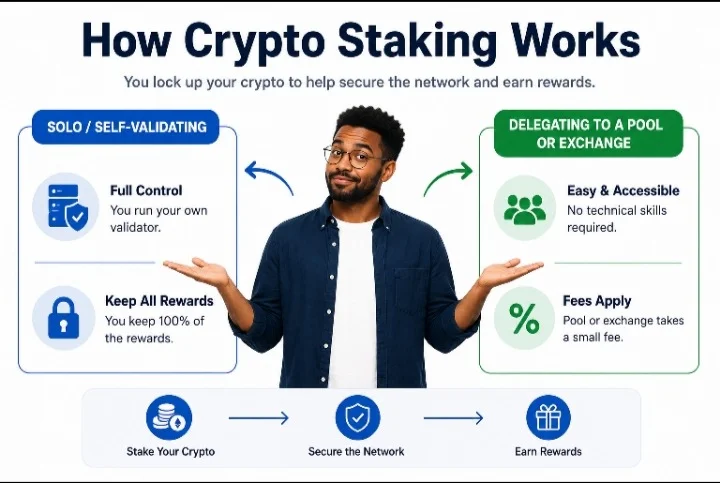
Solo/Self-Validating vs. Delegating to a Pool or Exchange
Solo staking means running your own validator node. On Ethereum, that requires 32 ETH per validator, along with a dedicated machine that stays online continuously and up-to-date client software.
It gives you full control and the highest rewards, but it’s a real operational commitment, not passive income, missed attestations from downtime directly reduce your yield, and misconfiguration is the most common cause of slashing.
Delegating skips that barrier. Instead of running a node yourself, you assign your tokens to a validator run by someone else, through a staking pool, a liquid staking protocol, or a centralized exchange.
How Rewards Are Calculated
Staking rewards aren’t a fixed interest rate. They scale with three variables:
Reward= (your stake ÷ total staked on the network) ×network rewards×validator performance
Your stake relative to total staked: rewards are distributed proportionally, so your share shrinks as more people stake the same asset, and grows if others withdraw.
Network rewards: the pool of new issuance plus fees available for validators that period, set by each blockchain’s protocol rules.
Validator performance: a multiplier based on uptime and correctness. A validator that’s offline or votes on the wrong data earns less, or gets penalized even if the stake amount is identical to a well-run validator.
That’s why two people staking the same amount of ETH can end up with different returns: one delegated to a validator with near-perfect uptime, the other to one that’s missed attestations.
As of early 2026, typical Ethereum staking APY runs roughly 3.2% to 4.5%, depending on the method and current network conditions.
The largest staked network by value, with roughly 35 million ETH staked. Ethereum’s staking yield is the lowest among major chains, around 3.5% APY, but it’s backed by the deepest liquidity and the most mature liquid staking infrastructure of any PoS network, through tokens like stETH and rETH.
2. Solana (SOL)
Solana’s headline rate sits around 6–8% APY with a short 2–3 day unbonding window, but inflation affects that, real yield after inflation is closer to 0–3%. Liquid staking can push effective returns higher by capturing MEV revenue on top of base rewards.
3. Cardano (ADA)
Cardano stakes without any lock-up or slashing risk, tokens stay spendable and transferable while earning, with roughly 3–4% APY and 2–4% real yield.
It’s widely considered the most beginner-friendly setup, since you delegate directly from your wallet and never lose custody.
4. Avalanche (AVAX)
Running a validator on Avalanche requires a 2,000 AVAX minimum, though delegation has no minimum, making it accessible for smaller holders even though solo validating has a high capital bar.
5. Polkadot (DOT)
Polkadot uses a nominated Proof-of-Stake model where holders choose up to 16 validators to back. Headline APY runs 7–14%, with real yield closer to 2–5%.
Join UEEx
Experience the World’s Leading Digital Wealth Management Platform
Cosmos advertises the highest headline APY among major chains, 10–19%, but high inflation of 10–14% and a 21-day unbonding period bring real yield down to roughly 2–8% a reminder that the highest advertised number isn’t always the best deal.
What Should You Check Before Staking a Cryptocurrency?
Consensus mechanism: Confirm the network actually uses PoS or a variant (DPoS, NPoS) before assuming it’s stakeable.
Minimum staking requirement: Varies widely, from none (Cardano, delegated Avalanche) to thousands of dollars in native tokens for solo validating.
Reward rate: Look at both headline APY and real yield after inflation, the gap between the two can be significant.
Lock-up/unbonding period: Ranges from none to several weeks, directly affecting how quickly you can access funds.
Validator requirements: Solo staking may require specific hardware, uptime, and minimum stake; delegating avoids this but shifts the responsibility to whoever you choose.
Slashing rules: Understand what triggers a penalty and whether delegators share in that risk, since this varies by network.
Network inflation: A high nominal APY on a highly inflationary token can still mean weak or negative real returns once dilution is accounted for.
Join UEEx
Experience the World’s Leading Digital Wealth Management Platform
Choose an asset: Pick a PoS network you’re comfortable holding long-term, staking ties your returns to the token’s price, so the asset matters more than the yield percentage alone.
Choose a method: Decide between solo staking (highest reward, highest technical commitment), delegating to a validator, staking through an exchange, or using a liquid staking protocol, based on how much capital, technical skill, and liquidity you need.
Check lock-up terms and fees: Before committing funds, confirm the unbonding period, any minimum stake required, and the commission or platform fee, these directly affect your real, net return.
Monitor validator performance: If you’re delegating or pooling, keep an eye on your validator’s uptime and slashing history. Poor performance on their end lowers your rewards even if you’ve done nothing wrong, switch validators if needed.
Risks of Crypto Staking
1. Slashing penalties
Validators that go offline for extended periods or double-sign conflicting blocks can have a portion of their staked funds dismissed as a penalty.
Delegators aren’t immune either, depending on the network, a slashed validator can reduce the rewards or principal of everyone who delegated to them.
2. Lock-up and unbonding periods
Staked funds usually aren’t instantly liquid. Exiting a validator and withdrawing funds can take anywhere from minutes to weeks depending on network congestion.
On Ethereum, for example, new validators faced roughly a 62-day wait to enter the active set due to entry queue backlogs, even though exits were processed almost instantly at the same time, a reminder that staking timelines can shift sharply based on network demand, in either direction.
3. Platform and custodial risk
Staking through an exchange, pool, or liquid staking protocol means trusting that platform’s security and solvency.
Exchange hacks, insolvency, or withdrawal halts can affect staked funds regardless of how secure the underlying blockchain is.
Smart contract bugs carry the same risk for liquid staking and pooled staking protocols, a flaw in the code can be exploited independent of validator behavior.
Frequently Asked Questions
Can you lose money staking crypto?
Yes. Slashing penalties can reduce your principal, and even without slashing, a drop in the token’s price can easily outweigh whatever yield you earned.
Can you unstake at any time?
Not instantly in most cases. Networks impose unbonding or exit queue periods before funds become withdrawable, and wait times can vary significantly based on network demand.
Join UEEx
Experience the World’s Leading Digital Wealth Management Platform
Staking has grown from a niche technical activity into a mainstream, well-regulated way to earn a return on crypto, but there’s no single “best” method.
Solo staking rewards technical commitment with the highest yield, delegating and pooling trade some return for simplicity, exchange staking prioritizes convenience over control, and liquid staking adds flexibility at the cost of extra smart contract risk.
Before staking any asset, look past the advertised APY. Check the lock-up terms, understand who or what you’re trusting with your funds, and remember that a token’s price movement will usually affect your position more than the yield itself.
Choose an asset you’d hold regardless of rewards, and treat validator or platform performance as something worth monitoring, not a “set and forget” decision.
Disclaimer: This article is intended solely for informational purposes and should not be considered trading or investment advice. Nothing herein should be construed as financial, legal, or tax advice. Trading or investing in cryptocurrencies carries a considerable risk of financial loss. Always conduct due diligence before making any trading or investment decisions.
Trade with proof of Reserves
UEEx publish monthly audits and third party verification on every listed market.