It ain’t what you don’t know that gets you into trouble. It’s what you know for sure that just ain’t so. Mark Twain wrote that about human certainty.
Every overconfident crypto price prediction ever published proves he was right, the traders who lost everything in 2022 were not short of predictions. They were short of probability. They had targets, not ranges, conviction, not calibration.
And when Bitcoin fell 65%, the certainty that had driven them in became the paralysis that kept them from getting out.
AI approaches crypto price prediction differently not by being certain, but by being consistently less wrong. The ensemble neural network strategy that returned 1,640% from 2018 to 2024 did not see every move coming.
It limited losses to 35% in 2022 while buy-and-hold lost 65%. That is not prediction, that is edge and edge, compounded over time, is what actually builds wealth in a market this volatile.
Read also: 8 Leading Indicators for Crypto Predictions
How Can AI Help You Predict Crypto Prices?
AI helps with crypto price prediction through the following ways highlighted below:

1. Machine Learning Algorithms
Machine learning algorithms utilize historical price data, trading volumes, and other market indicators to identify patterns and generate forecasts about future price movements.
Supervised learning models can be trained on historical data to predict future prices based on past performance. By processing data through various model architectures, machine learning can uncover relationships and trends that are not immediately visible to human analysts.
2. Natural Language Processing (NLP)
Natural Language Processing leverages AI to analyze textual data such as news articles, social media posts, and financial reports. By assessing the sentiment and context of this information, NLP provides insights into market mood and investor sentiment, which are critical drivers of short-term price movements.
A study published in MDPI Mathematics found that sentiment analysis using NLP can increase accuracy in predicting market trends based on news sentiment.
A study by PLoS One also found that the volume of tweets about Bitcoin had a statistically significant correlation with its price movements.
3. Predictive Indicators
Predictive indicators, enhanced by AI, analyze historical price data to forecast future trends. These include traditional tools like moving averages, RSI, and MACD, but AI improves their effectiveness by identifying more complex patterns and correlations.
AI algorithms process vast amounts of historical data to fine-tune these indicators, providing more precise signals than rule-based approaches alone.
4. Deep Learning
Deep learning, a subset of machine learning, uses neural networks with multiple layers to model complex patterns in data.
Long Short-Term Memory (LSTM) networks and Gated Recurrent Unit (GRU) models are particularly well-suited to cryptocurrency time series because they capture temporal dependencies and non-linear relationships that simpler models miss.
LSTMs are a special kind of smart network used in AI. They are designed to learn and remember information over time, making them effective for understanding patterns in sequential data like price histories or language.
A peer-reviewed study published in De Gruyter Engineering demonstrated that LSTM neural networks trained on historical Bitcoin price data can predict future prices with meaningful accuracy, outperforming traditional statistical models on directional forecasting tasks.
5. Algorithmic Trading
Algorithmic trading involves using AI to execute trades based on pre-set criteria and strategies. These algorithms process market data in real time, allowing them to react instantly to price changes and execute high-frequency trades.
This ability to operate at speed and scale makes algorithmic trading a valuable tool for capitalizing on short-term market opportunities that disappear before a human could act.
6. Ensemble Methods
Ensemble methods combine multiple machine learning models to improve prediction accuracy. By aggregating the predictions of different models, ensemble techniques reduce individual model errors and improve overall robustness.
Combining outputs of decision trees, neural networks, and support vector machines can provide more reliable predictions than any single model alone.
Ensemble approaches using XGBoost and LightGBM have become standard in competitive cryptocurrency prediction systems.
7. Reinforcement Learning
Reinforcement learning trains AI agents to make sequential trading decisions by rewarding profitable outcomes and penalizing losses.
These agents learn through trial and error across millions of simulated trading scenarios, developing strategies that can adapt to changing market conditions.
Performance benchmark: A peer-reviewed study published in Frontiers in Artificial Intelligence in 2025 found that an AI strategy using ensemble neural networks achieved a total return of 1,640% from January 2018 to January 2024 on Bitcoin, significantly outperforming an ML-based approach at 304% and a traditional buy-and-hold strategy at 223%.
Crucially, in 2022 the AI strategy limited losses to 35% while buy-and-hold lost 65%. Frontiers in Artificial Intelligence, 2025.
What Data Sources Does AI Use for Crypto Prediction?
Historical Price Data
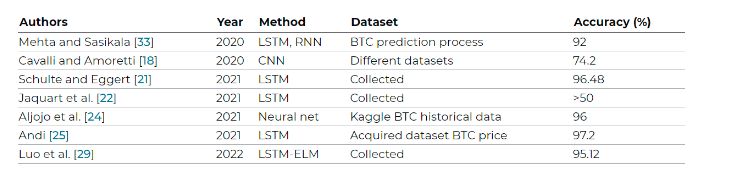
Historical price data is the backbone of any predictive model. By analyzing past price trends, including daily closing prices, highs, lows, and trading ranges, AI identifies patterns and correlations that might indicate future movements.
LSTM networks trained on this data can recognize cyclical patterns, momentum shifts, and volatility clustering.
Read also: Best Crypto Price Forecast Modeling Techniques.
Trading Volume and Market Capitalization
Trading volume and market capitalization are vital indicators of a cryptocurrency’s market activity and health. High trading volumes suggest strong investor interest and liquidity, which affects price stability and momentum.
Market capitalization provides a snapshot of the total value of a cryptocurrency and its relative position within the broader market.
Social Media and News Sentiment
Social media and news sentiment have become increasingly influential in crypto markets. Platforms like X (formerly Twitter), Reddit, and major news outlets can drive market sentiment through public opinion and breaking news stories.
AI algorithms analyze these sources at scale, detecting whether the general mood is positive or negative and identifying early signals before they manifest in price action.
Blockchain Metrics
Blockchain metrics provide valuable insights directly from the underlying technology. On-chain data including transaction volumes, active wallet addresses, hash rates, miner outflows, and exchange inflow and outflow data help assess network activity, security, and the behavior of large holders.
Platforms like Glassnode and IntoTheBlock specialize in converting this raw on-chain data into tradeable signals.
Which Are the Best AI Tools for Crypto Price Prediction?
They include;
1. CryptoPredictions
CryptoPredictions forecasts cryptocurrency prices using advanced algorithms, machine learning, and statistical models. It analyzes historical data, technical indicators, and market trends to provide both short-term and long-term predictions for over 8,000 crypto assets.
The platform uses data from CoinGecko and offers predictions across 8 languages and 33 currencies, making it one of the most comprehensive public-facing prediction tools available.
2. Santiment

Santiment leverages AI to summarize social media discourse surrounding assets, helping traders quickly grasp current market sentiment. Rather than predicting market movements directly, it enables users to analyze vast amounts of data more efficiently.
Santiment is particularly strong for its on-chain data, social volume tracking, and network activity metrics. It is best used as a sentiment and data layer that complements other prediction methods rather than a standalone price forecast tool.
3. Numerai

Numerai is a unique AI tool that leverages decentralized intelligence to generate market forecasts. Data scientists worldwide contribute predictions, earning NMR tokens as rewards for valuable insights.
The platform uses blockchain technology to ensure privacy while allowing contributors to share information anonymously.
Its integration with the Numerai hedge fund adds a competitive layer by enabling contributors to stake tokens on their predictive models, creating strong economic incentives for accuracy.

Tool accuracy context (2025): According to independent reviews, leading AI prediction platforms including Glassnode, Santiment, and TradingView extensions achieve directional accuracy of 55 to 65% at best.
CryptoQuant and IntoTheBlock lead in short-term trend direction accuracy. LunarCrush is considered the leading tool specifically for market sentiment analysis.
Read also: 5 Best Open-Source Crypto Analysis Software
What Are the Advantages of AI for Crypto Prediction?
1. Enhanced Data Processing
AI can simultaneously analyze factors including historical data, market trends, social media sentiment, news articles, and technical indicators.
This comprehensive analysis provides a more complete picture of market dynamics than any single indicator or human analyst could achieve alone.
2. Real-time Analysis
Crypto markets are highly volatile and operate without pause. AI processes information in real time, identifying trends and patterns as they emerge and providing traders with up-to-the-minute insights.
This is a decisive advantage in a market where seconds can determine whether a trade is profitable.
3. Objective Decision Making
Unlike human traders, AI is free from emotional biases that cloud judgment under pressure. It makes decisions based solely on data analysis, reducing the risk of impulsive actions driven by fear or greed.
Fear of missing out (FOMO) can cause investors to purchase at market highs, while fear of losing out (FOLO) can lead to panic selling during market declines. AI executes rules with complete consistency, eliminating both patterns.
4. Pattern Recognition
AI excels at identifying complex patterns within data that are imperceptible to human analysts. This capability can uncover hidden correlations and predict market movements that would be invisible to conventional technical analysis tools.
5. Automation
AI-powered trading bots execute trades automatically based on predefined parameters, allowing traders to capitalize on opportunities without constant manual monitoring.
This is particularly valuable in crypto markets that trade 24 hours a day, 7 days a week, across every time zone.
6. Risk Management
By assessing market volatility and identifying potential risks in real time, AI helps investors make more informed decisions.
AI systems can set dynamic stop-loss levels, adjust position sizes based on volatility regime, and flag emerging market conditions that require human attention before losses accumulate.
What Challenges Does AI Face in Predicting Crypto Prices?
1. Market Volatility and Unpredictability
The cryptocurrency market is known for its extreme volatility and unpredictability. Prices can swing dramatically within short periods due to regulatory news, geopolitical events, macroeconomic shifts, and market sentiment.
2. Data Quality and Availability
For AI models to generate accurate predictions, they require high-quality, comprehensive, and consistent data. In the crypto space, data can be sparse, noisy, and fragmented across hundreds of exchanges.
Issues such as incomplete historical data, errors in data collection, and discrepancies between sources can undermine model effectiveness.
The decentralized nature of the cryptocurrency market and the absence of standardized data reporting compound these challenges significantly.
3. Overfitting and Model Generalization
Overfitting occurs when a model performs exceptionally well on historical training data but fails to generalize to new market conditions.
This is a particularly persistent problem in crypto prediction because historical patterns may not repeat, especially across different market cycles.
Models trained during bull markets often fail spectacularly when conditions shift to bear markets or sideways consolidation. Striking the right balance between model complexity and generalization is essential.
4. Market Manipulation
In thinly-traded altcoins, large holders can trigger price movements that contradict all reasonable historical patterns.
Coordinated pump-and-dump schemes and artificial volume inflation create signals that mislead AI models.
Advanced tools have begun weighting social media signals by source credibility and applying manipulation detection filters, but this remains an imperfect science.
AI Accuracy & Performance in Crypto Price Prediction
| Performance Metric | Empirical Evidence & Findings | Key Operational Realities |
| Directional Accuracy (Up/Down) | 55% to 65% on short timeframes (though controlled lab models can peak higher, e.g., CNNs at 91%). | Outperforms random chance, but cannot serve as a standalone infallible signal. |
| Exact Price Targets | Accuracy drops dramatically; most professional models avoid specific numerical forecasts. | Excellent at trend direction; poor at predicting precise terminal price points. |
| Regime Changes & Shocks | Accuracy declines significantly during market reversals, macro news, or black swan events. | Fails most when protection is needed most (e.g., sudden regulatory crackdowns or crashes). |
| Long-Term Returns vs. HODL | Historically strong outperformance in backtests (e.g., AI ensemble 1,640% vs. 223% HODL from 2018–2024). | Leverages adaptive risk management and compounding over multi-year periods. |
| Downside Risk Protection | Superior capital preservation during major bear markets (e.g., limiting 2022 losses to 35% vs. 65% for HODL). | Real-world trading suffers from API limits, latency, and slippage missing in lab tests. |
Read also: Choosing the Best Crypto Technical Analysis Course
Conclusion
Crypto Price Prediction is not about eliminating uncertainty or hitting exact numerical targets; it is about cultivating mathematical edge and asymmetric risk management.
AI does not change the unpredictable nature of digital assets by guaranteeing outcomes, it changes how you survive the chaos. By replacing emotional conviction with probabilistic data, AI tools and ensemble strategies help traders stay consistently less wrong.
In a market as volatile as crypto, that edge is the ultimate difference between weathering the storm and becoming another statistic.