Bitcoin hit an all-time high of $126,198 on October 6, 2025. Ethereum followed six weeks earlier, touching almost $4,954 on August 24, 2025.
However, by the middle of 2026, Bitcoin was trading closer to $65,000, roughly half its peak. Ethereum had fallen even further, hovering around $1,800 to $2,300, more than half off its own high.
That swing is exactly why this comparison matters right now. Bitcoin and Ethereum are the two biggest cryptocurrencies by market value, but they are not the same kind of asset, and they don’t behave the same way in a downturn.
Bitcoin is often called “digital gold,” while Ethereum is often called a world computer. One is built to store value; the other is built to run applications. Picking between them, or deciding how much of each to hold, depends on knowing what each one actually does.
This guide walks through both coins in plain language: how they work, what they’re used for, how they’ve performed, and how you might think about investing in either one.
Key Takeaways
- Bitcoin and Ethereum solve different problems. Bitcoin is digital gold, built for storing value. Ethereum is a programmable platform that powers apps, DeFi, and tokenized assets. They complement each other more than they compete.
- Bitcoin tends to be the calmer asset. It has a longer track record, a simpler investment story, and historically smaller price swings. Ethereum tends to move harder in both directions, which means bigger gains in rallies and bigger losses in downturns.
- Both have real institutional backing now. Spot ETFs for both coins are trading in the US, and public companies hold both on their balance sheets. That doesn’t stop sharp corrections, as 2026 has shown, but it has changed who owns crypto.
- A blended portfolio is the most common approach. Many investors split their crypto holdings between the two rather than betting everything on one, adjusting the mix based on their own risk tolerance.
Bitcoin: Digital Gold for the Modern Era
Source: ai image
Launched in January 2009 by the pseudonymous Satoshi Nakamoto, Bitcoin emerged in the aftermath of the 2008 global financial crisis as a decentralized alternative to traditional finance.
Its whitepaper proposed a monetary network that allows users to send payments directly to one another without banks or intermediaries. Over time, Bitcoin has evolved from a digital payment system into a globally recognized store of value, underpinned by the principles of decentralization, censorship resistance, transparency, and a fixed monetary supply.
How Bitcoin Works
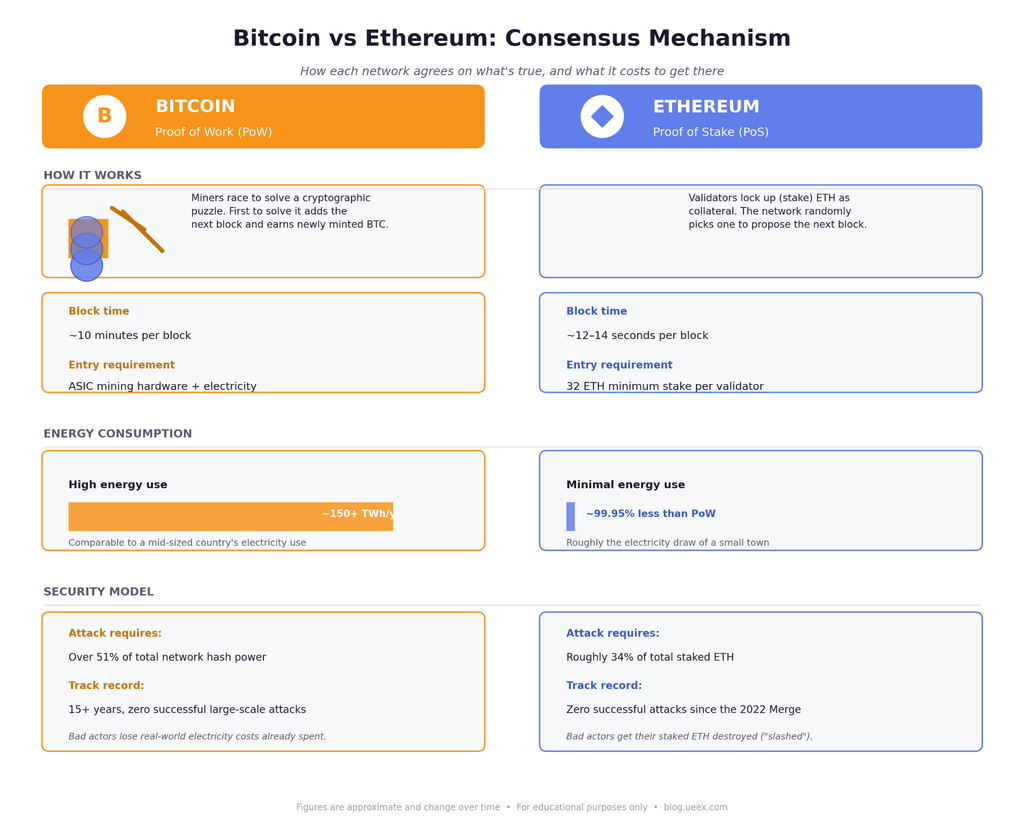
Bitcoin runs on a public blockchain that uses the UTXO (Unspent Transaction Output) model instead of Ethereum’s account-based system. Transactions are grouped into blocks roughly every 10 minutes and secured with Merkle trees, ensuring data integrity across the network.
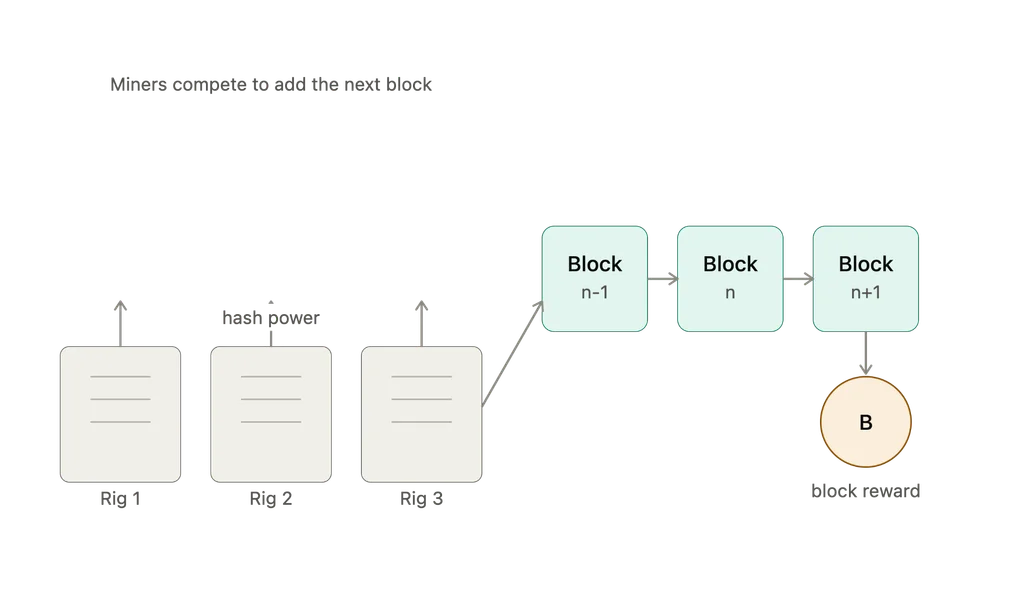
The pioneer asset relies on the Proof-of-Work (PoW) consensus mechanism, where miners compete to solve SHA-256 cryptographic puzzles. Since the 2024 halving, the block reward has stood at 3.125 BTC.
Despite criticism over its energy use, Bitcoin remains the world’s most secure blockchain by computational power, with a network hashrate fluctuating around 900 to 1,000+ EH/s (roughly 1 ZH/s) in 2026.
Bitcoin’s monetary policy is equally distinctive. Its supply is permanently capped at 21 million BTC, with just over 20 million coins already mined. New issuance halves every 210,000 blocks, reinforcing scarcity and strengthening Bitcoin’s reputation as digital gold, with the final BTC expected to be mined around 2140.
Also Read: Crypto Trading Journal: How to Build One That Actually Improves Your Trading
Primary Use Cases
Store of Value
Bitcoin’s biggest use case today is as a store of value. Investors increasingly view it as a hedge against inflation, currency depreciation, and macroeconomic uncertainty, while corporations and governments have also begun holding it as a treasury asset. For example, El Salvador continues to accumulate Bitcoin as part of its national reserve strategy.
Cross-border Payment
Beyond investment, Bitcoin is also used for cross-border payments, particularly in countries with unstable currencies or expensive remittance systems. The growth of the Lightning Network has significantly improved Bitcoin’s payment capabilities by enabling fast, low-cost transactions that make everyday spending more practical.
Portfolio Diversification
Bitcoin has also become an increasingly popular portfolio diversification asset. Although still volatile, its long-term performance and historically low correlation with many traditional investments have attracted institutional investors seeking alternative sources of return.
Expanding Beyond Digital Gold
Bitcoin’s ecosystem has grown considerably in recent years. Layer-2 solutions such as the Lightning Network enable instant payments, while projects like Stacks introduce smart contract functionality without compromising Bitcoin’s base-layer security.
The Taproot upgrade improved privacy, efficiency, and transaction flexibility, while newer innovations such as Ordinals, BitcoinOS, and Starknet’s Bitcoin initiatives are expanding Bitcoin’s capabilities into NFTs, rollups, and decentralized applications.
As a result, Bitcoin is no longer viewed solely as a store of value. It is steadily evolving into the foundation of a broader blockchain ecosystem while retaining the security and scarcity that made it the world’s leading cryptocurrency.
Ethereum: The World Computer
Source: ai image
Launched in July 2015 after being proposed by Vitalik Buterin in 2013, Ethereum was designed to do far more than transfer digital money. Its vision was to create a programmable blockchain where developers could build applications that run without central authorities.
Today, Ethereum powers thousands of decentralized applications (dApps), from lending platforms and NFT marketplaces to blockchain games and enterprise solutions. Rather than simply being a cryptocurrency, Ethereum has evolved into the foundation of the world’s largest smart contract ecosystem.
How Ethereum Works
Unlike Bitcoin’s UTXO model, Ethereum uses an account-based system consisting of Externally Owned Accounts (EOAs), controlled by users, and Contract Accounts, which execute smart contracts automatically.
Every smart contract runs on the Ethereum Virtual Machine (EVM), a decentralized computing engine capable of executing programmable code across the network. Ethereum typically produces blocks every 12 seconds, enabling developers to build applications ranging from decentralized exchanges to tokenized real-world assets.
Proof of Stake and Network Security
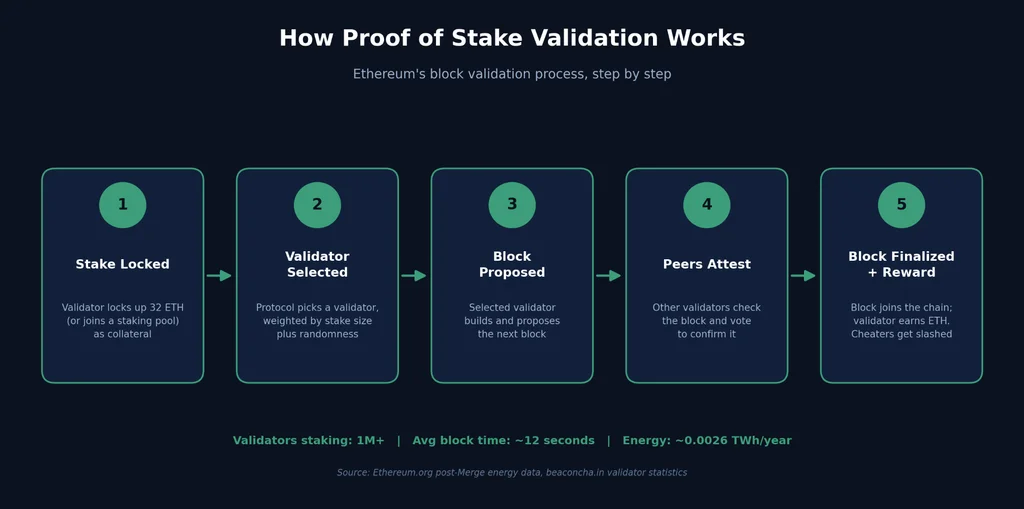
Ethereum completed its historic transition from Proof of Work (PoW) to Proof of Stake (PoS) during The Merge in September 2022, reducing the network’s energy consumption by approximately 99.95%.
Today, Ethereum is secured by around one million validators who together stake roughly 39 million ETH, about a third of the total supply, to verify transactions and maintain network security. Validators generally stake 32 ETH, although the Pectra upgrade introduced larger effective validator balances, making staking more efficient for operators. Validators that behave maliciously can have a portion of their stake “slashed,” creating strong economic incentives to act honestly.
ETH Supply and Token Economics
Unlike Bitcoin, Ethereum does not have a fixed maximum supply. Instead, its monetary policy adjusts based on network activity. The introduction of EIP-1559 in 2021 permanently changed ETH’s economics by burning a portion of every transaction fee.
During periods of heavy network usage, the amount of ETH burned can exceed new issuance, making ETH temporarily deflationary. After the Dencun (2024) and Fusaka (late 2025) upgrades reduced Layer 2 transaction costs, net issuance became more variable, depending largely on network demand.
Smart Contracts Power the Ethereum Economy
Ethereum’s biggest innovation is the smart contract, self-executing code that automatically performs actions once predefined conditions are met.
Most smart contracts are written in Solidity and, once deployed, cannot easily be altered. This immutability makes them ideal for financial applications that require transparency and trust.
Ethereum now supports an enormous on-chain economy, including:
- Decentralised finance (DeFi)
- NFTs and digital collectibles
- Decentralised autonomous organisations (DAOs)
- Blockchain gaming
- Decentralised identity systems
- Real-world asset (RWA) tokenisation
- Supply chain verification
Ethereum continues to dominate DeFi, securing hundreds of billions of dollars in on-chain value across lending protocols, decentralized exchanges, derivatives, and liquid staking platforms.
Token Standards That Shaped Crypto
Ethereum introduced standards that became the blueprint for the wider blockchain industry.
- ERC-20 powers fungible cryptocurrencies and utility tokens.
- ERC-721 created the NFT market by enabling unique digital assets.
- ERC-1155 combines fungible and non-fungible assets within a single smart contract, making blockchain gaming and digital collectibles significantly more efficient.
Scaling Through Layer 2 Networks
Ethereum’s long-term scaling strategy focuses heavily on Layer 2 rollups, which process transactions off the main blockchain while inheriting Ethereum’s security.
Leading Layer 2 networks such as Arbitrum, Optimism, Base, and zkSync have dramatically reduced transaction fees and increased throughput, making Ethereum far more practical for everyday users. This approach allows Ethereum to scale without sacrificing decentralization or security.
Also Read: Beyond the Hype: The Dark Side of AI in Crypto Nobody’s Talking About in 2026
Head-to-Head: Bitcoin vs Ethereum on the Metrics That Matter
Let’s explore the metrics that define both Bitcoin and Ethereum
| Metric | Bitcoin (BTC) | Ethereum (ETH) | Winner |
| Consensus Mechanism | Proof of Work (PoW): Miners solve cryptographic puzzles; highly secure and decentralized. Hash rate: about 1,000 EH/s (Aug. 2026). Pros: Battle-tested security, decentralization. Cons: Energy-intensive, slower finality. | Proof of Stake (PoS): Validators stake ETH to secure the network. 1.03M validators (2026). Uses 99.95% less energy than PoW. Pros: Energy-efficient, faster finality, staking rewards. Cons: Wealth concentration concerns, newer consensus model. | Tie: Bitcoin for security; Ethereum for efficiency. |
| Supply Economics & Scarcity | Fixed supply of 21 million BTC with around 20.1 million (about 96%) mined. Halving every four years reduces issuance, making Bitcoin deflationary by design. | No hard supply cap. Around 121 million ETH in circulation. EIP-1559 burns transaction fees, making ETH inflationary or deflationary depending on network activity. | Bitcoin for absolute scarcity; Ethereum for adaptive economics. |
| Transaction Speed & Scalability | 5–7 TPS on Layer 1. 10-minute block time. The Lightning Network enables near-instant, low-cost payments. Typical settlement: 10–60 minutes. | Around 30 TPS on Layer 1. 12–14 second block time. Layer-2 rollups process 1,000–10,000+ TPS with transactions settling in seconds. | Ethereum for throughput; Bitcoin for settlement security. |
| Smart Contracts | Limited scripting language with basic transaction logic. Supports innovations like Ordinals, Stacks, and BitcoinOS but remains focused on payments. | Turing-complete Solidity language, Ethereum Virtual Machine (EVM), thousands of dApps, DeFi, NFTs, and DAOs. | Ethereum |
| Developer Ecosystem | Conservative development, a security-first approach, BIPs, a smaller developer community, and slower upgrades. | The largest blockchain developer ecosystem with 5,000+ monthly active developers, EIPs, extensive tooling, and faster innovation. | Ethereum |
| Institutional Adoption | Spot Bitcoin ETFs launched in 2024. Strong corporate treasury adoption, CME futures, institutional custody, and growing ETF inflows. | Spot Ethereum ETFs launched in 2024. Rising institutional demand driven by tokenization, enterprise adoption, and increasing ETH treasury holdings. | Bitcoin (currently), though Ethereum is rapidly closing the gap. |
| Market Performance (2026) | ATH: $126,198 (Oct. 2025). Current trading range around $63,000 (Aug. 2026). | ATH: $4,954 (Aug. 2025). Current trading around $1,900 (Aug. 2026). | Context-dependent based on investment goals. |
| Primary Use Cases | Digital gold, store of value, inflation hedge, treasury reserve asset, Lightning payments, and censorship-resistant money. | DeFi, NFTs, DAOs, tokenization, gaming, enterprise blockchain, decentralized identity, and Web3 applications. | Bitcoin for simplicity; Ethereum for versatility. |
| Network Security & Reliability | No successful 51% attacks. Hash rate at record highs. Over 15 years of uptime with a conservative upgrade philosophy. | More than 1.03 million validators secure the network. Strong PoS security with validator slashing, although Ethereum has a more complex codebase. | Bitcoin for its longer security track record. |
| Fees & Cost of Use | Standard on-chain fees are typically $1–10. Lightning transactions usually cost less than $0.01. | Layer-1 gas fees now typically run from under $1 to a few dollars, spiking during congestion, while Layer-2 fees typically cost $0.01–0.50 after the Dencun upgrade. | Tie: Bitcoin Lightning and Ethereum Layer-2s both offer low-cost transactions, while Ethereum Layer 1 remains the most expensive. |
The Flippening Debate: Could Ethereum Overtake Bitcoin?
Source: ai image
“The flippening” is crypto slang for the day Ethereum’s total market value passes Bitcoin’s. People have predicted it since 2017, but it hasn’t happened yet. Meanwhile, the gap actually widened again in 2026 as Ethereum fell harder than Bitcoin during the downturn.
Some of the industry’s most prominent voices still argue it’s just a matter of time.
“Ethereum could flip Bitcoin similar to how Wall Street and equities flipped gold post-’71,” standard.
ConsenSys founder Joseph Lubin has made a similar case, suggesting Ethereum’s role as a settlement layer for tokenized finance could eventually let it overtake Bitcoin as the market’s dominant asset.
Robert Kiyosaki, author of Rich Dad Poor Dad, has taken a more balanced stance, naming both silver and Ethereum among his preferred holdings because they combine scarcity with real industrial and financial use.
ARK Invest’s own published research has put Bitcoin’s bull-case target as high as $2.4 million by 2030, while separately projecting Ethereum could reach roughly $166,000 to $180,000 in the same window if smart contract platforms capture a meaningful share of global finance.
Why Ethereum Could Flip Bitcoin
Ethereum’s biggest advantage is utility. Unlike Bitcoin, which is primarily viewed as a store of value, Ethereum powers thousands of decentralized applications, DeFi protocols, NFTs, stablecoins, and tokenized real-world assets, creating continuous demand for ETH as network “gas.”
Institutional interest is also accelerating. Asset managers including BlackRock now offer spot Ethereum ETFs, while Ethereum continues to dominate tokenization and enterprise blockchain initiatives.
Ethereum’s long-term economics strengthen the bull case. Thanks to the EIP-1559 burn mechanism, periods of heavy network activity can reduce ETH’s circulating supply, making it deflationary. Combined with the industry’s largest developer community and an expanding Layer-2 ecosystem, Ethereum enjoys powerful network effects that continue to drive adoption.
Why Bitcoin Remains Ahead
Despite Ethereum’s momentum, Bitcoin retains significant advantages. Its first-mover status, simple “digital gold” narrative, and more than 15 years of uninterrupted security make it the preferred choice for many institutions and long-term investors.
Bitcoin also benefits from deeper liquidity, stronger brand recognition, and a substantially larger market capitalization, meaning Ethereum would require an enormous capital shift to overtake it.
A Realistic Outlook
A Flippening remains possible but far from imminent. Ethereum is likely to continue gaining market share through DeFi, tokenization, and enterprise adoption, while Bitcoin should remain the dominant digital store of value. Rather than replacing one another, the two assets are increasingly serving different purposes, making a diversified portfolio that includes both a more balanced long-term strategy for many investors.
2026 Market Dynamics & Institutional Trends in Crypto
Let’s look at how market dynamics and institutional trends affect both assets
Bitcoin ETF Flows: Growth With More Volatility Than Expected
Bitcoin ETFs have grown into one of the largest ETF launches in history, but 2026 has been far choppier than early projections implied. Since their January 2024 debut, cumulative inflows have reached roughly $51.8 billion, pushing total net assets across the complex to about $80.9 billion.
Zooming out, total assets under management across spot Bitcoin ETFs peaked above $137 billion in late 2025, and these funds still hold more than 6% of Bitcoin’s total supply. But the path there hasn’t been linear; multi-billion-dollar inflow streaks have alternated with sharp outflows tied to macro headwinds, rate expectations, and profit-taking by major holders like Jane Street and Goldman Sachs.
Ethereum ETFs: A Rockier Year, But Signs of Recovery
Ethereum ETFs had a tougher 2026 than Bitcoin’s. Holdings across the nine SEC-approved spot ETH ETFs fell from 6.14 million to roughly 5.19 million ETH, representing a 15.4% reduction in asset quantity. While a 45% price decline compounded the total value drop, it is important to distinguish between market price depreciation and this net reduction in the quantity of ETH held. BlackRock has consolidated its lead throughout the downturn, now controlling close to 55% of all ETH held in US spot ETFs.
July brought the first real signs of a turnaround: Ethereum ETFs pulled in about $196 million in net inflows over a single week, with BlackRock’s ETHA driving most of the demand. Whether this marks a genuine institutional re-entry, rather than a short-lived bounce, will depend on sustained flows in the months ahead.
Corporate Treasury Adoption: Strategy Still Leads, But the Playbook Is Shifting
Strategy (formerly MicroStrategy) remains the largest corporate holder of Bitcoin globally, holding 843,775 BTC as of mid-August 2026. After years of accumulation-only policy, the company began trimming small tranches in mid-2026 (including a disclosed sale of 1,690 BTC in early August) while building a multi-billion-dollar USD reserve, and Executive Chairman Michael Saylor has acknowledged that the company could sell more of its position, a meaningful shift for a treasury strategy built almost entirely on accumulation.
Regulatory Clarity Is Catching Up With Institutional Demand
Two pieces of US legislation have reshaped the compliance picture over the past year:
- The GENIUS Act, the federal stablecoin law signed in July 2025, takes full effect by January 18, 2027, with federal regulators still finalizing its implementing rules.
- The CLARITY Act, the crypto market-structure bill, passed the House in July 2025 but remains pending in the Senate, which broke for its August 2026 recess without holding a floor vote.
Internationally, the EU’s MiCA framework continues to set the benchmark for unified crypto regulation, reinforcing a broader global trend: both BTC and ETH are increasingly treated as commodities rather than securities across major jurisdictions.
The Bigger Picture: BTC as “Digital Gold,” ETH as a Productive Asset
Despite a volatile year for flows, the underlying institutional thesis hasn’t changed; it’s evolving. Bitcoin continues to function as a macro hedge and treasury anchor, while Ethereum is increasingly viewed through the lens of utility: staking yield, tokenization, and Layer 2 activity.
As custody, regulation, and product structures (like staked ETH ETFs) mature, the two assets are settling into distinct institutional roles rather than competing for the same allocation.
Investment Strategies: Bitcoin, Ethereum, or Both?
Source: ai-generated
There’s no single right answer here. It depends on your risk tolerance and time horizon.
Bitcoin-Only: Bitcoin-only portfolios suit conservative investors chasing a scarce store of value. With a 15+ year track record, the deepest liquidity in crypto, and growing institutional backing through spot Bitcoin ETFs, BTC offers the simplest, lowest-volatility thesis in the space. The trade-off: no exposure to smart-contract innovation, and potential underperformance versus ETH during altcoin-driven bull runs.
Ethereum-Only: Ethereum-only allocations fit tech-forward investors backing DeFi, NFTs, and dApp growth. Staking currently yields roughly 2% to 4% APR, depending on the validator method, while the EIP-1559 fee burn adds deflationary pressure to supply. Downsides include higher volatility and rising competition from Layer-1 rivals like Solana and Cardano.
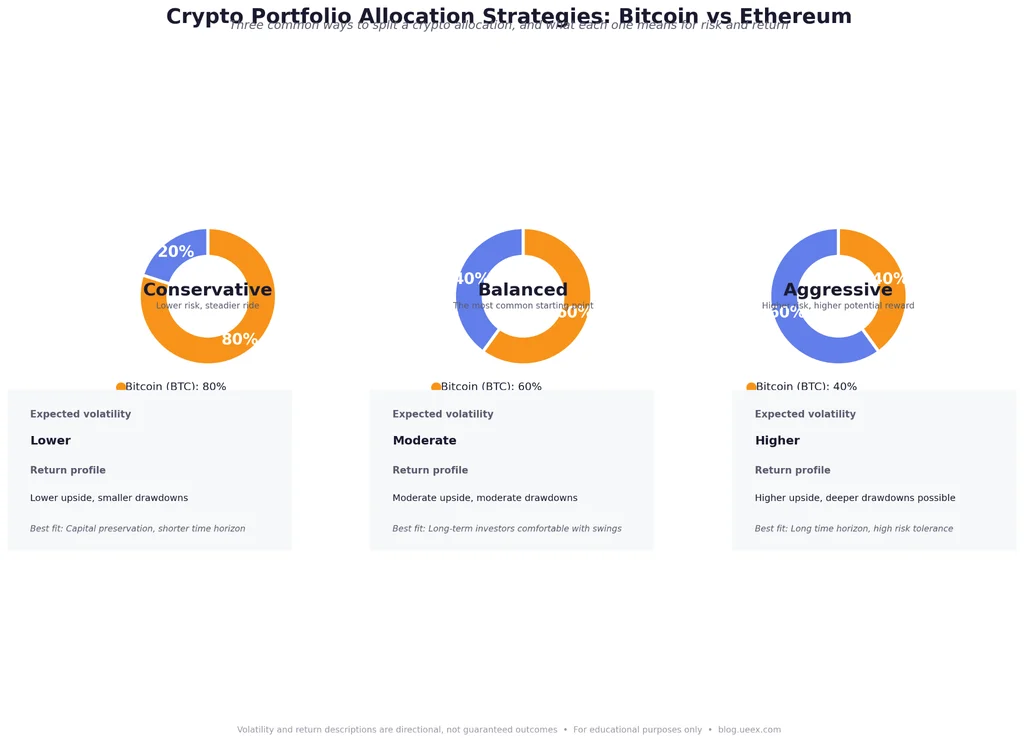
The 60/40 Balanced Portfolio: A 60% BTC/40% ETH split balances Bitcoin’s stability with Ethereum’s growth potential, capturing both the “digital gold” and “world computer” narratives. Rebalance quarterly whenever your allocation drifts more than 10% from target, selling the outperformer to buy the laggard.
Dynamic Allocation for Active Investors: Active traders can shift ratios with market cycles: 80/20 BTC/ETH in bear markets for capital preservation and 40/60 in bull markets to chase upside. Useful signals include the BTC/ETH ratio, the Crypto Fear & Greed Index, and ETF flow data, though this approach demands active monitoring and carries timing risk.
Dollar-Cost Averaging (DCA): DCA is the lowest-stress entry point for any investor. Automate fixed monthly buys (e.g., 60% BTC / 40% ETH) regardless of price, removing emotion from entry timing. Best suited to 3–10 year investment horizons.
Bottom Line:
There’s no universally “correct” allocation; match your investment strategy to your risk tolerance, time horizon, and conviction in each asset’s narrative.
Risk Analysis and How to Manage It
Every part of this comparison comes with real risk, and 2026 is a clear reminder of that.
Bitcoin-specific risks: Energy use has drawn regulatory scrutiny in some countries, mining remains concentrated among a relatively small number of large operations, and quantum computing is a long-term theoretical threat to its cryptography, though still likely decades away from being practical.
Ethereum-specific risks: Its code is more complex than Bitcoin’s, which means a larger surface area for smart contract bugs and exploits. It also faces real competition from other smart contract platforms like Solana, and its move to proof of stake, while successful so far, is a younger design than Bitcoin’s proof of work.
Shared risks: Both assets can and have dropped more than 50% in a matter of months. Both face the risk of sudden regulatory changes in any given country. Both are vulnerable to exchange hacks and lost private keys if you don’t manage custody carefully.
For more on managing this kind of downside, see our How to Diversify Your Cryptocurrency Portfolio to Minimize Risks guide.
A short risk checklist worth following regardless of which coin you choose:
- Never invest more than you can genuinely afford to lose
- Use dollar-cost averaging instead of trying to time entries
- Don’t put your entire crypto allocation into a single asset
- Move long-term holdings into a hardware wallet rather than leaving everything on an exchange
- Turn on two-factor authentication everywhere
- Keep records of every purchase and sale for tax purposes
For guidance on getting your first purchase right, see our Bitcoin vs Ethereum: Which Should You Buy in 2026? article.
How to Actually Invest: A Step-by-Step Approach
Here’s a step-by-step description on how to start your investment
1. Decide your time horizon
Short-term trading and long-term holding call for very different strategies and different risk levels. Most of the data on crypto returns favors long holding periods over short-term trading.
2. Set your risk tolerance honestly
Can you stomach a 50% drawdown without panic selling? If the answer is no, a heavier Bitcoin allocation is probably the more comfortable fit than a heavier Ethereum one.
3. Pick a platform
Centralized exchanges like UEEx make buying and holding straightforward for most investors. If you’d rather stay inside a traditional brokerage account, spot Bitcoin and Ethereum ETFs are now available through many standard investing platforms.
4. Secure your holdings
Smaller amounts can reasonably stay on a reputable, regulated exchange with strong account security. Larger, long-term holdings are generally safer moved into a hardware wallet you control directly.
5. Buy on a schedule, not a feeling
Setting up automatic, regular purchases removes the temptation to chase price spikes or panic during dips.
6. Review, don’t obsess
Check your portfolio periodically, rebalance if your allocation has drifted well off target, and avoid making decisions based on a single day’s price move.
Frequently Asked Questions
What is the main difference between Bitcoin and Ethereum?
Bitcoin is designed as a store of value with a fixed supply of 21 million coins, similar to digital gold. Ethereum is a programmable platform that runs smart contracts and powers apps like DeFi and NFTs, with no fixed supply cap.
Which is a better investment, Bitcoin or Ethereum?
Neither is objectively better; they suit different goals. Bitcoin tends to be less volatile and simpler to understand, which suits conservative investors. Ethereum offers exposure to a wider range of growth areas but tends to swing harder in both directions.
Can Ethereum overtake Bitcoin’s market cap, or “flip” it?
It’s possible but not close to happening as of 2026. Ethereum’s market value actually fell further than Bitcoin’s during this year’s downturn, widening the gap rather than closing it. Most analysts view a full flippening as a long-term, uncertain scenario rather than a near-term likelihood.
Should I buy Bitcoin, Ethereum, or both?
Many investors hold both to balance Bitcoin’s relative stability with Ethereum’s growth potential. The right split depends on your own risk tolerance, and it’s worth reviewing that split periodically rather than setting it once.
Is Bitcoin or Ethereum more likely to deliver life-changing returns?
Both have delivered enormous historical gains from their early years, and both have also delivered painful, multi-year drawdowns, including the current one. Past performance doesn’t guarantee future returns, and any prediction of huge future gains should be treated as speculation, not a promise.