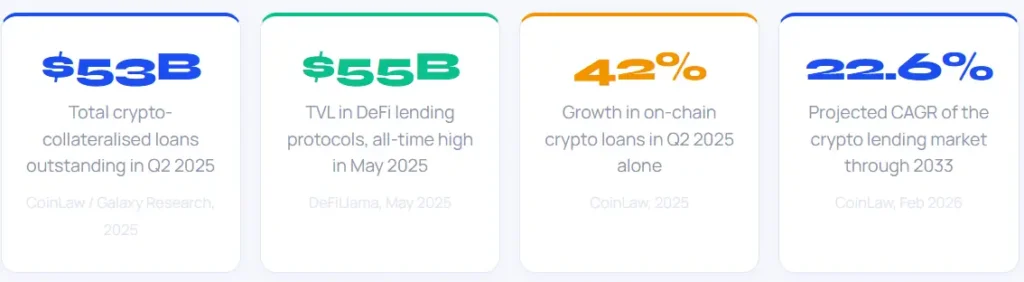
Cryptocurrency lending platforms are services that let digital asset holders lend their crypto to earn interest, or allow borrowers to use their holdings as collateral to access liquidity without selling.
Think of them as the savings accounts and loan facilities of the digital asset world but running on blockchain infrastructure instead of bank branches, and often generating yields that traditional banks cannot touch.
This guide gives you a complete, current, and honest picture about everything you should know about crypto lending platforms.
Join UEEx
Experience the World’s Leading Digital Wealth Management Platform
At their core, cryptocurrency lending platforms connect two parties: those who have digital assets and want to earn a return on them, and those who need liquidity but do not want to sell their holdings.
The mechanic mirrors traditional lending in many ways, but replaces banks and credit bureaus with blockchain-based infrastructure, smart contracts, and collateralisation ratios.
When you deposit Bitcoin or Ethereum into a lending platform, your assets are either pooled with other lenders and matched to borrowers algorithmically, or deployed into a smart contract that manages the entire loan cycle automatically.
In return for providing this liquidity, you receive interest payments typically expressed as an annual percentage yield (APY) credited to your account daily, weekly, or monthly depending on the platform.
For borrowers, the process works differently from a traditional bank loan. Because most crypto lenders operate globally and cannot run credit checks across dozens of jurisdictions, loans are overcollateralised.
A borrower wanting $5,000 must typically deposit $8,000 to $12,000 worth of crypto as collateral. This protects lenders against the volatility of the underlying assets.
If the collateral’s value drops below a set threshold the loan-to-value (LTV) ratio, the platform liquidates a portion of the collateral automatically to cover the loan.
Key Benefits of Cryptocurrency Lending Platforms
1. High Returns for Lenders
Many cryptocurrency lending platforms offer higher interest rates than traditional savings accounts or bonds. Depending on the asset and platform, lenders can earn interest rates as high as 10% to 20% annually.
For instance, lenders on the Nexo platform can earn as high as 16% interest in their crypto assets.
2. Access to Liquidity
Borrowers can access liquidity without selling their cryptocurrency holdings.
This is especially beneficial for investors who want to hold their crypto assets long-term but need short-term capital.
3. No Credit Checks
Unlike traditional lenders, cryptocurrency lending platforms do not require credit checks. Loans are secured by collateral, which minimizes the risk for lenders and makes it easier for borrowers to access funds.
For instance, the Compound DeFi platform has offered over $797 million worth of loans backed by over $1.9 trillion worth of collateral across 17 markets, all without credit checks to investors.
4. Decentralized and Global Access
Most cryptocurrency lending platforms are decentralized, meaning anyone with an internet connection can access them.
This global, permissionless access empowers users in countries with limited banking infrastructure or high inflation to participate in lending and borrowing.
Risks of Crypto Lending
Crypto lending carries several risks for both borrowers and lenders due to the inherent volatility of the cryptocurrency market. Below are some key risks associated with crypto lending:
1. Counterparty Risk
When you lend your crypto assets, there’s always the possibility that the borrower may default on the loan. This risk could result in the complete loss of your funds.
A notable example of loan default occurred with the now-defunct crypto hedge fund, Three Arrows Capital, which was unable to repay a $670 million loan to digital asset broker, Voyager Capital in 2022.
2. Margin Calls
When borrowers pledge crypto as collateral, any significant drop in the collateral’s value can trigger a margin call. This occurs when the loan-to-value (LTV) ratio exceeds the agreed-upon limit.
In this case, if borrowers cannot deposit additional collateral to bring the LTV back in balance, they risk having their collateral liquidated. For example, You choose to invest your $20,000 in 200 shares of a company, priced at $100 per share.
With a maintenance margin of 30 percent, if the market value of your account drops below $14,285.71, you risk receiving a margin call.
3. Illiquidity
Once assets are deposited on crypto lending platforms, they typically become illiquid, meaning they can’t be accessed easily or quickly.
Some platforms allow relatively fast withdrawals, but others may impose lengthy waiting periods before you can retrieve your funds.
4. Lack of Regulation
Unlike traditional banks, crypto lending platforms are largely unregulated, which means they don’t provide the same protections.
For example, U.S banks’ deposits are Federal Deposit Insurance Corporation (FDIC) insured up to $250,000 per depositor.
Therefore, in case of insolvency, users’ funds up to that amount are protected. On the other hand, if a lending platform faces insolvency, users are not guaranteed to recover their funds.
5. High Interest Rates
While some crypto loans offer competitive rates, most come with interest rates that range between 5% and 13% APR, with some loans charging even more.
For instance, Cropty Wallet charges as high as a 9% interest rate on loans backed by Aave on their platform. This can make borrowing costly, especially during times of market instability.
Dikemba Balogu, a chartered financial analyst and financial advisor for Genius Yield and Genius X, points out that crypto borrowers face a unique set of risks, including a heightened risk of liquidation.
“Decentralized lending with cryptocurrencies often requires borrowers to deposit up to double the value of their desired loan or maintain a loan-to-value (LTV) ratio of 50%,”
Here’s an overview of some of the leading cryptocurrency lending platforms, highlighting their unique features and offerings:
1. Aave
Kicking off our list of top 10 cryptocurrency lending platforms is Aave. The platform is one of the largest and most trusted DeFi lending platforms built on the Ethereum blockchain.
The decentralized platform offers various cryptocurrencies for lending and borrowing, including popular assets like Ether (ETH) and stablecoins like DAI.
Aave offers both variable and stable interest rates, allowing borrowers to choose their preferred interest structure.
Additionally, Aave’s flash loans allow users to borrow without collateral as long as the loan is repaid within the same transaction.
Likewise, the platform takes security seriously and has put extensive measures in place to reduce risks. The Aave Protocol code is open-source, allowing anyone to audit it, and it has undergone multiple audits by smart contract experts.
Join UEEx
Experience the World’s Leading Digital Wealth Management Platform
Compound is another major DeFi lending platform, also built on the Ethereum blockchain. The platform allows users to earn interest on over 15 cryptocurrencies and uses an algorithmic interest rate model that adjusts interest rates based on supply and demand for each asset.
Interest rates are also calculated and updated in real time, making it easier for users to track earnings. Compound is a major player in the DeFi lending space, especially known for its governance token, COMP, which allows users to vote on platform changes.
The platform is highly secured and adheres to security measures like market risk assessment, formal verification, and security audit all carried out by trusted third-party agents.
3. Nexo
Nexo is a CeFi (centralized finance) platform that allows users to lend and borrow cryptocurrency with a focus on providing a seamless user experience.
It supports over 80 cryptocurrencies, and users can earn daily interest on their deposits.
Furthermore, on Nexo, you can borrow cash or stablecoins without selling your crypto with rates as low as 2.9%. Just top up and your credit line is credited within 24 hours.
Unlike most DeFi platforms, Nexo offers a crypto debit card that allows users to spend their crypto directly.
4. YouHodler
This is a CeFi platform designed for users who want to maximize their cryptocurrency assets through lending, borrowing, and staking.
YouHodler offers high-yield savings accounts, crypto-backed loans, and multi-HODL products that allow users to multiply their crypto assets using leverage. It supports a variety of assets, including BTC, ETH, and numerous altcoins.
According to their loan page, any of the top 50 plus coins can be used as collateral to secure a loan of up to 90% of the collateral value.
Furthermore, a 0% loan fee is charged per day except if you have sufficient funds in your wallet.
The platform is licensed and regulated in multiple European countries, and its network of offices across Europe ensures easy access to its compliant platform and services.
5. KuCoin
KuCoin, commonly known as “The People’s Exchange,” has been a major force in the cryptocurrency space since its inception in 2017.
It provides a comprehensive crypto lending service through its KuCoin Lending platform, enabling users to lend their crypto assets to others and earn interest.
This service is ideal for individuals seeking to generate passive income from idle crypto holdings or borrowers looking to leverage their assets.
KuCoin Lending distinguishes itself with flexible loan terms and competitive interest rates, allowing users to choose options that align with their financial objectives.
Additionally, the platform offers an auto-lend feature, which automatically lends assets at the most favorable rates, optimizing lenders’ earnings.
With robust security measures in place, including insurance coverage for digital assets, KuCoin is a dependable option for both lenders and borrowers.
6. MEXC
MEXC, established in 2018, is a rapidly growing cryptocurrency exchange that offers a range of financial products, including a well-regarded lending platform.
Through its Crypto Loans feature, users can borrow against their crypto assets, providing a flexible and secure means of accessing liquidity without selling their holdings.
This makes it an excellent choice for users who want to retain their crypto investments while leveraging their value for loans.
MEXC’s lending platform is recognized for its competitive interest rates and intuitive user interface, simplifying loan management for users.
The platform supports various cryptocurrencies, giving borrowers numerous collateral options. Security is a top priority, with features like two-factor authentication and encrypted transactions to protect users’ assets.
Additionally, MEXC places a strong emphasis on customer support, ensuring that users receive assistance throughout the entire lending process.
Join UEEx
Experience the World’s Leading Digital Wealth Management Platform
Binance, launched in 2017, is one of the largest and most renowned cryptocurrency exchanges globally. Among its extensive range of financial services is the robust ‘Binance Loans’ platform, which allows users to borrow funds by leveraging their crypto assets as collateral.
This platform offers a convenient and secure way to access liquidity without the need to sell holdings, making it suitable for both individual and institutional borrowers.
Binance Loans provides flexible loan terms and supports a wide variety of cryptocurrencies for collateral.
With clear and transparent details on interest rates and repayment schedules, the platform makes it easy for users to effectively manage their loans.
Additionally, Binance prioritizes security, featuring two-factor authentication and the Secure Asset Fund for Users (SAFU) to protect user collateral.
8. HTX
HTX, founded as Huobi in China is a well-known cryptocurrency exchange recognized for its low trading fees, 24/7 customer support, and intuitive user interface.
In addition to these features, Huobi offers users the opportunity to borrow cryptocurrencies. One of the standout aspects of Huobi’s lending platform is the wide variety of coins and tokens supported for lending, including stablecoins, popular cryptocurrencies, and niche tokens.
While the list of supported collateral is smaller, Huobi still supports all the major coins you’d expect from a leading crypto lending platform.
Users can borrow up to 250,000 USDT (equivalent to $250,000), although the exact loan limit depends on the collateral supplied.
For a typical lending pair like USDT/BTC, the daily interest rate hovers around 0.5% at the time of writing, translating to an annual rate of approximately 18.25%. These numbers are competitive, especially considering how straightforward obtaining loan on Huobi’s platform.
9. BitMart
BitMart may not be as well-known as some of the other platforms on this list, but it still offers a variety of attractive benefits to its users.
These include features such as fiat-crypto acquisition, low trading fees, and a user-friendly experience, particularly for beginners.
One of the platform’s key features is its crypto lending functionality. Unlike many other platforms, BitMart’s lending model is slightly different. Users can purchase specific crypto assets either coins or tokens and lend them to certain institutions, rather than to individual borrowers.
This type of lending involves partnering with various projects, each offering unique yields, interest rates, and investment terms.
Once the project reaches its redemption date, the lender’s earnings are automatically distributed. In essence, with BitMart, you’re lending your assets to institutional partners of the platform rather than individuals, which may offer a more structured and potentially stable lending experience.
10. Equalizer Finance
Equalizer Finance rounds off our list of top 10 cryptocurrency lending platforms. This decentralized finance (DeFi) platform specializes in offering flash loans, with a focus on facilitating liquidity provision and trading.
It aims to provide innovative tools for creating and managing liquidity pools, emphasizing user-friendly features and the efficient deployment of capital.
As the first flash loan marketplace, Equalizer operates across multiple chains, with zero fees and top-tier gas efficiency, encouraging its adoption and integration across various DeFi platforms.
In addition to enhancing liquidity and trading within the DeFi space, Equalizer also supports research and development projects that focus on multi-chain and cross-chain capabilities, while offering incentives to users and contributors to boost the platform’s utilization.
“DeFi has the potential to create equal opportunity through peer-to-peer networks. It’s one of the greatest advantages it offers.”
—Jordan Kruger, CEO and Co-Founder, Vesper Finance
“When it comes to investing, nothing will pay off more than educating yourself. Do the necessary research and analysis before making any investment decisions”
Practical Tips Before Using Any Crypto Lending Platform
Start small. Before committing significant capital, test withdrawals and the interface with a small deposit. Confirm you can actually get your funds out before going larger.
Keep LTV below 50%. Most liquidations happen to borrowers who pushed their LTV close to the platform maximum. A 50% LTV gives you meaningful room for price drops before any forced selling occurs.
Check audit recency. A security audit from 2021 on a protocol that has since added new features is not reassuring. Look for audits completed within the past 12 months.
Diversify across platforms. Concentrating all lending exposure on a single protocol – even a well-established one – creates single points of failure. Splitting across two or three platforms caps the damage from any one exploit.
Understand the tax treatment in your jurisdiction before borrowing. Borrowing against collateral is generally not a taxable event, but liquidation events may trigger capital gains tax. Verify with a tax professional before making decisions based on this assumption.
Frequently Asked Questions
Can you borrow against Bitcoin without selling it?
Yes, and this is one of the most popular use cases for crypto lending platforms. By depositing Bitcoin as collateral, you can borrow fiat currency (typically USD or EUR) or stablecoins without triggering a taxable disposal event.
What happens if the value of my crypto collateral drops sharply?
If your collateral value drops and your LTV ratio breaches the platform’s liquidation threshold, the platform will automatically sell a portion of your collateral to bring the LTV back within acceptable limits.
What is the difference between APY and APR on crypto lending platforms?
APY (Annual Percentage Yield) includes the effect of compounding if interest earned is reinvested, your effective return is slightly higher than the stated rate.
APR (Annual Percentage Rate) does not account for compounding and represents the simple interest rate over a year. When comparing lending platforms, always check which metric is being quoted. For borrowers, a lower APR is better.
For lenders, a higher APY is better but only if the platform and custody model are sound.
What happens if the value of my crypto collateral drops sharply?
If your collateral value drops and your LTV ratio breaches the platform’s liquidation threshold, the platform will automatically sell a portion of your collateral to bring the LTV back within acceptable limits.
If you’re perfectly happy letting your digital assets gather dust while traditional banks offer you pennies in interest, then you can probably ignore cryptocurrency lending platforms entirely.
But if you’d rather not leave a $53 billion opportunity on the table, it’s time to stop acting like a spectator.
You can keep your Bitcoin locked away and unproductive, or you can start using the same liquidity-matching infrastructure that the world’s most aggressive investors use to outpace the market.
The tech is there whether you choose to utilize it or let the opportunity pass you by.
Abeeb is a goal-oriented content writer with over 4 years of experience in crafting compelling and insightful content across various genres, including tech, news, entertainment, and blockchain. Known for building strong connections with clients and stakeholders, Abeeb is dedicated to delivering clear, concise, and impactful writing that captivates audiences.
Disclaimer: This article is intended solely for informational purposes and should not be considered trading or investment advice. Nothing herein should be construed as financial, legal, or tax advice. Trading or investing in cryptocurrencies carries a considerable risk of financial loss. Always conduct due diligence before making any trading or investment decisions.
Trade with proof of Reserves
UEEx publish monthly audits and third party verification on every listed market.