Should I keep my crypto on the exchange, or move it somewhere else?” It’s the question almost every new crypto owner eventually runs into and it is really just the cold wallet vs hot wallet question in disguise.
In the first half of 2026 alone, there were plenty of reasons to ask it: $1.31 billion lost across 344 incidents, with wallet compromises alone accounting for over $444 million.
The honest answer isn’t one is safe and one isn’t. It’s that hot and cold wallets solve two completely different problems, and most people need both.
Join UEEx
Experience the World’s Leading Digital Wealth Management Platform
Here’s something that surprises a lot of people: your crypto wallet doesn’t actually hold your coins. Your Bitcoin or Ethereum lives on the blockchain, a shared, public record spread across thousands of computers around the world.
A wallet is just the tool that holds the keys that prove those coins are yours and let you spend them.
Every wallet works with two keys:
A public key, which works like your bank account number. You can hand it out freely so people can send you money.
A private key, which works like the only password to your entire account. Whoever holds it controls the funds. There’s no forgot password link. No customer support line. If it’s gone, the money is gone with it.
Think of it like a safety deposit box. Anyone can slide cash through the slot (that’s your public key at work). But only the person holding the physical key can open the box and take anything out.
Lose that key, and the box stays locked forever, even though everyone can still see it sitting there.
This isn’t a small detail. Somewhere between 11% and 18% of all Bitcoin ever created is believed to be stuck forever behind lost private keys, worth hundreds of billions of dollars today.
So the real question behind cold wallet vs hot wallet isn’t really about wallets at all. It’s about where you keep the one thing that decides whether your money is safe or gone: your private key.
Hot Wallets: Fast Access, Higher Exposure
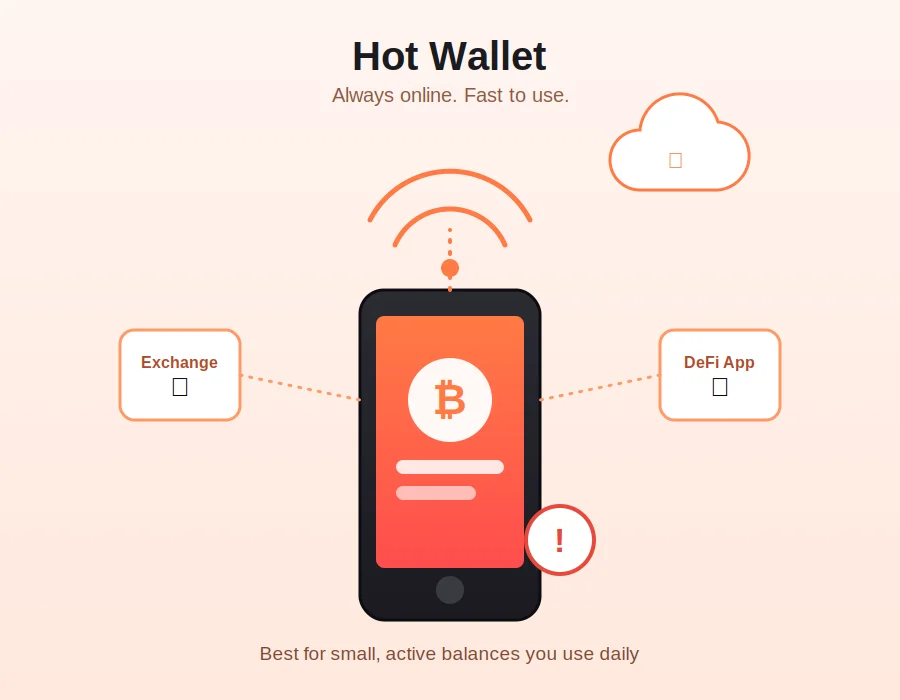
A hot wallet is any wallet connected to the internet. Your private keys live on a device, phone, computer, or web server that’s always online and reachable.
Types of Hot Wallets
Mobile wallets are the most common option by far. Apps like MetaMask Mobile, Trust Wallet, and Coinbase Wallet let you send, receive, and scan QR codes in seconds.
The tradeoff: if your phone is stolen or infected with malware, your funds are exposed too.
Desktop wallets like Electrum and Exodus give you more screen space and features, but they carry the same risks as any other software on your computer, viruses, spyware, and unpatched vulnerabilities included.
Browser wallets such as MetaMask or Phantom plug directly into your web browser, which makes DeFi and NFT trading smooth.
The catch is that browser extensions are a favorite phishing target, and fake versions of popular wallet extensions show up in app stores regularly.
Exchange wallets are the ones built into platforms like Binance, Coinbase, or Kraken. They’re the easiest to use because there’s no seed phrase to manage, but you don’t actually hold the keys.
As the crypto saying goes, “Not your keys, not your crypto.” If the exchange gets hacked or freezes withdrawals, you’re at their mercy.
When a hot wallet makes sense:
You’re trading frequently and need instant access
You’re actively using DeFi apps, staking, or NFT marketplaces
Your crypto holdings are small enough that losing them wouldn’t hurt financially
You’re brand new to crypto and still learning the basics
A simple rule that works well here: Only keep in a hot wallet what you’d be comfortable carrying around in cash. For most people, that’s somewhere around 10 to 20 percent of their total crypto holdings.
Join UEEx
Experience the World’s Leading Digital Wealth Management Platform
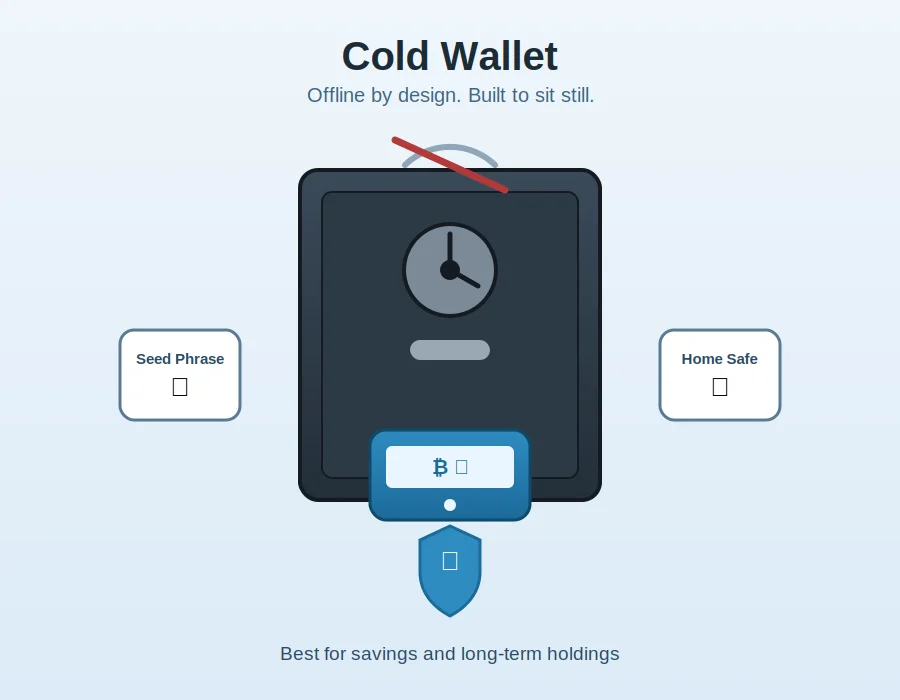
A cold wallet keeps your private keys completely offline. They never touch an internet-connected device, which means a remote hacker literally has nothing to reach.
Types of Cold Storage
Hardware wallets are physical devices, think Ledger, Trezor, or Coldcard, that generate and store your keys on a secure chip.
When you make a transaction, the signing happens inside the device itself, so your private key never leaves it. Ledger alone has sold more than 7.5 million devices and says it secures roughly 20% of the world’s crypto assets.
Paper wallets are exactly what they sound like: your keys printed on paper.
They’re free and completely offline, but paper burns, gets wet, and gets lost. Most serious holders have moved away from them.
Steel wallets solve the durability problem by engraving your seed phrase onto stainless steel plates. Products like Cryptosteel or Billfodl can survive house fires and floods that would destroy paper in seconds.
Air-gapped software wallets run on a computer that has never connected to the internet. They’re free if you have spare hardware, but they take real technical know-how to set up and maintain properly.
When cold storage is the right call:
Your holdings are worth more than a few thousand dollars
You’re holding for the long term rather than trading actively
You’d rather spend 10 extra minutes on a transaction than risk losing everything
You’re planning ahead for estate or inheritance purposes
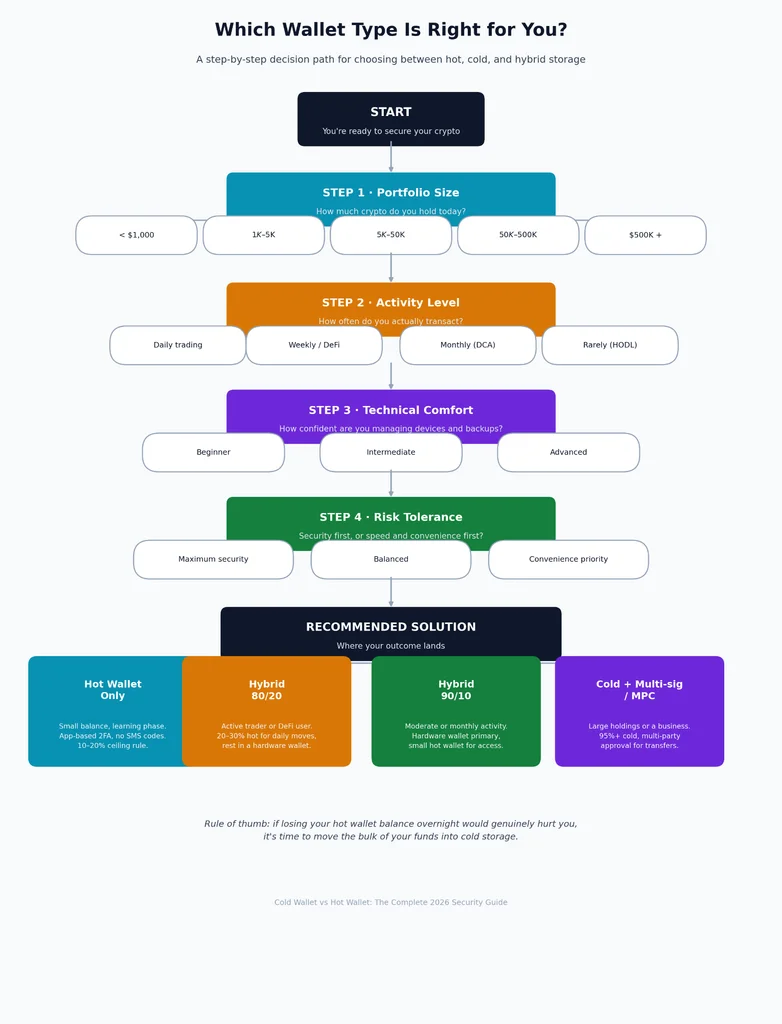
A good gut check: if losing your hot wallet balance overnight would genuinely hurt you financially, it’s time to move the bulk of your funds into cold storage.
The security gap between hot wallets and cold wallets has become increasingly clear. While hot wallets offer convenience for everyday transactions, they remain the primary target for cybercriminals.
Cold wallets, by contrast, significantly reduce online attack risks because private keys never leave the device.
Hot Wallet Risks in 2026
Hot wallets are constantly connected to the internet, making them vulnerable to phishing, malware, compromised browser extensions, and exchange breaches.
According to CertiK’s H1 2026 Web3 security report, the industry lost more than $1.31 billion across 344 security incidents during the first half of the year.
Wallet compromises alone accounted for over $444 million, making them the most expensive attack category, while phishing attacks caused another $366 million in losses.
Wallet compromise was the most costly attack vector in H1 2026, with $444 million stolen across 33 incidents.” – CertiK Hack3d Report, H1 2026
The biggest threats include:
Advanced phishing attacks: Criminals increasingly use AI-generated emails, fake wallet interfaces, deepfake voice calls, and address-poisoning scams to trick users into signing malicious transactions or sending funds to fraudulent addresses.
Malware and keyloggers: Wallet-stealing malware continues to target desktop and mobile devices, extracting seed phrases and private keys from infected systems.
Browser extension exploits: Vulnerable or malicious browser extensions remain a common source of credential theft.
Exchange compromises: Funds stored on custodial platforms inherit the security risks of the exchange itself, regardless of users’ personal security practices.
SIM-swapping: Attackers hijack victims’ phone numbers to intercept SMS authentication codes and reset account credentials, particularly targeting high-net-worth crypto holders.
Cold Wallet Risks: Lower Exposure, Different Threats
Cold wallets are not completely immune to attacks, but the threat model is fundamentally different. Because private keys remain offline, remote hackers cannot directly access them. Most successful attacks require physical access, user error, or operational failures rather than technical exploits.
The primary risks include:
Supply-chain attacks: Counterfeit or tampered hardware wallets sold through unofficial marketplaces may compromise security before users even receive the device. Purchasing directly from manufacturers and verifying firmware authenticity greatly reduces this risk.
Physical theft and coercion: So-called “wrench attacks” involve criminals forcing victims to reveal recovery phrases or PINs through intimidation.
Seed phrase loss: Lost or destroyed recovery phrases remain one of the biggest causes of permanent crypto loss. Estimates suggest 11–18% of all Bitcoin may be permanently inaccessible due to lost private keys.
Poor operational security: Mishandling recovery phrases, insecure backups, or improper wallet setup can undermine even the most secure hardware wallet.
The Bybit Lesson: Cold Storage Is Only as Strong as Its Ops
Bybit hack (Feb 2025): ~$1.5B stolen. Attributed to North Korea’s Lazarus Group, who used social engineering to compromise the signing workflow — not a flaw in cold wallet cryptography itself.
Takeaway: Cold storage protects keys, but ops security matters just as much.
Firmware Risks
Mostly theoretical vs. online attacks
No confirmed large-scale exploits on mainstream hardware wallets to date
Post-Ledger Recover controversy (2023–24), manufacturers are more transparent
Still recommended: regular firmware updates, audits, open-source firmware where possible
Bottom Line
Most 2026 crypto losses trace back to online wallets, compromised credentials, and social engineering not hardware encryption failures. Hot wallets are fine for daily spending; larger holdings belong in cold storage with solid operational practices.
Hot vs Cold: Which One Fits Your Life?
If you’re new to crypto with a small amount (under $2,000): A mobile hot wallet like Coinbase Wallet or Trust Wallet is fine while you’re learning. Turn on two-factor authentication through an app, never SMS, and keep amounts small while you get comfortable.
If you trade actively or use DeFi daily: Split your funds. Keep 20 to 30 percent in a hot wallet for quick moves, and the rest in cold storage.
Transfer between the two on a schedule instead of constantly shuffling funds.
If you’re a long-term holder who rarely transacts: Put 90 percent or more into cold storage. A hardware wallet plus a metal backup of your seed phrase, stored somewhere separate from the device itself, is the standard setup serious holders use.
If you’re running a business or managing funds for others: A single hardware wallet with one person holding the keys isn’t enough. This is where multi-signature wallets and MPC technology start to matter.
Join UEEx
Experience the World’s Leading Digital Wealth Management Platform
The Markets in Crypto-Assets (MiCA) regulation is the European Union’s first complete crypto framework.
It became fully applicable on 30 December 2024, while existing crypto-asset service providers (CASPs) were given a transitional period that ended across the EU on 1 July 2026.
From that date, firms serving EU customers must hold a MiCA authorization or wind down their operations.
What MiCA Means for Wallet Providers
Wallet providers offering custodial services in the EU must now meet significantly higher regulatory standards, including:
CASP authorization: Providers must obtain a crypto-asset service provider license before serving EU customers.
Capital requirements: Custodial providers must maintain minimum regulatory capital (up to €350,000, depending on the services offered).
Security controls: Firms must implement strong cybersecurity measures, operational resilience, governance policies, and procedures for safeguarding customer assets.
Fund segregation: Customer crypto assets must be kept separate from company funds.
AML and KYC compliance: Providers must verify customer identities, monitor transactions, and comply with the EU’s Travel Rule under the Transfer of Funds Regulation (TFR).
Incident reporting: Material security breaches and operational incidents must be reported promptly to regulators.
Consumer transparency: Providers must clearly disclose risks, fees, and custody arrangements.
Why MiCA Matters for Wallet Users
For consumers, MiCA raises the baseline for security and accountability. Choosing a regulated provider means dealing with companies that are licensed, supervised, capitalized, and subject to ongoing oversight.
When comparing wallets, look for providers that:
Hold (or publicly confirm) a MiCA CASP license
Segregate customer assets
Publish independent security audits
Maintain strong cybersecurity practices
Offer transparent risk disclosures and customer support
Although compliance may increase onboarding requirements and operating costs, the trade-off is stronger consumer protection and greater confidence in custodial services.
MiCA’s Global Influence
Several jurisdictions are strengthening their own frameworks while borrowing similar principles around licensing, custody, consumer protection, AML compliance, and operational resilience.
United Kingdom
The UK Financial Conduct Authority (FCA) published its final crypto market regulations on June 30, 2026, establishing a mandatory licensing regime for stablecoin issuers, crypto custodians, trading platforms, and staking providers, with the broader regime expected to take effect from October 2027.
The framework brings digital assets under direct regulatory oversight via the Financial Services and Markets Act 2000.
United States
The U.S. regulatory picture has become significantly clearer. The repeal of SEC Staff Accounting Bulletin (SAB) 121 removed a major accounting hurdle for banks providing digital asset custody.
Meanwhile, the Office of the Comptroller of the Currency (OCC) Interpretive Letter 1183 reaffirmed that national banks may offer crypto custody and engage in certain blockchain-related activities, provided they maintain appropriate risk controls.
The landmark GENIUS Act has further accelerated regulatory certainty by creating the first complete federal framework for payment stablecoins.
Federal agencies, including the OCC and Treasury, are now implementing the Act through detailed regulations.
Join UEEx
Experience the World’s Leading Digital Wealth Management Platform
Wallet Security Best Practices: How to Protect Your Crypto
Secure Your Hot Wallet
Because hot wallets remain connected to the internet, they’re the primary target for hackers.
Use stronger authentication
Enable multi-factor authentication (MFA) using an authenticator app like Google Authenticator, Authy, or 1Password instead of SMS, which remains vulnerable to SIM-swapping attacks. For even stronger protection, use a hardware security key such as YubiKey.
Secure your devices
Keep your operating system and wallet software updated, use reputable anti-malware protection, avoid public Wi-Fi when accessing your wallet, and consider using a dedicated phone or computer for crypto. If you must connect through an unfamiliar network, use a trusted VPN.
Stay alert for phishing
Most crypto theft still begins with fake emails, websites, or apps. Always access wallets through bookmarked official websites, download apps only from official app stores, and carefully verify wallet addresses before sending funds to avoid address-poisoning scams.
Review smart contract approvals
Before signing any transaction, understand exactly what you’re approving. Periodically revoke unused token allowances using tools like Revoke.cash to minimize exposure if a DeFi protocol is compromised.
Separate your wallets
Instead of keeping everything in one place, use different wallets for trading, DeFi, and everyday spending, while transferring larger balances to cold storage on a regular basis.
Protect your recovery phrase
Never store your seed phrase in cloud storage, screenshots, emails, or password managers. Keep a handwritten copy stored securely offline.
Secure Your Hardware Wallet
Hardware wallets offer the highest level of protection, but only when they’re set up and backed up correctly.
Buy directly from the manufacturer
Purchase only from official retailers such as Ledger or Trezor. If a device arrives with a pre-generated recovery phrase, don’t use it.
Set it up properly
Generate the recovery phrase on the device itself, record it offline, and create a strong PIN. Then test the recovery process before transferring significant funds.
Back up your seed phrase
Store at least two offline copies in separate secure locations. Many long-term investors also use metal seed backups for better protection against fire and water damage.
Verify every transaction
Always confirm wallet addresses and transaction details on the hardware wallet’s screen rather than relying on your computer or smartphone. Keep your device firmware updated and store the wallet securely when not in use.
The cold wallet vs hot wallet question isn’t really about which is better, it’s about matching the tool to the job. Hot wallets win on convenience and lose on exposure. Cold wallets win on security and lose on speed.
Cold wallets win on security and lose on speed. With wallet compromises now the costliest attack vector in crypto and adoption climbing past 741 million people worldwide, the setup that holds up isn’t the fanciest one.
It is the boring one: small hot wallet for spending, cold wallet for everything else, and a seed phrase backup that isn’t sitting in a screenshot somewhere.
Disclaimer: This article is intended solely for informational purposes and should not be considered trading or investment advice. Nothing herein should be construed as financial, legal, or tax advice. Trading or investing in cryptocurrencies carries a considerable risk of financial loss. Always conduct due diligence before making any trading or investment decisions.
Trade with proof of Reserves
UEEx publish monthly audits and third party verification on every listed market.