WordPress database error: [You have an error in your SQL syntax; check the manual that corresponds to your MariaDB server version for the right syntax to use near '' at line 1] SELECT * FROM wp_mica_ecta WHERE cta_id =
WordPress database error: [You have an error in your SQL syntax; check the manual that corresponds to your MariaDB server version for the right syntax to use near '' at line 1] SELECT * FROM wp_mica_ecta WHERE cta_id =
WordPress database error: [You have an error in your SQL syntax; check the manual that corresponds to your MariaDB server version for the right syntax to use near '' at line 1] SELECT * FROM wp_mica_ecta WHERE cta_id =
WordPress database error: [You have an error in your SQL syntax; check the manual that corresponds to your MariaDB server version for the right syntax to use near '' at line 1] SELECT * FROM wp_mica_ecta WHERE cta_id =
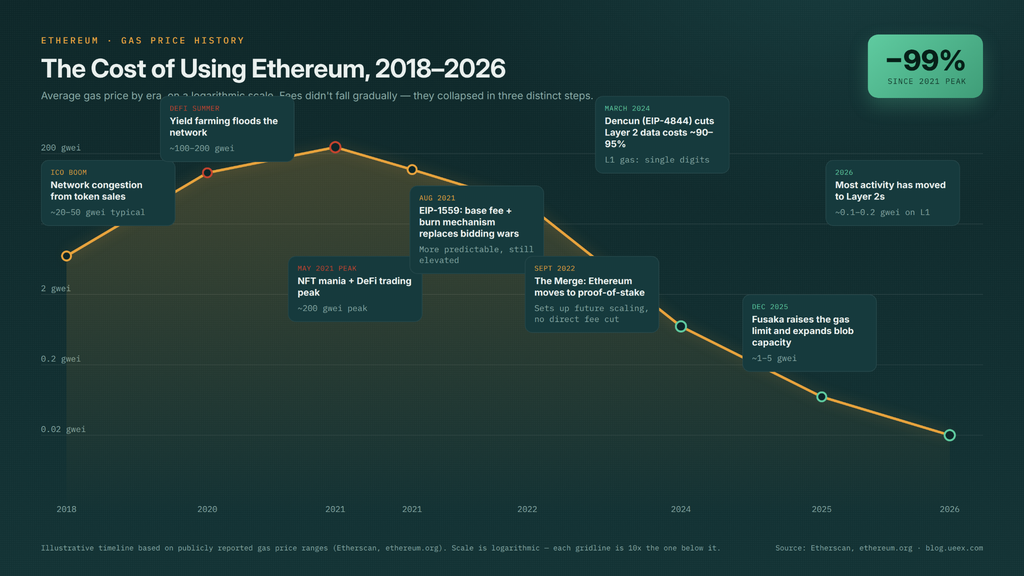
If you remember using Ethereum in 2021, you likely remember paying more in gas fees than some transactions were worth. Thanks to years of network upgrades, Ethereum has become far cheaper by 2026, with average gas fees often hovering below 0.2 gwei, making basic ETH transfers cost only around one or two cents.
However, low average fees do not mean every transaction is cheap. Complex DeFi trades, NFT mints, and multi-step smart contract interactions can still become expensive, especially for frequent users.
Without proper fee optimization, active traders and developers may still spend hundreds or even thousands of dollars annually on unnecessary gas costs.
This guide explains the most effective ways to reduce Ethereum gas fees in 2026, including understanding how fees work, choosing the best time to transact, using Layer 2 networks, batching transactions, and using gas-tracking tools to minimize costs while maximizing efficiency.
There's no Call To Action with the ID #0.
Key Takeaways
Gas fees on Ethereum have dropped more than 95% since their 2021 peak, but they still add up if you don’t manage them.
The single biggest fix is moving routine activity to a Layer 2 network like Arbitrum, Base, or Optimism, where swaps often cost less than a dollar.
Timing your transactions for weekends or early morning UTC hours can still shave 20-40% off Layer 1 costs.
Batching several actions into one transaction, and setting your wallet’s gas limit correctly, prevents the two most common ways people overpay.
Tools like Etherscan’s Gas Tracker, L2Fees.info, and Revoke.cash cost nothing and take the guesswork out of every transaction.
Understanding Gas Fees: How They Actually Work
Let’s explore what gas fees are all about
What Is a Gas Fee?
A gas fee is the cost of using the Ethereum network. Every time you send ETH, transfer a token, swap assets, mint an NFT, or interact with a smart contract, you pay a fee to compensate the network’s validators for processing and securing your transaction.
Gas fees also discourage spam and prevent malicious actors from overloading the network. Importantly, you pay for the computational work performed even if your transaction ultimately fails.
A simple way to think about gas is shipping. Sending a letter costs less than shipping a heavy package, and express delivery costs more than standard delivery. Similarly, simple Ethereum transactions require less computational work than complex smart contract interactions, while paying a higher priority fee can help your transaction get processed sooner when the network is busy.
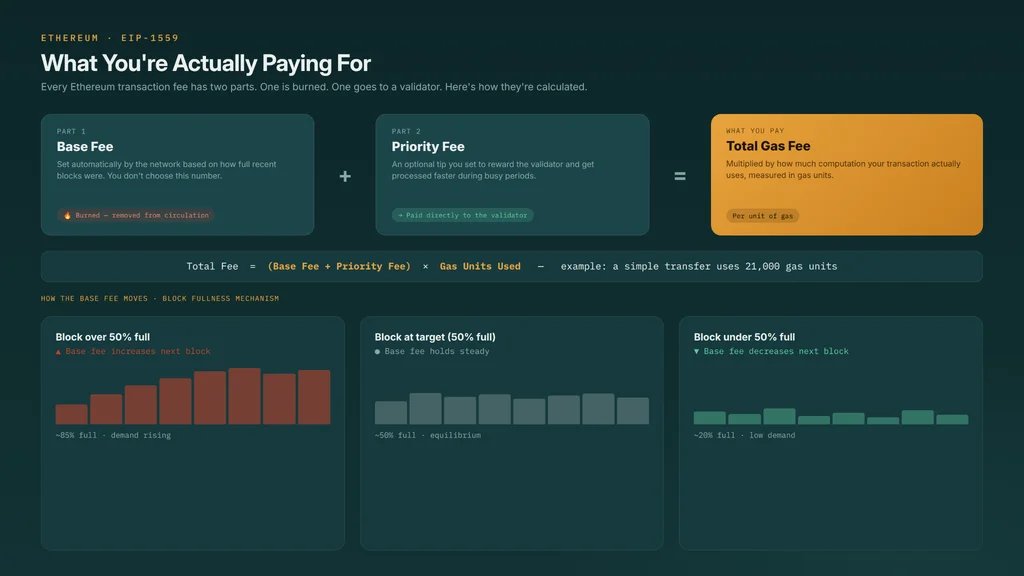
Gas prices are quoted in gwei, a small denomination of ETH. 1 gwei equals 0.000000001 ETH (one-billionth of an ether). So instead of saying a transaction costs 0.000000001 ETH in gas, it’s simply expressed as 1 gwei. Since Ethereum’s EIP-1559 upgrade, the total fee consists of a base fee set automatically by the network and an optional priority fee (tip) paid to validators to speed up confirmation.
How EIP-1559 Changed the Fee System
Before August 2021, Ethereum ran on a first-price auction. Users guessed a gas price and hoped it was high enough to get picked up. This led to wild overpaying and unpredictable costs.
EIP-1559 replaced that system with two separate pieces:
Base fee: A fee set automatically by the network based on how full recent blocks were. If blocks are more than half full, the base fee rises. If they’re under half full, it falls. This portion is burned, meaning it is permanently removed from circulation.
Priority fee (tip): An optional extra amount you pay directly to the validator to get your transaction processed faster.
“The base fee is not something you negotiate. It is something you time.” That’s the mental shift most new Ethereum users need to make before anything else clicks.
The math looks like this:
Total Gas Fee = (Base Fee + Priority Fee) × Gas Units Used
Here’s a simple example. A basic ETH transfer uses 21,000 gas units. If the base fee is 0.3 gwei and you add a 0.1 gwei tip, your total cost is:
21,000 × 0.4 gwei = 8,400 gwei = 0.0000084 ETH
At an ETH price of roughly $2,450, that transaction costs less than three cents.
What Actually Moves Gas Prices
Several factors push gas prices up or down:
Network demand: More people transacting at once means more competition for limited block space.
Transaction complexity: A plain ETH transfer needs 21,000 gas units. A DeFi swap can need 100,000 to 300,000. Minting an NFT often falls somewhere in between, depending on the contract.
ETH’s price: Gas is priced in gwei, but you feel it in dollars, so a jump in ETH’s price makes the same gas amount cost more in real terms.
Time of day: Fees tend to rise during US and European business hours and fall on weekends and in the early morning hours UTC.
Big events: A popular NFT drop, a major token launch, or a DeFi exploit can spike demand for block space temporarily.
The Upgrades That Got Us Here
Three upgrades explain most of the drop in fees since 2021:
The Merge (September 2022) moved Ethereum from energy-intensive mining to staking. It didn’t directly cut gas fees, but it set the stage for later scalability work.
Dencun (March 2024) introduced EIP-4844, also called proto-danksharding. This gave Layer 2 networks a cheap new way to post their data back to Ethereum, called “blob space,” instead of the expensive method they used before. Layer 2 transaction fees fell by roughly 90 to 95 percent following this upgrade, and it’s the single biggest reason swapping on Arbitrum or Base got so cheap.
Fusaka (activated December 3, 2025) raised Ethereum’s default block gas limit from around 36 million to 60 million gas units, letting each block handle noticeably more activity, and further expanded the blob capacity that Layer 2s depend on for cheap data posting.
The next planned upgrade, nicknamed Glamsterdam, is expected sometime in 2026 and is aimed at further improving fee stability and censorship resistance rather than another dramatic price cut. For the latest technical details, Ethereum.org’s roadmap page is the most reliable source.
There's no Call To Action with the ID #0.
Strategies for Reducing Gas Fees
Here are the strategies you can use to reduce your gas fees
Strategy 1: Time Your Transactions
Even with fees this low, timing still matters, especially for anyone doing large or frequent transactions on Layer 1.
Gas prices follow a fairly predictable daily and weekly rhythm:
Weekends are consistently cheaper than weekdays, since trading activity from institutions and active DeFi users drops off.
Early morning hours UTC, roughly 1am to 6am, tend to be the quietest window, since both US and European markets are asleep.
Weekday mornings in Europe and US afternoons are the two peak windows, since that’s when both regions overlap or are independently active.
Announced events like NFT drops, token launches, and major protocol upgrades create short, sharp spikes. If your transaction isn’t urgent, it’s almost always cheaper to wait a day or two after the initial rush.
Tools for Timing
Etherscan Gas Tracker shows real-time low, average, and high gas prices along with historical charts so you can spot patterns for yourself rather than guessing.
Blocknative’s gas estimator shows mempool-based predictions and offers a browser extension for real-time alerts.
L2Fees.info lets you compare live transaction costs across every major Layer 2 side by side.
A Practical Example
Say you want to make a $50 DeFi swap on Ethereum mainnet. During a busy Thursday evening in the US, the base fee might be high enough to push your gas cost to a couple of dollars.
Do the same swap early Saturday morning UTC, when the network is quiet, and that cost can drop by more than half. It’s not a huge dollar amount at today’s fee levels, but for anyone doing this regularly, or for larger transactions, the savings scale up fast.
Note: Don’t let a small gas saving cost you more in market movement. If ETH’s price or a token’s price is moving fast, the few dollars you save waiting for cheaper gas can easily be wiped out by an unfavorable price swing. Save the “wait it out” approach for transactions where timing your entry or exit doesn’t matter much.
Strategy 2: Move to a Layer 2 Network (Often 90%+ Cheaper)
If timing is a minor tweak, moving to a Layer 2 network is the strategy that actually changes your cost structure.
What Layer 2s Actually Do
Layer 2 networks process transactions off the main Ethereum chain, then bundle a batch of them together and post the results back to Ethereum for security. Because many users’ transactions are bundled into one posting, the cost gets shared, and each person pays a small fraction of what a full Layer 1 transaction would cost.
Layer 2s have become the dominant place where Ethereum activity actually happens. Cumulative Layer 2 TVL expanded from under $4 billion in 2023 to roughly $33.45 billion by mid-2026, and Base, Arbitrum, and Optimism together account for about 90% of all Layer 2 transactions.
Comparing Major Layer 2 Networks (2026)
TVL values are based on L2BEAT’s Total Value Secured (TVS) metric, which replaced the traditional TVL terminology for rollups
Polygon is a sidechain, so its value is typically measured by DeFi TVL rather than L2BEAT’s TVS methodology.
Base is now the largest Ethereum Layer 2 by value secured at about $11.75 billion, narrowly ahead of Arbitrum at $10.34 billion.
How to Bridge Your Funds to a Layer 2
Before you begin, decide which network best fits your needs based on transaction fees, supported dApps, and ecosystem.
Step 1: Choose a Layer 2
Pick the network that supports the applications you plan to use:
Arbitrum – Best for DeFi and broad dApp support.
Base – Strong ecosystem for consumer apps and Coinbase users.
Optimism – Home to many Ethereum-native protocols and the OP Superchain.
Step 2: Use the Official Bridge
Always bridge through the project’s official interface to reduce security risks.
Arbitrum Bridge
Optimism Bridge (Superbridge)
Base Bridge
Step 3: Connect Your Wallet
Connect a compatible wallet such as MetaMask. Make sure you have enough ETH on the Ethereum mainnet to pay the bridge transaction fee.
Step 4: Bridge Your Assets
Select the token and amount to transfer.
Review the estimated gas fee and transfer details.
Confirm the transaction in your wallet.
Deposits from Ethereum to most major L2s typically complete within 1–10 minutes, depending on network congestion.
Step 5: Confirm Your Funds
Once the transfer is complete:
Switch your wallet to the destination L2.
Add the network if it doesn’t appear automatically.
Verify that your assets have arrived before making additional transfers.
Security Best Practices
Use official bridges whenever possible.
Test with a small amount before transferring larger balances.
Never share your wallet’s seed phrase or private keys.
Double-check the destination network before approving any transaction.
If you frequently move assets between Ethereum networks, trusted bridge aggregators such as Hop Protocol and Orbiter Finance can automatically find efficient routes across multiple chains.
Bridging Back to Ethereum
Withdrawal times depend on the rollup technology:
Optimistic rollups (Arbitrum and Optimism): Standard withdrawals to Ethereum usually require a 7-day challenge period.
ZK rollups: Withdrawals are generally much faster because they rely on validity proofs rather than fraud-proof windows.
When an Alternative Layer 1 Makes Sense
Choose a standalone Layer 1 if:
Your preferred dApp exists only on that network.
You need the lowest possible transaction fees.
Maximum speed is more important than Ethereum compatibility.
Why Many Users Still Prefer Layer 2s
Ethereum Layer 2s remain the preferred choice for many users because they:
Inherit Ethereum’s security.
Provide access to Ethereum’s liquidity and DeFi ecosystem.
Offer significantly lower fees than the Ethereum mainnet.
Make it relatively easy to move assets back to Ethereum when needed.
For users who already hold ETH or rely on Ethereum-based applications, Layer 2s often provide the best balance of security, cost, and ecosystem access.
Strategy 3: Batch Multiple Actions Into One Transaction
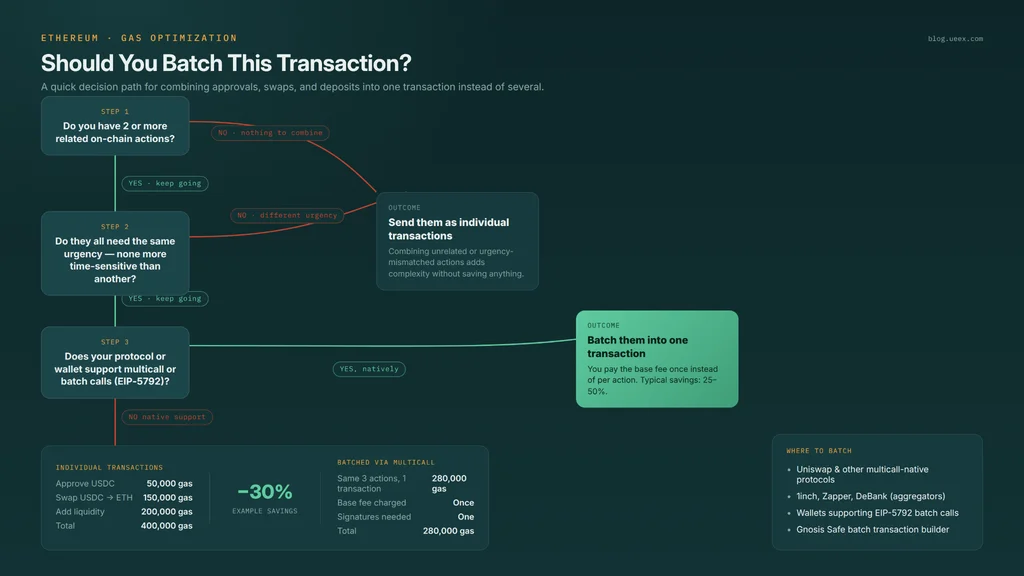
Every transaction you send pays its own base fee. If you’re doing several related actions back to back, like approving a token, then swapping it, then adding it to a liquidity pool, you’re paying that base fee three separate times.
Batching combines multiple actions into a single transaction, so you pay the overhead once instead of repeatedly.
How Batching Saves Money
Say a set of three DeFi actions individually uses 400,000 gas units total. Batched together through a multicall contract, overlapping overhead can bring that down to roughly 280,000 units, a savings in the range of 25-30%. The exact number varies by protocol and network, but the principle holds everywhere: fewer transactions means less repeated overhead.
Ways to Batch
Multicall contracts: Many protocols, including Uniswap, let you bundle several calls into one transaction automatically through their front end.
DeFi aggregators: Platforms like 1inch, Zapper, and DeBank often batch approvals, swaps, and deposits behind the scenes so you don’t have to think about it.
Wallet-level batching (EIP-5792): Newer wallet standards let you approve several actions with a single signature, and either everything succeeds together or everything fails together, so there’s no risk of getting stuck halfway through.
When Not to Batch
If one action is urgent and another isn’t, batching them together forces both to move at the same speed. And if you’re doing a single high-value operation, there’s nothing to batch, so don’t add unnecessary complexity for no reason.
Strategy 4: Set Your Wallet’s Gas Options Correctly
Most people never touch their wallet’s gas settings, and most of the time that’s fine. But two common mistakes cost people real money.
Gas Limit vs. Gas Price
These are two different things, and mixing them up is the single most common gas mistake:
Gas price is what you pay per unit of computation.
Gas limit is the maximum number of units you’re authorizing the transaction to use.
If you set your gas limit too low to “save money,” your transaction can fail after using up all the gas you allowed, and you still pay for the gas that was consumed before it failed. You get nothing for that money. Never reduce your gas limit below what your wallet estimates unless you genuinely understand the specific transaction you’re running.
Any gas you don’t use gets refunded automatically, so setting the limit slightly higher than needed costs you nothing extra.
Practical Wallet Settings
In MetaMask and similar wallets, you can usually choose between:
Low/slow: Good for non-urgent transactions. Saves money, may take longer to confirm.
Standard: A balanced default for most day-to-day use.
Fast: Worth it when you genuinely need speed, such as avoiding a liquidation or catching a time-sensitive opportunity.
Some wallets, including MetaMask, also let you set a maximum fee you’re willing to pay and have the transaction submit automatically once the network price drops to that level. This is a great option for anything that isn’t urgent.
There's no Call To Action with the ID #0.
Strategy 5: Manage Token Approvals
Before a DeFi protocol can move your tokens on your behalf, you have to approve it. There are two ways to do this, and the choice matters for both gas and security.
Limited approval: You approve only the exact amount needed for one transaction. It’s more secure since the protocol can never touch more than that amount, but you pay approval gas every single time.
Infinite approval: You approve an unlimited amount once, saving gas on every future transaction with that protocol, but you’re trusting that protocol’s contract completely.
A sensible middle ground for 2026: use infinite approval only with large, well-audited, established protocols like Uniswap, Aave, or Curve. Use limited approval for anything newer or less proven.
And periodically check what you’ve approved using Revoke.cash, a free tool that shows every approval tied to your wallet and lets you cancel the ones you no longer need. This costs a small amount of gas but closes off risk from old approvals sitting around indefinitely.
Strategy 6: Use the Right Tools Instead of Guessing
You don’t need to memorize gas patterns. A handful of free tools do the work for you:
Etherscan Gas Tracker: The most complete source for current and historical gas prices, plus a heatmap showing patterns by hour and day.
L2Fees.info: Compares live transaction costs for swaps, transfers, and NFT mints across every major Layer 2 network side by side.
Blocknative: A browser extension that shows real-time mempool data, useful for understanding what other users are currently paying.
Revoke.cash: Lets you review and cancel token approvals you no longer need.
MetaMask’s built-in estimator: Shows the expected cost before you sign any transaction, including a dollar conversion.
Bookmark two or three of these and check them before any transaction over a few dollars. It takes ten seconds and consistently pays for itself.
Strategy 7: For Developers, Write Gas-Efficient Contracts
If you’re building on Ethereum rather than just using it, gas efficiency is partly your responsibility to your users. A few well-established practices matter most:
Minimize storage writes: Writing to on-chain storage is one of the most expensive operations in the EVM. Keep temporary calculations in memory and only write to storage when necessary.
Use standard-sized integers: Smaller data types like uint8 often cost more gas than uint256 because the EVM has to convert them, despite seeming like they should be cheaper.
Avoid unbounded loops: A loop that grows with user activity can eventually cost more gas than a block allows, breaking the function entirely.
Use custom errors instead of long string messages: Solidity’s custom error feature can cut the gas cost of failed-transaction messages significantly compared to descriptive string reverts.
Support batching at the contract level: Building in a multicall-style function lets your users bundle actions and saves them money without any extra work on your end.
Tools like Hardhat’s gas reporter and Tenderly’s simulation features let you measure and catch expensive patterns before you ever deploy to mainnet.
Maximal Extractable Value (MEV) can quietly increase trading costs, especially during large or volatile DeFi transactions. Common MEV attacks include front-running, back-running, and sandwich attacks, where bots exploit the public mempool to profit at your expense.
To reduce these risks, consider:
Flashbots Protect: Sends transactions through a private mempool to reduce front-running and sandwich attacks. You only pay gas if the transaction succeeds, making it ideal for large or time-sensitive trades.
CoW Swap: Uses batch auctions and intent-based execution to minimize MEV while returning surplus value to users. It’s best suited for traders who can wait a few minutes for execution.
MEV protection is most valuable when trading over $10,000, during periods of high market volatility, or when executing complex multi-step DeFi strategies.
Watch Emerging Gas Innovations
Ethereum’s user experience continues to improve in 2026.
ERC-4337 Account Abstraction enables smart wallets, gas sponsorship (paymasters), and gasless transactions, reducing the need to hold ETH solely for fees.
Intent-based trading lets users specify the desired outcome while competing solvers find the cheapest execution path automatically.
Cross-chain protocols such as LayerZero, Axelar, and Wormhole continue to improve multichain transactions, reducing friction and moving toward gas payments in any supported token.
AI-powered wallet assistants are also emerging, helping users predict the best transaction times and automatically optimize gas settings.
Build a Long-Term Gas Strategy
Rather than chasing small fee savings, focus on structural improvements:
Hold assets across Ethereum, Layer 2s, and other networks you use frequently to reduce bridge costs.
Follow Ethereum improvement proposals through the Ethereum EIPs repository and monitor Layer 2 governance updates.
Automate where possible using gas alerts, aggregators, and batch transactions.
Prioritize changes that deliver the biggest savings. Migrating to Layer 2 networks typically has a far greater impact than simply waiting for lower gas prices.
Common Ethereum Gas Fee Mistakes (and How to Avoid Them)
Even though Ethereum transaction costs are now far lower thanks to major network upgrades, poor habits can still cost users money or even their funds.
1. Setting the Gas Limit Too Low
Many beginners reduce the gas limit hoping to save money. In reality, the gas limit only defines the maximum amount of computation a transaction can use; it doesn’t determine the gas price. If it’s too low, the transaction fails, but you’ll still pay for the gas already consumed.
Avoid this mistake
Leave your wallet’s gas limit unchanged unless you fully understand the contract’s requirements.
Only lower it if you’ve successfully tested the same transaction before.
2. Overpaying During Gas Spikes
Major token launches, NFT mints, or breaking market news can temporarily drive gas prices higher. Many traders rush to transact out of FOMO and end up paying unnecessary premiums.
Avoid this mistake:
Set a maximum gas budget before high-profile events.
For NFT purchases, consider waiting until secondary market activity cools.
For token swaps, use intent-based trading platforms like CoW Swap to help reduce unnecessary execution costs.
There's no Call To Action with the ID #0.
3. Ignoring Layer 2 Networks
Ethereum mainnet fees have dropped significantly in 2026, but users making frequent transactions can still save money by using Layer 2 networks such as Arbitrum, Base, or Optimism.
Best practice:
If you spend more than about $100 per month on gas, consider moving regular activity to a Layer 2.
Bridge a small amount first before transferring larger balances.
4. Granting Unlimited Token Approvals
Unlimited token approvals are convenient but risky. If a protocol is compromised, attackers may gain access to all approved tokens. Ethereum’s official documentation recommends reviewing and revoking unused approvals because they do not expire automatically.
Stay protected:
Use unlimited approvals only for trusted, audited protocols.
Give limited approvals to newer applications.
Regularly review and revoke unused permissions using Revoke.cash.
5. Skipping Transaction Batching
Executing several related transactions separately often means paying more gas than necessary.
Reduce costs by:
Using platforms that support transaction batching or multicall.
Grouping related actions into a single transaction whenever possible.
Planning DeFi operations instead of executing them one at a time.
Following these simple practices can help you minimize unnecessary fees, improve wallet security, and make the most of Ethereum’s much more efficient network in 2026.
Frequently Asked Questions
What’s the cheapest time to transact on Ethereum?
Weekends and early morning hours UTC, roughly 1am to 6am, are consistently the cheapest windows since both US and European trading activity is at its lowest. Checking Etherscan’s Gas Tracker before a large transaction takes a few seconds and shows you exactly where prices sit right now.
Is bridging to a Layer 2 worth it if I only transact occasionally?
If you’re doing more than a handful of transactions a month, yes. Bridging costs a small one-time fee, but the savings on each transaction afterward usually recover that cost within a few uses. If you truly only transact once or twice a year, staying on Layer 1 and timing your transaction well may be simpler.
Can I set my gas price to zero or extremely low?
You can try, but your transaction likely won’t get processed at all, since validators have no incentive to include it. It will sit in the pending pool, sometimes indefinitely, until you cancel it or raise the fee.
How much can I actually save by batching transactions?
Typical savings from batching related DeFi actions into one transaction run in the range of 25-50%, depending on how many separate calls you’re combining and which protocol you’re using. The savings come from paying the transaction overhead once instead of multiple times.
Disclaimer: This article is for educational purposes only and is not financial advice. Gas optimization strategies carry some technical risk, including smart contract vulnerabilities and bridge security considerations. Always verify contract addresses, start with small test amounts when trying a new technique, and never risk more than you can afford to lose. UEEx makes no guarantees about specific savings and is not liable for losses resulting from these strategies.
I am an SEO Specialist and Content Writer who helps businesses boost visibility, organic traffic, and search rankings.
I create SEO-driven strategies and engaging content through keyword research, on-page/off-page optimization, and user-focused writing.
Disclaimer: This article is intended solely for informational purposes and should not be considered trading or investment advice. Nothing herein should be construed as financial, legal, or tax advice. Trading or investing in cryptocurrencies carries a considerable risk of financial loss. Always conduct due diligence before making any trading or investment decisions.
Trade with proof of Reserves
UEEx publish monthly audits and third party verification on every listed market.